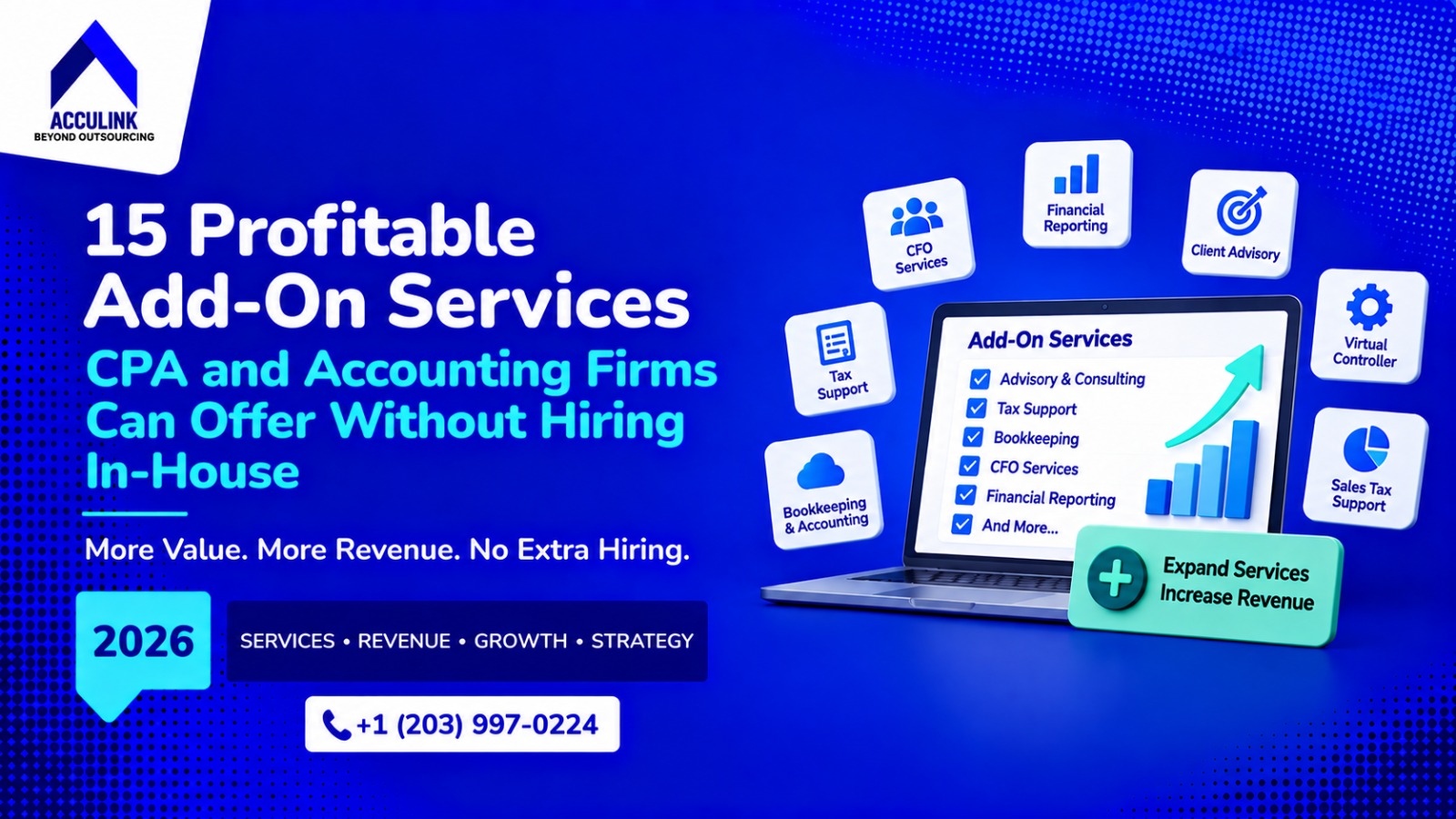
15 Profitable Add-On Services CPA and Accounting Firms Can Offer Without Hiring In-House

Summary
CPA and accounting firms do not need to build every new service with another in-house hire. This guide compares 15 practical add-on services by client need, revenue pattern, delivery work, professional responsibility, and launch difficulty. It also provides a profitability test, packaging framework, and 90-day pilot plan.
The best add-on services for CPA and accounting firms are recurring, repeatable services that clients already need and the firm can review efficiently. Examples include bookkeeping, AP and AR management, payroll, close support, reporting, forecasting, tax preparation, and audit support. An outsourced delivery team can provide production capacity while the firm retains the client relationship, approvals, professional judgment, and sign-off.
That distinction matters. Adding a service is not profitable simply because a client will buy it. The work also needs a clear scope, reliable delivery process, sensible price, and review requirement that does not create a new partner bottleneck.
Key Takeaways
- Start with an unmet need already visible inside your client base.
- Favor repeatable services with predictable inputs, deadlines, and review points.
- Treat recurring accounting and reporting work as the easiest path to steadier revenue.
- Delegate production, not accountability. Your firm retains approvals, professional judgment, supervision, and client communication.
- Test profitability using total delivery and review cost, not offshore hourly cost alone.
- Launch one service with a controlled client cohort before expanding the menu.
Why Add-On Services Support Accounting Firm Growth
Client advisory services have been one of the profession's strongest growth areas. The 2024 CPA.com and AICPA PCPS CAS Benchmark Survey reported 17% median growth among 206 self-selected U.S. CAS practices. Only 10% of respondents still used hourly billing as their primary pricing method, while formal planning, defined niches, and higher-level advisory services were associated with stronger practice economics.
The opportunity arrives while firms remain capacity constrained. In the 2024 AICPA PCPS CPA Firm Top Issues Survey, finding qualified staff ranked as the top issue for every firm-size category except sole practitioners. Larger firms also identified staff retention and utilization among their leading concerns.
Many recurring accounting firm services in this guide fall within client accounting services, particularly bookkeeping, close support, reporting, forecasting, and advisory. Tax preparation and audit support have different professional and regulatory boundaries, so firms should define each offer separately instead of treating every add-on as the same type of CAS engagement.
Those facts do not mean every firm should launch a large CAS department. They point to a more focused strategy: select one service clients already need, standardize it, and add flexible production capacity behind your firm's existing relationship.
Firms planning to use outside capacity can follow a documented accounting outsourcing process to define the scope, workflow, access, supervision, review, sign-off, and feedback process before launch.
What Makes an Add-On Service Profitable?
Use contribution margin as the first screen:
Estimated monthly contribution = client fee - delivery labor - review labor - software - rework - service-specific overhead
An offer can have a high client fee and still underperform if every engagement is customized, source documents arrive late, senior staff repair avoidable errors, or the scope expands without a price change.
The strongest add-on services usually share five traits:
- Existing demand: Current clients are already asking for the work or struggling without it.
- Repeatability: Inputs, outputs, deadlines, and exceptions can be documented.
- Efficient review: Senior review focuses on exceptions and judgment, not rebuilding the file.
- Visible value: The client can connect the service to cleaner books, faster decisions, fewer surprises, or a completed compliance requirement.
- Pricing fit: The fee reflects volume, complexity, service level, and review effort.
This is why a narrow, standardized service can outperform a broad package that tries to solve every finance problem at once.
15 Add-On Services for CPA and Accounting Firms, Compared
| # | Add-on service | Best cross-sell signal | Revenue pattern | Firm retains |
|---|---|---|---|---|
| 1 | Monthly bookkeeping | Books are late or unreliable | Monthly recurring | Accounting policies, exceptions, final review |
| 2 | Cleanup and catch-up accounting | Backlog, unreconciled balances, tax-ready deadline | Fixed project | Scope, adjustment approval, completion review |
| 3 | Bank and card reconciliations | Old reconciling items or inconsistent close | Monthly recurring | Exception resolution and review |
| 4 | Accounts payable management | Invoice and approval bottlenecks | Monthly recurring | Payment authority and vendor decisions |
| 5 | Accounts receivable support | Aging increases or cash application lags | Monthly recurring | Credit and collection policy |
| 6 | Payroll processing support | Manual payroll work or growing headcount | Recurring per cycle | Final payroll and filing approval |
| 7 | Month-end and year-end close | Reports arrive too late to use | Monthly or annual | Estimates, adjustments, close approval |
| 8 | Financial statement preparation | Lender, board, or owner reporting need | Monthly, quarterly, or project | Framework, disclosures, issuance, review |
| 9 | Management reporting | Owners ask what changed and why | Monthly recurring | Interpretation and client advice |
| 10 | FP&A and forecasting | Hiring, cash, pricing, or expansion decisions | Project or retainer | Assumptions and recommendations |
| 11 | Virtual CFO support | Client needs ongoing financial leadership | Monthly retainer | Engagement scope and accountable advice |
| 12 | Sales tax compliance support | Ecommerce or multi-state activity | Monthly or quarterly | Nexus and tax-position decisions |
| 13 | Tax return preparation support | Seasonal backlog or capacity shortfall | Per return or seasonal block | Review, signature, filing, client advice |
| 14 | Financial audit support | Testing or workpaper bottleneck | Project or seasonal block | Independence, planning, judgment, report |
| 15 | 401(k) and EBP audit support | Benefit plan audit demand or backlog | Seasonal or project | Independence, supervision, opinion |
Find the right next service to launch.
Use an editable scorecard to rank your best add-on service by client demand, delivery readiness, review capacity, and margin potential.
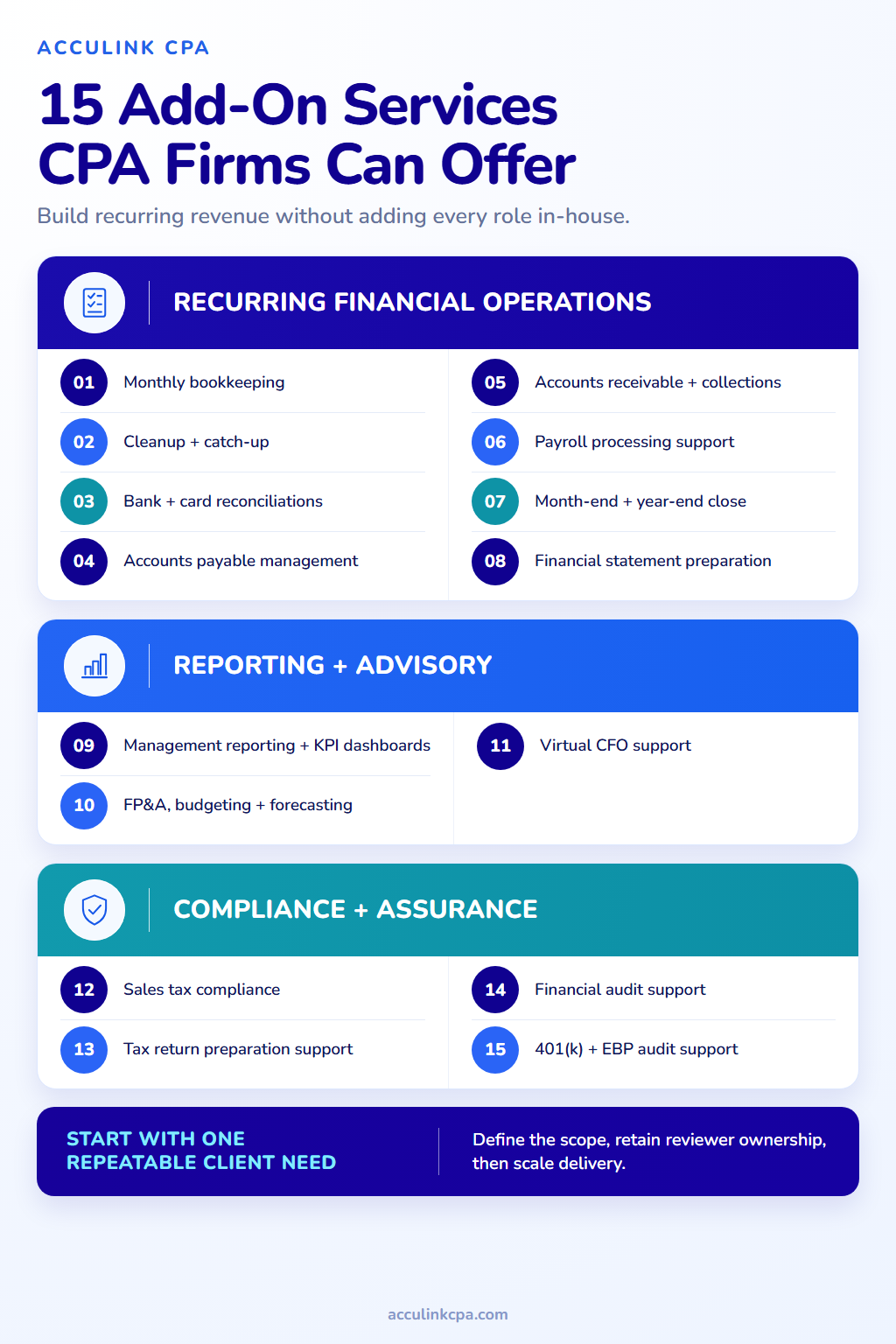
Recurring Financial Operations Services
1. Monthly Bookkeeping
Monthly bookkeeping is often the most practical first add-on because it creates a regular client touchpoint and supplies the clean data needed for tax, reporting, and advisory work. A strong scope can cover transaction categorization, general-ledger maintenance, standard journal entries, supporting schedules, and a defined monthly close checklist.
An outsourced team can perform the repeatable production work inside the firm's approved software and procedures. The firm should retain accounting-policy decisions, review unusual transactions, clear material exceptions, and approve the final deliverable.
The best prospects are existing tax or quarterly clients whose books arrive late, require repeated cleanup, or prevent meaningful planning. Package bookkeeping outsourcing services by transaction volume, entity count, account count, close date, and reporting requirements. Acculink's guide to outsourced bookkeeping explains what to delegate, how the delivery model works, and what to evaluate before adding capacity.
2. Accounting Cleanup and Catch-Up
Cleanup converts a visible client problem into a defined project. Common triggers include months of unposted activity, duplicate balances, uncategorized transactions, stale receivables or payables, and records that are not ready for tax preparation or financing.
The service needs a diagnostic phase before a fixed fee is quoted. Define the periods in scope, systems involved, expected source documents, known balance-sheet issues, and conditions that trigger a change order. An outsourced team can build reconciliation schedules, trace transactions, correct coding, document proposed entries, and assemble an exception list.
The firm should approve material adjustments and determine when the books are complete. Well-run accounting cleanup services can also create a natural transition into monthly bookkeeping, but that follow-on should be proposed only after the cleanup scope is understood.
3. Bank and Credit Card Reconciliations
Reconciliations are narrower than full bookkeeping, which makes them a useful entry offer for clients that keep their own books but struggle to close accurately. The recurring output should show reconciled balances, outstanding items, unusual transactions, and aged exceptions.
Production work can include importing activity, matching entries, tracing transfers, preparing reconciliation schedules, and maintaining an exception log. The firm decides how to treat unusual or material items and reviews corrections before close.
Price the service by account count, monthly activity, complexity, and required completion date. Do not treat every account as equal. A high-volume payment account with multiple currencies or integrations requires more work than a low-activity savings account. See Acculink's bank and card reconciliation support.
4. Accounts Payable Management
Accounts payable becomes valuable when client invoices are scattered across inboxes, coding is inconsistent, approvals are slow, or vendors repeatedly ask about status. The offer can cover invoice capture, coding, three-way matching where applicable, approval routing, due-date tracking, vendor statement reconciliation, and an AP aging report.
An outsourced team can prepare the queue and document exceptions. The client or accounting firm must keep payment authorization with named approvers. Bank-access roles, dollar limits, segregation of duties, new-vendor verification, and changes to payment instructions should be documented before processing begins.
For pricing, use monthly invoice volume, entities, approval steps, payment runs, and exception rate. AP can be sold independently or together with AR and AP management, bookkeeping, and close support.
5. Accounts Receivable and Collections Support
AR support helps clients issue invoices consistently, apply receipts correctly, monitor aging, and follow a defined collection cadence. This is attractive when revenue is growing but cash application and follow-up remain informal.
The delivery team can prepare invoices from approved source data, apply payments, reconcile customer balances, maintain the aging schedule, send approved reminders, and escalate disputes. The client should set credit terms, approve write-offs, own customer relationships, and decide when an account moves to formal collection.
A useful recurring report includes billed revenue, collections, overdue balances, disputed invoices, unapplied cash, and promised payment dates. Price by invoice count, receipt volume, customer count, follow-up cadence, and required communication. Avoid promising faster cash collection unless the client's billing accuracy, approval process, and dispute resolution are also addressed.
6. Payroll Processing Support
Payroll is recurring and deadline-driven, which can make it sticky, but mistakes have immediate consequences. A well-defined service can include employee-data maintenance, time-file checks, payroll calculations in the client's platform, payroll journal entries, reconciliations, standard reports, and preparation support for required forms.
The client or accounting firm should approve pay rates, employee status, benefits, deductions, bank funding, final payroll, and filings. Changes need an audit trail and cutoff time. The scope should also specify who handles registrations, notices, amendments, and multi-state questions.
Price payroll outsourcing support by employee count, pay frequency, number of states, systems, off-cycle runs, and filing responsibility. Payroll works well as an add-on to bookkeeping when roles and approvals remain clearly separated.
7. Month-End and Year-End Close Support
Clients do not benefit from reports that arrive after the decision window has passed. Close support creates value by moving recurring tasks into a controlled calendar with owners, dependencies, due dates, review points, and an exception queue.
An outsourced team can prepare recurring entries, reconcile control accounts, roll forward schedules, assemble accrual support, update fixed-asset or prepaid schedules, and prepare a review-ready trial balance. The firm retains decisions about estimates, reserves, unusual transactions, material adjustments, and final close approval.
Sell the outcome as a defined close process, not a vague promise to "help with month end." Price by entity count, account complexity, integrations, consolidation needs, close deadline, and review level. Year-end accounting services can also support annual clean close and tax-ready records.
8. Financial Statement Preparation
Financial statement preparation can extend bookkeeping or close work into a clearer client deliverable. Depending on the engagement, outputs may include a balance sheet, income statement, cash-flow statement, supporting schedules, comparative periods, and draft disclosures.
The scope must distinguish management reports from financial statements prepared under an identified reporting framework and from any compilation, review, or audit engagement. An outsourced team can prepare schedules, map accounts, roll forward templates, draft statements, and clear review notes. The responsible firm remains accountable for the applicable professional standards, reporting framework, material judgments, disclosures, review, and issuance.
Price financial statement preparation by frequency, entities, consolidation, framework, disclosures, source quality, and deadline. The engagement letter should state exactly what is and is not being provided.
Reporting and Advisory Add-On Services
9. Management Reporting and KPI Dashboards
Management reporting translates closed books into a consistent decision pack. A useful monthly package can include actual-versus-budget results, cash movement, working-capital measures, margin trends, operational KPIs, and a short exception summary.
The outsourced delivery team can update templates, validate source data, calculate approved metrics, prepare variance schedules, and flag missing explanations. The firm should select the KPIs, interpret the results, challenge anomalies, and lead the client discussion.
This service is strongest when the client already has reasonably reliable monthly books. If the source data is unstable, sell cleanup and close discipline first. Price management reporting by entities, reporting frequency, data sources, KPI count, customization, and meeting cadence. A standardized industry dashboard is easier to scale than a different report for every client.
10. FP&A, Budgeting, and Forecasting
FP&A helps clients look forward instead of only reviewing historical results. Common deliverables include an annual operating budget, rolling forecast, cash-flow model, scenario analysis, headcount plan, and budget-versus-actual review.
An outsourced team can maintain the model, collect inputs, update actuals, prepare scenarios, test formulas, and document variances. Firm leadership should own material assumptions, interpretation, recommendations, and communications that influence client decisions.
The best cross-sell signal is a recurring management question that the general ledger cannot answer alone: Can we hire? When will cash tighten? What happens if volume or price changes? Sell FP&A services as a scoped project or retainer based on model complexity, update frequency, data sources, scenarios, and meeting cadence.
11. Virtual CFO Support
Virtual CFO support combines financial reporting, forecasting, cash planning, performance analysis, and decision support in an ongoing relationship. It should not be a label applied to bookkeeping with a larger fee. The client must receive a defined leadership outcome, such as a monthly decision meeting, forward-looking cash view, board package, or financing-readiness plan.
The delivery team can maintain reporting packs, models, schedules, and action trackers. The designated finance leader owns the discussion, recommendations, stakeholder communication, and accountable follow-through. Scope boundaries should identify whether the service includes lender support, board participation, fundraising materials, or operational planning.
Offer virtual CFO services only after the data foundation is dependable. Price the retainer by complexity, decision cadence, entities, stakeholders, deliverables, and leadership involvement.
Compliance and Assurance Support Services
Accounting firms may offer tax and compliance work subject to applicable credential, jurisdiction, and engagement requirements. Financial audits and employee benefit plan audits require an appropriately licensed and independent CPA or attest firm. A non-attest accounting firm should treat services 14 and 15 as referral or production-support opportunities, not engagements it can sign or issue.
12. Sales Tax Compliance Support
Sales tax support becomes relevant when a client sells across states, adds channels, changes fulfillment arrangements, or struggles to manage filing calendars. A service may include registration support, data preparation, jurisdiction mapping, return workpapers, filing calendars, notice tracking, and reconciliation of liabilities to filed returns.
An outsourced team can organize data, prepare schedules, maintain calendars, and draft returns within an approved process. The firm should retain tax-position decisions, nexus conclusions, exposure advice, client communication, and final review. Complex facts may require specialist input.
Price sales tax compliance support by jurisdictions, filing frequencies, sales channels, entities, registrations, data quality, and notice volume. Do not quote a simple per-return price before understanding how transaction data reaches the workpaper.
13. Tax Return Preparation Support
Tax preparation support allows a CPA or accounting firm to accept or retain more work without making a permanent hire solely for peak season. The scope can cover source-document organization, workpaper preparation, data entry, rollforwards, diagnostics, draft returns, and review-note clearance across agreed return types.
The firm retains client acceptance, tax positions, professional judgment, supervision, final review, signature, filing, and advice. Before disclosing tax return information, the firm should determine which consent and privacy requirements apply. IRS guidance under Section 7216 restricts unauthorized use or disclosure, and overseas disclosure can require prior taxpayer consent under the applicable rules.
Price outsourced tax preparation by return type, complexity, source quality, states, turnaround, reviewer level, and expected volume, not by form name alone. The tax preparation outsourcing guide provides a deeper framework for scope, data access, review, and seasonal capacity.
14. Financial Audit Support
Audit support can add seasonal capacity for workpaper preparation, PBC coordination, tie-outs, sampling administration, vouching, tracing, testing documentation, and review-note clearance. It is most useful when the firm identifies the exact stage where the engagement queue is forming.
The CPA firm retains independence, client acceptance, audit strategy, risk assessment, materiality, procedure design, professional judgment, supervision, review, client communication, and report issuance. Access should be limited by engagement and role, with review evidence retained in the firm's audit platform.
Price financial audit support by engagement type, stage, estimated hours, requested seniority, timeline, software, documentation standard, and review level. A pilot on one defined workstream is safer than transferring an entire audit process at once. For a fuller delegation framework, see the guide to audit outsourcing for CPA firms.
15. 401(k) and Employee Benefit Plan Audit Support
401(k) and other employee benefit plan audits create concentrated seasonal demand and specialized documentation needs. Delivery support can include PBC tracking, census-data preparation, contribution and distribution testing schedules, investment tie-outs, participant-file organization, workpaper preparation, and review-note clearance under the firm's program.
The engagement team retains independence, planning, risk assessment, sampling judgments, evaluation of exceptions, communication with management or those charged with governance, supervision, review, and the audit opinion. Staff experience should be matched to the plan type and assigned procedures.
Package 401(k) audit support or broader EBP audit support by plan count, participant size, procedure set, file quality, timeline, and staff level. Keep engagement-specific confidentiality and access controls in place.
Which Add-On Service Should Your CPA or Accounting Firm Launch First?
Choose the service that scores best across demand, repeatability, delivery readiness, review capacity, and economics. Use a simple 1-to-5 score for each factor.
| Factor | Question | Reject or redesign when |
|---|---|---|
| Client demand | How many current clients have the same problem? | Demand depends on an untested market |
| Repeatability | Can most of the workflow use one checklist? | Every engagement requires a new process |
| Data readiness | Are inputs available in a consistent system? | Staff must chase or rebuild source data |
| Review capacity | Who reviews exceptions and by when? | The reviewer is already the bottleneck |
| Risk and controls | Can access, approvals, and escalation be defined? | Responsibility is unclear |
| Economics | Does the fee cover all delivery and review cost? | Margin depends on perfect execution |
| Cross-sell path | What is the logical next service? | The offer remains isolated and low value |
Practical starting points differ by firm:
- Tax-focused firm with messy client books: Start with cleanup, then monthly bookkeeping.
- Bookkeeping firm with slow client reporting: Add close support, then management reporting.
- CAS firm with reliable monthly data: Add forecasting or virtual CFO support.
- Firm with recurring back-office requests: Add AP, AR, payroll, or reconciliations.
- Audit firm with a seasonal queue: Add a controlled audit-support workstream.
- Tax firm turning away good-fit returns: Pilot tax preparation support for defined return types.
The best first service is usually adjacent to work your team already understands. Adjacency reduces training, sales friction, and review uncertainty.
How to Package Add-On Services Without Creating Scope Creep
A three-level package structure can make the buying decision easier while protecting the workflow.
| Package | Typical components | Best fit |
|---|---|---|
| Financial foundation | Bookkeeping, reconciliations, AP or AR, monthly close | Client needs reliable books and routine execution |
| Reporting and control | Foundation plus financial statements, management reports, and variance schedules | Client needs timely visibility and accountability |
| Planning and advisory | Reporting plus forecast, scenarios, cash planning, and decision meetings | Client has reliable data and needs forward-looking support |
Each proposal should define:
- entities, accounts, transactions, employees, jurisdictions, or returns in scope;
- source systems and required access;
- client responsibilities and document cutoffs;
- delivery calendar and turnaround assumptions;
- approval and review responsibilities;
- included meetings and communication channels;
- exception handling and change-order triggers;
- data retention, access removal, and transition steps.
Do not hide unlimited work inside a fixed fee. Fixed pricing works when the operating assumptions and change rules are visible.
Add capacity before you add overhead.
Build a delivery team for bookkeeping, payroll, reporting, tax, or audit support while your firm keeps client control.
A 90-Day Launch Plan
Days 1 to 15: Validate Demand and Scope
Review your client base for repeated requests, cleanup patterns, deadline failures, and work referred elsewhere. Interview a small number of good-fit clients. Select one service, one client profile, one software path, and one owner.
Create the scope, exclusions, intake checklist, output sample, approval matrix, service calendar, and pricing assumptions. Confirm professional, licensing, independence, insurance, privacy, and engagement-letter requirements.
Days 16 to 30: Build the Delivery System
Write the workflow from intake through final approval. Create standard workpapers, naming conventions, review statuses, exception categories, escalation times, and a definition of done.
Assign least-privilege access. The FTC Safeguards Rule guidance tells covered financial institutions to select service providers capable of maintaining safeguards, put security expectations in contracts, monitor their work, and reassess suitability. Tax practices should also use the IRS's current data-security resources when reviewing their written information security plan.
Days 31 to 60: Run a Small Pilot
Choose three to five cooperative, representative clients. Avoid using only the cleanest file, because it will not reveal the real exception load. Track time by stage, missing inputs, review notes, corrections, turnaround, and client questions.
Hold a short weekly review with delivery and firm owners. Fix the process before adding more clients.
Days 61 to 90: Measure, Reprice, and Expand
Compare actual delivery and review time with the pricing model. Calculate contribution after software, rework, onboarding, and manager time. Review on-time completion, first-pass acceptance, open exceptions, and client retention signals.
If the service meets its quality and economic gates, add the next client cohort. If it does not, narrow the scope, improve intake, change the role mix, adjust the fee, or stop the offer before it becomes a larger problem.
How Outsourcing Supports the Offer Without Replacing Your Firm
Outsourcing works best as a controlled capacity layer. The external team performs approved production tasks in the firm's systems and documentation standards. The firm owns the engagement, client promise, professional requirements, review, and final output.
When the outside team works behind the firm's brand, the arrangement may be structured as white label accounting services. The label does not change the firm's responsibility for scope, supervision, review, client communication, or any applicable professional requirements.
Before selecting a provider, verify:
- relevant experience by service, software, entity, and engagement type;
- preparer and reviewer roles;
- workpaper and documentation standards;
- access controls, multi-factor authentication, encryption, and activity logging;
- background checks, confidentiality, training, and staff continuity;
- incident response, business continuity, subcontractor, and offboarding procedures;
- turnaround commitments and escalation paths;
- pilot options and the ability to change capacity.
Acculink provides accounting outsourcing support for U.S. CPA and accounting firms across recurring accounting, reporting, tax, and audit-support workflows. Review Acculink's IT and data security approach and its guide to accounting outsourcing data security, then validate the controls against your firm's own legal, professional, client, and insurer requirements.
Frequently Asked Questions
What add-on services can CPA and accounting firms offer?
Practical services offered by accounting firms include monthly bookkeeping, cleanup accounting, bank reconciliations, AP and AR management, payroll support, month-end close, financial statement preparation, management reporting, FP&A, virtual CFO support, sales tax compliance, and tax preparation. Licensed CPA and attest firms may also offer financial-audit and EBP-audit engagements with properly supervised delivery support. The most profitable accounting services are usually those clients already request and the firm can standardize, price, and review consistently.
Are client accounting services the same as all accounting-firm add-on services?
No. Client accounting services commonly include recurring bookkeeping, close, reporting, controllership, forecasting, and advisory work. Tax preparation, sales-tax compliance, and audit support can also be profitable add-ons, but they involve different scopes, credentials, professional standards, and review responsibilities.
Which add-on service is usually easiest to launch first?
Monthly bookkeeping, cleanup, reconciliations, or AP and AR support are often easier first offers because the work is recurring or clearly project-based and can use documented checklists. The best choice still depends on existing client demand, software consistency, available reviewers, and whether the proposed fee covers all delivery and review time.
Can an accounting firm grow without hiring full-time employees?
Yes. One practical way to grow an accounting firm without immediately adding full-time employees is to use an outsourced project team, flexible capacity, or dedicated offshore professionals. The firm still needs an internal service owner, adequate supervision and review, clear client communication, secure access, and compliance with all professional and legal requirements.
How should CPA and accounting firms price add-on services?
Choose a price after estimating delivery labor, senior review, software, onboarding, rework, and service overhead. Fixed monthly fees can suit stable recurring scopes; project fees can suit cleanup or implementation work; per-unit pricing can suit standardized returns or transactions; and retainers can suit advisory services. State volume assumptions and change triggers in the proposal.
What accounting work should CPA and accounting firms not fully delegate?
The firm should not relinquish client acceptance, professional judgment, material accounting or tax positions, independence decisions, final review, approvals, signatures, report issuance, or accountable client advice. The exact boundary depends on the service and applicable standards, but outsourcing production work does not outsource the firm's responsibility.
Is offshore accounting support secure?
Location alone does not establish security. Evaluate the provider's access controls, encryption, authentication, logging, personnel screening, confidentiality, incident response, continuity, subcontractors, data retention, and offboarding. Contractual safeguards and ongoing monitoring matter. Tax-return data may also trigger specific consent and disclosure requirements, so obtain qualified advice for the intended workflow.
Turn One Client Need Into a Scalable Service
The strongest add-on service is not the longest menu item or the latest industry trend. It is a service your clients already value, your team can review reliably, and your delivery model can produce at a healthy contribution after every real cost is counted.
Start with one offer. Define the client, inputs, deliverables, exclusions, controls, review points, fee, and success metrics. Then test it with a small cohort before expanding.
Launch your next service without another local hire.
Flexible accounting talent from $8 to $35 per hour.
Tags:
About the Author

Related Posts
Top 10 Offshore Staffing Companies for Accounting Firms (2026)
Hiring an offshore team is one of the highest-leverage moves a short-staffed CPA firm can make, but the partne…
Top Outsourced Accounting Firms for CPA Practices (2026)
Choosing an outsourced accounting partner is a high-stakes call because the team touches your clients' data. T…

Tax Preparation Outsourcing for CPA Firms: How It Works, What It Costs, and Where to Start (2026)
Tax preparation outsourcing lets a CPA firm hand routine return preparation to an external team, usually offsh…