Data Security in Accounting Outsourcing: A Due Diligence Guide for CPA and Accounting Firms

Summary
Accounting outsourcing can be secure when work stays inside controlled systems, each worker uses an individual account with multifactor authentication, permissions are limited by client and task, activity is monitored, and the provider supplies independent evidence and contractual commitments. This guide helps CPA firms evaluate access controls, SOC 2 and ISO 27001 evidence, incident response, insurance, contracts, subprocessors, and secure offboarding before sharing sensitive financial or taxpayer data.
Accounting outsourcing can be secure when work stays inside controlled systems, every worker uses an individual account with multifactor authentication, permissions are limited by client and task, activity is monitored, and the provider supplies independent evidence and contractual commitments. A location or security logo cannot answer the question by itself.
For CPA firms, the real question is: Can this provider prove that only authorized people can reach the minimum information they need, from approved devices, with important actions logged and a tested response if something goes wrong?
This guide provides a practical framework for evaluating data security in accounting outsourcing before tax records, Social Security numbers, payroll files, bank information, credentials, or client documents are shared.
Key Takeaways
- Your firm retains responsibility. Outsourcing work does not outsource your duty to protect confidential client information.
- Control access before evaluating certifications. Named accounts, MFA, least privilege, managed devices, and immediate revocation form the foundation.
- Request evidence, not badges. SOC 2, ISO 27001, penetration testing, incident planning, insurance, and deletion procedures answer different questions.
- Put security promises in the contract. Define permitted use, incident notification, subprocessors, audit evidence, insurance, return or deletion of data, and exit obligations.
- Start with a limited pilot. Test access, workflow, logging, quality, and escalation before expanding the engagement.
7 Data Security Questions to Ask an Accounting Outsourcing Provider
Before entering a detailed cybersecurity due diligence process, ask seven questions:
- Will our information remain inside systems controlled or approved by our firm?
- Will every worker have a named account, MFA, and access limited by client and task?
- Can personal devices, local downloads, printing, USB drives, personal email, and unapproved AI tools be blocked?
- Can you show us what activity is logged, who reviews alerts, and how access is revoked?
- Can we review current independent security evidence under NDA?
- Will the contract require prompt incident notice, investigation cooperation, and secure deletion?
- Can you identify every work location, data location, administrator, and subprocessor involved?
Shared credentials, uncontrolled devices, unclear data locations, untested incident response, or refusal to provide relevant evidence should stop the evaluation until resolved.
What Changes When Accounting Work Is Outsourced?
Data security outsourcing introduces another organization into the environment your firm must govern. That organization may have employees, devices, networks, administrators, cloud services, and subcontractors touching information for which your firm remains accountable.
The risk is not determined by a map. A domestic contractor using a shared laptop may present more risk than an offshore team working through a restricted virtual desktop. An offshore provider with poor controls may present far more. The access model and control environment decide the risk.
Map five things before granting access:
- Data: What information will the provider see?
- Systems: Which tax, accounting, payroll, document, or practice-management platforms are involved?
- People: Which named workers and administrators can obtain access?
- Locations: Where will work, storage, support, logging, and backups occur?
- Lifecycle: How will access be approved, reviewed, changed, and removed?
If a provider cannot explain that data flow clearly, your firm cannot assess it properly.
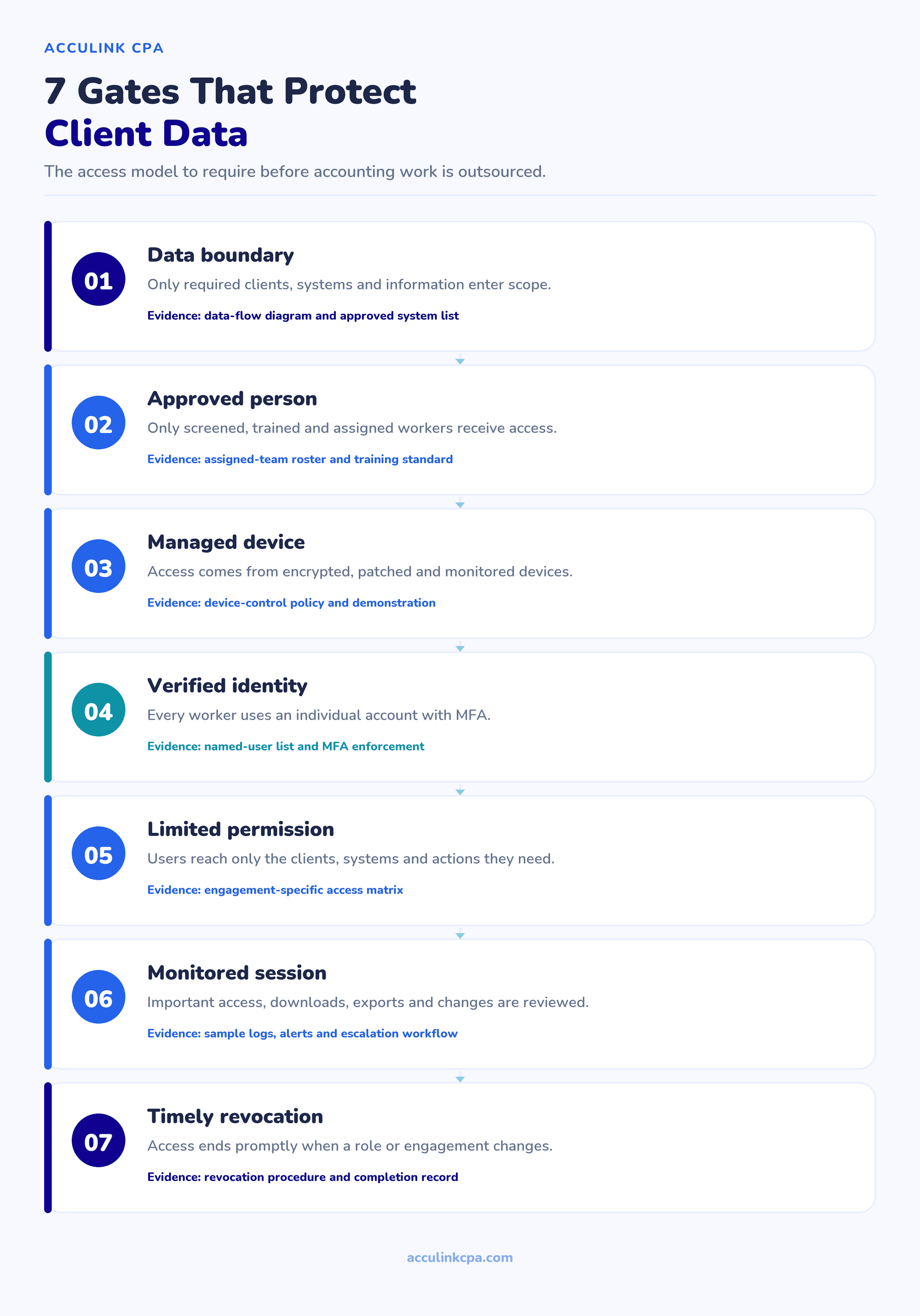
The Seven-Gate Access Model to Require
The preferred model is not to email files to an offshore team. It is to bring named people to narrowly defined work inside an approved environment.
Assigned person → approved device and workplace → verified identity → permitted client and system → permitted action → monitored event → timely revocation
| Gate | Control to require | Evidence to request |
|---|---|---|
| 1. Data boundary | Only necessary clients, systems, and data enter scope | Data-flow diagram and approved system list |
| 2. Person and workplace | Screened, trained, assigned people work only in approved settings | Assigned-team roster, training standard, and workplace policy |
| 3. Device | Access comes from managed, encrypted, patched, monitored devices | Device-control policy and demonstration |
| 4. Identity | Every action can be traced to one person | Named accounts, MFA enforcement, and login record |
| 5. Permission | Users reach only required clients, systems, and actions | Engagement-specific access matrix |
| 6. Session and monitoring | Copying is restricted and important activity is reviewed | Sample logs, alerts, and escalation workflow |
| 7. Revocation | Access ends promptly when a role or engagement changes | Joiner-mover-leaver procedure and sample evidence |
Keep data inside a defined boundary
Define scope by client, system, task, data element, permitted action, and retention period. A bookkeeper reconciling five clients does not need the entire document-management system. If a separate copy is necessary, document where it is stored, who can administer it, whether it enters backups, and how deletion will be proven.
Control people, devices, and identity
Require provider-managed devices with full-disk encryption, endpoint protection, current patches, restricted administrative rights, and appropriate controls over local storage, printing, screenshots, cameras, clipboard use, and removable media. Each worker must use an individual account protected by MFA. Never accept shared team credentials.
Apply least privilege and monitor important actions
Authentication proves who the user is. Authorization controls what that user can see or change. Record the person, role, systems, clients, permission level, approver, date granted, next review, and revocation owner.
Logs should cover logins, file access, exports, downloads, permission changes, and administrative activity. Ask which events trigger alerts, who reviews them, and what escalation follows. Logging that nobody reviews provides limited protection.
What Security Evidence Should a CPA Firm Request?
A logo is marketing. Vendor security assessment requires current documents and a clear scope.
| Evidence | What it helps establish | What it cannot prove alone |
|---|---|---|
| SOC 2 Type II report | Controls examined over a period, exceptions, scope, and responsibilities your firm must perform | That every service, office, or subprocessor is covered |
| ISO/IEC 27001 certificate | A certified information security management system within the stated scope | That a particular engagement has no vulnerabilities |
| Penetration-test summary | Tested weaknesses, remediation, and retesting | Continuous security or correct employee behavior |
| Incident plan and exercise record | Response roles, escalation, recovery, and whether the plan is practiced | That an incident will never occur |
| Cyber insurance evidence | Carrier, period, limits, and high-level coverage | That every loss involving your firm will be covered |
| Data-flow and subprocessor list | Where information goes and which third parties participate | That each party has adequate controls |
| Deletion procedure | How information is returned or removed at exit | That deletion occurred without completion evidence |
For SOC 2, review the legal entity, services, locations, systems, period, auditor's opinion, exceptions, subprocessors, and any controls assigned to your firm. SOC 2 is an examination and report, not a blanket security certification.
For ISO 27001, inspect the edition, scope, legal entity, covered sites, certification body, issue date, and expiry. ISO identifies ISO/IEC 27001:2022 as the current edition. A narrow certificate may not cover the team serving your firm.
Which Rules Matter for Accounting Outsourcing Data Security?
FTC Safeguards Rule and WISP
The FTC Safeguards Rule includes tax preparation firms among examples of covered financial institutions. Covered firms must select service providers capable of maintaining safeguards, require safeguards by contract, and periodically assess them. The provider relationship should also appear in the firm's written information security plan, or WISP.
The IRS points tax professionals to Publication 4557 for safeguarding taxpayer data.
IRS Section 7216
Section 7216 concerns the disclosure and use of tax return information. The IRS requires consent before disclosure to a preparer outside the United States and prescribes mandatory consent language in Revenue Procedure 2013-14. Restrictions also apply to disclosing Social Security numbers outside the United States.
There is no general "7216 certified" status. Evaluate the provider's consent workflow, masking, permissions, training, and evidence. See Acculink's IRS Section 7216 guide and obtain qualified advice for your circumstances.
CPA confidentiality obligations, state breach-notification laws, client contracts, and rules for health, benefits, financial-services, or government data may create additional requirements.
What Should Happen After a Suspected Data Breach?
A claim of "no previous breaches" is not a data breach response plan. Before access begins, define:
- Events that trigger notice, including suspicious access that requires containment.
- Named security, legal, operational, and after-hours contacts.
- A prompt contractual notification deadline.
- Information required in the first notice.
- Preservation of logs, device evidence, access records, and configurations.
- Investigation roles and your firm's participation rights.
- Authority over communications with clients and regulators.
- Responsibility for investigation, restoration, notification, and related costs.
- Validation of secure recovery and a corrective-action report.
Ask when the provider last tested its response through a tabletop exercise. NIST's current incident-response guidance treats preparation, detection, response, recovery, and improvement as connected risk-management activities.
Does the Provider Need Cyber Liability Insurance?
Yes, appropriate cyber liability and, where relevant, technology errors-and-omissions coverage should be part of the review. Insurance does not prevent a breach. It provides financial capacity and coordinated response support when costs or claims arise.
Ask about the carrier, policy period, limits, deductibles, territory, subcontractor incidents, ransomware, privacy liability, regulatory response, forensics, notification, restoration, business interruption, exclusions, and sublimits. Then involve your own broker. The provider's insurance may not protect your firm, and your policy may impose conditions on outsourcing or foreign providers.
Security Terms to Put in the Contract
The contract should cover:
- permitted use, confidentiality, and prohibited activities;
- approved people, locations, devices, and subprocessors;
- MFA, encryption, logging, training, storage, printing, and removable-media controls;
- assessment rights, evidence, remediation, and notice of material control changes;
- incident definition, notification time, cooperation, evidence preservation, and costs;
- continuity, recovery expectations, and test evidence;
- data ownership, retention, return, deletion, and confirmation;
- insurance, liability, indemnity, and transition assistance.
A security questionnaire records the answer. The contract makes the commitment enforceable.
A 15-Question Vendor Security Assessment
Ask the provider:
- What exact information will you access, and can the scope be reduced?
- Will work remain in systems controlled or approved by our firm?
- Does every worker receive a named account with MFA?
- How are permissions approved, reviewed, and revoked?
- Can users download, print, email, photograph, or store information locally?
- Which activities are logged, and who investigates alerts?
- Are devices provider-owned, encrypted, patched, monitored, and restricted?
- Where will people work and where will our information, logs, and backups reside?
- Which subprocessors are involved and how are they assessed?
- Can we review your current SOC 2 and ISO 27001 evidence under NDA?
- What did your latest penetration test identify, and was remediation retested?
- When did you last exercise incident response and disaster recovery?
- How do you support FTC service-provider oversight and Section 7216 processes?
- What cyber and technology E&O insurance do you maintain?
- What evidence will confirm access removal and data deletion at exit?
Use a limited pilot after the provider passes cybersecurity due diligence. Test a representative workflow, named-user access, logging, escalation, deliverable quality, and offboarding before expanding. Acculink's broader accounting outsourcing process explains how secure access fits into operational onboarding.
What CPA Firms Can Request from Acculink
Acculink's IT and data security page describes its security controls, while its certificates and alliances page presents independent credentials. Before publication, every statement and document offered to prospects must be verified for current scope and validity.
During an evaluation, a CPA firm should be able to request applicable security evidence under NDA, review the proposed access model, identify relevant locations and subprocessors, understand incident and offboarding commitments, and discuss insurance evidence. The objective is not to ask a prospect to trust broad claims. It is to make the controls verifiable.
Firms comparing delivery options can also review Acculink's accounting outsourcing services and its approach to building a dedicated offshore team. Security controls should be evaluated against the actual service, systems, and team proposed for the engagement.
Frequently Asked Questions
Is accounting outsourcing safe for CPA firms?
It can be when work uses named, least-privilege accounts, MFA, managed devices, restricted copying, activity monitoring, independent evidence, enforceable contract terms, and a tested incident process. Outsourcing is not inherently safe or unsafe. Actual controls determine the risk.
What security certifications should an accounting outsourcing provider have?
Request a current SOC 2 Type II report and ISO/IEC 27001 certificate where applicable, then examine their scope. Also review penetration testing, incident exercises, insurance, access design, subprocessors, contract terms, and ongoing monitoring.
How should offshore accountants access our systems?
Use individual accounts, MFA, least-privilege permissions, approved managed devices, encrypted connections, restricted downloads, activity logging, and centrally controlled revocation. Avoid shared credentials, emailed files, personal storage, and unnecessary local copies.
What happens when the outsourcing engagement ends?
Your firm should revoke every account and integration, require information to be returned or securely deleted according to contract, address backups and subprocessors, preserve required records, and obtain evidence that offboarding was completed.
The Bottom Line
CPA firms should not judge financial data security from a country, badge, or sales promise. Judge it from the provider's access model, independent evidence, contract, incident readiness, insurance, and willingness to let your firm verify each one.
If you are evaluating offshore support, request a security and workflow review. Bring your proposed systems, data types, and work scope so the access model and required evidence can be reviewed before the first file moves.
Tags:
About the Author

Related Posts
Top 10 Offshore Staffing Companies for Accounting Firms (2026)
Hiring an offshore team is one of the highest-leverage moves a short-staffed CPA firm can make, but the partne…
Tax Preparation Outsourcing for CPA Firms: How It Works, What It Costs, and Where to Start (2026)
Tax preparation outsourcing lets a CPA firm hand routine return preparation to an external team, usually offsh…
Offshore Accounting: What CPA Firms Need to Know in 2026
A practical 2026 guide to offshore accounting for U.S. CPA firms: what it is, what to safely delegate, what it…