The Accounting Outsourcing Process for CPA and Accounting Firms: What Actually Happens, Stage by Stage

Summary
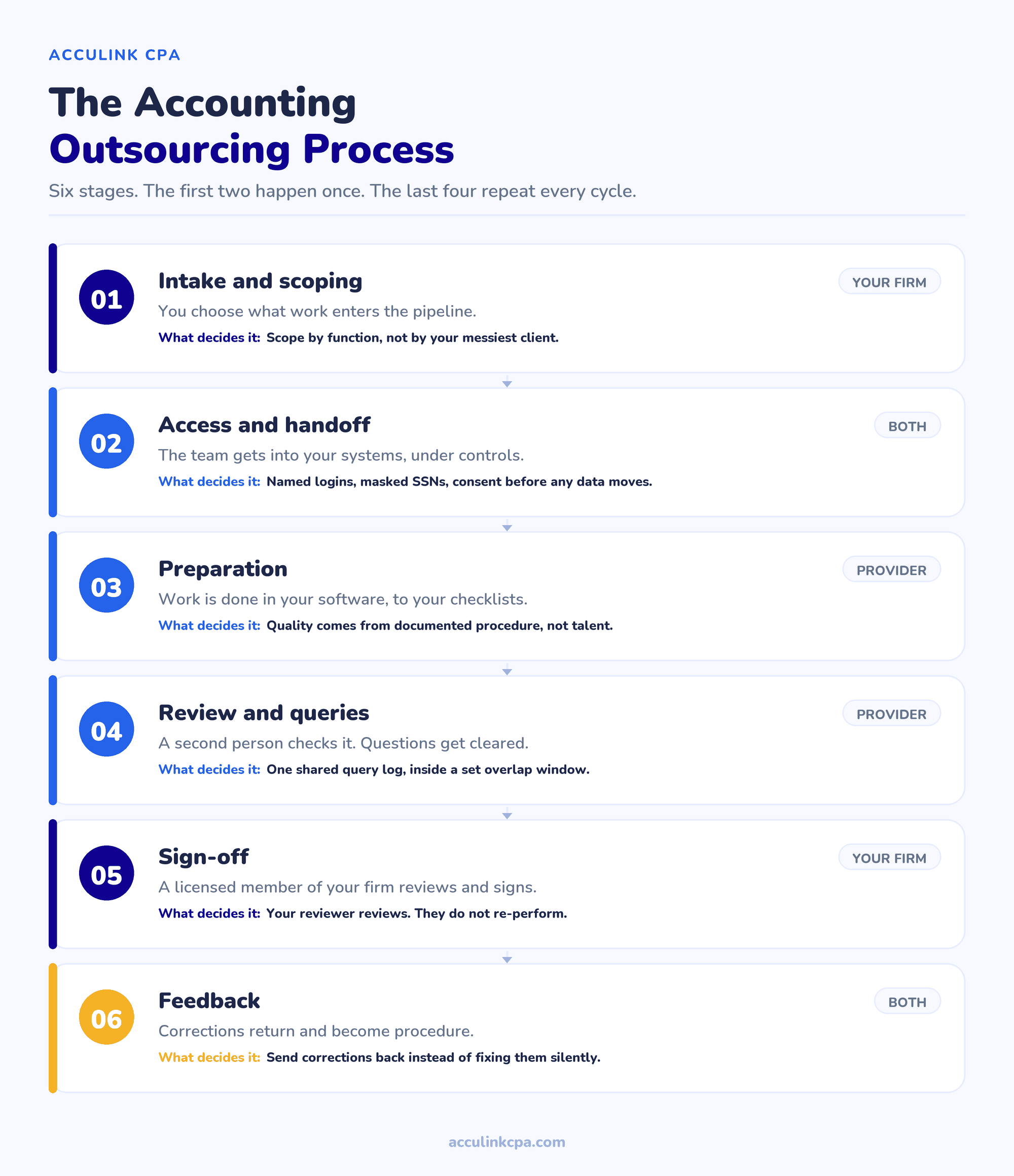
The accounting outsourcing process is a production workflow, not a purchase: six stages, intake and scoping, secure access, preparation, review and queries, sign-off, and feedback. The first two happen once; the last four repeat every cycle. Your firm never gives up the file, an outsourced team prepares and a licensed member of your firm reviews and signs. This guide walks CPA and accounting firms through what actually happens at each stage, in which software, who decides what, and where the process most often breaks.
Key Takeaways
- The accounting outsourcing process is a production workflow, not a purchase. Six stages: intake and scoping, secure access, preparation, review and queries, sign-off, feedback. The first two happen once. The last four repeat every week.
- Quality comes from documented procedure, not from talent. The firms that struggle most are the ones carrying their process in their heads, because there is nothing to hand over.
- Your firm never gives up the file. The outsourced team prepares, a licensed member of your firm reviews and signs. If your reviewer is re-doing the work rather than reviewing it, stage 3 or stage 4 is broken.
- Consent comes before data. Under IRS Section 7216, a US firm needs the client's written, specific, advance consent before tax return information goes to a preparer outside the United States.
- Most failures happen in stages 2 and 4, secure access and the query loop. Almost never in the preparation itself.
Most guides about outsourcing explain how to buy it: assess your needs, shortlist providers, sign, onboard. Far fewer explain what the accounting outsourcing process actually looks like once the contract is done and a real client file has to move. That is the part firm owners ask about most and find least often, so it is what this guide covers, stage by stage: who touches the work, in what order, in which software, what each side decides, and where your firm's review sits.
The short version is that a well-run engagement looks less like sending work away and more like adding a desk. The file stays in your systems. A prepared set of books or a drafted return comes back to your reviewer instead of to your client.
A quick note on wording, because the two terms get used as if they mean the same thing. This guide is about the outsourcing process, the workflow itself, which is identical whether your provider sits in Ohio or Ahmedabad. Where the location genuinely changes something, and there are two places where it does, consent rules and time zones, we say offshore and explain why.
The Accounting Outsourcing Process: Six Stages
Stages 1 and 2 happen once per engagement. Stages 3 to 6 repeat every cycle.
| Stage | What happens | Who owns it | What decides success |
|---|---|---|---|
| 1. Intake and scoping | You choose what work enters the pipeline | Your firm | Scoping by function, and not starting on your messiest client |
| 2. Access and handoff | The team gets into your systems under controls | Both | Named logins, masked SSNs, consent before any data moves |
| 3. Preparation | Work is done in your software, to your checklists | Provider | Whether your procedure is actually written down |
| 4. Review and queries | A second person checks it, questions get cleared | Provider | One shared query log, inside a set overlap window |
| 5. Sign-off | Your firm reviews and signs | Your firm | Reviewing rather than re-performing |
| 6. Feedback | Corrections return and become procedure | Both | Sending corrections back instead of fixing them silently |
Stage 1: Intake and scoping
In one line: you decide what enters the pipeline.
This is a capacity decision, not a cost one, so the question is what eats hours without eating judgment. Run your recurring work against those two axes and reconciliations, AP entry, payroll runs and routine return preparation land in the same corner every time, which is why they make up the bulk of most accounting outsourcing engagements.
Two ways to cut the scope:
- By function. All bank reconciliations, every client. One procedure, learned once, repeated. Errors surface fast and trace easily.
- By client. Everything for one or two clients. Deeper familiarity, but several procedures to learn at once.
Function-first isolates the variable: when something breaks, you know it is the process and not the client. Either way, write the scope down, including monthly volumes so your provider can staff correctly, your internal review dates rather than just filing deadlines, and who answers questions on your side.
The trap: testing a provider on your messiest client. It proves nothing, because you cannot tell whether the mess came from the provider or from the file. Start clean and representative, save the difficult one for month three, and if you are building for busy season, start six to eight weeks out.
Stage 2: Access and the secure handoff
In one line: the team gets into your systems, under controls.
One principle carries most of this stage: the work comes to your environment, your data does not go to theirs. Named individual logins, never a shared account, with access limited by role to the specific clients that person touches. Files stay in your ledger, your document management and your tax software. Nothing moves as an email attachment, because the moment files travel that way you lose the security position and version control together. Device-side, expect encrypted machines, disabled USB ports, no local data storage, two-factor authentication, and access you can revoke centrally the day someone leaves.
For tax work, a legal step comes first. IRS Section 7216 requires your client's written, specific, advance consent before tax return information goes to a preparer outside the United States. The obligation sits on your firm rather than your provider, and it cannot be retrofitted once data has moved.
The detail most firms miss: under Treasury Regulation Section 301.7216-3(b)(4), a US preparer cannot obtain consent to disclose a taxpayer's SSN to a preparer outside the United States, and must redact or mask it first. Consent creates no exception, because no valid consent exists for that disclosure. Revenue Procedure 2013-14 sets the mandatory language. In practice this makes SSN masking a configuration question for your tax software, not something a signature solves, so raise it before go-live.
Before go-live, ask to see three things: the actual SOC 2 Type II report rather than a logo, the ISO/IEC 27001 certificate, and how access is logged, masked and reviewed. Ours are set out on our data security and certificates and alliances pages. None of this is slow when it is done properly. Ours is a five to ten business day setup, and if a provider quotes weeks for access provisioning, ask what specifically is taking the time.
Stage 3: Preparation
In one line: the work gets done, in your software, to your checklists.
This is the stage firms worry about most and should worry about least. Depending on what you scoped, that is a dedicated bookkeeper, a tax preparer or a staff accountant assigned to your firm, but the person matters less than the thing they are following.
Quality comes from documented procedure, not individual brilliance. A competent preparer with a clear checklist beats a brilliant one guessing at your preferences, every time and not narrowly. Which produces an odd result: the firms that struggle most are often the strongest technically, because they have carried the procedure in their heads for fifteen years and have nothing written down to hand over. Documenting your workflow is not preparation for outsourcing. It is the outsourcing.
Agree what "prepared" means before anyone starts:
- A reconciled month. Every account tied, reconciling items identified and aged, unexplained differences listed with what is needed to clear them.
- A drafted return. Return prepared, software diagnostics cleared, open items flagged with the specific document or answer required.
- Prepared workpapers. Schedules built, tied to the trial balance, cross-referenced, exceptions noted rather than silently adjusted.
All three share one thing: the open-items list matters as much as the finished work. A file that comes back clean because the preparer quietly guessed at three treatments is worse than the same file with three flagged questions. Say that at the start, because a preparer who reads questions as weakness will stop asking them and you will not find out for months.
Expect the first 30 to 90 days to run slower while the team absorbs your workflow, software and preferences. That is true of a new in-house hire too.
Stage 4: Review and the query loop
In one line: a second person checks the work, and questions get cleared.
Every file is prepared by one person and checked by another before it leaves your provider. The second reviewer is not repeating the work: they check it against the same checklist the preparer used, test the flagged exceptions, confirm diagnostics are clear, and make sure the open-items list is specific. On tax engagements a dedicated tax reviewer fills that seat rather than whoever happens to be free.
Then the query loop, where more engagements fail than anywhere else. Every preparer hits questions, and how those get answered decides whether the engagement feels fast or maddening.
What works is unglamorous. One shared query log rather than individual emails, with each entry carrying which client, which item, what is blocking, and what the preparer thinks the answer probably is. That last field does most of the work, because confirming a proposed treatment takes seconds where diagnosing an open-ended question takes minutes. Clear them inside a defined overlap window, and a good partner provides several hours of daily overlap with US business hours. Without that window, one question costs a full day and four questions cost most of a week.
The failure mode: questions arriving by email at random hours, answered by whoever sees them first, with the answer living in one person's inbox. Three months later the same question returns because nothing recorded how it was settled. Firms in that pattern usually conclude outsourcing does not work for them. What actually failed was the query process.
Stage 5: Sign-off and delivery
In one line: your firm reviews, signs and delivers.
A licensed member of your firm reviews the completed work and signs it. The preparer does not sign, does not file, and does not speak to your client. That is the structure of the arrangement rather than a courtesy: your firm remains the engaged professional, so the signature, representation before the IRS under Circular 230, and every client-facing conversation stay with you.
Your reviewer reviews. They do not re-perform. The checks are judgment-level, so: is the treatment right, is the classification reasonable, does the result square with what you know about this client, are the flagged open items properly resolved. If you find yourself re-adding columns or re-checking arithmetic, the problem is upstream in stage 3 or stage 4 and no amount of extra review will fix it.
Watch how long your review takes. It is the most useful early signal you have, and it should fall month over month as the preparer absorbs your standards. Flat review time after several cycles means the feedback loop is not working, which is the whole of the next stage.
Stage 6: Feedback and scaling
In one line: corrections go back and become procedure.
Review comments return to the preparer as standing corrections, then get added to the checklist so they stop being one-time notes. That single habit is what separates a firm whose error rate falls steadily from one that plateaus. Fixing something silently is faster this month and guarantees you fix it again next month. Keep a short record of recurring issues too, because nearly all of them resolve into one of three things: a checklist gap, an access problem, or an expectation nobody actually stated.
Three signals you are ready to add the next function:
- Query volume has dropped
- Your review time has fallen and stabilized
- Open-items lists read as specific rather than vague
Most firms reach that point in the second or third month, once the checklist has absorbed the first round of corrections. Agree the turnaround you expect for each work type while you are still scoping rather than discovering it later, because your own client deadlines end up resting on that number.
What a Typical Week Looks Like
Once the process is running, the rhythm is more ordinary than most firms expect.
| When | What happens | Who |
|---|---|---|
| Your Monday morning | Week's work queued and scoped | Your team |
| Overnight (your time) | Preparation runs | Preparer |
| Their day end | Internal maker-checker review | Second reviewer |
| Overlap window | Queries raised and cleared live | Both |
| Your Wednesday to Thursday | Prepared work lands for your review | Your reviewer |
| Your Friday | Sign-off, delivery, review notes returned | Your team |
The time difference, which firms treat as the main obstacle, is often the quiet advantage: work queued at the end of your day is prepared while your office is closed. What has to be engineered is not the preparation but the overlap window in the middle of that table. It is the only row that requires both sides to be awake, and it is the one that makes or breaks the week.
Which Accounting Work Can Be Outsourced, and Which Stays With Your Firm
Recurring, rule-based, documented work travels well. Work that requires professional judgment, a license, or a client relationship does not.
| Work type | Can be outsourced | Stays with your firm |
|---|---|---|
| Bookkeeping and write-up | ✅ | |
| Bank and credit card reconciliations | ✅ | |
| Accounts payable and receivable processing | ✅ | |
| Payroll processing | ✅ | |
| Sales tax return preparation | ✅ | |
| Month-end close and year-end | ✅ | |
| Individual and business return preparation (1040, 1120, 1120S, 1065) | ✅ prepared | ✅ reviewed and signed |
| Workpaper preparation and audit support | ✅ | ✅ opinion and conclusions |
| Financial statement preparation | ✅ drafted | ✅ reviewed |
| Management reporting | ✅ built | ✅ interpreted |
| Final review and signature | ✅ | |
| Client advisory conversations | ✅ | |
| Engagement letters and scope decisions | ✅ | |
| Independence and ethics judgment | ✅ | |
| Representation before the IRS (Circular 230) | ✅ |
The pattern is consistent: preparation travels, judgment does not. A useful test when you are unsure is whether the task could be written down as a procedure. If it could, it can be handed off under review. If the answer depends on knowing the client, it stays.
Each linked row above goes to how we scope that specific function, if you want the detail on any one of them.
Where the Accounting Outsourcing Process Breaks
Four failure points account for most of it, and none is the preparation.
A handoff built on email. Files as attachments means an indefensible security position and version control that collapses within weeks.
No consent process for tax work. Section 7216 is not optional, and consent cannot be retrofitted after data has moved.
An unmanaged query loop. Questions answered ad hoc, across a time difference, with no shared log. This is the single most common reason firms conclude outsourcing does not work for them.
Review notes that go nowhere. Corrections made silently instead of returned to the preparer. Quality plateaus and the firm ends up doing the work twice.
All four are setup problems rather than provider problems, which is why they are worth fixing before you conclude a provider is at fault. If you are still choosing between providers, our ranking of the top outsourced accounting firms for CPA practices scores them on the things that decide fit.
Outsourcing and Offshoring Are Not the Same Thing
Worth clearing up, because the terms get used interchangeably and they answer different questions.
| Term | The question it answers | What it tells you |
|---|---|---|
| Outsourcing | Who does the work? | Someone outside your firm, in-country or abroad |
| Offshoring | Where does the work sit? | Another country, whether by an outside firm or your own overseas staff |
| Offshore accounting | Both | An external team, in another country, doing accounting work |
They are two axes rather than competing models. You can outsource without offshoring by using a domestic provider, or offshore without outsourcing by opening your own overseas office. Most CPA firms do both at once: they engage an external partner whose team sits abroad, commonly in India.
The process described above is the same either way. Location changes exactly two things: the Section 7216 consent requirement in stage 2, and the shape of the overlap window in stage 4.
Two Delivery Models, One Process
The same six stages run under either model. The difference shows up in stages 4 and 6.
Back office accounting outsourcing hands over a function. You send the work, an agreed output comes back, and the provider manages who performs it. Queries route through the provider, and improving the process is the provider's job. This suits defined, high-volume tasks like AP processing or reconciliations, where you care about the result rather than the person.
Dedicated offshore staffing gives you named people who work your files every week and learn your clients. Your reviewer works with the same preparer continuously, so the feedback loop in stage 6 compounds and query volume falls over time.
Firms outsourcing accounting work purely for capacity relief often prefer the first. Firms that want an extension of their own team choose the second, which is how a dedicated team engagement is structured.
If you are weighing where that team should sit, we compare the main delivery locations in our guide to offshore staffing for accounting firms across India, the Philippines and Latin America, and rank providers in our list of the top offshore staffing companies for accounting firms.
Why CPA Firms Choose Acculink
- Built exclusively around US CPA and accounting firms, so the workflow needs no translation.
- Dedicated accountants and bookkeepers working white-label, under your brand and your review.
- Fully certified: SOC 2 Type II, ISO/IEC 27001, IRS Section 7216, GDPR, the AICPA Code of Professional Conduct and the FTC Safeguards Rule, with enterprise-grade data-security controls.
- Encrypted devices, disabled USB ports, zero local data storage, two-factor authentication and role-based access, with a five-year record and no data breaches.
- 300+ qualified professionals (CPAs, EAs, Chartered Accountants and Big-4 alumni) supporting 80+ US firms.
- Two-tier maker-checker review on every engagement, before anything reaches your desk.
- Works in your stack: QuickBooks Online and Desktop, Xero, Sage Intacct, NetSuite and the common ledger and workflow tools.
- 40-hour free trial, no setup fee, no lock-in, live in 5 to 10 business days.
- Transparent $8 to $35 per hour all-inclusive pricing, generally 60 to 70% below the cost of a comparable US hire.
Certifications are public on our certificates and alliances page.
Frequently Asked Questions
How does the accounting outsourcing process work?
The accounting outsourcing process runs in six stages: you scope which work enters the pipeline, the outsourced team is given secure role-based access to your systems, a preparer completes the work in your software, a second reviewer checks it, a licensed member of your firm reviews and signs, and review notes feed back to improve the next cycle. Stages 3 through 6 then repeat continuously.
What is offshore accounting?
Offshore accounting is when qualified accountants in another country prepare a firm's accounting or tax work inside that firm's own systems, with final review and sign-off retained by the firm. It is a delivery location, not a different standard of work: the preparation happens abroad, the professional responsibility stays with your practice.
What is the difference between outsourcing and offshoring?
Outsourcing describes who does the work, someone outside your firm. Offshoring describes where the work sits, in another country. They are separate axes rather than competing choices. You can outsource domestically, or offshore to your own overseas office. Most CPA firms do both at once by engaging an external partner whose team is based abroad.
What accounting work can be outsourced?
Recurring, rule-based, documented work travels well: bookkeeping and write-up, bank and credit card reconciliations, accounts payable and receivable, payroll processing, sales tax returns, month-end close, tax return preparation, workpaper preparation and audit support, and financial statement drafting. The practical test is whether the task could be written down as a procedure.
What work should stay with the US firm?
Final review and signature, client advisory conversations, engagement letters and scope decisions, independence and ethics judgment, and representation before the IRS under Circular 230. Anything requiring professional judgment, a US license, or the client relationship itself stays inside your firm.
Do I need client consent before sending tax data offshore?
Yes. IRS Section 7216 requires a US firm to obtain the client's written consent before disclosing tax return information to a preparer located outside the United States, and that consent must be specific and obtained in advance. The obligation sits with your firm. Any provider that is casual about this stage should be treated with caution.
Who reviews and signs outsourced work?
A licensed member of your firm. The preparer prepares, a second reviewer checks the work internally, and then your firm performs the final review and signs. The outsourced team does not sign, does not file, and does not communicate with your clients.
What is the difference between back office accounting outsourcing and dedicated offshore staffing?
Back office accounting outsourcing hands over a function and an agreed output, with the provider managing who performs it. Dedicated offshore staffing gives you named people who work your files continuously and learn your clients. The process differs most in the query loop: with dedicated staffing the same preparer improves against your review notes over time, so query volume falls.
Will my clients know their accounting is outsourced?
Not from the work itself. White label accounting services are delivered under your firm's brand, templates and review, and all client-facing communication stays with your team. Your separate disclosure obligations, including Section 7216 consent for tax work, are a different matter and must be met regardless.
The Bottom Line
The accounting outsourcing process is more ordinary than its reputation. Work is scoped, access is granted under real controls, a preparer completes it to your checklists, a second reviewer checks it, your firm signs, and the notes feed back into the next cycle. There is no point in that loop where your firm stops being the professional of record.
What separates engagements that work from those that do not is rarely the quality of the preparation. It is whether stage 2 was built properly, whether stage 4 has a real query process, and whether your own procedures were written down before any of it started. Get those right and the rest is repetition.
If you want to see the process on your own files rather than on a diagram, the practical next step is a small, real piece of work. Acculink offers a 40-hour trial and a free consultation to do exactly that.
Tags:
About the Author

Related Posts
Offshore Accounting: What CPA Firms Need to Know in 2026
A practical 2026 guide to offshore accounting for U.S. CPA firms: what it is, what to safely delegate, what it…
Top Outsourced Accounting Firms for CPA Practices (2026)
Choosing an outsourced accounting partner is a high-stakes call because the team touches your clients' data. T…
Top 10 Offshore Staffing Companies for Accounting Firms (2026)
Hiring an offshore team is one of the highest-leverage moves a short-staffed CPA firm can make, but the partne…