Offshore Accounting: What CPA Firms Need to Know in 2026

Summary
A practical 2026 guide to offshore accounting for U.S. CPA firms: what it is, what to safely delegate, what it costs, whether it is secure, and how to choose a partner.
Offshore accounting is the practice of having qualified accountants in another country handle your firm's accounting work, under your brand and your review, instead of (or alongside) hiring locally. For U.S. CPA and accounting firms facing a shrinking talent pool and rising salaries, it has become a mainstream way to add capacity, cut delivery costs by 60-70%, and keep up with client demand without burning out the team. This guide covers what offshore accounting is, why firms are adopting it, what you can move offshore, whether it is safe, what it costs, and how to choose a partner.
What Is Offshore Accounting?
Offshore accounting means delegating accounting tasks, such as bookkeeping, tax preparation, and audit support, to a team based in another country (most commonly India or the Philippines) who work as an extension of your firm. The work is delivered white-label: it runs under your firm's brand, your software, and your review, so your clients deal only with you.
It is worth separating three terms that often get mixed up:
- Outsourcing is handing off a function or task to an outside provider. That provider can be domestic or overseas.
- Offshore means the team is located in another country, which is where the cost savings come from.
- Offshore staffing means a dedicated offshore team that you direct day to day, as opposed to handing off one-off projects.
Most firms end up using some mix of these. The common thread is the same: senior-quality accounting work, done for less, without adding to your local headcount.
Why CPA Firms Are Turning to Offshore Accounting
The shift is being driven by a genuine staffing crisis, not just cost-cutting. Any firm owner who has tried to hire a qualified accountant lately knows the squeeze: roles sit open for months, the candidates worth hiring are juggling multiple offers, and the experienced people already on staff are stretched thin. Three pressures are hitting at once:
- A shrinking talent pipeline. Fewer accountants are entering the profession even as a wave of senior staff retires, so firms head into every busy season already short-handed.
- Rising salaries. When you do land a qualified hire, keeping them costs more every year, and that raise lands on the same work at the same client fees.
- Heavier workloads. Tax complexity, advisory demand, and client expectations keep climbing, and "more work, fewer people" ends in overtime, burnout, and turned-away business.
Offshore accounting answers all three at once: it adds trained capacity in weeks rather than months, it does so at 60-70% below the cost of a comparable U.S. hire, and it scales up for busy season without a hiring-and-firing cycle.
What Accounting Work Can You Move Offshore?
Most firms start with high-volume, rule-based work and keep client-facing judgment in-house. Common functions to hand off offshore include:
- Bookkeeping and bank or credit-card reconciliations
- Accounts payable and accounts receivable
- Tax preparation (individual and business returns)
- Audit support and workpaper preparation
- Payroll processing
- Year-end accounting and financial statement preparation
- CFO, FP&A, and management reporting support
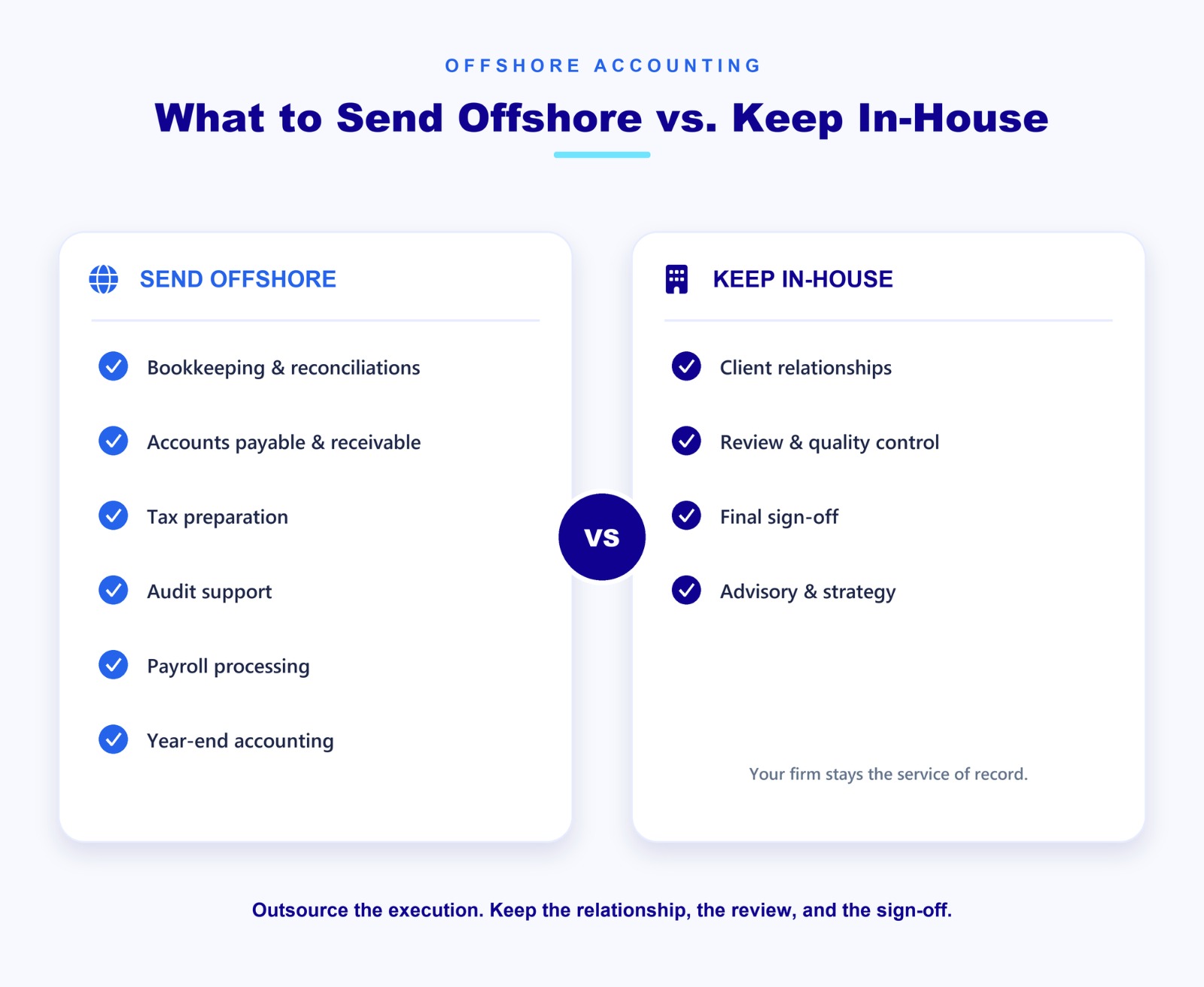
The usual rule: outsource the execution, keep the client relationship, the review, and the final sign-off. That way you expand capacity without giving up control or quality. Most firms begin with one function and expand as it proves out.
The most common mistake is not choosing the wrong provider, it is offshoring the wrong work. Firms that hand off client communication or final review to save a little more time usually regret it, while the high-volume execution behind that work can almost always move safely. Start with what is repeatable and rule-based, keep the judgment in-house, and you protect both the savings and your clients' trust.
Offshore vs. Outsourced vs. Nearshore: A Quick Comparison
| Term | What it means | Why firms choose it |
|---|---|---|
| Outsourced | Work handed to an outside provider (anywhere) | Frees your team from routine work |
| Offshore | The provider's team is overseas (e.g., India, Philippines) | Lowest cost, large talent pool |
| Nearshore | The team is in a nearby country/time zone (e.g., Latin America) | More time-zone overlap, usually higher cost than offshore |
| Offshore staffing | A dedicated offshore team you direct | Continuity and control, like in-house staff |
For most U.S. firms, offshore wins on cost and talent availability, and a good partner closes the time-zone gap with several hours of daily U.S. overlap.
Is Offshore Accounting Safe?
Yes, with the right controls, and it is often more secure than ad-hoc in-house handling. Before you share any client data, confirm the partner has:
- SOC 2 Type II, ISO/IEC 27001, and IRS Section 7216 compliance (the standards that govern data security and the confidentiality of tax-return information)
- Encrypted devices, disabled USB ports, and zero local data storage
- Two-factor authentication and role-based access controls
- A maker-checker review process so nothing reaches your client unreviewed
Ask for the actual SOC 2 Type II report, not just a claim. A certified offshore team operating under these data-security controls protects your clients' data to the same standard your firm is accountable for, including the FTC Safeguards Rule, which applies to accounting and tax firms.
How Much Does Offshore Accounting Cost?
Offshore accounting is priced to be a clear saving over a domestic hire:
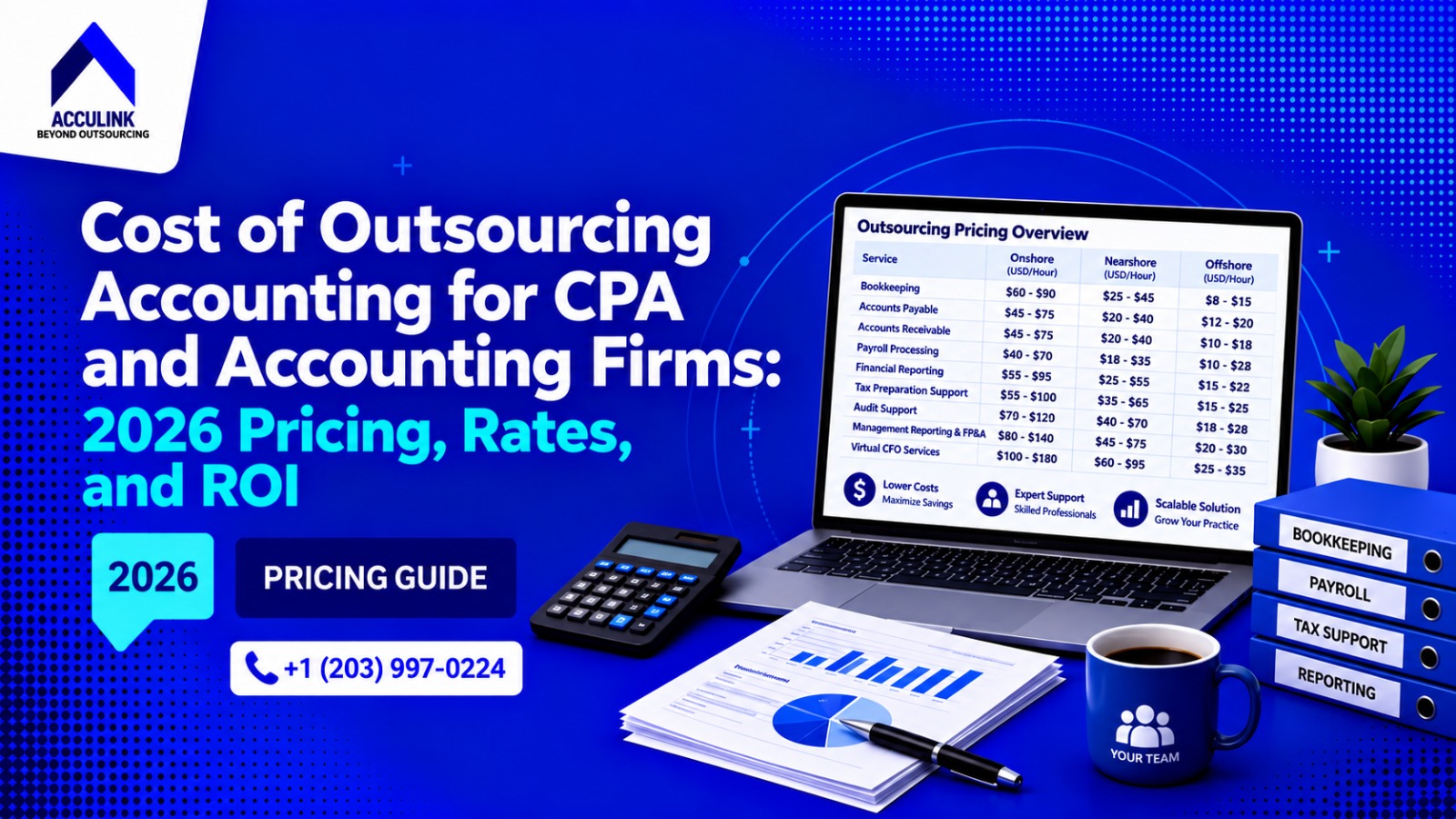
- All-inclusive rates typically run $8 to $35 per hour depending on the role, covering compensation, software, infrastructure, and supervision.
- That works out to roughly 60-70% below the fully-loaded cost of a comparable U.S. hire.
- You can engage a dedicated staffer (ongoing capacity) or use project-based help (overflow), and scale the hours to your actual workload.
To put that in real terms: the U.S. median wage for accountants and auditors is $81,680 a year (2024, per the U.S. Bureau of Labor Statistics), and that is base pay, before benefits, payroll taxes, software, and overhead push the real cost higher. The same workload through a dedicated offshore accountant typically costs a fraction of that, which is where the 60-70% saving comes from, plus the senior time your firm gets back.
Always ask for the all-in number in writing so you are comparing like for like against a U.S. salary plus benefits, software, and overhead. For a fuller breakdown of typical rates by role and how to compare quotes, see our 2026 outsourced accounting pricing guide.
Here is how it tends to play out in practice. Picture a 15-person firm heading into tax season already turning away 1040 work because the team is maxed out. Instead of a months-long search for a seasonal hire, they move individual-return prep and monthly bookkeeping to a dedicated offshore team, keep review and client contact in-house, and put their senior staff back on advisory work that actually grows the firm. The capacity problem eases within the first season, and the cost of that added capacity runs well below what a single local hire would have cost.
How to Choose an Offshore Accounting Partner
Run any shortlist against five questions:
- Do they specialize in accounting-firm work? A partner used to multi-client books and firm review cycles needs no translation.
- Can they prove their security? Ask to see the SOC 2 Type II report and ISO 27001 certificate.
- Is the talent genuinely qualified? Look for CPAs, EAs, and chartered accountants, and ask whether you can interview.
- Do they overlap your hours and review their own work? Time-zone overlap plus a maker-checker process keeps quality high.
- Can you start small? A free trial and no long lock-in let you prove the model before committing.
If you want a head start on who to shortlist, see our ranked lists of the top outsourced accounting firms for CPA practices and the top offshore staffing companies for accounting firms.
Why CPA Firms Choose Acculink
- Built only for U.S. CPA and accounting firms, with no generalist learning curve.
- Dedicated offshore accountants, white-label, working as an extension of your team.
- Fully certified: SOC 2 Type II, ISO 27001, IRS Section 7216, GDPR, AICPA, FTC Safeguards.
- 300+ qualified professionals (CPAs, EAs, CAs, Big-4 alumni) supporting 80+ U.S. firms, five years breach-free.
- Two-tier maker-checker review on every engagement.
- 40-hour free trial, no setup fee, no lock-in.
- All-inclusive $8-$35/hr pricing, 60-70% below a U.S. hire.
If you would like to see how it works on your own files, you can start a 40-hour trial or book a consultation.
Frequently Asked Questions
What is offshore accounting?
Offshore accounting is having qualified accountants in another country handle your firm's accounting work (bookkeeping, tax preparation, audit support, and more) as an extension of your team, under your brand and review. It lets a firm add capacity at a lower cost than hiring locally.
Is offshore accounting safe for client data?
Yes, with the right controls. Look for SOC 2 Type II, ISO/IEC 27001, and IRS Section 7216 compliance, plus encrypted devices, disabled USB ports, zero local data storage, two-factor authentication, and role-based access. Ask for the actual SOC 2 Type II report before sharing data.
What accounting work can be done offshore?
Most firms move high-volume, rule-based work offshore: bookkeeping and reconciliations, accounts payable and receivable, payroll, tax preparation, audit support, year-end accounting, and CFO or FP&A support. Client-facing work, review, and final sign-off usually stay in-house.
How much does offshore accounting cost?
All-inclusive rates typically run $8 to $35 per hour depending on the role, which is roughly 60-70% below the fully-loaded cost of a comparable U.S. hire. Always get the all-in figure in writing.
What is the difference between offshore and outsourced accounting?
Outsourcing means handing work to an outside provider, who can be domestic or overseas. Offshore specifically means that provider's team is in another country, which is where the cost savings come from. Many firms use offshore providers as their outsourcing partner.
Will my clients know their accounting is done offshore?
No. The work is delivered white-label: your firm remains the service provider, and the offshore team works under your brand, your procedures, and your review. Client-facing communication stays with your team.
Where are offshore accounting teams usually based?
Most offshore accounting talent for U.S. firms is based in India or the Philippines, where there is a large pool of qualified, English-speaking accountants. A good partner provides several hours of daily overlap with U.S. business hours.
How does a firm start with offshore accounting?
Start small and keep risk low: pick one high-volume workflow, choose a certified partner that offers a free trial and no lock-in, and prove the model on a real batch of work before scaling. Acculink, for example, offers a 40-hour trial with no setup fee.
The Bottom Line
Offshore accounting has moved from a cost play to a survival strategy for firms caught in the talent crunch. Done well, it gives you trained capacity at 60-70% less than a local hire, under security controls that match your own obligations, and without your clients ever seeing the seam.
The firms getting it right start small: one workflow, a certified partner, a trial before any commitment. If that is on your roadmap for 2026, Acculink offers a 40-hour trial and a free consultation to test the model on your own work.
Tags:
About the Author

Related Posts
Top 10 Offshore Staffing Companies for Accounting Firms (2026)
Hiring an offshore team is one of the highest-leverage moves a short-staffed CPA firm can make, but the partne…

Top Outsourced Accounting Firms for CPA Practices (2026)
Choosing an outsourced accounting partner is a high-stakes call because the team touches your clients' data. T…
Cost of Outsourcing Accounting for CPA and Accounting Firms: 2026 Pricing, Rates, and ROI
The cost to outsource accounting typically ranges from $8 to $35 per hour, depending on the service, experienc…