Cost of Outsourcing Accounting for CPA and Accounting Firms: 2026 Pricing, Rates, and ROI

Summary
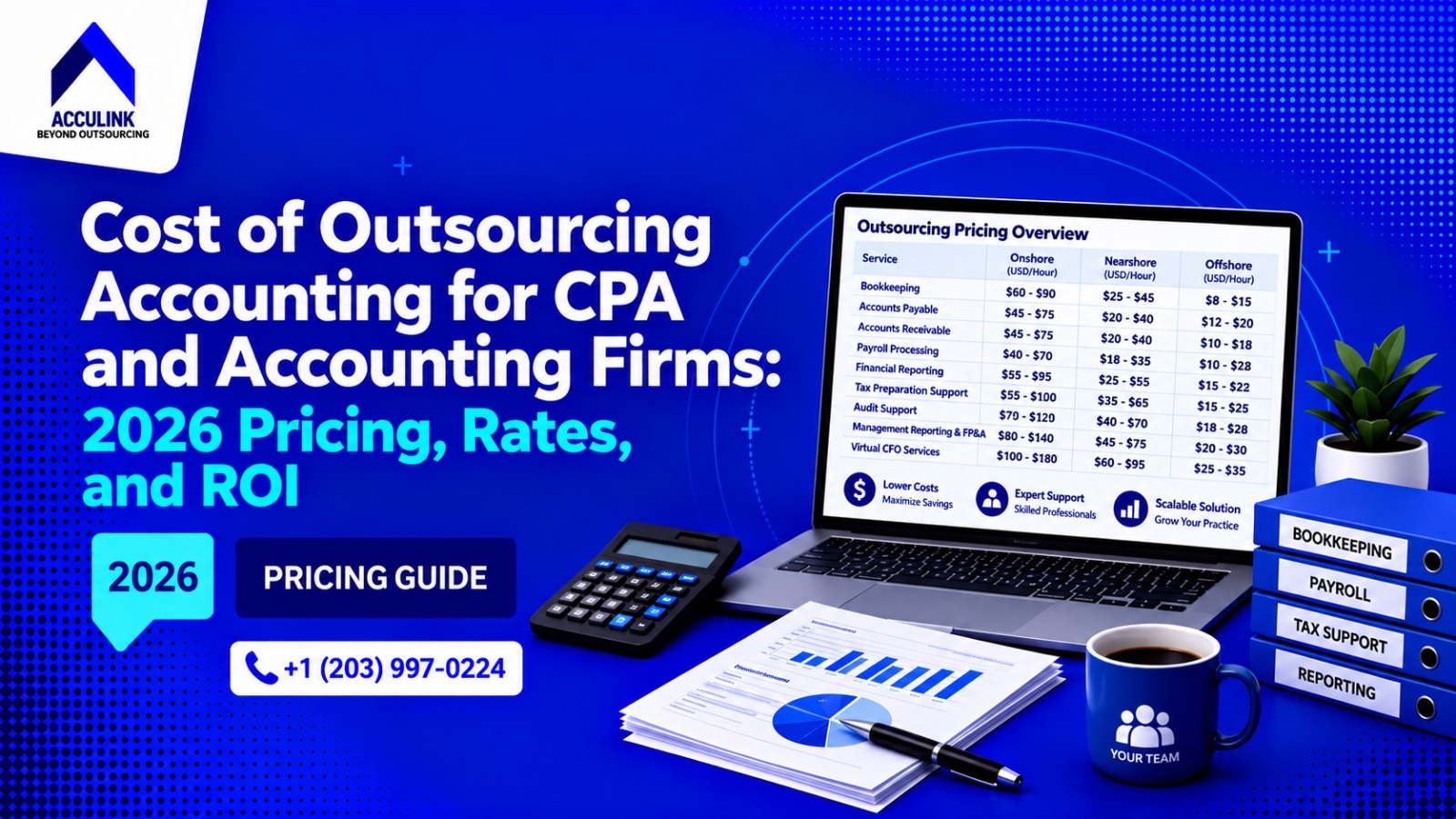
The cost to outsource accounting typically ranges from $8 to $35 per hour, depending on the service, experience level, scope, and engagement model. In matched staffing scenarios, outsourcing can reduce costs by 60% to 70% compared with U.S. in-house hiring, although actual results vary.
A practical 2026 planning range for outsourced accounting is $8 to $35 per hour, depending on the service, experience level, workload, and review requirements. At these rates, 40 hours of monthly capacity costs $320 to $1,400, 80 hours costs $640 to $2,800, and 160 hours costs $1,280 to $5,600.
Compare providers using the total cost of producing accurate, reviewed work by the required deadline. Include provider fees, technology, transition, internal review, rework, and excluded services. Firms can use accounting outsourcing services for function-based delivery or dedicated accounting teams for assigned capacity without building the same recruiting, HR, workplace, and technology infrastructure in-house.
Key Takeaways
- Compare like with like. Match the role, scope, productive capacity, review, technology, and accepted output before comparing provider rates.
- For staff-accountant planning, compare $75,000 to $130,000 for a fully loaded U.S. hire with $15,000 to $40,000 for comparable offshore capacity.
- The U.S. Bureau of Labor Statistics lists an $83,680 median annual wage for accountants and auditors in May 2025. Benefits represented 30% of private-industry compensation costs in June 2026, so salary alone understates the employer's cost.
- The $8 to $35 hourly planning range converts to $15,360 to $67,200 per year at 160 hours per month across the full range of roles.
- Common service bands begin at $8 to $15 per hour for basic bookkeeping and reach $25 to $35 per hour for virtual CFO work.
- A matched cost comparison can produce a 60% to 70% reduction in staffing cost, but the result depends on the in-house benchmark, outsourced role, utilization, transition, and retained review.
- Total outsourced accounting services cost should include setup, software, internal review, rework, minimums, transition, and exit support, not only the hourly rate.
- Acculink includes salary, HR, IT infrastructure, office space, security controls, training, and account management in the quoted range. There is no setup or recruitment fee, and firms can begin with a 40-hour free trial.
- ROI should compare matched scope and output quality. A lower provider bill can be offset by extra manager review, missed deadlines, or repeated corrections.
How Much Does It Cost to Outsource Accounting in 2026?
For a CPA or accounting firm, the simplest starting formula is:
Monthly outsourced accounting cost = approved monthly hours x applicable hourly rate
Using the $8 to $35 hourly planning range, the cost at three common capacity levels is:
| Monthly capacity | Cost at $8 per hour | Cost at $35 per hour | Annual range at the same hours |
|---|---|---|---|
| 40 hours | $320 | $1,400 | $3,840 to $16,800 |
| 80 hours | $640 | $2,800 | $7,680 to $33,600 |
| 160 hours | $1,280 | $5,600 | $15,360 to $67,200 |
These figures convert the two ends of the range into capacity costs. They are not a quote. A routine reconciliation role and a senior reviewer should not be priced as if they require the same experience. A firm should map each task to the right role before estimating the monthly cost.
Quick comparison with hiring in-house
For a staff-accountant comparison, use these annual planning ranges:
| Staffing option | Annual planning range | What the range represents |
|---|---|---|
| Fully loaded U.S. staff accountant | $75,000 to $130,000 | Salary plus benefits and employer-side operating costs |
| Comparable offshore staff accountant | $15,000 to $40,000 | A matched offshore staff-accountant role within the defined scope |
The $15,000 to $40,000 range applies to the staff-accountant comparison. The broader $8 to $35 hourly range also covers senior review, specialized work, and virtual CFO support, so full-time-equivalent pricing can extend above $40,000 for those roles. Match seniority, productive capacity, responsibilities, review, and output before calculating the difference.
Firms with a defined recurring workload can hire an offshore accountant or hire a bookkeeper who works in the firm's process. Firms that prefer delivery by function can scope the work as an outsourced service. The economics differ, so choose the operating model before comparing prices.
Which service should you white label first?
Get the checklist for scope, review capacity, security, and margin before work moves.
Outsourced Accounting Pricing by Service
The table below provides practical 2026 planning ranges by service. Each band reflects the complexity and experience generally required for that workstream, while the final quote depends on the actual scope and delivery model.
| Service category | 2026 hourly range | Typical work included |
|---|---|---|
| Basic bookkeeping | $8 to $15 | Data entry, bank and card reconciliations, transaction coding, and routine AP or AR support |
| Advanced bookkeeping | $12 to $20 | Month-end close support, adjusting schedules, and financial-statement workpapers |
| Payroll processing | $10 to $18 | Recurring payroll processing, reconciliations, payroll journals, and defined filing support |
| Tax preparation | $15 to $25 | Individual and entity return preparation based on agreed scope and complexity |
| Audit support | $15 to $25 | Workpaper preparation, testing support, documentation, and engagement coordination under firm direction |
| Financial statement preparation | $15 to $22 | Draft statements, schedules, tie-outs, and presentation support |
| Management reporting and FP&A | $18 to $28 | Management packs, variance analysis, KPI schedules, budgets, and forecasts |
| Tax review and quality control | $20 to $30 | Review support, issue identification, review-note resolution, and quality-control procedures |
| Virtual CFO services | $25 to $35 | Higher-level reporting, cash-flow guidance, planning, and decision support |
The service name alone is not enough to price an engagement. For example, bookkeeping for one reconciled entity with five accounts is different from multi-entity bookkeeping that begins with incomplete records. When the books need repair before recurring work can start, accounting cleanup services should be scoped separately from steady-state monthly production.
Audit support does not transfer the CPA firm's attest responsibility, and tax preparation support does not remove the firm's review and filing obligations. The guide to audit outsourcing for CPA firms explains the related delegation and review boundaries.
Outsourced Accounting Rates by Experience Level
Seniority changes both the hourly rate and the work that can be assigned responsibly.
| Level | Experience profile used in the 2026 guide | Hourly range | Best-fit work |
|---|---|---|---|
| Entry | 3 or more years of domestic experience and up to 2 years of U.S. experience | $8 to $14 | Data entry, reconciliations, routine bookkeeping, and simple preparation tasks |
| Associate | 3 or more years of domestic experience and 2 to 4 years of U.S. experience | $14 to $20 | Full-cycle bookkeeping, AP/AR, close support, and standard returns |
| Mid-level | 3 or more years of domestic experience and 4 to 6 years of U.S. experience | $18 to $25 | Complex returns, month-end close, audit support, and higher-risk reconciliations |
| Senior | 3 or more years of domestic experience and 6 or more years of U.S. experience | $22 to $35 | Review support, complex entities, virtual CFO work, supervision, and escalation handling |
A cost-efficient structure does not assign every task to the least expensive person. It uses a role mix. Routine production can sit with an entry or associate professional, while exceptions and review go to a senior professional. This is usually more economical than applying a senior rate to the entire workflow or allowing low-cost work to create expensive rework for a U.S. manager.
Which Outsourced Accounting Pricing Model Is Best?
The best model depends on how predictable the workload is and how much operational control the firm wants.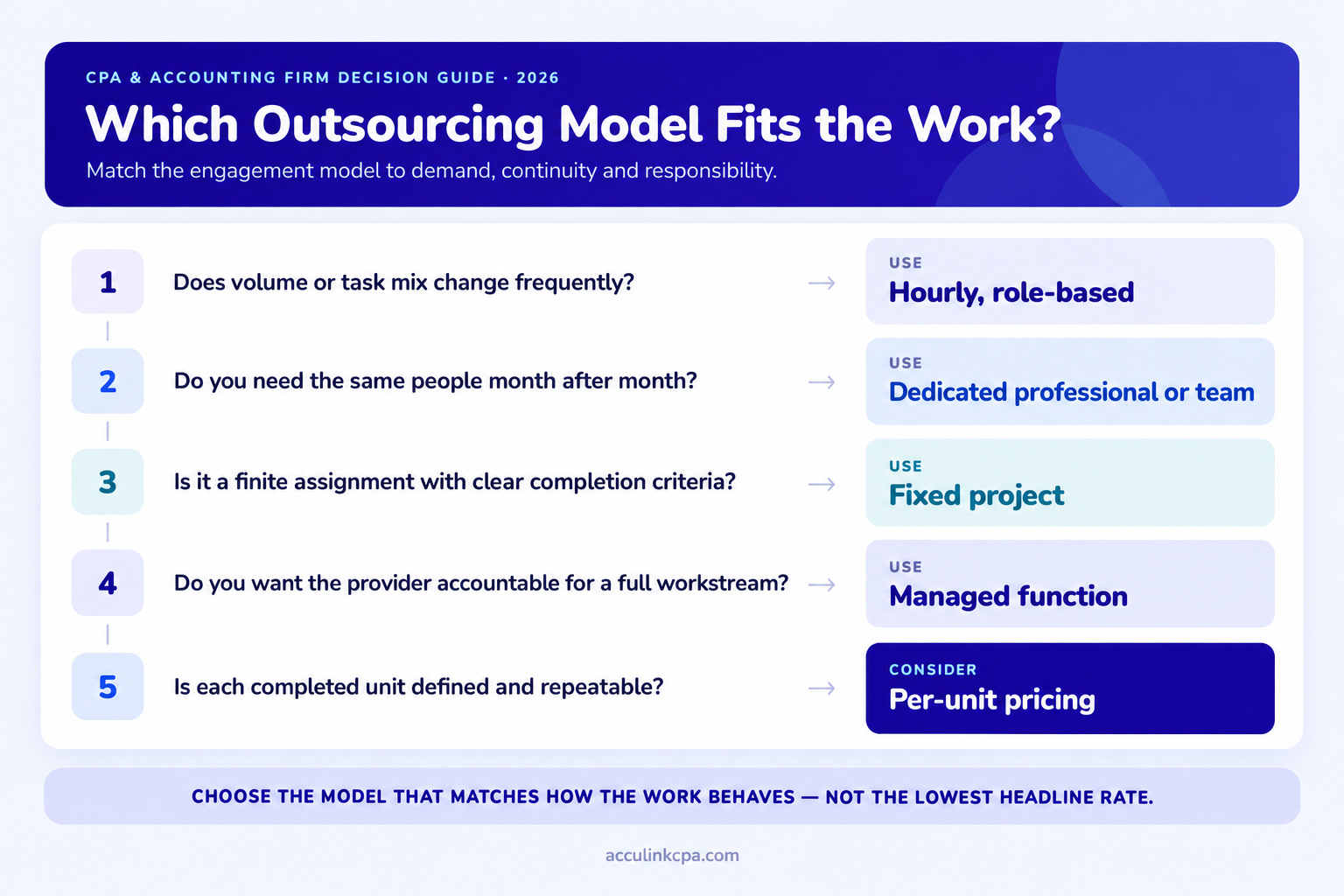
| Pricing model | How billing works | Best fit | Main question to resolve |
|---|---|---|---|
| Hourly, role-based | Approved hours multiplied by the applicable role rate | Variable volume, seasonal demand, or mixed-complexity work | Which tasks and activities count as billable time? |
| Dedicated professional or team | Reserved capacity billed hourly or through a monthly commitment | Stable recurring work and firms that want the same people in their workflow | What productive capacity, supervision, leave, and backup are included? |
| Fixed project | One price for a defined project or deliverable | Cleanup, backlog, conversion, or another finite assignment | What assumptions, exclusions, change rules, and acceptance criteria apply? |
| Managed function | Monthly fee for an agreed workstream and volume band | Firms that want a provider to manage capacity within a defined process | How are volume changes, exceptions, service levels, and overages handled? |
| Per unit | Fee per return, entity, reconciliation, transaction band, or other output | Standardized, repeatable work with a consistent definition of completion | What makes a unit simple, complex, complete, or out of scope? |
| Independent freelancer | Hourly or project rate set by the individual | Narrow or temporary assignments with limited continuity needs | Who provides supervision, backup coverage, security controls, quality review, and process continuity? |
Hourly pricing suits changing scope. Dedicated staffing provides continuity for reliable recurring demand. Fixed-price work provides budget certainty only when inputs and completion criteria are specific. Acculink's engagement models let firms choose between assigned capacity and function-based delivery.
What Determines the Cost of Outsourcing Accounting Services?
Two firms requesting the same service can receive different prices because the workload behind the label is different. These factors have the greatest effect on cost:
- Scope. Reconciliation-only support costs less than a full close with schedules, adjustments, statements, and management packs.
- Volume. Entities, accounts, transactions, returns, workpapers, and reporting packages affect required hours.
- Record condition. Reconciled books cost less to process than incomplete records with missing documents or unsupported balances.
- Complexity. Multi-entity, multi-state, multi-currency, intercompany, inventory, and fund-accounting work require more experience.
- Role mix. Preparation, review, supervision, and client coordination may require different levels.
- Deadline and seasonality. Compressed calendars, tax season, year-end, and urgent catch-up work require reserved capacity.
- Software. Several ledgers, tax systems, document tools, bank feeds, or integrations add setup and support.
- Client contact. Back-office production differs from a role that attends meetings or owns follow-up.
- Controls. Maker-checker review, workpapers, exception logs, and access evidence require time but reduce avoidable risk.
- Transition. Process mapping, access setup, cleanup, training, and parallel production affect first-month cost.
Send every shortlisted provider the same workload profile. If one quote assumes clean books and another includes a backlog, the two prices are not comparable.
In-House Accounting Cost Versus Outsourced Accounting Cost
The quick comparison above gives annual planning ranges for the two staffing models. To test the U.S. side against an independent labor reference, start with official wage and compensation data, then add any firm-specific costs that the benchmark does not capture.
Official labor data provides an independent reference for the U.S. side of the calculation. The U.S. Bureau of Labor Statistics lists a median annual wage of $83,680 for accountants and auditors in May 2025. Within accounting, tax preparation, bookkeeping, and payroll services, the median was $81,490. The lowest 10% earned less than $56,020, while the highest 10% earned more than $144,090.
The BLS Employer Costs for Employee Compensation release shows that wages and salaries represented 70% of private-industry compensation costs in June 2026, while benefits represented 30%. Benefits are therefore not calculated by simply adding 30% to wages. If a wage figure represented 70% of total compensation, the matching illustration would be:
Illustrative total compensation = $83,680 / 0.70 = approximately $119,543
This broad compensation illustration is not an accountant-specific quote. It also excludes recruiting, equipment, software, office space, management time, training, turnover, and unfilled-seat risk.
The resulting planning references are:
| Cost reference | Annual amount | What it represents |
|---|---|---|
| U.S. staff-accountant planning range | $75,000 to $130,000 | A fully loaded U.S. hire |
| BLS median annual wage | $83,680 | Median wage for U.S. accountants and auditors in May 2025 |
| Illustrative compensation using the 70% wage share | Approximately $119,543 | Wage divided by the BLS private-industry wage share |
| Comparable offshore staff-accountant range | $15,000 to $40,000 | Staff-accountant roles within matched scope |
| 160 hours per month at $8 per hour | $15,360 | Lower end of the hourly planning range |
| 160 hours per month at $20 per hour | $38,400 | Mid-range arithmetic example |
| 160 hours per month at $35 per hour | $67,200 | Upper end of the hourly planning range |
The apparent difference is not automatically the firm's saving. The offshore staff-accountant planning band is specific to comparable staff-accountant roles, while the full hourly range includes more senior and specialized work. First match the work, productive capacity, seniority, review level, software, and responsibility. Then add retained internal review and transition costs. The comparison is useful only when both sides describe the same operating result.
Can outsourced accounting reduce staffing costs by 60% to 70%?
It can in a properly matched cost scenario. Use this formula:
Cost reduction = (matched in-house cost - total outsourced cost) / matched in-house cost x 100
| Illustrative matched scenario | Calculation | Cost reduction |
|---|---|---|
| $75,000 in-house cost versus $30,000 outsourced cost | ($75,000 - $30,000) / $75,000 | 60% |
| $100,000 in-house cost versus $30,000 outsourced cost | ($100,000 - $30,000) / $100,000 | 70% |
These examples show how the 60% to 70% range can arise within the planning figures above. They are not a guaranteed result. A firm with a lower in-house cost, a more senior outsourced role, low utilization, extensive retained review, or significant transition work may save less. Calculate the percentage only after both models reflect comparable capacity and accepted output.
When is outsourcing more cost-effective than hiring?
Outsourcing is usually the stronger cost model when the work is repeatable, demand fluctuates, hiring speed matters, or the firm does not need another full-time employee year-round. An in-house hire may be the better fit when the role depends on daily on-site collaboration, direct client ownership, or continuous firm-specific judgment. Many CPA and accounting firms use a hybrid model: partners and managers retain client relationships, judgment, review, and sign-off while an outsourced team handles documented production work.
| Workload pattern | Model to evaluate first | Why |
|---|---|---|
| Predictable full-time role with on-site or client-facing responsibilities | In-house hire | The firm needs direct availability, cultural integration, and broad ownership beyond a defined workflow |
| Seasonal, variable, or backlog-driven production work | Outsourced service | Capacity can expand or contract without carrying a year-round seat |
| Recurring documented work that needs the same assigned people | Dedicated offshore professional or team | The firm gains continuity while avoiding the infrastructure of another internal role |
| Production can be delegated, but judgment and sign-off must remain with the firm | Hybrid model | The firm keeps control of professional decisions while adding delivery capacity |
Use cost as one decision input. Quality evidence, review time, continuity, security, turnaround, and responsibility determine whether the lower-cost model produces better economics in practice.
Hidden Costs That Can Change the Lowest Quote
An inexpensive hourly rate can become costly when the workflow creates extra review or excludes routine items. Put every cost into the model before selecting a provider.
Rework
The current pricing example shows why review quality matters. In this hypothetical scenario, assume an internal reviewer spends an extra 30 minutes on each of 500 deliverables and the firm's loaded reviewer cost is $50 to $75 per hour. The firm would absorb 250 additional review hours, resulting in an illustrative rework cost of:
250 hours x $50 to $75 = $12,500 to $18,750
This is an illustration, but the method should be part of every comparison. Track reviewer hours and returned items during a pilot. Acculink's accounting workflow uses a two-tier maker-checker process so a senior reviewer checks work before it reaches the CPA firm.
Training and Transition
If a firm spends 20 hours teaching basic processes that the provider was expected to understand, the internal cost is $1,000 to $1,500 at the same $50 to $75 hourly assumption. Separate necessary firm-specific onboarding from avoidable remedial training.
Software and Infrastructure
Ask who pays for the provider's workstation, secure environment, HR administration, communication tools, and provider-side licenses. Also identify which client or firm software remains the CPA firm's responsibility.
Minimums and Unused Capacity
A low rate can be expensive when it requires more hours than the firm can use. Compare the minimum monthly invoice, not only the hourly rate. For a dedicated role, calculate expected utilization and decide whether unused capacity can support another approved workstream.
Turnover and Continuity
Replacement recruiting, retraining, and lost process knowledge can affect both cost and deadlines. Ask for named backup coverage, transition duties, documentation standards, and the replacement policy.
Communication and Coordination
Repeated clarification, incomplete handoffs, and slow escalation consume manager time even when the provider's hourly rate is low. During a pilot, track response time, reopened tasks, clarification loops, missed handoffs, and the time internal staff spend coordinating the work. Define overlap hours, communication channels, escalation contacts, and expected response times before recurring delivery begins.
Security and Compliance
Weak controls can shift risk and remediation cost back to the firm. Evaluate the provider's IT and data security controls, including access, encryption, incident response, monitoring, data return, and subcontractor oversight.
Scope Changes and Exit Support
Determine how the provider bills extra entities, urgent work, cleanup, corrections, custom schedules, and offboarding. Define data export, access removal, knowledge transfer, and open-item handoff.
How to Compare Outsourced Accounting Services Pricing
Normalize every quote to the same representative month. Give providers the same entity count, transaction volume, close calendar, applications, expected deliverables, role mix, review standard, and exception assumptions.
Use this formula:
Normalized monthly cost = provider fees + allocated setup + software + internal review + expected rework + exception charges + allocated annual costs
Then calculate:
Effective hourly cost = normalized monthly cost / accepted productive hours
Cost per client = normalized monthly cost / active clients supported
Cost per completed deliverable = normalized monthly cost / accepted deliverables
Accepted productive hours and accepted deliverables matter. Paid time that produces incomplete or rejected work should not be treated as equal output.
Use the following quote-comparison checklist:
- Is the quoted rate tied to a named role and experience level?
- Are salary, HR, IT infrastructure, workspace, training, and provider supervision included?
- Is setup or recruitment billed separately?
- Are minimum hours or long-term commitments required?
- Who pays for provider-side and client-side software?
- Is reviewer time included, and what evidence shows the review occurred?
- How are rework, scope changes, and rush requests billed?
- Is backup coverage included during leave or turnover?
- What working-hour overlap, response expectations, and escalation route apply?
- What security evidence can the provider supply?
- How are time, output, exceptions, and service levels documented?
- What happens to access, files, and process knowledge at exit?
The CPA-firm vendor due diligence checklist provides a wider framework for evaluating the business, delivery, security, continuity, and contractual evidence behind the rate.
See whether white-label delivery improves your margin.
Start with 40 hours of defined work and measure quality, review time, and contribution before you scale.
How to Calculate ROI From Accounting Outsourcing
Cost reduction is only one part of ROI. A firm may also gain billable capacity, shorten a backlog, protect deadlines, or release managers for review and advisory work. Do not include those benefits unless the firm can measure them.
| Potential business gain | What it can change for the firm | How to measure it |
|---|---|---|
| Partner and manager time recovered | Less senior time spent on routine production | Monthly production hours shifted to review, advisory, and client work |
| Additional capacity | More returns, closes, workpapers, or clients handled without another internal seat | Accepted output and backlog before and after launch |
| Faster turnaround | Work continues through a structured handoff and reaches review sooner | Median cycle time and on-time completion rate |
| Lower workload pressure | Less overtime and fewer deadline-driven bottlenecks | Overtime hours, weekend work, missed deadlines, and team retention |
| Faster access to talent | Capacity can be added without completing a full domestic recruitment cycle | Days from approved need to productive delivery |
| Revenue contribution | Available capacity supports new work or more advisory time | Realized contribution from accepted new work, not pipeline estimates |
Use two formulas:
Year-one outsourcing cost = provider cost + transition cost + retained internal review + software + rework + other direct costs
ROI = (avoided in-house cost + measured contribution from added capacity - year-one outsourcing cost) / year-one outsourcing cost x 100
Illustrative Cost Comparison
Assume the following:
- Illustrative in-house compensation proxy: $119,543, based on the BLS wage and compensation-share illustration above
- Outsourced capacity: 160 hours per month at $20 per hour
- Retained review: 4 hours per month at $65 per hour
- Transition: 20 internal hours at $65 per hour
- No speculative revenue benefit included
The calculation is:
| Item | Calculation | Amount |
|---|---|---|
| Annual provider cost | $20 x 160 x 12 | $38,400 |
| Retained review | 4 x $65 x 12 | $3,120 |
| Transition | 20 x $65 | $1,300 |
| Year-one outsourcing cost | $38,400 + $3,120 + $1,300 | $42,820 |
| Illustrative cost difference | $119,543 - $42,820 | $76,723 |
The $76,723 result is an illustrative cost difference, not a quote, forecast, guaranteed saving, or promised performance result. Replace every assumption with the firm's actual loaded cost, expected hours, role mix, review time, transition effort, and accepted output. Then apply the ROI formula using only benefits the firm can document. If the outsourced role does not replace matched in-house capacity, compare it with the overtime, temporary staffing, backlog cost, or contribution it actually displaces.
Financial results should be paired with operational measures. Track first-pass acceptance, reviewer time, turnaround, backlog, deadline performance, utilization, and capacity converted into revenue. The guide to CPA firm KPIs explains how to monitor those measures without mistaking activity for business value.
Accounting Outsourcing Rates by Region
The regional planning ranges used in the current 2026 comparison are:
| Delivery region | Hourly planning range |
|---|---|
| India | $8 to $35 |
| Philippines | $10 to $30 |
| Latin America | $15 to $40 |
These are budgeting ranges, not standardized tariffs. Skill, experience, time overlap, security, and scope can move a quote within or outside a band. Region is a screening factor, not the final decision.
India offers a deep accounting talent base and long experience supporting U.S. workflows. Acculink is built specifically for U.S. CPA and accounting firms, so delivery fits the firm's review standards, software, deadlines, and client commitments.
What Is Included in the $8 to $35 Hourly Range?
Not every provider includes the same items in its hourly rate. Acculink's $8 to $35 range includes the following operating costs, controls, and commercial terms:
| Pricing component | Included terms |
|---|---|
| Hourly rate | $8 to $35 based on role, scope, complexity, and experience |
| Included in the rate | Salary, HR, IT infrastructure, office space, security controls, training, and account management |
| Setup or recruitment fee | $0 |
| Contract | Flexible month-to-month engagement with no long-term lock-in |
| Trial | 40 hours at no charge to interview, train, and evaluate fit |
| Billing | Monthly, with detailed time records and activity visibility |
| Scaling | Begin with one professional and scale to 20 or more as demand changes |
| Replacement | Free replacement with knowledge transfer when needed |
Price is one part of the decision. Acculink is built specifically for U.S. CPA and accounting firms and has 300 or more qualified professionals supporting more than 80 U.S. accounting firms. Its professionals work in firms' existing applications, and every accounting deliverable follows a preparer and senior-reviewer workflow before delivery.
Firms can use accounting outsourcing for a defined function or dedicated offshore staffing for assigned capacity. The right choice depends on whether the firm wants the provider to manage the output or wants an assigned professional working within its own operating process.
Why Security and Responsibility Belong in a Pricing Decision
Accounting pricing is incomplete when it excludes the cost of protecting client information and supervising the provider. The FTC Safeguards Rule guidance tells covered financial institutions to select service providers capable of maintaining safeguards, state security expectations in contracts, monitor their work, and reassess suitability periodically.
Tax return information requires a separate analysis. The IRS Section 7216 information center explains federal rules concerning the use and disclosure of tax return information by tax return preparers. The firm should determine which consents, disclosures, contractual terms, and controls apply to its engagement with qualified counsel and tax professionals.
Acculink maintains documented IT and data security controls supported by SOC 2 Type II and ISO/IEC 27001 evidence, with processes designed to support applicable Section 7216, GDPR, AICPA, and FTC Safeguards obligations. Firms should review the underlying certificates and assurance evidence, scope, period, exceptions, and contractual responsibilities rather than treating a badge as due diligence.
The cheapest provider is not the best-priced provider when the firm must add manual controls, restrict the scope, or absorb preventable risk. Security, review, continuity, and documented responsibility belong in total cost of ownership.
Frequently Asked Questions
How much does it cost to outsource accounting?
A practical 2026 planning range for outsourced accounting is $8 to $35 per hour. At 160 hours per month, that equals $1,280 to $5,600 monthly or $15,360 to $67,200 annually before separately agreed items. The final rate depends on the service, experience level, scope, and delivery model.
Is there a standard outsourced accounting rate?
There is no single government-set or industry-wide outsourced accounting rate. Providers price work by role, experience, service, hours, output, project, or managed function. Compare matched scope and total delivered cost rather than treating one provider's range as an industry tariff.
What is the monthly cost of outsourced accounting services?
At $8 to $35 per hour, 40 hours per month costs $320 to $1,400, 80 hours costs $640 to $2,800, and 160 hours costs $1,280 to $5,600. The actual monthly cost depends on the role mix and approved hours rather than one universal package price.
How much does outsourced bookkeeping cost?
Basic outsourced bookkeeping in the 2026 guide ranges from $8 to $15 per hour. Advanced bookkeeping, including close support and financial-statement workpapers, ranges from $12 to $20 per hour. Record condition, transaction volume, entity count, account count, deadline, and review scope determine the final price.
Is outsourced accounting cheaper than hiring in-house?
It can be substantially less expensive when the scope is matched correctly. Planning ranges compare $75,000 to $130,000 for a fully loaded U.S. hire with $15,000 to $40,000 for comparable offshore capacity. Matched scenarios can produce a 60% to 70% cost reduction, but the result is not automatic. BLS lists an $83,680 median wage for accountants and auditors, and firms should also compare review, transition, quality, and accepted output.
Is hourly or fixed-price accounting outsourcing better?
Hourly pricing is usually better for variable demand or work with changing scope. Fixed pricing is useful for a defined project with clear inputs, exclusions, and acceptance criteria. Dedicated capacity is often the better model for stable recurring work that requires continuity inside the firm's systems.
Does higher volume reduce outsourced accounting cost?
It can, but a lower rate is not automatic. Predictable recurring volume may support a more efficient role mix, steadier utilization, or a different pricing structure. Ask providers to document any volume tiers, minimum commitments, included capacity, overage rates, and conditions for changing the price.
What hidden costs should an accounting firm check?
Check setup, recruitment, software, minimum hours, unused capacity, internal review, rework, training, corrections, rush work, backup coverage, security, turnover, data return, and exit support. Require each provider to label every item as included, excluded, pass-through, or separately priced.
What does the $8 to $35 hourly price include?
At Acculink, the hourly price includes salary, HR, IT infrastructure, office space, security controls, training, and account management. There is no setup or recruitment fee, engagement is flexible month to month, and firms can begin with a 40-hour free trial.
How should a CPA firm calculate accounting outsourcing ROI?
Add provider cost, transition, internal review, software, rework, and other direct costs to get year-one outsourcing cost. Then compare that total with the matched in-house cost and any measured contribution from added capacity. Exclude speculative revenue and use accepted output rather than paid hours alone.
Does outsourcing transfer the CPA firm's responsibility?
No. The firm still owns client acceptance, engagement scope, professional judgment, required consents, supervision, review, sign-off, and applicable legal or professional obligations. Contracts should define responsibilities clearly, but a vendor agreement does not remove duties that remain with the CPA or accounting firm.
Price the Result, Not Just the Hour
There is no single outsourced accounting rate that fits every CPA or accounting firm. A reliable buying decision requires matched roles, normalized quotes, retained review and transition costs, and accepted output after launch. Shortlist providers on comparable scope, then use a pilot to measure first-pass acceptance, reviewer time, turnaround, and communication quality.
For firms that value transparent pricing, Acculink combines the $8 to $35 hourly range with no setup or recruitment fee, flexible engagement options, a 40-hour free trial, and a delivery model designed around U.S. accounting-firm workflows. That combination lets partners test quality, fit, and economics against their own process before making a longer-term capacity decision.
Ready to add capacity without giving up your brand?
Start with one workflow, retain final review, and expand only after the work meets your standards.
Tags:
About the Author

Related Posts
Top 10 Offshore Staffing Companies for Accounting Firms (2026)
Hiring an offshore team is one of the highest-leverage moves a short-staffed CPA firm can make, but the partne…
Top Outsourced Accounting Firms for CPA Practices (2026)
Choosing an outsourced accounting partner is a high-stakes call because the team touches your clients' data. T…
Top 10 Payroll Outsourcing Companies for CPA and Accounting Firms (2026)
This guide compares ten payroll outsourcing companies for U.S. CPA and accounting firms. It separates processi…