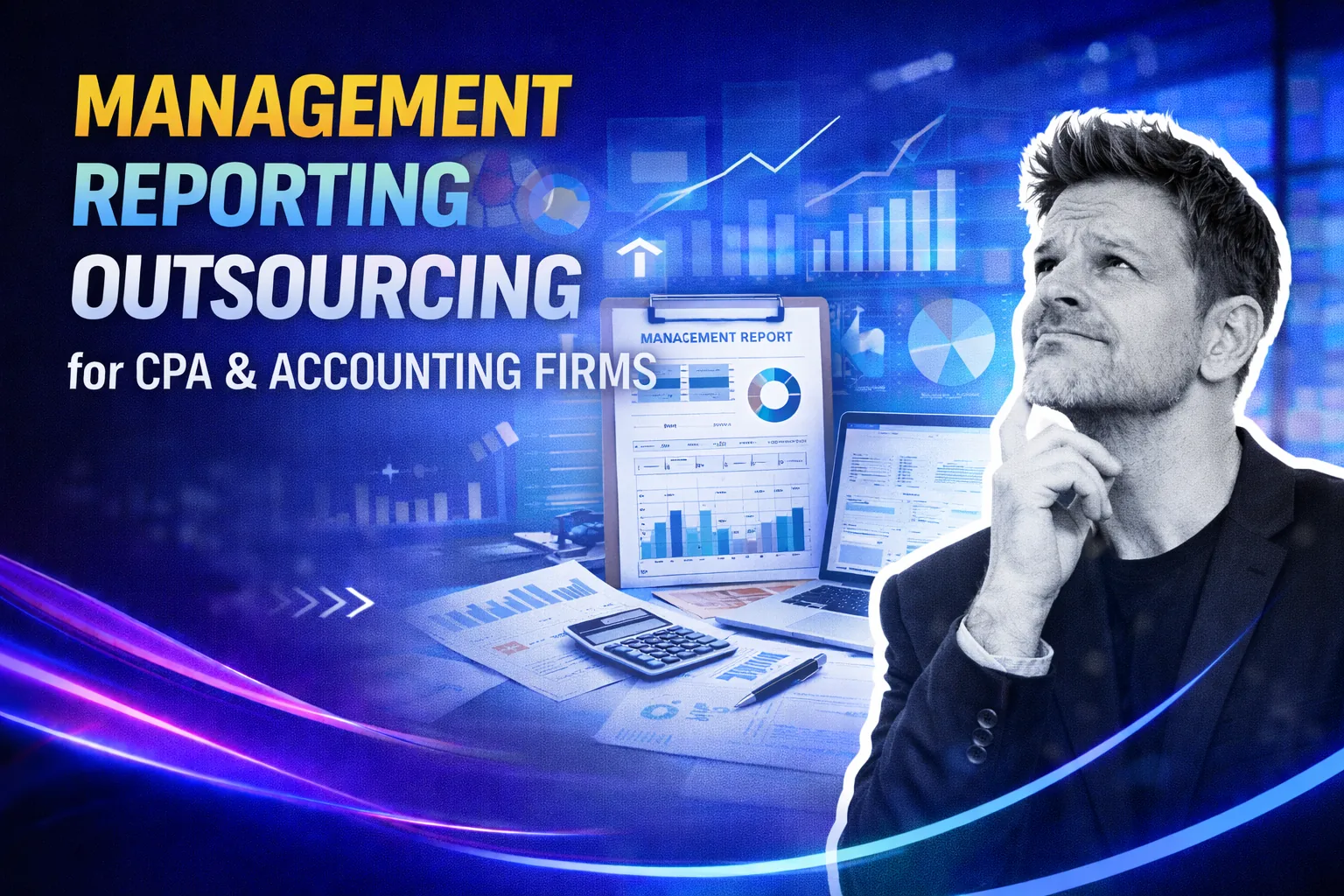
Management Reporting Outsourcing for CPA & Accounting Firms—Why It Works

Summary
How management reporting outsourcing lets CPA firms deliver timely, insight-driven KPI reports at scale — what's included, why it works, and how to choose a partner.
Compliance work tells a client what already happened. Management reporting tells them what to do next — and it's the work that turns a CPA firm from a once-a-year filer into a year-round advisor. The problem is capacity: building KPI dashboards, variance analysis, and cash-flow forecasts every month is time-intensive, and it's the first thing that gets dropped in busy season. Management reporting outsourcing solves that — a dedicated team produces the reporting package on your schedule, under your review, so you can deliver advisory value at scale without burning partner hours.
This guide covers what management reporting outsourcing includes, why it works, how to keep quality high, and how to choose a partner.
Management reporting vs. financial statements
They're not the same deliverable: - Financial statements (P&L, balance sheet, cash flow) report what happened, formatted for external stakeholders and compliance. - Management reports are built for internal decisions — KPIs, trends, variances against targets, and forward-looking data that help owners run the business.
The shift toward this kind of advisory work (Client Advisory Services) is one of the fastest-growing areas in the profession (AICPA) — and it's exactly the work that's hardest to staff for.
What management reporting outsourcing includes
A typical package covers: - KPI dashboards tuned to the client's industry and model - Departmental P&Ls and gross-margin analysis by product or service line - Budget-vs-actual variance reports, with a written narrative on material variances - Rolling cash-flow forecasts (including 13-week forecasts for clients who need them) - Working-capital analysis and an executive-summary narrative
The KPIs flex by client — gross margin %, operating EBITDA, the cash-conversion cycle (DPO/DSO/DIO), revenue per employee, churn, inventory turnover; for real-estate clients, NOI, cap rate, and occupancy.
Why outsourcing it works
1. Insight at scale. Every client gets a consistent, professional reporting package every period — not just the ones a partner has time for. 2. Capacity without hiring. A dedicated analyst absorbs the production work; firms commonly report savings of up to 70–75% versus building the capability in-house. 3. Speed. A standard package (P&L, balance-sheet summary, cash flow, 3–5 KPIs) can be live for the first reporting period in 10–15 business days; multi-entity or custom-dashboard builds take 3–4 weeks. 4. It's advisory glue. Good monthly reporting is what earns the higher-margin advisory conversations — and makes a firm hard to switch away from.
Where it can go wrong — and how to de-risk it
Garbage in, garbage out. A report is only as good as the books behind it. The fix is a pre-report data-quality check — reconciliations complete, all transactions posted, actuals tying to the source GL — before the report is built, plus a senior review before delivery. Confidentiality. Management reports hold proprietary business intelligence. They should move through secure portals (never unencrypted email), with NDAs and role-based access on the team. Format fit. The team should deliver in whatever your clients already use — Excel with dynamic charts, PDF summaries, Google Sheets, or BI tools like Power BI, Fathom, or Jirav — not force a platform change.
How to choose a partner
Look for: a real review layer (maker-checker), industry-matched KPI experience, secure delivery, format flexibility, and U.S.-firm fluency (GAAP, your workflow) rather than a generic BPO.
How Acculink CPA fits
Acculink is an India-based (Ahmedabad) team that works exclusively with U.S. CPA and accounting firms — 300+ professionals (CPAs, EAs, CAs, several Big-4 alumni) who build management-reporting packages inside your stack and BI tools, under a two-tier (maker-checker) review. Security is built in — ISO 27001:2013 certified, SOC 2 Type II–aligned, GDPR compliant, with IRS §7216, AICPA Code, and FTC Safeguards Rule compliance, NDAs for every team member, and a zero-breach record over 5+ years. Reporting is usually bundled into a monthly accounting retainer or available standalone, with no setup fees, no lock-in, and a 40-hour free trial. Book a free call to scope a package.
Frequently asked questions
What does management reporting outsourcing include?
Custom KPI dashboards, departmental P&Ls, gross-margin analysis, budget-vs-actual variance reports, rolling cash-flow forecasts, working-capital analysis, and an executive-summary narrative — tailored to each client's industry and model.
How is management reporting different from financial statements?
Financial statements report what happened for external/compliance purposes; management reports are built for internal decisions — KPIs, trends, variances vs. targets, and forward-looking data.
What KPIs can be tracked?
Whatever fits the client — gross margin %, operating EBITDA, the cash-conversion cycle (DPO/DSO/DIO), revenue per employee, CAC, churn, inventory turnover, ROE; for real estate, NOI, cap rate, and occupancy.
How quickly can a reporting package be set up?
A standard package can be delivered for the first period within 10–15 business days; complex multi-entity or custom-dashboard builds take 3–4 weeks.
Is our client data secure?
Yes — Acculink is ISO 27001:2013 certified, SOC 2 Type II–aligned, and GDPR compliant. Reports are shared via secure portals (never unencrypted email), and every team member signs an NDA with confidentiality provisions.
How is report accuracy ensured?
Through a pre-report data-quality check (reconciliations complete, transactions posted, actuals tying to the GL) and a senior review before delivery — discrepancies are corrected first, not reported.
Tags:
About the Author

Related Posts
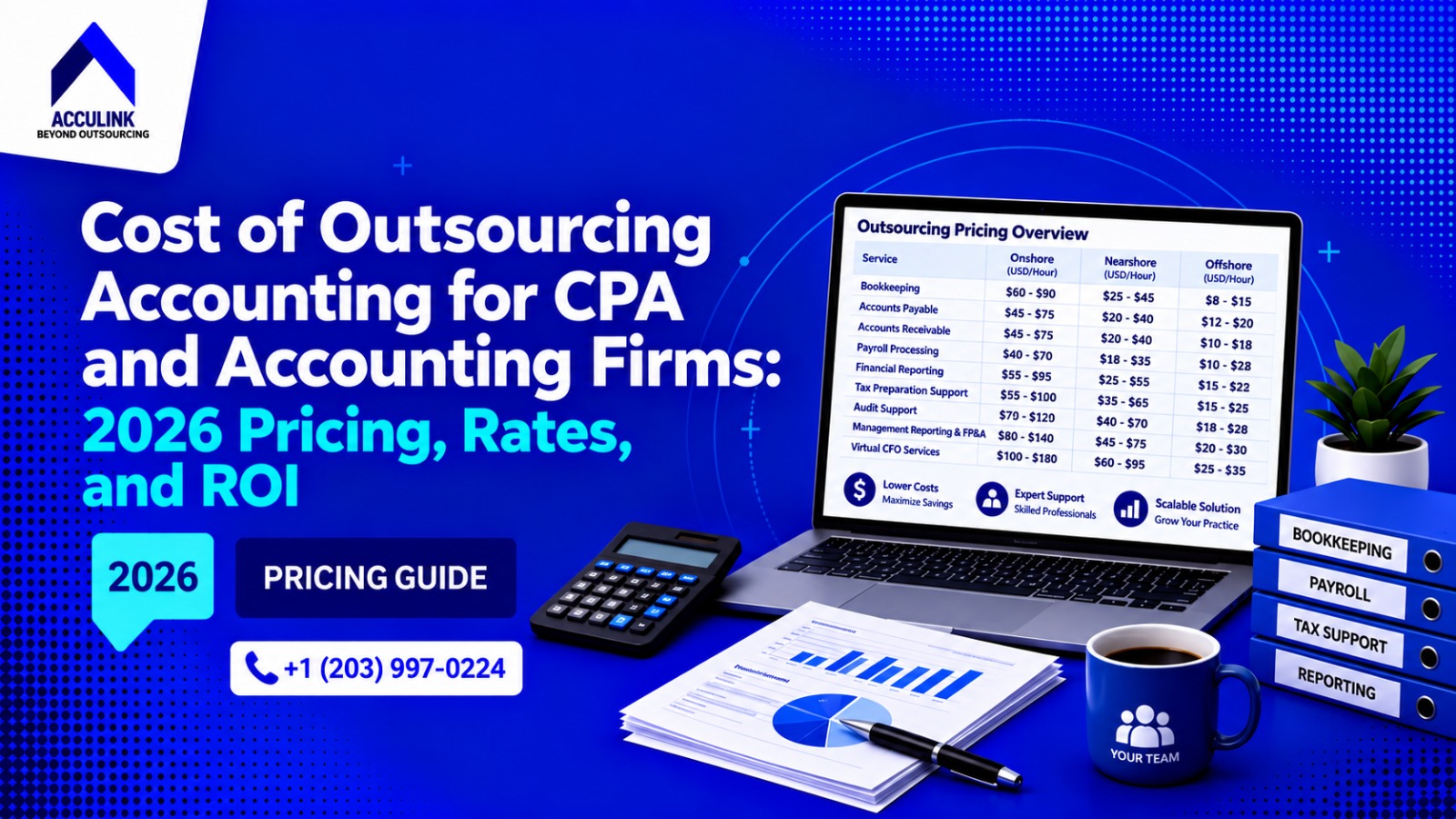
Cost of Outsourcing Accounting for CPA and Accounting Firms: 2026 Pricing, Rates, and ROI
The cost to outsource accounting typically ranges from $8 to $35 per hour, depending on the service, experienc…
15 Profitable Add-On Services CPA and Accounting Firms Can Offer Without Hiring In-House
CPA and accounting firms do not need to build every new service with another in-house hire. This guide compare…
Top 10 Payroll Outsourcing Companies for CPA and Accounting Firms (2026)
This guide compares ten payroll outsourcing companies for U.S. CPA and accounting firms. It separates processi…