Payroll Outsourcing Services for CPA & Accounting Firms – Your Guide to Payroll & Compliance


Summary
How payroll outsourcing keeps CPA firms' clients compliant — 941/940 and multi-state filings, W-2/1099, on a 24–48h cycle. What's covered and how to start safely.
Payroll is unforgiving. A missed Form 941 deposit, a botched multi-state withholding, or a late W-2 turns into penalties — and the blame lands on the firm. It's also relentless: every pay cycle, every month, every quarter. That combination is exactly why so many CPA firms hand payroll to a dedicated team. Payroll outsourcing keeps every run and every filing on schedule, white-label under your firm, so you can offer payroll as a service line without taking on the workload or the compliance risk.
This guide covers what's included, the compliance backbone, the controls that keep it safe, and how to start.
What payroll outsourcing covers
- Processing on any cycle — weekly, bi-weekly, semi-monthly, or monthly
- Payroll-tax calculation and filing — Form 941, 940, and state withholding
- W-2 and 1099 preparation, direct-deposit setup, and year-end reconciliation
- Payroll journal entries posted to the general ledger, broken out by department or cost center
Why CPA firms outsource payroll
1. Compliance risk moves off your desk. A trained team tracks the deposit deadlines and multi-state rules so a missed filing never becomes your problem. 2. Cost. Firms commonly report saving up to 70–75% versus a dedicated in-house payroll specialist. 3. A new service line without new hires. You can offer payroll to clients who ask for it, at scale, without staffing for it.
The compliance backbone
This is where outsourcing earns its keep: - A compliance calendar per client, tracking federal (941, 940) and state deposit deadlines, with taxes deposited electronically on the correct schedule based on the client's lookback period (IRS employment taxes). - Multi-state payroll handled properly — state withholding, unemployment insurance (SUTA), reciprocity agreements, and nexus flags raised to the partner-in-charge. - Mixed workforces managed end-to-end — tracking 1099-NEC thresholds alongside W-2 employees, with worker-classification guidance to reduce IRS risk. - Year-end W-2s and 1099s prepared, reconciled, and filed.
The controls that keep it safe
- You approve before anything runs. Standard cycle: client submits hours by Day 1, the team processes and sends a pre-approval summary by Day 2, your firm approves, and direct deposit goes out Day 3.
- A formal error-correction protocol — if an over/underpayment or tax error appears, the team calculates the correction, prepares the amended filing, and runs a root-cause review.
- Mid-year takeovers done cleanly — pulling year-to-date history from the prior processor and reconciling to filings already submitted, so W-2s are accurate at year-end.
Software
Payroll specialists work in Gusto, ADP, Paychex, QuickBooks Payroll, Rippling, Patriot, and Paylocity, or natively within QuickBooks Desktop/Xero where clients have built-in payroll.
How Acculink CPA fits
Acculink is an India-based (Ahmedabad) team working exclusively with U.S. CPA and accounting firms — 300+ professionals (CPAs, EAs, CAs, Big-4 alumni) trained in U.S. payroll compliance, running payroll under a two-tier review. Security is built in — ISO 27001:2013 certified, SOC 2 Type II–aligned, GDPR compliant, with IRS §7216, AICPA Code, and FTC Safeguards Rule compliance, NDAs, and a zero-breach record over 5+ years. No payroll data is stored on local devices; every run needs your approval first. No setup fees, no lock-in, 40-hour free trial. Book a free call.
Frequently asked questions
What payroll services can be outsourced?
Processing on any cycle, payroll-tax calculation and filing (941, 940, state withholding), W-2 and 1099 prep, direct deposit, year-end reconciliation, and payroll journal entries posted to the GL.
How is payroll-tax compliance handled?
Through a per-client compliance calendar tracking federal and state deadlines, electronic deposits on the correct schedule (based on the lookback period), and year-end W-2/1099 filing.
Can multi-state payroll be handled?
Yes — state withholding, SUTA, and reciprocity agreements, with nexus considerations flagged to the partner for any new state.
What's the processing timeline?
Payroll is processed within 24–48 hours of approved inputs: submit Day 1, pre-approval summary Day 2, direct deposit Day 3 — with rush processing available.
Can you take over payroll mid-year?
Yes — year-to-date history is pulled from the prior processor and reconciled to filings already submitted, establishing a clean starting point so W-2s are accurate at year-end.
Is payroll data secure?
Yes — ISO 27001:2013 certified, SOC 2 Type II–aligned, and GDPR compliant; specialists access data only through encrypted, firm-provided credentials, with no payroll data stored on local devices.
Tags:
About the Author

Related Posts
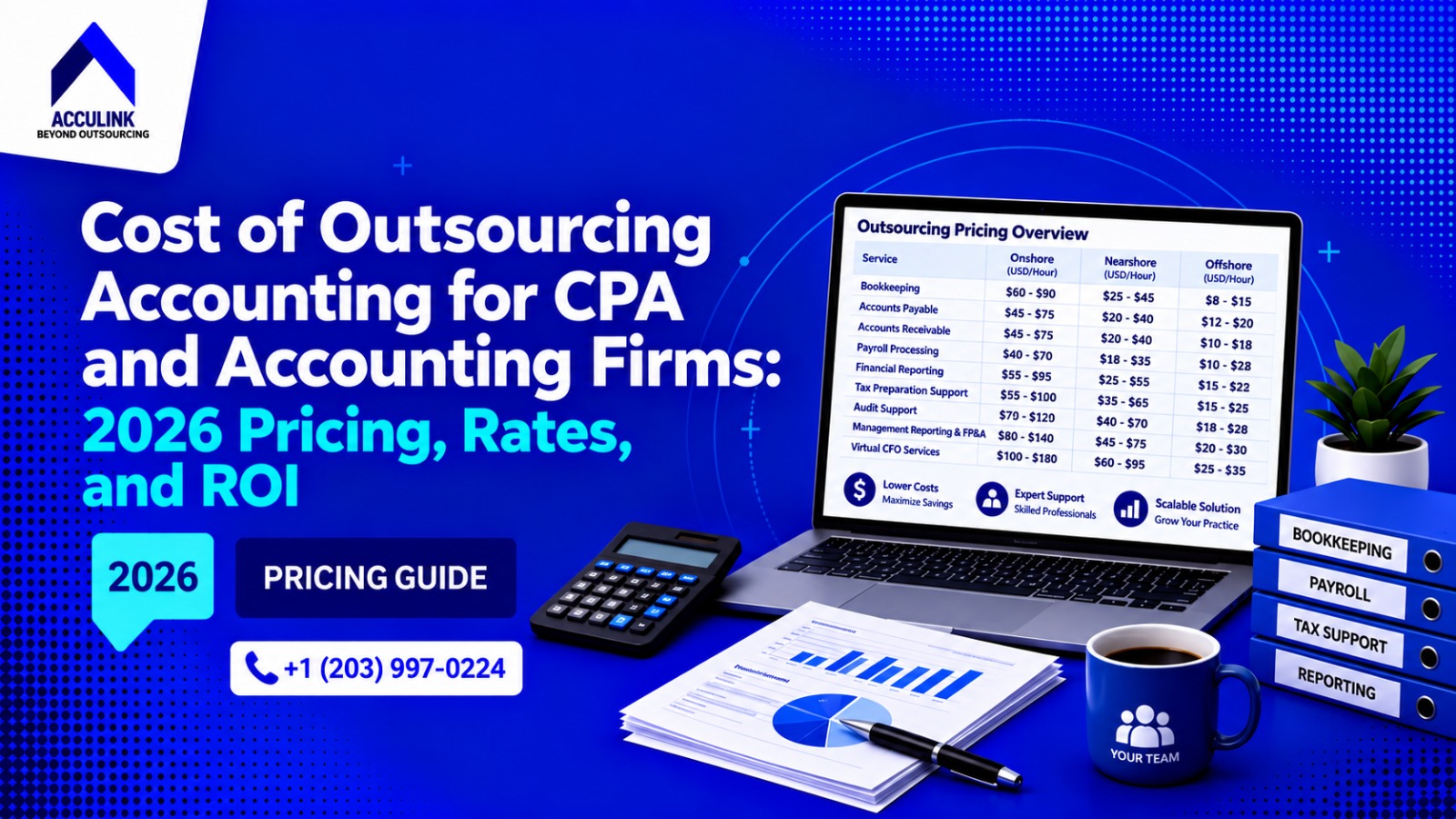
Cost of Outsourcing Accounting for CPA and Accounting Firms: 2026 Pricing, Rates, and ROI
The cost to outsource accounting typically ranges from $8 to $35 per hour, depending on the service, experienc…
15 Profitable Add-On Services CPA and Accounting Firms Can Offer Without Hiring In-House
CPA and accounting firms do not need to build every new service with another in-house hire. This guide compare…
Top 10 Payroll Outsourcing Companies for CPA and Accounting Firms (2026)
This guide compares ten payroll outsourcing companies for U.S. CPA and accounting firms. It separates processi…