Financial Statement Preparation Outsourcing for CPA & Accounting Firms

Summary
How outsourced financial statement preparation gives CPA firms GAAP-compliant, lender-ready statements faster — what's included, quality control, and how to choose.
Financial statement preparation sits in an unusual position in a CPA firm's service mix. The work is skilled — it requires understanding of GAAP, proper classification, note disclosures, and the client's accounting system — but it is also production work. It can take a trained accountant 4–12 hours per client per engagement, depending on the complexity of the books. For firms carrying 20–50 compilation or review clients, the aggregate production load is substantial.
Financial statement preparation outsourcing shifts that production work to offshore staff, while the CPA firm retains the judgment work: review, final adjustments, sign-off, and client delivery. Our financial statement preparation service is built specifically for this model. This guide explains how the arrangement works, what the offshore team does versus what stays in-house, and what to look for in a provider.
What Financial Statement Preparation Involves
Before examining the outsourcing model, it helps to be precise about what "financial statement preparation" actually means in a CPA firm context.
Under SSARS No. 21 (Compilation and Review Engagements), compilation is the most basic level of CPA service. The CPA assembles financial statements from management-provided information, without performing any audit or review procedures. The CPA may or may not apply GAAP, depending on the engagement terms. There is no assurance — the CPA simply presents the information in financial statement form.
Review engagements are a step up: the CPA applies analytical procedures and inquiry to provide limited assurance that the statements are free from material misstatement. More work, more judgment, more risk.
Financial statement preparation (a new category under SSARS 21) is even more minimal than compilation: the CPA prepares the statements but does not issue a report. The statements may include a note that no compilation, review, or audit was performed.
What outsources well is the preparation work — the production of properly formatted, accurately classified financial statements from the client's trial balance and supplemental data — before the CPA applies their professional judgment in review.
What the Offshore Team Handles
In a well-structured financial statement preparation outsourcing arrangement, the division of work looks like this:
Offshore team: - Receives the client's trial balance (exported from QuickBooks, Xero, or wherever the client books) - Prepares the Income Statement (or Statement of Activities for nonprofits) in the correct format - Prepares the Balance Sheet with proper classification (current/non-current, long-term debt schedule) - Prepares the Statement of Cash Flows using the indirect method (or direct, per firm preference) - Prepares notes to financial statements based on a template the CPA firm provides; flags areas requiring management input or CPA judgment - Prepares any required supplemental schedules (depreciation, related party transactions, debt maturity schedule) - Packages the complete draft in the firm's standard format (Excel or PDF)
CPA firm: - Reviews the draft for GAAP compliance and correct classification - Makes adjusting entries where required - Prepares or reviews disclosures that require professional judgment - Signs off on the final statements - Delivers to the client
The review step is where the CPA's professional responsibility lies. The offshore team handles the production of the draft; the CPA cannot outsource the review and sign-off.
The Time Economics
Why do CPA firms outsource this? The arithmetic is straightforward.
A senior accountant with CPA firm experience costs $70,000–$90,000/year in most US markets. Add benefits and overhead: $100,000–$120,000 fully loaded. At 1,800 billable hours per year, that's $55–67/hour of fully-loaded cost.
A financial statement preparation engagement takes 4–10 hours depending on complexity. At $55–67/hour cost, the production work alone costs $220–670 per engagement. If the firm bills the compilation at $500–1,200, the margin on the production is thin.
Offshore financial statement preparation runs $8–18/hour. The same 4–10 hour engagement costs $32–180 offshore. Margin improves dramatically — even after accounting for 1–2 hours of US partner review time.
For a firm doing 30–50 compilation or review engagements per year, the aggregate savings from outsourcing the preparation work runs $15,000–40,000 annually in reduced production cost. The savings on large engagement volumes are proportionally greater.
Software and Format Requirements
Financial statement preparation outsourcing works best when the firm has standardized templates. The offshore team fills in the template from the client's trial balance; the firm's brand, formatting, and disclosure language are pre-built.
The typical software stack:
- Accounting system access: QuickBooks, Xero, or read-only trial balance export
- Statement preparation: Microsoft Excel (the most common format for working papers and draft statements), CaseWare (used by mid-to-large CPA firms), or Engagement (Thomson Reuters)
- Final output: PDF for client delivery; Excel workpapers retained in the firm's file
The offshore team should be told explicitly which format the firm uses, so the draft arrives in a format that requires no reformatting before review.
Note Disclosures: The Gray Area
Notes to financial statements are partially mechanical (standard disclosures about accounting policies, basis of accounting, going concern language) and partially judgment-based (contingent liabilities, related party transactions, subsequent events).
In a financial statement preparation outsourcing arrangement, the offshore team typically: - Prepares the mechanical notes from a firm-provided template - Flags areas where management input is needed (e.g., "Client to confirm whether any contingent liabilities exist") - Does NOT draft judgment-based disclosures without CPA input
The CPA firm should maintain a disclosure checklist and template that the offshore team uses as a starting point. This ensures the draft is complete enough for efficient partner review without the offshore team making professional judgments they shouldn't be making.
Controlling Quality: The Review Protocol
The risk in financial statement outsourcing is that the partner reviews a draft that looks complete but has classification errors or missing disclosures that a less experienced reviewer doesn't catch.
Recommended quality controls:
Standardized input package Define exactly what the offshore team needs to receive for each engagement: trial balance (date, format, account structure), prior-year statements for comparison, any management representations about account balances.
Engagement-specific checklist Each engagement type (S-Corp, Partnership, LLC, C-Corp, Nonprofit) has a different set of required disclosures and statement formats. The offshore team works from a checklist appropriate to that entity type.
Tiered review Offshore team member prepares draft → offshore team lead reviews draft before sending → US partner reviews final version. The extra layer at the offshore team level reduces the number of basic errors that reach the partner's desk.
Turnaround agreement Set a clear turnaround time for draft delivery (e.g., 3 business days from receipt of complete trial balance package). Manage the workflow accordingly.
When Financial Statement Outsourcing Makes the Most Sense
Not every CPA firm is a good fit for financial statement preparation outsourcing. The arrangement works best when:
- The firm has a volume of compilation or review clients where production time is a bottleneck (roughly 15+ engagements/year)
- The firm has standardized statement formats and disclosure templates
- There is a US-based manager or partner who has time for the review step (2–4 hours per engagement) even if not for the full preparation
It works less well for:
- Highly customized engagements where each client has unique statement formats or industry-specific requirements the offshore team hasn't handled before
- Very small firms (5 or fewer compilations/year) where the setup cost outweighs the savings
- Firms without standardized templates, where each statement is built from scratch
The efficiency gains increase with volume. A firm doing 15 compilations/year will see modest savings. A firm doing 80 will see substantial savings and material time freed for advisory work.
Acculink provides financial statement preparation support for CPA firms through dedicated offshore teams. We prepare working-paper-ready drafts from client trial balances — income statements, balance sheets, cash flow statements, and note disclosure templates — ready for partner review. See our accounting outsourcing services for the full scope. Contact us.
Tags:
About the Author

Related Posts
Hire Offshore Accountants for CPA & Accounting Firms – Why Outsourced Accounting Works
How to hire an offshore accountant for your CPA firm — month-end close, GL, GAAP reporting, in your software —…
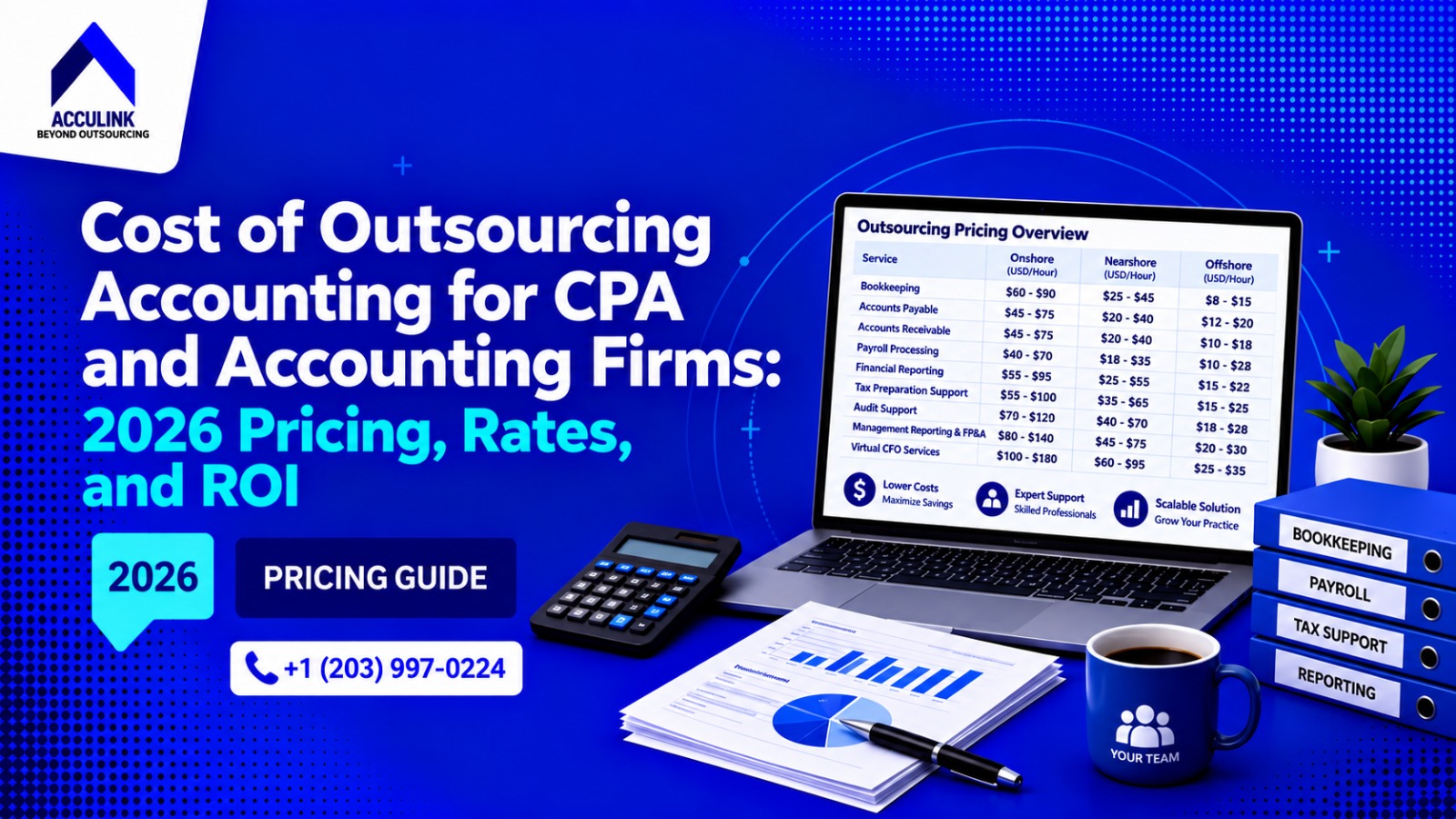
Cost of Outsourcing Accounting for CPA and Accounting Firms: 2026 Pricing, Rates, and ROI
The cost to outsource accounting typically ranges from $8 to $35 per hour, depending on the service, experienc…
15 Profitable Add-On Services CPA and Accounting Firms Can Offer Without Hiring In-House
CPA and accounting firms do not need to build every new service with another in-house hire. This guide compare…