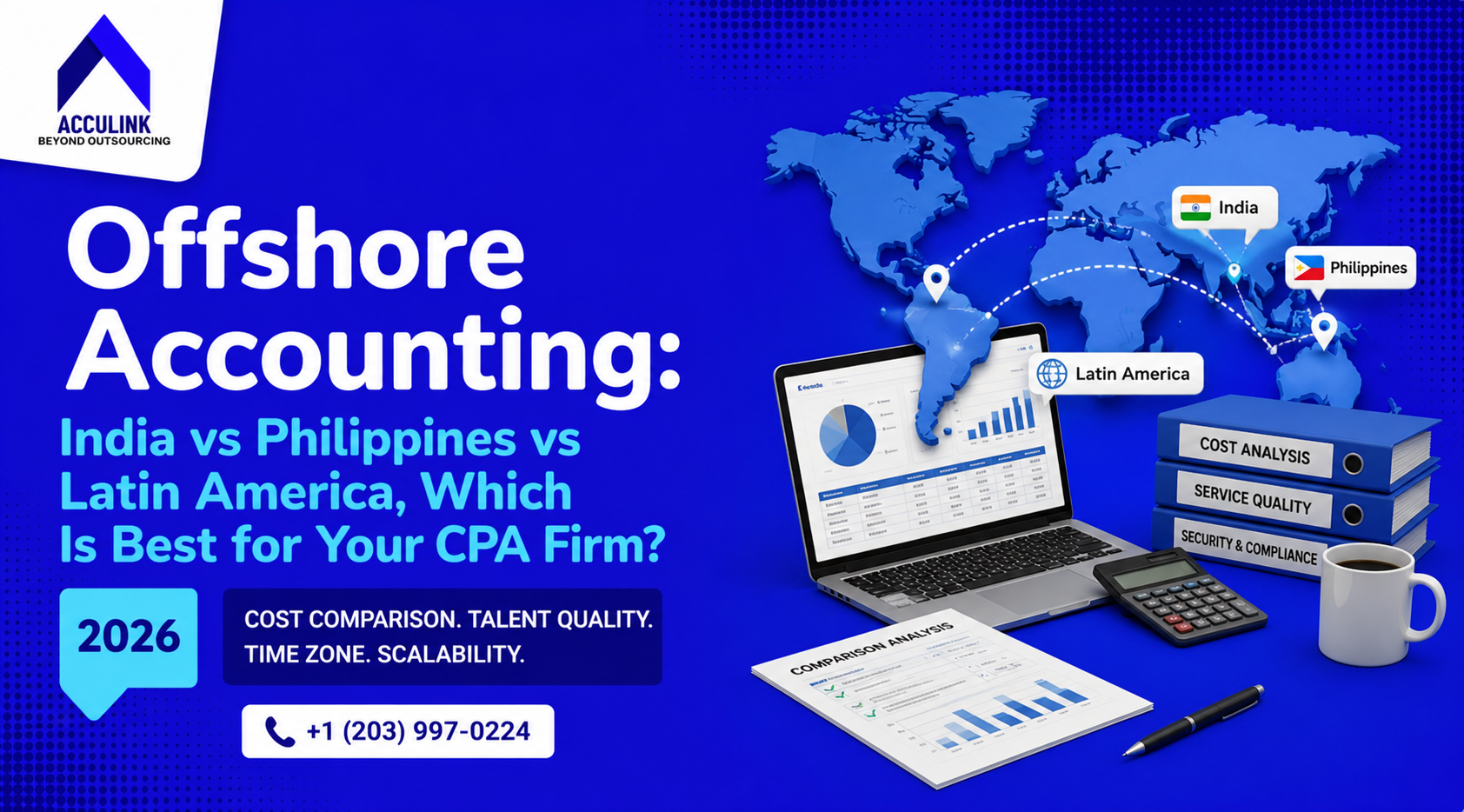
Offshore Accounting: India vs Philippines vs Latin America, Which Is Best for Your CPA Firm? (2026)

Summary
For most CPA firms, India is the strongest all-around choice for offshore accounting: the largest talent pool, the deepest US GAAP and tax expertise, and the lowest cost. The Philippines is the better fit when English and client-facing communication matter most, and Latin America is the nearshore option for real-time overlap or Spanish-speaking support. This guide compares all three on cost, talent, time zone, English, and compliance, and shows how to choose, vet a provider, and get started.
Quick answer: For most CPA firms, India is the strongest all-around choice for offshore accounting: the largest talent pool, the deepest U.S. GAAP and tax expertise, and the lowest cost, which is why it handles the bulk of offshore accounting work today. The Philippines is the better fit when English communication and client-facing roles matter most. Latin America is the nearshore option, worth its higher cost when you need real-time time-zone overlap or Spanish-speaking support. Many firms use India as their core team and add the Philippines or Latin America for specific roles.
This guide compares the three destinations in depth, on the factors that actually decide the outcome, and then gives you a practical way to choose, vet a provider, and get started.
Key takeaways
- India leads on cost, scale, and technical depth. With more than 407,000 chartered accountants and one of the world's largest accounting graduate pools, it is the default for firms that want the most capability for the lowest cost.
- The Philippines leads on English and communication. Strong, neutral-accent English and a large U.S.-facing workforce make it ideal for client-facing and communication-heavy roles.
- Latin America leads on time zone. Near real-time overlap with U.S. hours and bilingual English and Spanish talent make it the nearshore choice, at a higher price.
- The destination matters less than the provider. Quality, retention, and security depend far more on who you hire and how you run the engagement than on the country itself. A great provider in any of the three beats a weak one anywhere.
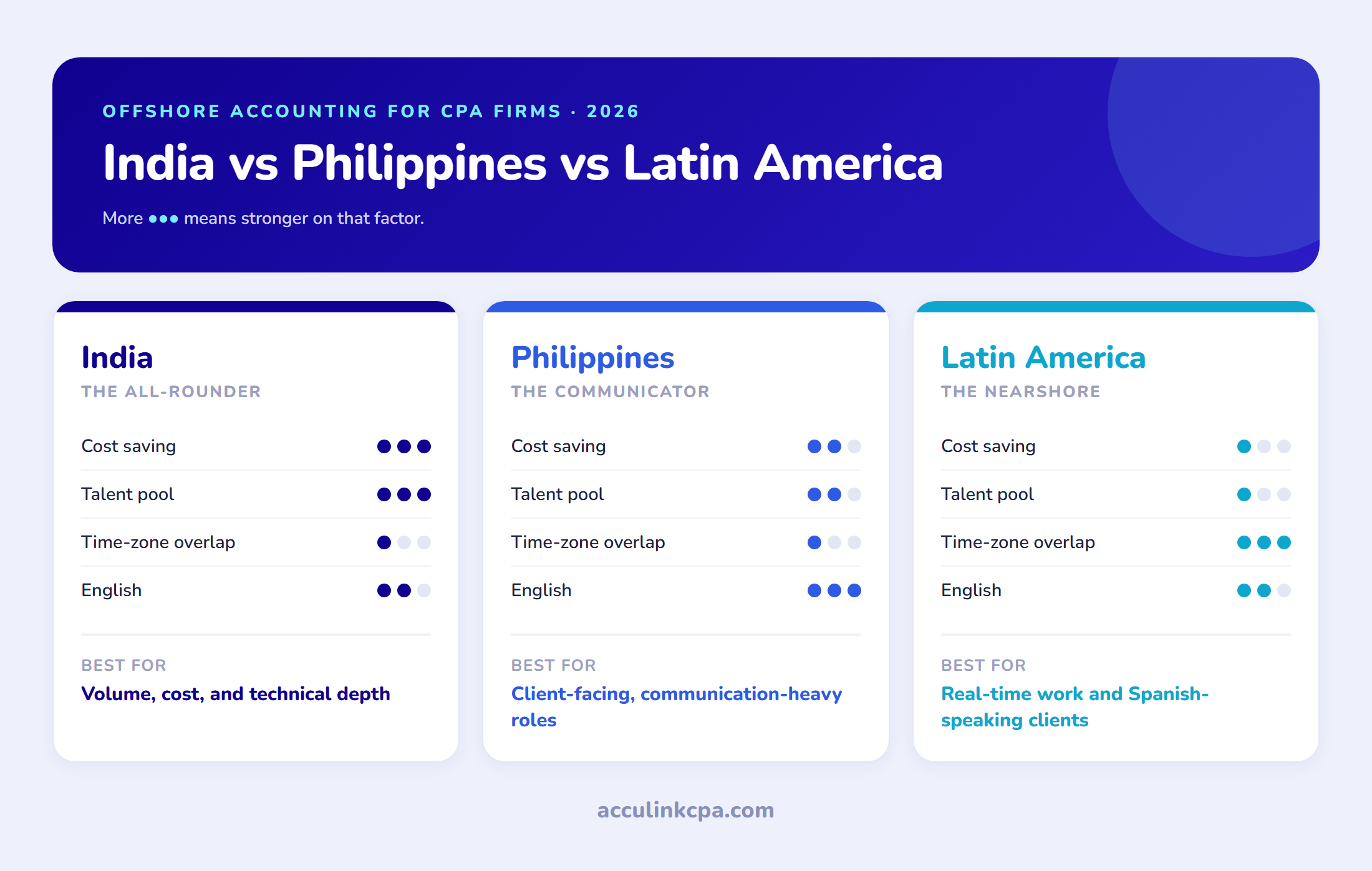
India vs Philippines vs Latin America at a glance
| Factor | India | Philippines | Latin America |
|---|---|---|---|
| Relative cost | Lowest | Low | Moderate (nearshore premium) |
| Talent pool | Largest (407,000+ CAs) | Large, English-fluent | Growing, bilingual EN/ES |
| U.S. GAAP / tax depth | Deepest | Strong | Emerging |
| Time-zone overlap (EST) | Low (overnight shift) | Very low | High (near real-time) |
| English | Strong, mainly written | Excellent, neutral accent | Good, bilingual EN/ES |
| Industry maturity | Most mature | Mature (BPO heritage) | Younger, fast-growing |
| Scalability | Easiest | Good | Moderate |
| Best for | Volume, cost, technical work | Communication, client-facing | Real-time work, Spanish clients |
India: the dominant destination
India is where most offshore accounting work goes, for good reason. It has the deepest bench of qualified accountants anywhere: the Institute of Chartered Accountants of India reported more than 407,000 members in its 2025 Student and Member Report, on top of millions of commerce graduates entering the workforce every year. That depth means you can staff almost any role, from bookkeeping to complex tax and audit support, and scale a team quickly when busy season demands it.
India's talent also comes in tiers, which is part of what makes it flexible. Chartered accountants (the rough equivalent of a U.S. CPA) handle review, complex tax, and technical work. Semi-qualified accountants and experienced graduates handle the high-volume production work: bookkeeping, data entry, accounts payable and receivable, and first-pass tax prep. A well-structured team blends these tiers, which is how the cost saving is achieved without sacrificing quality on the work that needs a senior eye.
The country's outsourcing industry is also the most mature of the three. Providers have spent two decades building U.S.-facing processes, so the better ones arrive with established security controls, U.S. GAAP and U.S. tax training, and familiarity with the software U.S. firms run, from QuickBooks and Xero to the major tax platforms.
Strengths: the largest and deepest talent pool, the lowest cost, the strongest U.S. GAAP and tax expertise, tiered staffing that balances cost and quality, and the easiest scaling for busy season.
Considerations: the smallest real-time overlap with U.S. hours, which you manage with a handoff routine, and a competitive labor market where staff retention depends on choosing a provider with a strong culture and low attrition.
Best for: firms that want the most capability and the biggest cost saving, and that have a steady volume of bookkeeping, tax prep, and accounting work to move offshore.
This mix of depth, cost, and technical strength is why Acculink operates from India. Acculink's India-based accountants run from $8 to $35 an hour depending on role and seniority, all trained on U.S. GAAP, U.S. tax, and the software your clients use.
Philippines: the communication specialist
The Philippines is the destination firms choose when communication is the priority. Its accountants are known for excellent, neutral-accent English and a strong service culture, shaped by decades of U.S.-facing business process work. That heritage is not incidental: the country built one of the world's largest business process outsourcing sectors serving U.S. companies, so working across a U.S. business day and communicating clearly with U.S. clients is deeply embedded.
The country's Professional Regulation Commission licenses several thousand new CPAs every year, giving it real depth, though not on India's scale. The trade-off is time zone and, for the most technical U.S. work, a slightly shallower bench than India. Cost sits a little above India but still well below onshore.
Where the Philippines shines is any role where a client or a U.S. team member is on the other end of the conversation: client coordination, accounts payable and receivable, payroll support, and general bookkeeping. It is a common choice for the client-facing layer of a team whose technical backbone sits in India.
Strengths: the best English and client communication of the three, a strong service culture, a deep BPO talent base, and solid accounting skills.
Considerations: minimal real-time U.S. overlap, higher cost than India, and a smaller pool for the most specialized technical work such as complex multi-state tax.
Best for: client-facing roles, communication-heavy tasks, and firms that put spoken English at the top of the list.
Latin America: the nearshore option
Latin America (commonly Mexico, Colombia, Argentina, and Costa Rica) is the nearshore choice. Its defining advantage is time zone: a team there works most or all of your business day, which makes live collaboration and same-day turnarounds easy. It also offers bilingual English and Spanish talent, which is genuinely valuable for firms with Spanish-speaking clients or those serving Hispanic-owned businesses.
The trade-offs are cost, which runs above both India and the Philippines, and a smaller, less established pool of U.S. GAAP and tax specialists, since the region's outsourcing industry for U.S. accounting is younger and still maturing. You will find excellent people, but the depth for highly technical U.S. work is not yet what India offers.
Strengths: near real-time overlap with U.S. hours, bilingual English and Spanish talent, cultural proximity, and easy live collaboration.
Considerations: the highest cost of the three, a shallower pool of deep U.S. technical expertise, and a younger provider ecosystem.
Best for: firms that need real-time collaboration, serve Spanish-speaking clients, or run advisory work that benefits from same-day back-and-forth.
India vs Philippines: the head-to-head
This is the comparison most firms actually run, so here is the direct verdict. Choose India when cost, technical depth, and the ability to scale matter most, which covers the bulk of production accounting work: bookkeeping, tax prep, accounts payable and receivable, and audit support. Choose the Philippines when the role is client-facing or communication-heavy and spoken English is the deciding factor.
In practice, these are not mutually exclusive. A common and effective setup is India as the technical backbone for volume work, with a few Philippines-based staff for the client-facing layer. Latin America enters the picture when a firm needs real-time overlap or Spanish-language support that neither Asian option provides. The point is not to crown one winner but to match each destination to the work it does best.
What each destination costs
Cost follows a consistent order even though exact rates vary widely by role, seniority, and provider: India is the lowest, the Philippines slightly higher, and Latin America the highest because of its nearshore premium. All three sit well below a comparable U.S. hire.
A few things drive the number, and understanding them matters more than any single quoted rate:
- Role and seniority. A bookkeeper or data-entry role costs a fraction of a senior tax reviewer or a controller. This is why fully staffed teams blend tiers.
- Fully loaded versus wage. A credible rate includes the provider's overhead, infrastructure, security, management, and margin, not just the salary. Compare like for like.
- Engagement model. A dedicated full-time seat prices differently from hourly or project work, and month-to-month differs from an annual commitment.
Be skeptical of any single quoted number, including the ones in competing articles, since published rates for the same country can differ by two or three times depending on what they include. The reliable takeaway is the ranking and the size of the gap versus onshore. For Acculink specifically, India-based accountants run from $8 to $35 an hour depending on the role. For a broader view of how offshore fits your model, our guide to offshore accounting for CPA firms goes deeper.
What we see in practice
Placing offshore accounting teams across these regions, a few patterns hold regardless of country, and they matter more than the country choice itself.
Quality is a function of the review layer, not the map. A well-run team in any of the three delivers clean work, and a poorly managed one does not. The firms that get burned almost always skipped the same things: a defined scope, a review step before work reaches the client, and a provider with real quality control. Blaming the country is usually a misdiagnosis.
Every engagement has a ramp. Expect the first 30 to 90 days to be slower as the team learns your workflows, software, and preferences, in any country. The firms that treat month one as training rather than full production get far better output for the two years that follow. The ones that expect day-one perfection are the ones that give up too early.
Retention is the quiet risk, and it is where India's competitive labor market shows up. The cost saving means nothing if your team turns over every six months, because you pay the ramp cost again each time. The provider's culture and retention record matter as much as its rates, so ask about attrition directly and favor providers who can show low turnover.
The time gap is a two-week problem, then an advantage. Firms that struggle with the offshore time difference are almost always the ones that never set up a handoff rhythm. The ones that thrive treat the overnight gap as a second shift: work goes out at the end of the U.S. day and comes back finished by morning.
Most firms do not pick one country and stop. They build a core team where the work and the economics point, usually India, and add specific roles elsewhere: the Philippines for client communication, Latin America for real-time or Spanish-language needs. The country is a tool, not a loyalty test.
How to choose
Match the destination to your firm, not the other way around.
By priority:
- Cost and scale first: India.
- English and client communication first: the Philippines.
- Time zone and real-time work first: Latin America.
By service line:
- Bookkeeping, tax prep, AP/AR, audit support: India, where volume and technical depth are cheapest.
- Client-facing coordination, phone and email support: the Philippines.
- Spanish-speaking client work, real-time advisory support: Latin America.
By firm size:
- Smaller firms are usually best served by a single country, most often India, for simplicity and the strongest economics.
- Larger firms with varied needs often run a multi-country model: an India backbone plus Philippines or Latin America roles for specific functions.
Two rules matter more than the grid. First, match the destination to the task, not the whole firm. Second, the provider decides the outcome, so weigh security, training, and retention above the headline hourly rate.
How to vet an offshore provider
Because the provider matters more than the country, run the same due diligence wherever you look. Before you sign, get clear answers to these:
- Data security. Do staff use individual logins with role-based access? How is access removed when someone rolls off? Can they show recognized certifications such as SOC 2 or ISO 27001?
- Compliance. For tax work, how do they handle IRC Section 7216 client consent for sharing return information?
- The review layer. Who reviews the work before it reaches you or your client? Junior staff without a review step is the most common failure point.
- Training. What are the team trained on specifically: U.S. GAAP, U.S. tax, multi-state issues, and the software your clients use?
- Retention. What is their staff turnover, and what do they do to keep people? High attrition quietly erodes the cost saving.
- Scaling. How quickly can they add and release capacity for busy season?
- References. Can they connect you with firms like yours that have used them for a year or more?
A provider who answers these clearly is worth more than any particular country. A provider who cannot is a risk anywhere, onshore included.
How to get started
Moving work offshore goes more smoothly when you treat it as a phased process rather than a switch you flip.
- Start with a defined scope. Pick one or two clear, repeatable workflows to move first, such as monthly bookkeeping for a set of clients or first-pass individual tax prep. Resist handing over judgment-heavy advisory on day one.
- Run a small pilot. Many providers offer a trial so you can judge quality on real work before committing. Use it to test communication and output, not just to fill hours.
- Document and hand off. Write down your workflows, naming conventions, and review expectations. The clearer the handoff, the shorter the ramp.
- Set a review cadence. Decide who reviews the offshore team's work and when, especially in the first 90 days while trust is being built.
- Scale on results. Once the first workflow is running cleanly, expand scope and headcount. This is also when many firms add a second country for a specific need.
When you are ready to move, our accounting outsourcing services cover the whole process, from first scope to a full team.
Security and compliance across all three
Client financial data can be protected or exposed in any of the three countries. What protects it is the provider's setup, not the location: individual logins rather than shared credentials, role-based access, clean offboarding when someone rolls off, and recognized certifications such as SOC 2 and ISO 27001. Offshore tax work adds one more requirement everywhere: compliance with IRC Section 7216, the IRS rule governing client consent for sharing tax return information. A serious provider in India, the Philippines, or Latin America will already meet all of this, and will be able to show you how.
Where Acculink fits
Acculink CPA operates from India, which is where the depth, cost, and technical strength line up for the widest range of accounting work. We place professionals trained on U.S. GAAP, U.S. tax, and the platforms your clients use, and we run engagements the way this guide recommends: defined scope, a review layer, named team members, and a single point of contact so your firm keeps clear oversight. When a firm needs the Philippines or a nearshore option for a specific role, we help structure that too, because the right answer is the one that fits your work.
If you want to see how it works before committing, our overview of offshore staffing companies for accounting firms is a good next read, or you can build a dedicated team with us directly. A 40-hour free trial lets you put a team on real work first.
Frequently asked questions
Is India or the Philippines better for offshore accounting?
India is better for cost, technical depth, and scaling volume work such as bookkeeping, tax prep, and audit support. The Philippines is better for client-facing and communication-heavy roles where spoken English is the priority. Many firms use India as their core team and add Philippines staff for the client-facing layer.
Which country is cheapest for offshore accounting?
India is the lowest cost of the three, the Philippines is slightly higher, and Latin America is the most expensive because of its nearshore time-zone premium. All three cost well below a comparable U.S. hire, though exact rates vary by role, seniority, and provider.
What is the time-zone difference with each country?
India has minimal real-time overlap with U.S. hours and works best as an overnight shift, with a handoff routine. The Philippines has very little overlap as well. Latin America has high overlap, working most or all of a U.S. business day, which is its main advantage.
Is Latin America better than India for accounting?
Only for specific needs. Latin America wins on time-zone overlap and Spanish-language support, so it suits real-time work and firms with Spanish-speaking clients. India wins on cost, talent depth, and technical expertise, which is why it handles the majority of offshore accounting work.
Which roles can I outsource to an offshore team?
Commonly bookkeeping, accounts payable and receivable, payroll, tax preparation, audit support, financial statement preparation, and controller-level review. Firms typically start with high-volume, repeatable work and move up to more judgment-heavy tasks as trust builds.
Can I hire from more than one country at once?
Yes, and many firms do. A common model is an India backbone for volume and technical work, plus Philippines staff for client communication or Latin America staff for real-time or Spanish-language needs. A single provider can often manage a multi-country team under one point of contact.
Is offshore accounting in these countries safe?
Yes, when the provider runs proper controls: individual logins, role-based access, clean offboarding, recognized certifications such as SOC 2 and ISO 27001, and Section 7216 compliance for tax work. Security depends on the provider's setup, not the country.
How do I keep quality high with an offshore team?
Define the scope, document your workflows, and above all keep a review layer between the offshore preparer and the client, especially in the first 90 days. Quality problems are almost always a process gap, not a country problem.
Which country has the most qualified accountants?
India, by a wide margin. It has more than 407,000 chartered accountants and millions of commerce graduates, the deepest pool of the three. The Philippines has a large, English-fluent accounting workforce, and Latin America's bilingual pool is smaller but growing.
How long before an offshore team is fully productive?
Plan for a 30 to 90 day ramp in any country while the team learns your workflows and software. Firms that treat the first month as training rather than full production see far better output over the following years.
The bottom line
India, the Philippines, and Latin America each win a different contest: India on cost, depth, and scale, the Philippines on English and communication, and Latin America on time zone and Spanish-language support. For most CPA firms, India is the right core, with the Philippines or Latin America added for specific roles. But the destination is only half the decision. The provider you choose, and the security, review, and retention they bring, will matter more than the country on the map. Vet the provider properly, start with a defined scope, and give the team a real ramp, and any of the three can work.
Tags:
About the Author

Related Posts

Top 10 Offshore Staffing Companies for Accounting Firms (2026)
Hiring an offshore team is one of the highest-leverage moves a short-staffed CPA firm can make, but the partne…
Top Outsourced Accounting Firms for CPA Practices (2026)
Choosing an outsourced accounting partner is a high-stakes call because the team touches your clients' data. T…

Top 15 Accounting Conferences for CPA Firms (2026-2027)
Not every accounting conference is worth the time or the travel budget. This guide breaks down the 15 best acc…