IRS 7216 Compliance for Offshore Tax Preparation: What Every CPA Firm Must Know


Summary
IRS Section 7216 is the federal regulation governing how tax return preparers can disclose and use taxpayer information — and it’s mandatory for any CPA firm outsourcing tax work to professionals located outside the United States.
Key Takeaways
-
IRS Section 7216 is the federal regulation governing how tax return preparers can disclose and use taxpayer information — and it’s mandatory for any CPA firm outsourcing tax work to professionals located outside the United States.
-
The core requirement is simple: obtain written taxpayer consent before disclosing tax return information to any person outside the U.S. Most firms handle this through a standard clause in their engagement letter.
-
Violations carry criminal penalties — fines up to $1,000 and/or up to one year imprisonment per violation under 26 U.S.C. §7216. This is not a civil penalty; it’s a criminal statute.
-
Compliant offshore providers build §7216 into their operating DNA: NDAs, encrypted access, disabled USB ports, monitored facilities, and documented compliance protocols.
-
Acculink CPA maintains active IRS §7216 compliance certification alongside ISO 27001, SOC 2, and GDPR — with zero security breaches in 5+ years.
In the 1992 legal thriller A Few Good Men, Jack Nicholson’s Colonel Jessup thunders from the witness stand, "You can’t handle the truth!" When it comes to IRS §7216 compliance and offshore tax preparation, many CPA firm partners feel the same way — the regulation sounds intimidating, the penalties sound severe, and the instinct is to avoid the topic altogether.
But here’s the truth you absolutely can handle: §7216 compliance is straightforward. The requirements are clearly defined by the IRS, the implementation is practical, and thousands of CPA firms across the country are outsourcing tax preparation offshore in full compliance with the law. The firms that understand §7216 use it as a competitive advantage — it builds client trust and demonstrates professionalism. The firms that don’t understand it either avoid outsourcing entirely (leaving capacity and cost savings on the table) or, worse, outsource without proper compliance (creating legal exposure).
This guide will walk you through everything you need to know about IRS 7216 compliance for offshore tax preparation — what the law says, what it requires, how to implement it in your firm, and how compliant providers like Acculink CPA handle it on their end. By the end, you’ll have a clear, actionable compliance roadmap.
What Is IRS Section 7216? The Plain-English Explanation
IRS Section 7216 (26 U.S.C. §7216) is a federal criminal statute that restricts tax return preparers from disclosing or using tax return information for any purpose other than preparing the return, unless they have the taxpayer’s explicit consent. The statute was enacted to protect taxpayer privacy and is enforced by the IRS.
In practical terms, here’s what it means for CPA firms:
-
If your firm prepares tax returns (you are a "tax return preparer" under the statute), you are bound by §7216.
-
If you share any tax return information with a person located outside the United States (including an offshore preparer in India, the Philippines, or anywhere else), you must first obtain the taxpayer’s written consent.
-
The consent must be knowing and voluntary — it can’t be buried in fine print that no one reads.
-
If you fail to obtain consent and still disclose taxpayer information offshore, you violate a federal criminal statute.
The regulation itself is defined in the Internal Revenue Code, and the Treasury Department has issued detailed implementing regulations under 26 CFR §301.7216. The IRS has also published Revenue Procedure 2013-14 and related guidance to clarify the consent requirements.
Who Does Section 7216 Apply To?
Section 7216 applies to anyone who is a "tax return preparer" as defined by the IRS — which is broader than you might think.
|
Who’s Covered |
Examples |
Notes |
|
The signing preparer |
The CPA who signs the return |
Obviously covered — they’re the preparer of record |
|
Any person who assists in the preparation |
An offshore tax preparer who enters data into CCH Axcess |
Covered — they handle tax return information |
|
Firms that employ preparers |
Your CPA firm as an entity |
The firm itself is subject to §7216, not just individual CPAs |
|
Outsourced service providers |
An offshore staffing company providing tax preparers |
The provider’s staff are handling taxpayer data — compliance is required |
The IRS provides the full definition and scope at the Section 7216 Information Centre. The key takeaway: if anyone in your workflow touches tax return information, §7216 applies to them.
The Consent Requirements: Exactly What You Need to Do
This is the section that matters most practically. The consent requirements under §7216 are specific but not burdensome. Here’s exactly what the IRS requires: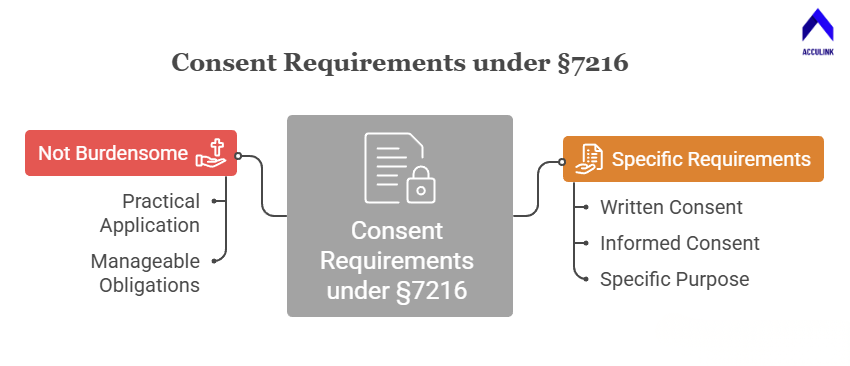
1. Written Consent Is Mandatory
Oral consent is not sufficient. The taxpayer must sign a written consent form or electronically consent through a compliant process. Most CPA firms include the consent language directly in their client engagement letter, which the taxpayer signs at the beginning of the engagement.
2. The Consent Must Be Specific About Offshore Disclosure
The consent form must clearly state that tax return information will be disclosed to a person located outside the United States. Vague language like "we may share your information with service providers" is not sufficient. The consent must specifically reference the offshore location.
3. The Consent Must Identify the Country
Under the IRS regulations, the consent should identify the country or countries where the tax return information will be sent. For most CPA firms outsourcing to India, this means a simple statement: "Your tax return information may be disclosed to tax preparation professionals located in India."
4. The Consent Must Be Knowing and Voluntary
The taxpayer must understand what they’re consenting to. The consent can’t be conditioned on the engagement — meaning you can’t refuse to prepare a return simply because the client declines offshore consent. (In practice, you can choose not to take the client, but you can’t force consent as a condition of service.)
5. The Consent Must Have a Time Limitation
The consent should specify a duration — typically one tax year or the duration of the engagement. Open-ended, unlimited consents may not meet IRS requirements.
Sample Consent Language
While your firm should have legal counsel review your specific language, a typical consent clause reads something like this:
"I/We hereby consent to the disclosure of my/our tax return information to tax preparation professionals located in India, who are engaged by [Firm Name] to assist in the preparation of my/our federal and state income tax returns for the tax year ending [Year]. This consent is limited to the tax return information necessary for return preparation and is valid for the duration of this engagement. I/We understand that this consent is voluntary and that declining to consent will not affect the quality of services provided, though [Firm Name] may need to discuss alternative arrangements."
For a deeper understanding of how engagement letters and compliance intersect with outsourcing, see Acculink’s blog on outsourcing compliance advisory for CPA firms.
Penalties for Non-Compliance: Why This Matters
Section 7216 is a criminal statute, not a civil one. The penalties are serious:
|
Violation |
Penalty |
Statute |
|
Knowingly or recklessly disclosing tax return information without consent |
Fine up to $1,000 and/or imprisonment up to 1 year |
26 U.S.C. §7216(a) |
|
Using tax return information for purposes other than return preparation without consent |
Fine up to $1,000 and/or imprisonment up to 1 year |
26 U.S.C. §7216(a) |
|
Civil damages (taxpayer lawsuit) |
Greater of $1,000 per violation or actual damages + costs |
26 U.S.C. §7431 |
Beyond the statutory penalties, a §7216 violation can trigger state bar or licensing board investigations, malpractice claims, and catastrophic reputational damage. The IRS Criminal Investigation Division enforces these provisions, and the consequences extend well beyond fines.
As the character Gordon Gekko warns in the 1987 film Wall Street, "The most valuable commodity I know of is information." For CPA firms, protecting that commodity isn’t just good practice — it’s the law.
How Compliant Offshore Providers Handle §7216
A reputable offshore provider doesn’t just acknowledge §7216 — they build compliance into every layer of their operations. Here’s what that looks like in practice:
Operational Controls
-
All staff sign NDAs with penalty clauses before accessing any client data.
-
Staff access client systems only through encrypted VPN connections with static IPs — no personal networks, no public Wi-Fi.
-
USB ports, external storage devices, and personal email are disabled on all workstations.
-
No printers or fax machines are available on premises — eliminating paper-based data leaks.
-
Unique login credentials are assigned to every staff member, with all activity logged and auditable.
Physical Security
-
24/7 CCTV monitoring with recorded footage retention.
-
Keycard-controlled access — only authorised staff can enter the work area.
-
Personal devices (phones, smartwatches, USB drives) are stored separately before entering the work floor.
-
Security guards are stationed at all entry points around the clock.
Training & Certification
-
All staff receive onboarding training on §7216 requirements, data handling protocols, and incident reporting.
-
Ongoing training includes phishing awareness, application security, and compliance refreshers.
-
The provider maintains active §7216 compliance documentation that can be reviewed by clients or auditors.
Acculink CPA implements every one of these controls at its secure office facilities in India. The complete security and compliance framework is documented on the IT & Data Security page and the certifications and alliances page. For firms that want to see the setup firsthand, virtual and in-person facility tours are available.
Your Firm’s Step-by-Step §7216 Compliance Roadmap
Here’s the exact process to follow to ensure your firm is fully compliant when outsourcing tax preparation offshore:
Step 1: Update Your Engagement Letter
Add §7216 consent language to your standard client engagement letter. Include: the specific disclosure statement (tax return information will be sent to a person in India), the purpose (tax return preparation), the time limitation (this tax year), and the voluntary nature of consent. Have your legal counsel review the language.
Step 2: Obtain Signed Consent Before Disclosing
Before any client data is sent to your offshore team, ensure the signed engagement letter (with consent) is on file. No exceptions. Build this into your client onboarding checklist so it’s never missed.
Step 3: Verify Your Provider’s Compliance
Ask your offshore provider for documentation of their §7216 compliance. Verify their security certifications (ISO 27001, SOC 2). Review their NDA templates, access controls, and physical security setup. If they can’t produce this documentation, they’re not compliant — find a provider who is. Acculink’s compliance advisory blog walks through the verification process in detail.
Step 4: Limit Access Using Least-Privilege Principles
Give your offshore team access only to the specific client files they need to work on. Don’t grant blanket access to your entire system. Use role-based permissions in your tax software to control what each user can see and do.
Step 5: Document Everything
Maintain records of: signed consent forms for each client, your provider’s compliance certificates, staff NDAs (request copies from your provider), access logs, and any incident reports. If the IRS ever questions your compliance, this documentation is your defence.
Step 6: Conduct Annual Reviews
Don’t "set and forget." Review your consent language annually, verify your provider’s certifications are current, and audit your access controls. Compliance is ongoing, not a one-time event.
Common Misconceptions About §7216
Misconception: "§7216 means I can’t outsource tax work offshore."
False. §7216 doesn’t prohibit offshore tax preparation. It regulates it. With proper consent and a compliant provider, outsourcing tax prep offshore is fully legal, and thousands of firms do it every tax season.
Misconception: "The consent process is too complicated for my clients."
False. The consent is typically one paragraph added to your engagement letter. Clients sign it along with everything else. In practice, very few clients object — they care about accuracy and timeliness, not where the preparation happens.
Misconception: "Only large firms need to worry about §7216."
False. §7216 applies to every tax return preparer, regardless of firm size. A solo practitioner who sends one return to an offshore preparer without consent is in the same violation as a 200-person firm.
Misconception: "My provider handles all the compliance, so I don’t need to do anything."
Partially false. Your provider handles their side of compliance (security, NDAs, access controls). But the obligation to obtain taxpayer consent rests with your firm — the tax return preparer of record. Both parties have responsibilities.
For more on how to structure your offshore engagement compliantly, visit Acculink’s outsourced tax preparation services page and the outsourced tax review services page, which detail how compliant workflows are structured from end to end.
Frequently Asked Questions
What exactly is "tax return information" under §7216?
Tax return information includes any information furnished to a tax return preparer in connection with the preparation of a return — the taxpayer’s name, SSN, income figures, deductions, and any supporting documents. It also includes information derived from the return, such as calculations and worksheets.
Can I include §7216 consent in my electronic engagement letter?
Yes. The IRS permits electronic consent as long as it meets the requirements: the taxpayer must affirmatively consent (not just fail to opt out), the consent language must be clear and specific, and a record of the consent must be retained.
What if a client refuses to consent to offshore disclosure?
You have two options: prepare the return entirely with domestic staff, or decline the engagement. You cannot outsource that client’s return offshore without consent. In practice, refusals are rare — most clients are comfortable once they understand the security measures in place.
Does §7216 apply to bookkeeping or audit work?
Section 7216 specifically applies to tax return preparers and tax return information. Bookkeeping, audit, and general accounting work are not directly covered by §7216. However, if a bookkeeper handles data that will be used in tax return preparation, the line can blur. Firms should consult legal counsel for borderline situations.
How often should I renew client consent?
Best practice is to include consent in each year’s engagement letter, ensuring it’s renewed annually. This keeps consent current and aligned with the specific tax year being prepared.
Where can I find the full text of Section 7216?
The full statute is available at 26 U.S.C. §7216. The IRS maintains a dedicated Section 7216 Information Centre with guidance documents, FAQs, and related revenue procedures. The implementing regulations are at 26 CFR §301.7216.
References
IRS Section 7216 Information Centre — https://www.irs.gov/tax-professionals/section-7216-information-center
IRS Criminal Investigation Division — https://www.irs.gov/compliance/criminal-investigation
American Institute of CPAs (AICPA) — https://www.aicpa.org/
About Acculink CPA
Acculink CPA is a premier offshore staffing and outsourcing company purpose-built for CPA firms, accounting firms, and tax firms in the United States, Canada, and the UAE. With a team of 300+ qualified professionals — including CPAs, Chartered Accountants, Enrolled Agents, and Big 4-trained staff — Acculink provides dedicated offshore accountants, bookkeepers, tax preparers, auditors, virtual CFOs, and virtual assistants at $8–$35/hr, delivering up to 75% cost savings compared to domestic hiring. The company is ISO 27001 certified, SOC 2 Type II aligned, IRS §7216 compliant, and GDPR compliant, with zero security breaches in 5+ years of operations. Acculink offers a 40-hour free trial with no setup fees, no recruitment charges, and no long-term contracts. Over 80 CPA firms across the United States trust Acculink to deliver quality, security, and scalability.
Website: Acculink CPA | Schedule a Call: book a 45-minute call | Email: Info@acculinkcpa.com | Phone: +1 (203) 997-0224
Tags:
About the Author

Related Posts

Hire Offshore Tax Preparers for CPA & Accounting Firms – Why Outsourced Tax Preparation Works Best.
How to hire an offshore tax preparer for your CPA firm — 1040/1065/1120/1120-S, CCH/UltraTax/Drake, IRS §7216-…
Sales Tax Compliance Outsourcing for CPA & Accounting Firms – Why It Works
How outsourcing sales tax compliance handles nexus, multi-state filings, and exemption certificates for CPA fi…