Tax Preparation Outsourcing for CPA Firms: How It Works, What It Costs, and Where to Start (2026)


Summary
Tax preparation outsourcing lets a CPA firm hand routine return preparation to an external team, usually offshore, while the firm keeps the review, the signature, and the client. The outsourced preparer works inside your own tax software and returns a finished draft; your credentialed preparer reviews, signs, and carries the responsibility. This guide covers what to send out, what must stay in-house, the IRS rules that land on you, what it costs, and where to start.
Ask a firm owner about last busy season and you usually get a specific story: the week the returns came in faster than anyone could clear them, and a partner ended up doing 1040 data entry at 9pm instead of reviewing it. Tax preparation outsourcing is how firms keep the next season from producing that story, by moving the mechanical work to an external team while the firm keeps the review, the signature, and the client.
The real question is rarely whether to outsource. It is what to send out, what must never leave your firm, and whether you can hand a client's return to a team in another country without breaching a federal rule you may not know applies to you. This guide works through all three, plus what it costs, and the timing that quietly decides whether the whole thing works: firms that do this well set it up in the off-season, not in the middle of the crunch.
Key takeaways
- Standardized volume is where the biggest win is. A book of routine 1040s and clean business returns is what saves the most, so the first move is to separate the returns that run to a pattern from the handful that genuinely need a partner's judgment.
- Whether it saves you time comes down to one question: does the provider review its own work before it reaches you? A real maker-checker layer is the difference between a draft you review and a draft you have to fix, so ask about it before you ask about price.
- On cost, offshore preparation runs roughly $8 to $35 an hour, all in, about 60 to 70 percent under an in-house hire. What sits outside that rate matters more than the rate itself.
- The compliance duty is yours, not the provider's. Section 7216 requires written client consent before a return leaves your office, and IRS Publication 4557 requires you to vet the provider, contract for safeguards, and oversee them.
- Start in the off-season, and give it a full season before you judge it. The first returns are slow while the team learns your firm, so trial the arrangement on extension work, where a mistake costs an afternoon instead of a client.
What Is Tax Preparation Outsourcing?
Tax preparation outsourcing is an arrangement in which a CPA firm contracts an external team, typically offshore, to prepare client tax returns, while the firm keeps review, signature authority, and the client relationship. The outsourced preparer works inside the firm's own tax software, follows the firm's conventions, and returns a completed draft. The firm's credentialed preparer reviews it, signs it, and carries the professional responsibility.
The distinction that matters is where the team sits, not what the service gets called. Domestic outsourcing keeps the work in the US and prices close to US rates. Nearshore moves it to Latin America for a modest saving and near-total time-zone overlap. Offshore tax preparation, usually India, is where the real cost difference is, and where the overnight turnaround comes from. Vendors use tax outsourcing, outsourced tax preparation, and outsourcing tax preparation interchangeably across all three. So ask where the people actually are.
What it is not is a staffing agency placing a contractor in your office, and it is not handing your client to another firm. The client stays yours. They deal with you, they get the return from you, and in most arrangements they never interact with the preparation team at all.
What Can You Outsource, and What Must Stay In-House?
This is the question that decides whether outsourcing works for a firm, and the one most providers answer vaguely.
Sensible to outsource:
- Standardized 1040s. Wage income, ordinary schedules, a clean prior year. The bulk of most firms' volume, and the least interesting work in the building.
- Business returns with organized books. 1120, 1120S, and 1065 where the trial balance ties, and trust returns once the fiduciary accounting is settled.
- Data entry and document handling. Organizer intake, scanning and indexing, carryforward setup, prior-year rollover.
- Reconciliation and tie-out, including chasing the difference and documenting what moved.
- Diagnostics and first-pass cleanup, so mechanical errors are cleared before a reviewer opens the file.
- Extension processing, which nobody enjoys and which quietly eats a lot of hours.
Should stay in your firm:
- Every judgment call. Reasonable compensation, basis questions, nexus, an aggressive position a client wants to take.
- The review and the signature. Your credentialed preparer signs and carries the responsibility. That does not change because the preparation happened elsewhere.
- The client conversation. Anything involving explaining, advising, or managing an expectation.
- Anything genuinely novel. A first-time transaction, a messy multi-state question, a return that looks nothing like last year's.
The honest read: the more standardized the return, the better it outsources. A firm whose 1040 book is 400 near-identical returns will get far more out of this than a firm with 40 bespoke high-net-worth clients. That is not a knock on the second firm. The leverage is just smaller.
If what you want is a second set of eyes rather than preparation help, that is a different service. Tax review sits on the other side of the workflow, and some firms buy only that.
How Does Outsourcing Tax Preparation Work?
The mechanics are more ordinary than most partners expect:
- The client sends documents to you. Your portal, your organizer, your branding. Nothing changes on the client's side.
- The work is assigned to a named preparer, with your firm's instructions for that client attached.
- The preparer works in your software. They log into your own tax application, whether that is CCH Axcess, UltraTax, Lacerte, or Drake, over a secure connection, using your templates and your prior-year file. Ask a provider which platforms their people are already fluent in before you onboard, not after.
- An internal reviewer checks it first. A good provider runs a two-tier maker-checker process, so a second person catches mechanical errors before the file reaches you. This is the step that decides whether outsourcing saves you time or costs you time.
- Your reviewer opens a finished draft. Diagnostics cleared, tie-outs documented, open items flagged as questions rather than left blank.
- You review, sign, and deliver.
The part that trips firms up is step 3. If your firm's conventions live in a partner's head rather than in a document, the first few returns will be slow and disappointing. The efficiency shows up in returns twenty through four hundred, not in returns one through five.
Is Outsourcing Tax Preparation Legal? What the IRS Requires of You
Yes, and firms of every size do it. But two federal duties land on your firm rather than on your provider, and this is where firms get caught.
First, consent. Under IRS Section 7216, a tax return preparer is generally prohibited from disclosing or using a client's tax return information without that client's consent. Sending return information to an outside preparer is a disclosure. So before any document leaves your firm, you need the client's written consent, obtained properly and kept on file. It has to be genuine and specific, not boilerplate buried in an engagement letter.
Second, oversight of the provider itself. IRS Publication 4557, Safeguarding Taxpayer Data, requires tax return preparers to comply with the FTC Safeguards Rule, which means creating and enacting a written information security plan. That plan has to reach your provider. The rule tells firms to select service providers capable of maintaining appropriate safeguards, to make sure the contract requires those safeguards, and to oversee how the provider handles client information.
That last point changes the conversation. Asking a provider for their SOC 2 Type II report is not diligence theatre. It is you discharging a duty you already owe. The same goes for asking where the data physically sits, who can access it, whether anything can be copied to a personal device, and what your contract actually says about safeguards. A serious provider answers plainly and shows you the certification. A defensive one tells you not to worry.
Acculink is SOC 2 Type II certified and ISO 27001 certified, works over encrypted connections with role-based access and full activity logging, and has recorded zero data breaches in more than five years. The full setup is on our data security page.
How Much Does Tax Preparation Outsourcing Cost?
Pricing comes in three shapes: per return, hourly, or a dedicated preparer you retain for the season or the year.
Per-return pricing looks simplest and is the easiest to get wrong, because a "1040" covers everything from a single W-2 to a return with four rentals and a K-1 from a partnership nobody can reach. Hourly is more honest for mixed work. A dedicated preparer makes sense once your volume is steady enough to keep one person busy, and it is where the economics get genuinely good, because you stop paying a premium per file.
An offshore tax preparer runs roughly $8 to $35 an hour all-inclusive depending on seniority, which lands around 60 to 70 percent below an equivalent in-house hire once you count salary, benefits, software seats, and the overhead of managing someone.
| In-house seasonal hire | Domestic outsourcing firm | Offshore dedicated team | |
|---|---|---|---|
| Cost | Salary, benefits, overhead | US hourly rates | $8 to $35/hr, all-inclusive |
| Capacity | Fixed at one person | Per return, per engagement | Scales with your volume |
| Lead time | Recruit, hire, train | Per engagement | About two weeks to onboard |
| Coverage | One person, one vacation | Varies by firm | A team, with built-in review |
| Software | Yours | Often theirs | Yours |
The number that matters is the all-in rate. Ask directly whether security, software access, the internal review layer, and project management sit inside the rate or get billed on top. A cheap headline rate with four line items underneath is not cheap.
Should You Hire a Preparer or Outsource?
By September most firms are really choosing between two options: post a job, or add an offshore team.
Hiring gives you fixed capacity. One person, one salary, available all year whether or not you need them in June. If you find the right senior preparer, that is a genuine asset. The problem is the finding: experienced tax staff are hard to recruit, the search runs for months, and you are competing with every other firm running the same search at the same time of year.
Outsourcing gives you capacity that flexes. You scale up for six weeks and back down in May without carrying a salary through the summer, and onboarding runs about two weeks rather than a months-long search. The trade is that you manage a relationship rather than an employee, and you have to write your conventions down.
Most firms that do this well end up doing both: a small permanent core in-house, and offshore capacity that expands for the season. The core holds the client relationships and the judgment; the offshore team absorbs the volume. So the practical question is rarely "outsource or hire" but "what is the smallest permanent team I need, and where does everything else go?"
When you are ready to compare providers, our rundown of the top offshore staffing companies for accounting firms lays out who does what. If you need capacity across more than tax, you can build a dedicated offshore team spanning preparation, bookkeeping, and review, or add a tax reviewer alone if review is your bottleneck rather than preparation.
Why Do US Firms Outsource Tax Preparation to India?
Most offshore tax preparation for US firms happens in India, and the reason is not only the rate.
US tax is a career track there rather than a sideline. The preparers working your returns are Chartered Accountants, CPAs, or Enrolled Agents who have worked US returns and nothing else, which is a different proposition from a generalist who also does bookkeeping for three other countries.
The time zone is the part firms end up liking most, and it surprises them. Work goes out at the end of your day and comes back before your morning. During busy season that overnight cycle is worth more than the rate: you add a second shift without asking anyone to work nights. You keep three to four hours of daily overlap for real-time questions.
The catch worth naming: outsourcing tax return preparation to India works when the provider serves US firms specifically. A general offshore BPO that also does customer support and medical billing will not know what a Schedule K-1 basis limitation is. Ask what percentage of their book is US tax work. If the answer is a shrug, keep looking.
Why CPA Firms Choose Acculink
Acculink works exclusively with US CPA, accounting, and tax firms. Not general business process outsourcing. US firms are the whole book, which is why our preparers know what your review notes mean, and why firms choose us to carry busy-season volume they cannot hire for.
- A team that already knows US tax: 300+ professionals including CPAs, EAs, and CAs, some Big-4 alumni, supporting 80+ US CPA firms.
- Two-tier review before it reaches you: a maker-checker process, so your partners review a draft rather than fix one.
- Secure by design: SOC 2 Type II and ISO 27001 certified, IRS Section 7216 compliant, encrypted access with role-based permissions, zero data breaches in five-plus years.
- In your software, on your clock: we work in your tax application, with three to four hours of daily US overlap.
- Priced all-in: $8 to $35 an hour depending on the role, around 60 to 70 percent below an in-house hire.
- A low-risk start: a 40-hour free trial, no setup fee, no long lock-in. Try it on extensions before you commit to a season.
Work runs under your brand as standard, not as a special request. You can hire an offshore tax preparer for a defined scope, or see the full outsourced tax preparation services scope. As the relationship settles and the compliance load leaves your desk, many firms put their partners back onto higher-value tax planning and advisory work.
Frequently Asked Questions
What is tax preparation outsourcing?
Tax preparation outsourcing is when a CPA firm sends return preparation to an external team, usually offshore, while keeping review, sign-off, and the client relationship in-house. The outsourced preparer handles data entry, reconciliation, and a first-pass draft; your firm makes the judgment calls and signs the return.
How does outsourcing tax preparation work?
Your client sends documents to you as usual. The return is assigned to a named preparer who works in your tax software over a secure connection, using your prior-year file and firm conventions. An internal reviewer checks it, then your firm reviews, signs, and delivers.
Is outsourcing tax preparation to India legal?
Yes, and it is common practice among US firms of every size. The rule that governs it is IRS Section 7216, which requires you to obtain the client's written consent before disclosing their tax return information to an outside preparer. The consent obligation sits with your firm, not the provider.
Do I need client consent to outsource tax preparation?
Yes. Under IRS Section 7216, sending a client's return information to an outside preparer is a disclosure, and disclosure requires consent. It must be obtained before the work begins and kept on file. Boilerplate buried in an engagement letter is not sufficient.
How much does it cost to outsource tax preparation?
Offshore tax preparation typically runs $8 to $35 an hour all-inclusive, roughly 60 to 70 percent below an equivalent in-house hire once salary, benefits, software, and management overhead are counted. Ask whether security, software, and review sit inside the rate or get billed separately.
Should I hire a seasonal tax preparer or outsource?
Hiring gives you fixed capacity and a person who is yours, but the search takes months and experienced preparers are scarce in the autumn. Outsourcing scales up for six weeks and back down afterwards, onboarding in about two weeks. Many firms do both: a small permanent core, with offshore capacity for the season.
Can an outsourced preparer sign the tax return?
No. Your firm's credentialed preparer reviews the return, signs it, and carries the professional responsibility. The outsourced team prepares the work; the signature and the liability stay with you.
When should a CPA firm start outsourcing before tax season?
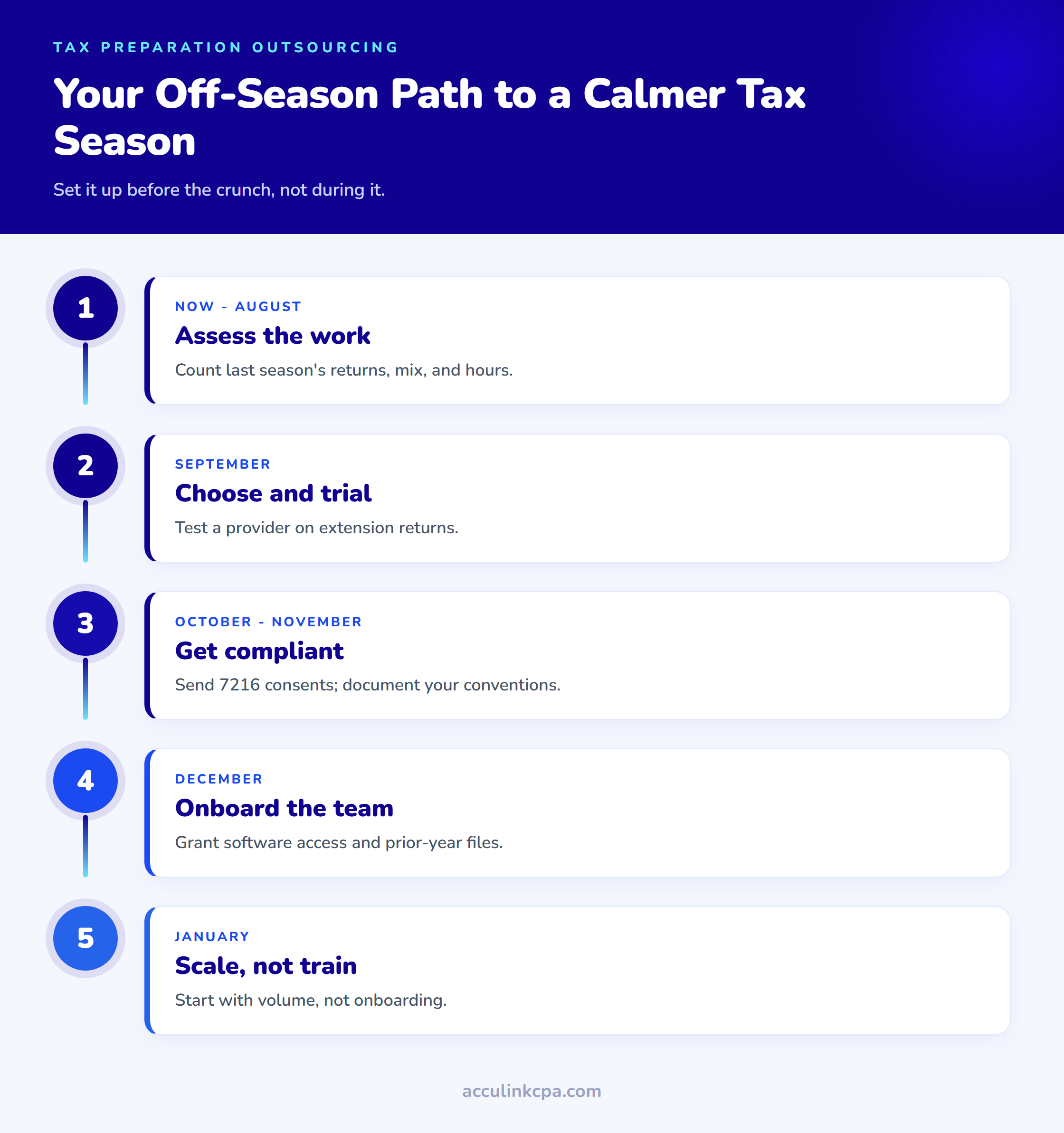
Pick a provider by September and trial them on extension work in the autumn, so consents, software access, and your firm's conventions are settled by December. Starting in January means training a team during your busiest weeks, which is where most disappointing first seasons come from.
The Bottom Line
Tax preparation outsourcing rewards firms that are deliberate about it. Decide what genuinely leaves the building and what never does. Get the 7216 consents out early. Write down the conventions living in your partners' heads. Trial it on extensions, when a mistake costs you an afternoon instead of a client.
Do that and the arithmetic is straightforward: the mechanical half of your return volume gets done at a fraction of the cost, and your partners spend busy season reviewing and advising instead of entering data. Skip it, and you will spend January doing exactly what you did last January.
If you want to see how it would run on your own returns, the practical next step is a small scoped trial. Acculink offers a 40-hour free trial so you can test the workflow on real files before committing to a season.
Tags:
About the Author

Related Posts
Top 10 Offshore Staffing Companies for Accounting Firms (2026)
Hiring an offshore team is one of the highest-leverage moves a short-staffed CPA firm can make, but the partne…
Outsourced Bookkeeping: What to Delegate, What It Costs, and How to Hire (2026)
A practical 2026 guide to outsourced bookkeeping: what it is, which tasks to hand off, how it works, what it c…
Offshore Accounting: What CPA Firms Need to Know in 2026
A practical 2026 guide to offshore accounting for U.S. CPA firms: what it is, what to safely delegate, what it…