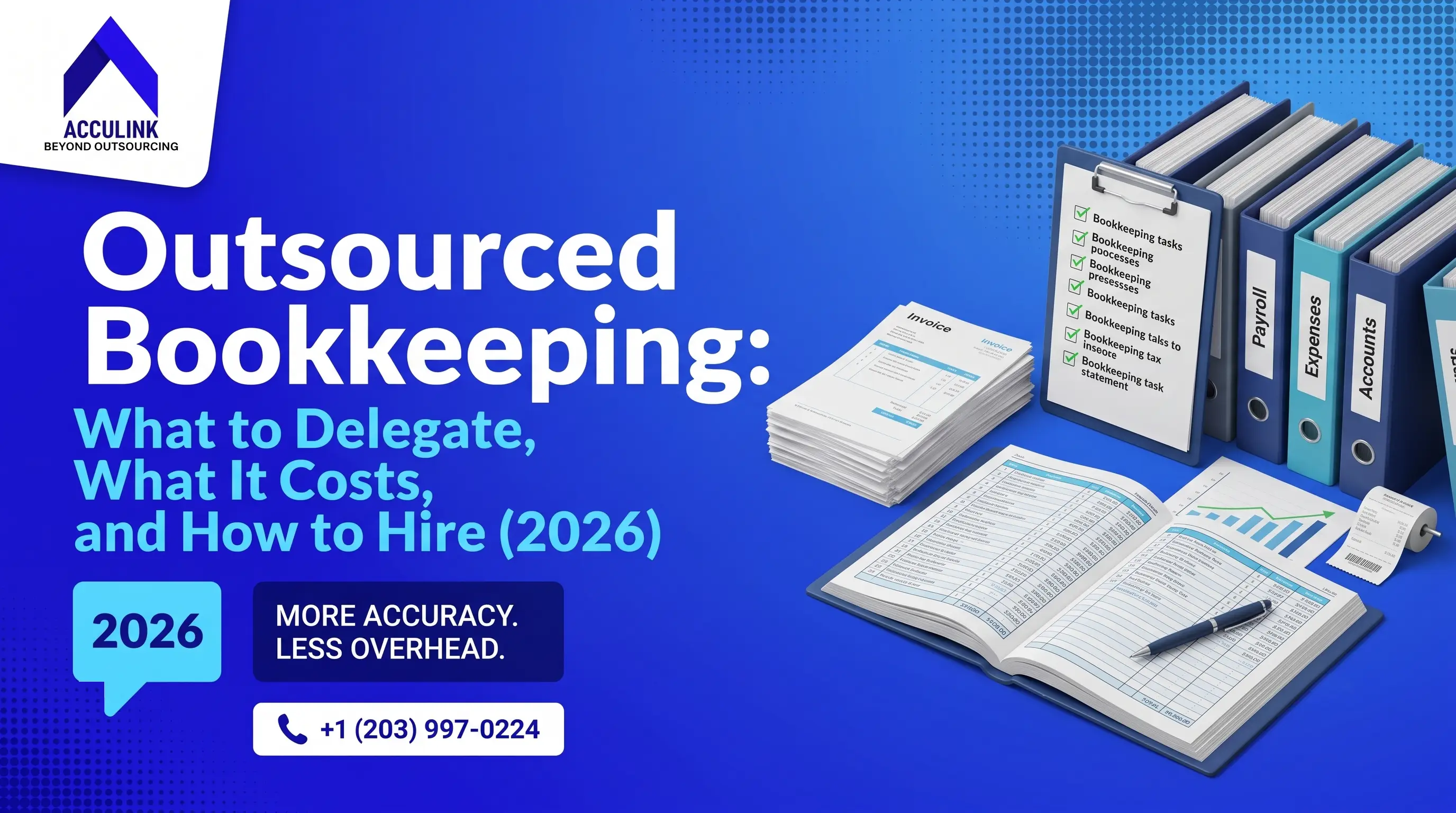
Outsourced Bookkeeping: What to Delegate, What It Costs, and How to Hire (2026)

Summary
A practical 2026 guide to outsourced bookkeeping: what it is, which tasks to hand off, how it works, what it costs, and how to choose a provider, including the offshore option that runs 60-70% below an in-house hire.
Outsourced bookkeeping is the practice of handing your day-to-day books to an external team instead of hiring an in-house bookkeeper. You get accurate, up-to-date financials (reconciliations, accounts payable and receivable, and a clean month-end close) without carrying a salary, and when the work is delivered by an offshore team it typically costs 60 to 70 percent less than a local hire. This guide covers what outsourced bookkeeping is, which tasks to hand off, what it costs, and how to choose the right provider.
What Is Outsourced Bookkeeping?
Outsourced bookkeeping is the practice of hiring an external professional or firm to record transactions, reconcile bank accounts, manage accounts payable and receivable, and prepare financial reports, instead of employing an in-house bookkeeper. The team works inside your own accounting software rather than from your office, delivering clean, current books that your accountant or CFO can build on.
The reason businesses do this is straightforward. Bookkeeping is essential but repetitive, and a full-time in-house bookkeeper is expensive once you add salary, benefits, software, and the time it takes to manage them. Outsourcing gives you the same accurate books for the hours you actually need, and nothing more.
For accounting firms the logic is the same, one step removed: firms outsource their clients' bookkeeping, or their own overflow during busy season, to a dedicated team, keeping the client relationship while the external team does the production work under the firm's brand.
What Bookkeeping Tasks Can You Outsource?
Almost all routine bookkeeping can be delegated. The tasks most commonly handed off:
- Transaction recording and categorization, keeping the ledger current.
- Bank and credit-card reconciliations, so the books match reality.
- Accounts payable and receivable: paying bills, sending invoices, and chasing collections.
- Payroll processing support.
- Month-end and year-end close.
- Catch-up and cleanup when the books have fallen behind.
- Financial reporting: profit and loss, balance sheet, and cash-flow statements.
What usually stays in-house is the judgment layer: final review, tax strategy, and any decision that needs an owner or a licensed accountant. A good outsourced team does the production work; your accountant or CFO reviews and advises on top of it.
How Outsourced Bookkeeping Works
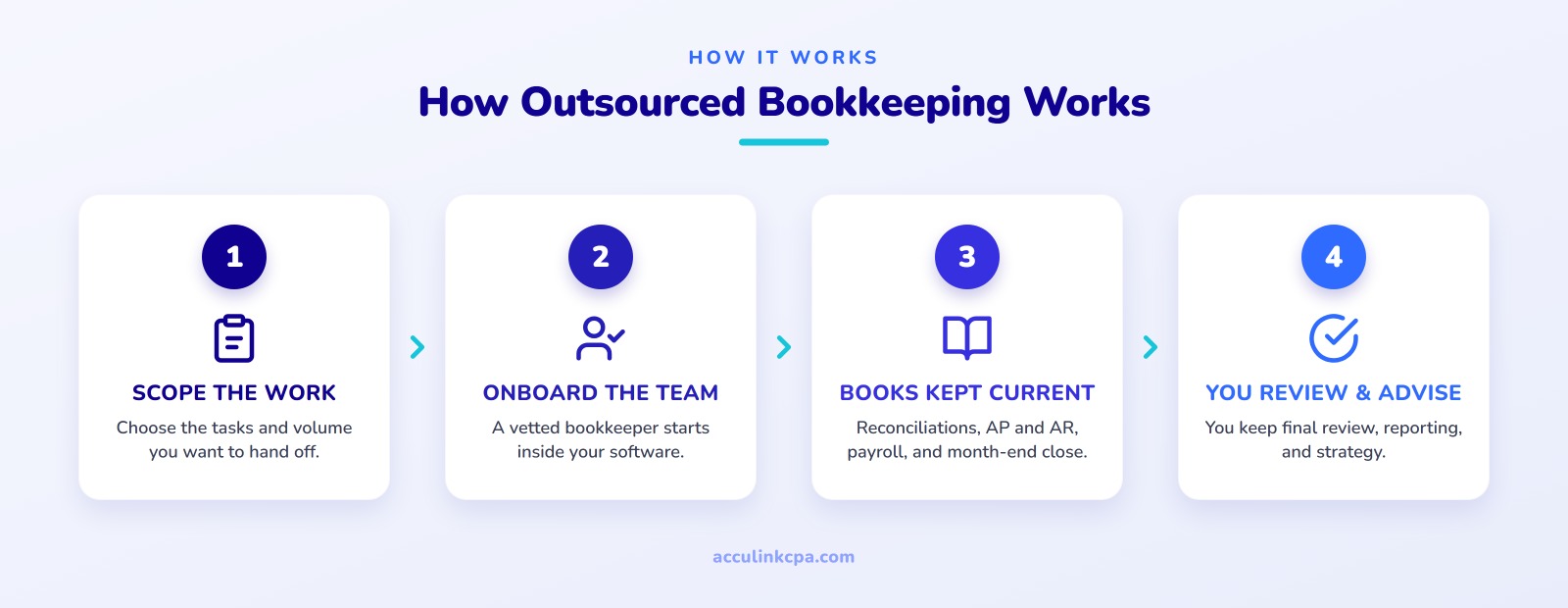
Bringing on an outsourced bookkeeping team is more straightforward than most owners expect. It usually runs in four steps.
- Scope the work. You decide which tasks and how much volume to hand off, from a few reconciliations a month to your entire monthly close.
- Onboard the team. A vetted bookkeeper is matched to your account, usually within about two weeks, and set up inside your existing software with access controls and a clear point of contact.
- Books kept current. The team handles the day-to-day: reconciliations, accounts payable and receivable, payroll support, and month-end close, delivered on a set schedule.
- You review and advise. Clean financials come back to you or your accountant for final review, reporting, and the strategic decisions that stay in-house.
Because the team works inside your systems and overlaps your business hours, it functions as an extension of your own staff rather than a black box.
Outsourced vs. In-House Bookkeeping
An in-house bookkeeper makes sense once the volume genuinely fills a full-time role and you want someone physically in the office. For most small and mid-sized businesses, outsourcing wins on cost and flexibility:
- Cost: you pay for hours worked, not a full salary plus benefits, software, and overhead.
- Scalability: scale hours up during busy periods and down when things are quiet, with no hiring or layoffs.
- Coverage: a team does not take vacations or resign, so the books never stall on one person.
- Built-in expertise: you get trained bookkeepers with a review layer, rather than betting everything on a single hire.
The trade-off is that you give up having someone down the hall, which is exactly why security, communication, and time-zone overlap matter when you choose a provider.
How Much Does Outsourced Bookkeeping Cost?
A full-time in-house bookkeeper earns a median of $49,210 a year, about $24 an hour before you add benefits, software, and management overhead, according to the US Bureau of Labor Statistics. Outsourcing turns that fixed salary into a variable cost you control. Pricing usually follows one of three models:
- Hourly: you pay for time used. Common for smaller or variable workloads.
- Monthly fixed fee: a set price for a defined scope, easier to budget.
- Full-time dedicated: a bookkeeper who works only on your account, billed monthly.
Domestic outsourced bookkeeping in the US commonly runs from the high tens to over a hundred dollars an hour, depending on the provider. An offshore team delivers the same work at all-inclusive rates of roughly $8 to $35 per hour depending on the role, which is around 60 to 70 percent below the fully loaded cost of a comparable US hire, while still working in your software and overlapping your business hours.
The better question is not just the rate, it is the all-in cost and what is included. Ask whether security, software, and management are built into the hourly figure or billed on top, the way they are with Acculink's bookkeeping outsourcing services.
Signs It Is Time to Outsource Your Bookkeeping
You have likely outgrown DIY or a part-time bookkeeper if any of these sound familiar:
- Your books are always behind, and you close the month weeks late.
- You are spending nights and weekends in the accounting software instead of running the business.
- You cannot get a clear, current picture of cash flow when you need it.
- Reconciliations, bills, or invoices are slipping through the cracks.
- You are about to hire a full-time bookkeeper mainly because you are drowning, not because the volume truly justifies the salary.
Any one of these is a signal. Several together usually means the cost of disorganized books, in late fees, missed collections, and your own time, is already higher than the cost of outsourcing.
How to Choose an Outsourced Bookkeeping Provider
Once you decide to outsource, evaluate providers on five things:
- Credentials and review. Look for trained bookkeepers with a built-in review layer, not a single freelancer working unchecked.
- Data security. Your provider will see everything. Confirm SOC 2 Type II controls, IRS Section 7216 compliance, encrypted devices, and role-based access before sharing anything.
- Software fit. The team should work inside your existing stack (QuickBooks, Xero, or similar), not force a migration.
- Time-zone overlap and communication. You want a provider that shares enough of your working day to respond, with a clear point of contact.
- A low-risk start. A defined scope, a short trial, or no long lock-in lets you prove the fit before you commit.
Whichever provider you choose, start on a small, defined scope and expand as it proves out. When you are ready to begin, you can hire a dedicated bookkeeper and keep the first engagement tight.
Accounting firms use the same checklist when they add an offshore bookkeeping team, then offer bookkeeping to their own clients under their brand, turning a back-office cost into a profitable service line without a local hire.
Why Businesses and Firms Choose Acculink's Outsourced Bookkeeping
Acculink's bookkeeping outsourcing services already support 80+ US CPA firms with offshore bookkeeping from $8 an hour, all-inclusive and about 60 to 70 percent below an in-house hire, backed by the security and review layer a serious book of business needs.
- Trained, pre-vetted bookkeepers with a built-in review layer, not a lone freelancer.
- Works inside your software: as QuickBooks Advanced Certified ProAdvisors and Xero Certified Advisors, with no migration.
- Secure by design: SOC 2 Type II certified and IRS Section 7216 compliant, with encrypted devices, role-based access, and zero data breaches in five-plus years.
- Full scope, on time: reconciliations, AP and AR, payroll support, and reporting, with month-end close delivered by the 12th business day.
- Built for accounting firms: deliver bookkeeping to your own clients under your brand and keep the margin, without adding a domestic salary.
- A genuinely low-risk start: a free trial, no setup fee, and no long lock-in, so you can prove the fit before you scale.
Ready to see it on your own books? You can hire a dedicated bookkeeper or book a free consultation to scope the work.
Frequently Asked Questions
What is outsourced bookkeeping?
Outsourced bookkeeping is when an external provider maintains your financial records instead of an in-house employee. Working inside your accounting software, they record transactions, reconcile accounts, manage bills and invoices, and deliver monthly financials, for the hours you need rather than a full salary.
What tasks can you outsource to a bookkeeper?
Most routine bookkeeping: transaction recording and categorization, bank and credit-card reconciliations, accounts payable and receivable, payroll support, month-end and year-end close, cleanup and catch-up work, and financial reporting. Final review, tax strategy, and owner-level decisions usually stay in-house.
How much does outsourced bookkeeping cost?
It depends on volume and model (hourly, monthly fixed fee, or full-time dedicated). Domestic providers often charge from the high tens to over a hundred dollars an hour, while an offshore team delivers the same work at roughly $8 to $35 per hour, around 60 to 70 percent below the cost of a comparable in-house hire.
Is outsourced bookkeeping secure?
It is, with the right provider. Look for SOC 2 Type II controls, IRS Section 7216 compliance, encrypted devices, disabled local storage, two-factor authentication, and role-based access. Ask to see the provider's actual certifications before you share any data.
Outsourced vs. in-house bookkeeping: which is better?
In-house makes sense when the volume genuinely fills a full-time role and you want someone on-site. For most small and mid-sized businesses, outsourcing wins on cost and flexibility: you pay for the hours you use, scale up or down with demand, and get a team with built-in review instead of relying on one hire.
What is the difference between outsourced, virtual, and offshore bookkeeping?
Outsourced means an outside provider rather than an employee. Virtual (or remote) describes how the work is delivered, through cloud software rather than on-site. Offshore means the team is based in another country, which is where the largest cost savings come from. Most outsourced bookkeeping today is both virtual and, often, offshore.
Can a CPA firm outsource its clients' bookkeeping?
Yes, and many do. A firm can hand client or overflow bookkeeping to a dedicated offshore team that works under the firm's brand and review, so the firm keeps the client relationship while adding capacity without hiring locally. It is a common way for firms to grow their bookkeeping and accounting lines profitably.
How do I choose an outsourced bookkeeping provider?
Evaluate on five things: credentials and a review layer, data security (SOC 2 Type II, IRS Section 7216), fit with your existing software, time-zone overlap and communication, and a low-risk start such as a trial or no long lock-in. Prove the fit on a defined scope before you scale.
The Bottom Line
Outsourced bookkeeping gives you accurate, current books without the cost and management of a full-time hire. For most businesses, and for accounting firms adding capacity, the offshore model takes it furthest on cost, around 60 to 70 percent below an in-house bookkeeper, while keeping the work in your software and on your schedule.
If your books are behind or a full-time hire feels premature, the practical next step is a small, scoped engagement. Acculink offers a free consultation to map the work to your needs before you commit to anything.
Tags:
About the Author

Related Posts
Top 10 Offshore Staffing Companies for Accounting Firms (2026)
Hiring an offshore team is one of the highest-leverage moves a short-staffed CPA firm can make, but the partne…
Top Outsourced Accounting Firms for CPA Practices (2026)
Choosing an outsourced accounting partner is a high-stakes call because the team touches your clients' data. T…

Offshore Bookkeeping Services: Everything CPA Firms Need to Know Before Hiring
Bookkeeping is the most commonly outsourced accounting function globally — and for good reason. It’s high-volu…