Offshore Bookkeeping Services: Everything CPA Firms Need to Know Before Hiring


Summary
Bookkeeping is the most commonly outsourced accounting function globally — and for good reason. It’s high-volume, process-driven, and ideally suited for offshore delivery.
Key Takeaways
-
Bookkeeping is the most commonly outsourced accounting function globally — and for good reason. It’s high-volume, process-driven, and ideally suited for offshore delivery.
-
Offshore bookkeepers handle the full scope of day-to-day accounting: bank reconciliations, journal entries, AP/AR, month-end close, payroll processing, and financial statement preparation — using QuickBooks, Xero, and other platforms your firm already runs.
-
CPA firms save 60–75% on bookkeeping labor costs by hiring offshore, with fully loaded rates starting at $8/hr compared to $45,000–$65,000+ for a domestic bookkeeper.
-
Quality control is built into the process — standardized checklists, multi-layer review workflows, and ongoing training ensure accuracy from day one.
-
You can start with a single offshore bookkeeper, test them on a 40-hour free trial, and scale to a full team as your client base grows.
In his 1776 masterwork The Wealth of Nations, Adam Smith introduced the concept of division of labor — the idea that breaking work into specialized tasks and assigning them to the best-suited workers drives efficiency, quality, and growth. Two and a half centuries later, CPA firms are discovering that Smith’s principle applies perfectly to bookkeeping.
Bookkeeping is the backbone of every accounting practice. It’s also the function that consumes the most hours, creates the most bottlenecks, and offers the least leverage for firm growth. When your partners and senior accountants are spending time on bank reconciliations instead of advisory conversations, something is structurally wrong.
The solution is offshore bookkeeping services — hiring dedicated, qualified bookkeepers in India who handle the day-to-day work while your U.S. team focuses on review, client relationships, and higher-value services. As Accounting Today has reported, bookkeeping outsourcing is among the fastest-growing segments in the accounting services industry, driven by the talent shortage and the economics of offshore delivery.
This guide covers everything you need to know before hiring an offshore bookkeeper — from the tasks they handle and the software they use, to pricing, quality control, and the hiring process. For firms already familiar with bookkeeping outsourcing services, this guide will help you optimize and scale. For firms exploring it for the first time, consider this your complete roadmap.
What Is Offshore Bookkeeping? A Quick Definition
Offshore bookkeeping is the practice of hiring a dedicated bookkeeper located overseas — typically in India — to perform day-to-day accounting tasks for your firm’s clients. The bookkeeper works exclusively for your firm, uses your software and processes, and functions as a seamless extension of your in-house team. The offshore provider handles all infrastructure: HR, payroll, IT, office space, and compliance.
This is not the same as sending work to a call-center-style vendor. Your offshore bookkeeper logs into QuickBooks or Xero every morning, opens the same client files your U.S. team uses, and completes work according to your SOPs. The only difference is geography.
As one CPA firm partner in Chicago put it: "Our offshore bookkeeper knows our clients’ QuickBooks files better than some of our local staff did. She’s been with us two years — she’s part of the team."
What Tasks Can Offshore Bookkeepers Handle?
The scope of work an offshore bookkeeper can handle is broader than most firm partners initially expect:
|
Category |
Tasks |
|
Daily Transactions |
Recording income and expenses, categorising transactions, coding invoices, and data entry from source documents |
|
Bank & Card Reconciliations |
Reconciling bank accounts, credit cards, and merchant accounts on a daily, weekly, or monthly basis |
|
Accounts Payable |
Processing vendor invoices, scheduling payments, managing AP ageing and sending payment reminders |
|
Accounts Receivable |
Generating client invoices, tracking collections, managing AR ageing, and recording payments received |
|
Journal Entries |
Posting adjusting entries, accruals, deferrals, depreciation entries, and reclassifications |
|
Month-End Close |
Completing month-end checklists, preparing trial balances, reconciling intercompany accounts, and creating close packages |
|
Payroll Support |
Processing payroll runs, recording payroll journal entries, reconciling payroll liabilities, and supporting quarterly payroll returns |
|
Financial Statement Prep |
Preparing income statements, balance sheets, and cash flow statements in client-ready format |
|
Year-End Close |
Preparing year-end adjustments, supporting tax return preparation, and organising audit workpapers |
|
Client Reporting |
Preparing custom management reports, KPI dashboards, and budget-vs-actual analyses |
For specialized bookkeeping needs, Acculink also provides dedicated QuickBooks accounting experts, Xero accounting specialists, and staff trained on Sage, Zoho Books, and other platforms. The team adapts to whatever software your clients use.
QuickBooks vs. Xero for Offshore Bookkeeping Teams
The two most common platforms for offshore bookkeeping are QuickBooks (Online and Desktop) and Xero. Both work well with offshore teams, but there are differences worth understanding:
|
Feature |
QuickBooks (Online) |
Xero |
|
Market Dominance (U.S.) |
Dominant — used by ~80% of small businesses and most CPA firms |
Growing — popular with cloud-first firms and international clients |
|
Offshore Team Proficiency |
Very high — most offshore accountants are QBO-trained |
High — Xero-certified professionals available at top providers |
|
Multi-User Access |
Up to 25 users on higher-tier plans; role-based permissions |
Unlimited users on all plans; excellent for large teams |
|
Cloud Access for Offshore Teams |
Fully cloud-based (QBO); Desktop requires hosting |
Fully cloud-based — ideal for distributed teams |
|
Bank Feed Integration |
Strong — supports most U.S. banks |
Strong — excellent auto-matching with bank rules |
|
Reporting |
Good built-in reports; customizable with add-ons |
Clean, modern reporting with strong visualisation |
|
Best For |
Most U.S.-based CPA firms and small businesses |
Firms with international clients or cloud-native preferences |
For a deeper dive into platform-specific outsourcing, see Acculink’s guides on QuickBooks outsourcing services and Xero outsourcing services for CPA firms. For firms exploring newer platforms, our guide on Zoho Books covers emerging options.
How Much Do Offshore Bookkeeping Services Cost?
Let’s get straight to the numbers. As management guru Peter Drucker once said, "What gets measured gets managed." Here’s what bookkeeping costs look like when you compare domestic and offshore:
|
Cost Component |
U.S. In-House Bookkeeper |
Offshore Bookkeeper (India) |
|
Annual Salary |
$42,000–$60,000 |
$10,000–$25,000 (fully loaded) |
|
Benefits & Overhead |
$10,000–$20,000 |
$0 (included in rate) |
|
Office Space & Equipment |
$4,000–$10,000/year |
$0 (included) |
|
Recruiting Costs |
$3,000–$8,000 per hire |
$0 (no fees) |
|
Total Annual Cost |
$59,000–$98,000 |
$10,000–$25,000 |
|
Cost Savings |
— |
60–75% reduction |
With Acculink CPA, bookkeeping rates start at $8/hr for entry-level professionals and go up to $20–$25/hr for senior bookkeepers with 6+ years of U.S. experience. Explore the full pricing structure on the engagement models page. Every rate is all-inclusive — salary, HR, IT, office, security — with zero hidden fees.
As the CPA Practice Advisor has noted, the cost advantage of offshore bookkeeping isn’t just about cheaper labor — it’s about the elimination of overhead, benefits, recruiting costs, and the hidden expense of turnover.
Quality Control: How to Ensure Accuracy in Offshore Bookkeeping
Accuracy in bookkeeping isn’t optional — a misclassified expense or a missed reconciliation item can cascade into incorrect financial statements and tax returns. The good news: offshore bookkeeping quality is highly controllable when you build the right systems.
In the 1995 film Apollo 13, Ed Harris’s character delivers the iconic line, "Failure is not an option." The same mindset applies to bookkeeping quality control. Here’s how to make it work:
1. Standardize with Checklists
Create a detailed checklist for every recurring bookkeeping task: monthly reconciliation checklist, month-end close checklist, payroll processing checklist, and new client setup checklist. Your offshore team follows the checklist every time. No shortcuts, no memory-based workflows.
2. Implement a Review Layer
Build a multi-layer review process:
-
Layer 1: Offshore bookkeeper completes the work and self-reviews against the checklist.
-
Layer 2: Offshore senior (if available) conducts a first-pass review for common errors.
-
Layer 3: Your in-house reviewer or manager conducts the final review before anything goes to the client.
3. Track Error Rates Monthly
Measure the number of review notes or corrections per bookkeeper per month. Expect a learning curve in the first 30–60 days, then a steady decline. If error rates aren’t dropping, address training or process gaps immediately.
4. Invest in Ongoing Training
Your offshore bookkeeper should receive the same professional development you’d give a local hire. The Journal of Accountancy regularly publishes updates on accounting standards, software features, and best practices — share these with your offshore team.
Acculink’s in-house Learning & Development team provides continuous training on U.S. accounting standards, software updates, and communication skills. This is one of the key differentiators highlighted on the why Acculink page.
Communication Best Practices for Offshore Bookkeeping Teams
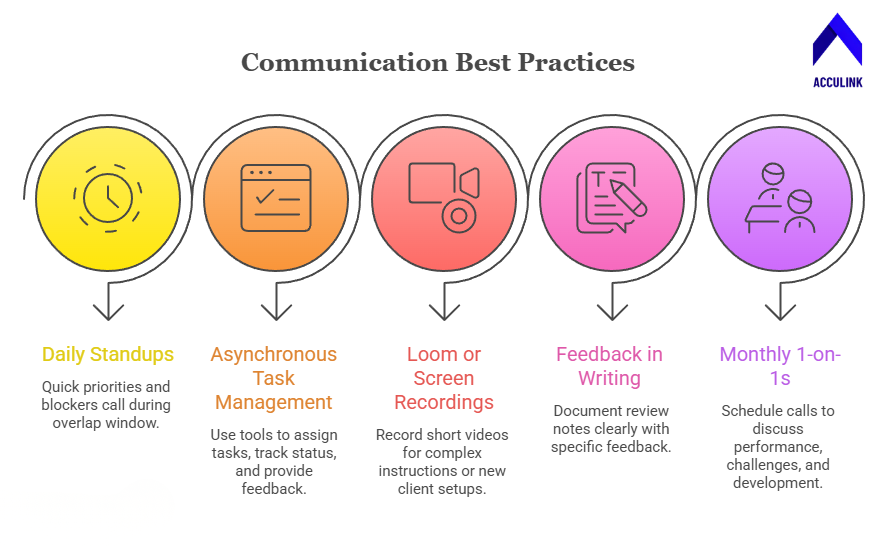
Good communication is the difference between an offshore team that feels like an extension of your firm and one that feels like a disconnected vendor. Here’s what works:
-
Daily standups (10–15 minutes): Use the 3–4 hour overlap window for a quick priorities and blockers call. Keep it structured: What was completed yesterday? What’s the plan today? Any blockers?
-
Asynchronous task management: Use Karbon, Canopy, Jetpack Workflow, or even a shared spreadsheet to assign tasks, track status, and provide feedback. Don’t rely on email chains.
-
Loom or screen recordings: For complex instructions or new client setups, record a 5-minute Loom video walking through the process. It’s faster than writing and easier for the bookkeeper to follow.
-
Feedback in writing: Document review notes clearly. Vague feedback like "fix the reconciliation" doesn’t help. Specific feedback like "Check the outstanding deposit dated March 12 — it cleared the bank but wasn’t matched" does.
-
Monthly 1-on-1s: Schedule a 30-minute monthly call to discuss performance, challenges, and professional development — just as you would with any team member.
As Stephen Covey wrote in The 7 Habits of Highly Effective People, "Seek first to understand, then to be understood." The firms that communicate most effectively with offshore teams are the ones that invest in clear, two-way dialogue — not just one-way task assignments.
How to Hire an Offshore Bookkeeper: Step-by-Step
Step 1: Define the Role
Be specific about what you need: How many clients? What software? What’s the volume of monthly transactions? Full-time or part-time? This clarity ensures you get candidates matched to your actual workload, not generic profiles.
Step 2: Request Candidates
Contact your provider and share the role specification. Acculink delivers pre-vetted, shortlisted resumes within 5–7 days. You can browse role-specific options like hire a bookkeeper or hire a QuickBooks expert to see what’s available.
Step 3: Interview
Interview 2–3 candidates. Test them on reconciliation scenarios, software proficiency (have them walk you through a task in QBO or Xero), and communication quality. The interview is free — no obligation to hire.
Step 4: Start the Free Trial
Begin the 40-hour free trial. Assign real (but lower-risk) bookkeeping tasks. Evaluate turnaround time, accuracy, communication, and attention to detail.
Step 5: Transition to Full Production
Once you’re satisfied, transition to full workload. Your bookkeeper is now part of your team — working on your clients, in your software, under your supervision.
For year-end bookkeeping considerations, see our guide on year-end accounting services for CPA firms. For firms with recurring monthly bookkeeping needs across multiple industries, Acculink’s team is proficient in manufacturing, real estate, healthcare, nonprofit, and ecommerce accounting.
When Offshore Bookkeeping May Not Be the Right Fit
Transparency matters. Offshore bookkeeping is a powerful solution, but it’s not for every situation:
-
If your firm handles extremely niche bookkeeping that requires in-person access to physical records or on-site client visits, offshore may not be practical.
-
If your firm has zero documentation of processes — no SOPs, no checklists, no templates — you’ll need to create these first. Offshore teams execute well against clear processes; they struggle without structure.
-
If you need someone for in-person client meetings or face-to-face interactions, offshore handles the back-office work while you handle the relationship.
As the AccountingWEB community has frequently discussed, the most successful offshore engagements are ones where the firm owns the client relationship and the offshore team owns the execution. It’s a division of labor — back to Adam Smith.
Frequently Asked Questions
What qualifications do offshore bookkeepers have?
Offshore bookkeepers from CPA-focused providers like Acculink typically hold degrees in accounting or commerce, with many possessing CA (Chartered Accountant) inter or equivalent qualifications. They are trained on U.S. GAAP, QuickBooks, Xero, and other platforms. Senior bookkeepers have 4–6+ years of experience working with U.S. CPA firms.
Can offshore bookkeepers work in QuickBooks Desktop?
Yes. While QuickBooks Online is cloud-native and easiest for remote access, QuickBooks Desktop can be accessed via hosted environments (Right Networks, Ace Cloud Hosting) or through VPN connections. Many offshore bookkeepers are proficient in both versions.
How long does it take for an offshore bookkeeper to leaabout rn my clients?
Most offshore bookkeepers are productive within 2–3 weeks. They’ll be familiar with your SOPs and software immediately; learning the nuances of specific client accounts takes a bit longer but is comparable to any new hire’s learning curve.
What if my clients have industry-specific bookkeeping needs?
Offshore teams are experienced across industries, including real estate, manufacturing, healthcare, nonprofit, ecommerce, and hospitality. You can request bookkeepers with specific industry experience during the hiring process.
How do I handle month-end if my offshore bookkeeper is in a different time zone?
The time zone difference actually helps. Your offshore bookkeeper starts the month-end close during their business hours (your evening), and the work is ready for your review the next morning. During the 3–4 hour overlap, you resolve any questions in real time.
Is a 40-hour trial really free?
Yes. Acculink’s 40-hour free trial is genuinely no-cost and no-obligation. You interview the candidate, assign real tasks, evaluate the work, and decide whether to proceed. There are no setup fees, no credit card required, and no automatic commitments.
References
Accounting Today — https://www.accountingtoday.com/
CPA Practice Advisor — https://www.cpapracticeadvisor.com/
Journal of Accountancy — https://www.journalofaccountancy.com/
AccountingWEB — https://www.accountingweb.com/
The CPA Journal — https://www.cpajournal.com/
Intuit QuickBooks — https://quickbooks.intuit.com/
Xero — https://www.xero.com/us/
Bureau of Labor Statistics — Bookkeeping, Accounting, and Auditing Clerks — https://www.bls.gov/ooh/office-and-administrative-support/bookkeeping-accounting-and-auditing-clerks.htm
Wikipedia — Bookkeeping — https://en.wikipedia.org/wiki/Bookkeeping
About Acculink CPA
Acculink CPA is a premier offshore staffing and outsourcing company purpose-built for CPA firms, accounting firms, and tax firms in the United States, Canada, and the UAE. With a team of 300+ qualified professionals — including CPAs, Chartered Accountants, Enrolled Agents, and Big 4-trained staff — Acculink provides dedicated offshore accountants, bookkeepers, tax preparers, auditors, virtual CFOs, and virtual assistants at $8–$35/hr, delivering up to 75% cost savings compared to domestic hiring. The company is ISO 27001 certified, SOC 2 Type II aligned, IRS §7216 compliant, and GDPR compliant, with zero security breaches in 5+ years of operations. Acculink offers a 40-hour free trial with no setup fees, no recruitment charges, and no long-term contracts. Over 80 CPA firms across the United States trust Acculink to deliver quality, security, and scalability.
Website: Acculink CPA | Schedule a Call: book a 45-minute call | Email: Info@acculinkcpa.com | Phone: +1 (203) 997-0224
Tags:
About the Author

Related Posts

Hire Offshore Bookkeepers for CPA & Accounting Firms – Blueprint for Outsourced Bookkeeping
How to hire an offshore bookkeeper for your CPA firm — what they do, how vetting and onboarding work, cost (up…
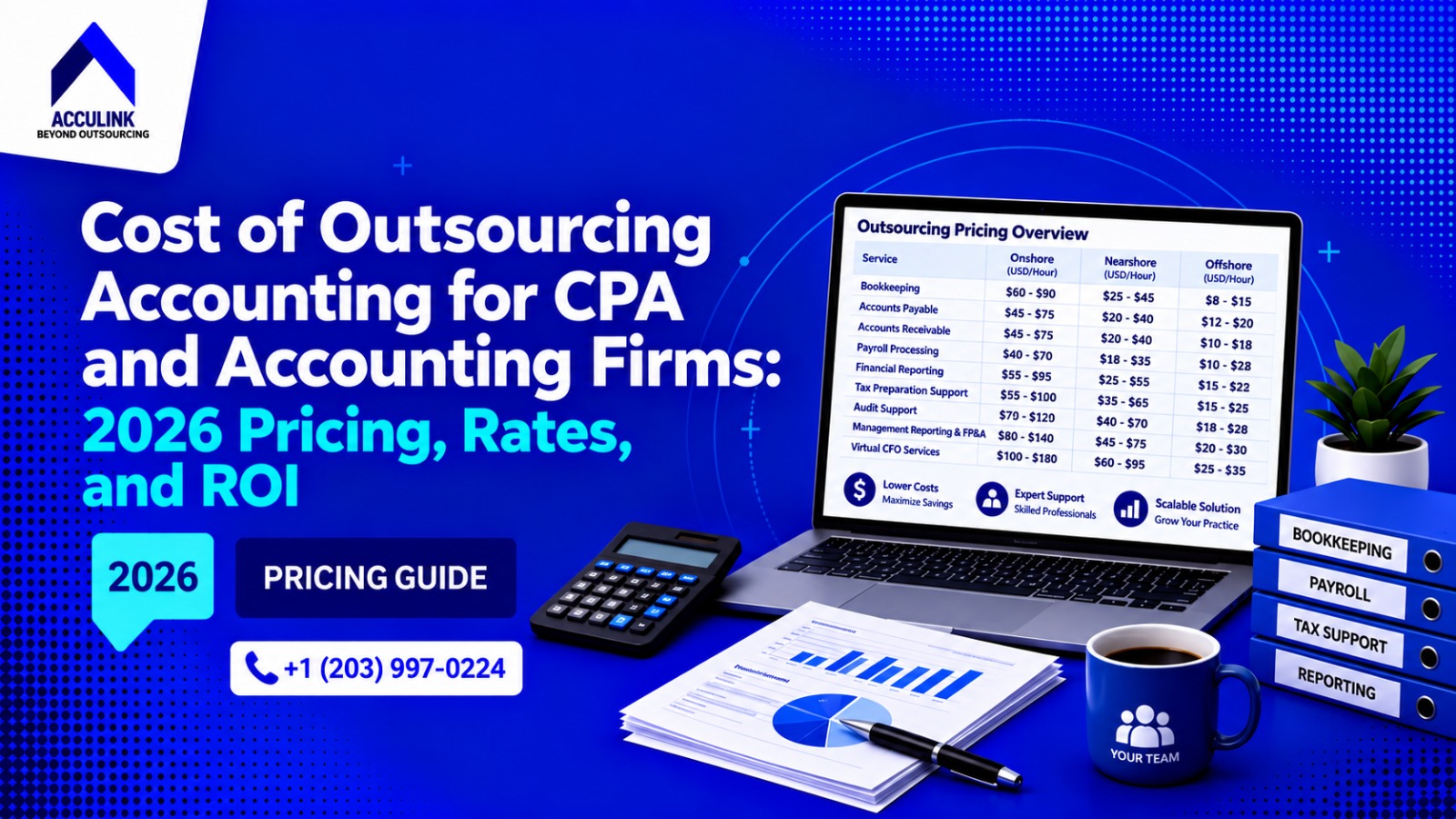
Cost of Outsourcing Accounting for CPA and Accounting Firms: 2026 Pricing, Rates, and ROI
The cost to outsource accounting typically ranges from $8 to $35 per hour, depending on the service, experienc…
15 Profitable Add-On Services CPA and Accounting Firms Can Offer Without Hiring In-House
CPA and accounting firms do not need to build every new service with another in-house hire. This guide compare…