Audit Outsourcing for CPA Firms: How to Offshore Audit Support Without Losing Quality

Summary
Audit outsourcing doesn’t mean handing over your audit opinion — it means delegating the labor-intensive support work (workpaper preparation, testing, documentation) to qualified offshore professionals while your firm retains all judgment, review, and sign-off authority.
Key Takeaways
-
Audit outsourcing doesn’t mean handing over your audit opinion — it means delegating the labour-intensive support work (workpaper preparation, testing, documentation) to a qualified offshore professional. At the same time,e your firm retains all judgment, review, and sign-off authority.
-
Offshore audit teams can support financial audits, 401(k) audits, employee benefit plan (EBP) audits, internal audits, and SOX compliance testing — covering the full spectrum of assurance work.
-
The key to maintaining quality is a structured workpaper framework: standardised templates, clear instructions, detailed review checklists, and a multi-layer review process.
-
CPA firms that outsource audit support report 40–60% reductions in audit staff costs, faster engagement completion, and the ability to accept more audit clients without hiring domestically.
-
Peer review readiness is maintained because your firm controls the methodology, the review, and the final work product — the offshore team is an execution layer, not a decision-making layer.
In the 1957 film 12 Angry Men, Henry Fonda’s character stands alone in a jury room and methodically examines every piece of evidence before reaching a verdict. It’s a masterclass in thoroughness, attention to detail, and the refusal to cut corners — qualities that define great audit work.
For CPA firm audit partners in 2026, the challenge isn’t a lack of thoroughness — it’s a lack of people to be thorough with. Finding qualified audit staff domestically has become one of the profession’s most pressing problems. The talent shortage that has plagued tax and accounting has hit audit practices particularly hard, because audit requires a specific combination of technical skills, professional judgment, and documentation discipline that takes years to develop.
The Journal of Accountancy has extensively covered the audit staffing crisis, noting that firms of all sizes are struggling to find and retain qualified audit professionals. The CPA Journal has published an analysis showing that the talent gap in audit is widening as experienced professionals retire and fewer graduates choose audit as a career path.
This is why audit outsourcing for CPA firms is no longer a fringe idea — it’s an operational necessity for firms that want to maintain their audit practices without burning out their existing teams. And when done correctly, offshore audit support services can maintain the same quality standards your firm has always upheld.
In this guide, we’ll walk through exactly what can be outsourced in audit, how to maintain quality and peer review readiness, the types of audits offshore teams support, and how to get started.
What Can Be Outsourced in Audit — and What Can’t
Let’s start with the most important distinction: outsourcing audit support is not outsourcing your audit opinion. Your firm retains full control over methodology, risk assessment, materiality determinations, professional judgment, review, and the final audit report. What you outsource is the execution-heavy work that consumes the most hours.
What You CAN Outsource
|
Audit Phase |
Tasks for Offshore Team |
|
Planning & Risk Assessment Support |
Preparing planning memos, compiling industry research, documenting internal control walkthroughs, and creating lead sheets |
|
Fieldwork / Testing |
Performing tests of details (vouching, tracing, recalculations), tests of controls, analytical procedures, preparing confirmation requests, ticking and tying |
|
Workpaper Preparation |
Building workpaper sections using firm templates, documenting procedures performed, cross-referencing to the trial balance, and preparing PBC (Prepared by Client) checklists |
|
Sampling |
Selecting samples using firm methodology, documenting sample selection rationale, and performing testing procedures on selected items |
|
Roll-Forward Work |
Updating prior-year workpapers for current-year figures, carrying forward permanent file items, and updating lead schedules |
|
Financial Statement Drafting |
Preparing draft financial statements, notes to financial statements, and supplementary schedules from trial balance data. |
|
Documentation & ArchivingOrganising |
g workpaper files, creating a table of contents, ensuring sign-offs are complete, and preparing files for archival |
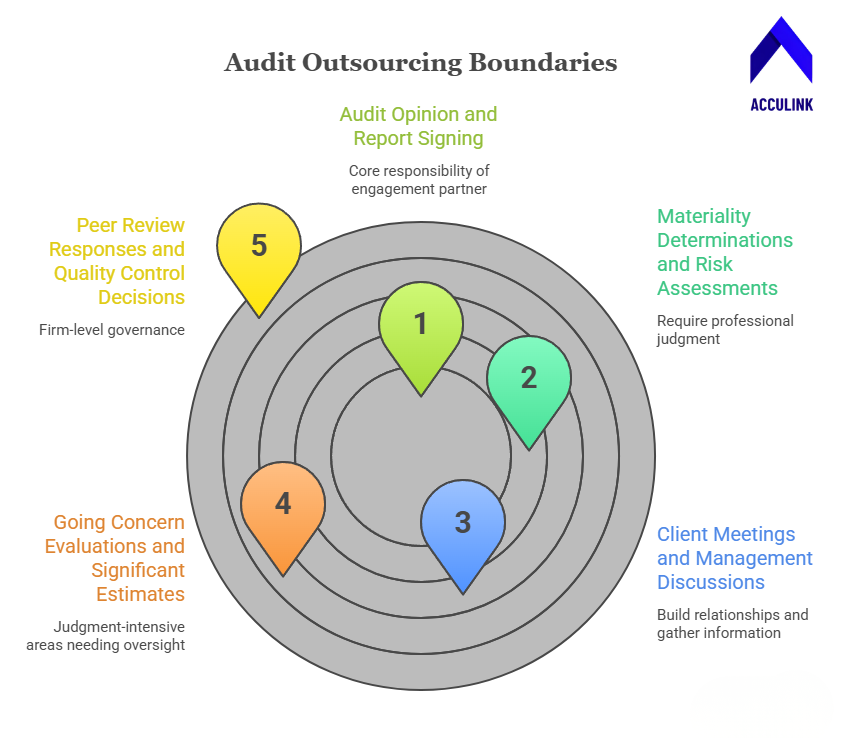
What You Should NOT Outsource
-
Audit opinion and report signing — always the engagement partner’s responsibility.
-
Materiality determinations and risk assessments — these require professional judgment from your senior team.
-
Client meetings and management discussions — relationship and inquiry work stays in-house.
-
Going concern evaluations and significant estimates — judgment-intensive areas that require U.S.-based professional oversight.
-
Peer review responses and quality control decisions — firm-level governance stays with your partners.
As Albert Einstein reportedly said, "Everything should be made as simple as possible, but not simpler." The same principle applies to audit outsourcing — delegate the execution, retain the judgment.
Types of Audits Offshore Teams Can Support
Financial Statement Audits
This is the bread and butter of audit outsourcing. Offshore teams prepare workpapers for each audit area — cash, receivables, inventory, fixed assets, payables, revenue, expenses — using your firm’s templates and methodology. They perform the testing, document the results, and pass the completed workpaper to your in-house reviewer for evaluation. For firms using audit support services, this is the most common starting point.
401(k) Audits
401(k) plan audits under ERISA are a growing niche for CPA firms — and one that’s ideally suited for offshore support. The work is highly standardised: testing participant data, verifying contributions and distributions, reconciling plan assets, and preparing the Form 5500 support workpapers. Acculink’s blog on 401(k) audit outsourcing for CPA firms covers this in depth.
Employee Benefit Plan (EBP) Audits
Beyond 401(k)s, CPA firms audit a range of employee benefit plans — defined benefit plans, health and welfare plans, ESOP audits — each with specific DOL and ERISA requirements. Offshore teams handle the workpaper preparation, contribution testing, eligibility testing, and benefit calculation verification. See the detailed guide on EBP audit outsourcing for more on this area.
Internal Audit & SOX Compliance
For firms serving publicly traded clients or companies that voluntarily adopt internal control frameworks, offshore teams can support internal audit functions: testing internal controls, documenting process walkthroughs, preparing SOX 302/404 workpapers, and performing remediation testing. This work is highly procedural and scales well with offshore capacity.
As Accounting Today has reported, the demand for audit outsourcing is growing faster than almost any other segment of the accounting outsourcing market, driven by the combination of talent scarcity and increasing regulatory complexity.
Maintaining Workpaper Standards with an Offshore Team
Workpaper quality is the backbone of any audit engagement — and it’s the area where firms worry most about offshore quality. The concern is valid, but the solution is straightforward: standardise everything.
1. Use Firm-Specific Templates
Your offshore team should never start with a blank page. Provide them with your firm’s standardised workpaper templates for every audit area. Include section headers, testing procedures, sample documentation language, and cross-reference conventions. The template is the guardrail.
2. Create Detailed Audit Programs
For each engagement type, provide a step-by-step audit program that spells out exactly what procedures to perform, what evidence to gather, and how to document it. The more specific the audit program, the less ambiguity the offshore team faces.
3. Document Your Review Note Style
Different reviewers have different preferences. Standardise how review notes are communicated — whether through margin comments in the workpaper, a separate review notes tracker, or screen-recorded explanations. Consistency reduces back-and-forth.
4. Establish a Naming Convention
Workpaper file naming, section numbering, and cross-referencing should follow a documented convention. This sounds basic, but it’s where many engagements get messy. Something as simple as "A-100 = Cash, B-100 = Receivables, C-100 = Inventory" eliminates confusion.
The CPA Practice Advisor has written extensively about the role of standardised workflows in improving audit efficiency — whether the work is done domestically or offshore. The principles are the same.
Quality Control: Ensuring Peer Review Readiness
This is the section that audit partners care about most. Can you outsource audit work and still pass peer review? The answer is yes — definitely — if your quality control framework is sound.
The AICPA’s peer review standards focus on whether the engagement was performed in accordance with professional standards, not on where the people doing the work were physically located. What matters is the quality of the workpapers, the appropriateness of the procedures, and the adequacy of the review.
The Three-Layer Review Model for Offshore Audit Work
|
Review Layer |
Who |
What They Do |
|
Layer 1: Offshore Preparer Self-Review |
The offshore audit associate who completed the work |
Checks their own work against the audit program checklist, verifies all cross-references, and ensures all procedures are documented |
|
Layer 2: Offshore Senior Review (Optional) |
A senior-level offshore professional with 6+ years of audit experience |
Reviews for technical accuracy, completeness of testing, proper documentation, and flags issues before the workpaper reaches your desk |
|
Layer 3: In-House Partner/Manager Review |
Your U.S.-based audit partner or manager |
Final review for professional judgment, materiality assessment, compliance with standards, and sign-off |
This layered approach means that by the time a workpaper reaches your partner’s desk, it’s already been reviewed twice. The partner’s review focuses on the substantive, judgment-intensive areas — not on formatting, footing, or missing cross-references.
As the fictional character Atticus Finch reminds us in Harper Lee’s To Kill a Mockingbird, "You never really understand a person until you consider things from his point of view." In audit quality control, that means considering the work from the peer reviewer’s perspective: Is every conclusion supported? Is every procedure documented? Is the trail complete?
How to Get Started with Audit Outsourcing
Phase 1: Identify the Right Engagements
Start with your most standardised, repeatable audit engagements — not your most complex ones. 401(k) audits, EBP audits, and smaller financial statement audits are ideal starting points because the procedures are well-defined and the workpaper structure is consistent.
Phase 2: Prepare Your Templates and Audit Programs
Before your offshore team starts, ensure your templates, audit programs, and review checklists are documented and accessible. If your firm has been running on "everyone knows how we do it" without written SOPs, now is the time to formalise them.
Phase 3: Hire and Onboard
Request pre-vetted audit professionals from your provider. Acculink’s hire auditor page details the experience levels available — from audit associates with 2–4 years of U.S. audit experience to audit seniors and supervisors with 6+ years and Big 4 backgrounds. Interview candidates with the same rigour you’d apply to local hires.
Phase 4: Start with a Pilot Engagement
Assign one complete audit engagement (or a defined section of a larger engagement) as a pilot. Review the work thoroughly, provide detailed feedback, and calibrate expectations. Most firms find that after 2–3 pilot engagements, the offshore team is operating at full capacity with minimal review notes.
Phase 5: Scale
Once the pilot proves the model, expand to more engagements and additional audit staff. Most firms start with 1–2 audit associates and scale to a dedicated audit pod of 4–6 professionals within the first year.
The Cost of Audit Outsourcing: What to Expect
|
Role |
Offshore Rate ($/hr) |
U.S. In-House Equivalent (Annual) |
Estimated Annual Savings |
|
Audit Associate (2–4 yrs U.S. experience) |
$14–$20 |
$55,000–$75,000 |
$30,000–$50,000 |
|
Audit Senior (4–6 yrs U.S. experience) |
$18–$25 |
$70,000–$95,000 |
$40,000–$60,000 |
|
Audit Supervisor/Manager (6+ yrs) |
$22–$32 |
$85,000–$120,000 |
$50,000–$80,000 |
All rates with Acculink are all-inclusive — salary, HR, IT, office space, security, and training. No setup fees, no recruitment charges, no contracts. Visit the engagement models page for the full pricing structure.
As AccountingWEB has noted, audit outsourcing isn’t just about cost savings — it’s about capacity. Firms that can’t find domestic audit staff are choosing between turning away audit engagements and building offshore capacity. The economics of offshore make the decision straightforward.
Common Concerns About Audit Outsourcing — Addressed Directly
"Will peer reviewers flag offshore-prepared workpapers?"
No — if the workpapers meet professional standards. Peer reviewers evaluate the quality of the work, not the location of the preparer. If your workpapers are properly documented, your testing is appropriate, and your review is thorough, the source of preparation is irrelevant to the peer reviewer.
"How do offshore staff access our audit software?"
Through encrypted VPN connections to your firm’s systems. Whether you use CaseWare, ProSystem fx Engagement, AuditBoard, MindBridge, or any other platform, the offshore team logs in remotely — the same way any remote worker would. All access is tracked and logged.
"What about client confidentiality for audit engagements?"
The same security framework that protects tax data protects audit data. ISO 27001, SOC 2, NDAs, encrypted VPN, disabled USB ports, and 24/7 monitored facilities. Review Acculink’s complete IT & data security framework for details.
"Can offshore teams handle complex audit areas?"
Senior offshore audit professionals with Big 4 backgrounds routinely handle complex areas,s including revenue recognition, lease accounting (ASC 842), consolidations, and multi-entity audits. The key is matching the right experience level to the engagement complexity.
Frequently Asked Questions
Is it permissible under AICPA standards to use offshore staff for audit work?
Yes. The AICPA does not prohibit the use of offshore staff for audit support. The engagement partner remains responsible for the audit opinion and must ensure that all work meets professional standards, regardless of where it was performed. Proper supervision and review are required.
What audit software are offshore teams trained on?
Offshore audit professionals from CPA-focused providers are trained on CaseWare, ProSystem fx Engagement, AuditBoard, MindBridge, and other common platforms. They also work proficiently in Excel, which remains the backbone of many audit workpapers.
How do I manage audit timelines with an offshore team?
Set clear milestone deadlines for each audit area and use project tracking tools to monitor progress. The time zone advantage helps — work assigned in the afternoon is completed overnight and ready for review the next morning, effectively compressing audit timelines.
Can I outsource only part of an audit engagement?
Absolutely. Most firms start by outsourcing specific sections — cash, receivables, fixed assets — while keeping complex or judgment-heavy areas in-house. As confidence builds, they expand the scope of offshore work.
What experience levels are available for offshore audit staff?
Acculink provides audit professionals ranging from associates (2–4 years U.S. experience) to seniors (4–6 years) and supervisors/managers (6+ years). Many have Big 4 backgrounds (Deloitte, PwC, EY, KPMG) and hold CA or CPA-equivalent qualifications.
How does audit outsourcing affect my firm’s peer review?
It doesn’t — as long as your firm maintains proper supervision and review. Peer reviewers assess the quality of workpapers and compliance with standards, not the geography of the preparer. Firms with strong offshore workflows pass peer reviews without issue.
References
American Institute of CPAs (AICPA) — Peer Review — https://www.aicpa.org/
Journal of Accountancy — https://www.journalofaccountancy.com/
The CPA Journal — https://www.cpajournal.com/
Accounting Today — https://www.accountingtoday.com/
CPA Practice Advisor — https://www.cpapracticeadvisor.com/
AccountingWEB — https://www.accountingweb.com/
PCAOB — Auditing Standards — https://pcaobus.org/
U.S. Department of Labour — ERISA — https://www.dol.gov/agencies/ebsa
Wikipedia — Sarbanes–Oxley Act — https://en.wikipedia.org/wiki/Sarbanes%E2%80%93Oxley_Act
About Acculink CPA
Acculink CPA is a premier offshore staffing and outsourcing company purpose-built for CPA firms, accounting firms, and tax firms in the United States, Canada, and the UAE. With a team of 300+ qualified professionals — including CPAs, Chartered Accountants, Enrolled Agents, and Big 4-trained staff — Acculink provides dedicated offshore accountants, bookkeepers, tax preparers, auditors, virtual CFOs, and virtual assistants at $8–$35/hr, delivering up to 75% cost savings compared to domestic hiring. The company is ISO 27001 certified, SOC 2 Type II aligned, IRS §7216 compliant, and GDPR compliant, with zero security breaches in 5+ years of operations. Acculink offers a 40-hour free trial with no setup fees, no recruitment charges, and no long-term contracts. Over 80 CPA firms across the United States trust Acculink to deliver quality, security, and scalability.
Website: Acculink CPA | Schedule a Call: book a 45-minute call | Email: Info@acculinkcpa.com | Phone: +1 (203) 997-0224
Tags:
About the Author

Related Posts
Accounting Outsourcing Services for CPA & Accounting Firms – Why Outsourcing Works
Accounting outsourcing lets CPA firms add capacity without adding headcount. Why outsourced accounting service…
Employee Benefit Plan Audit Outsourcing for CPA & Accounting Firms – Why It Matters
How outsourcing employee benefit plan (EBP) audit support helps CPA firms — 401(k), 403(b), pension, H&W, ESOP…
401K Audit Outsourcing for CPA & Accounting Firms – Your Guide to EBP Audits
How outsourcing 401(k) plan audit support helps CPA firms clear Form 5500 audits — participant, contribution, …