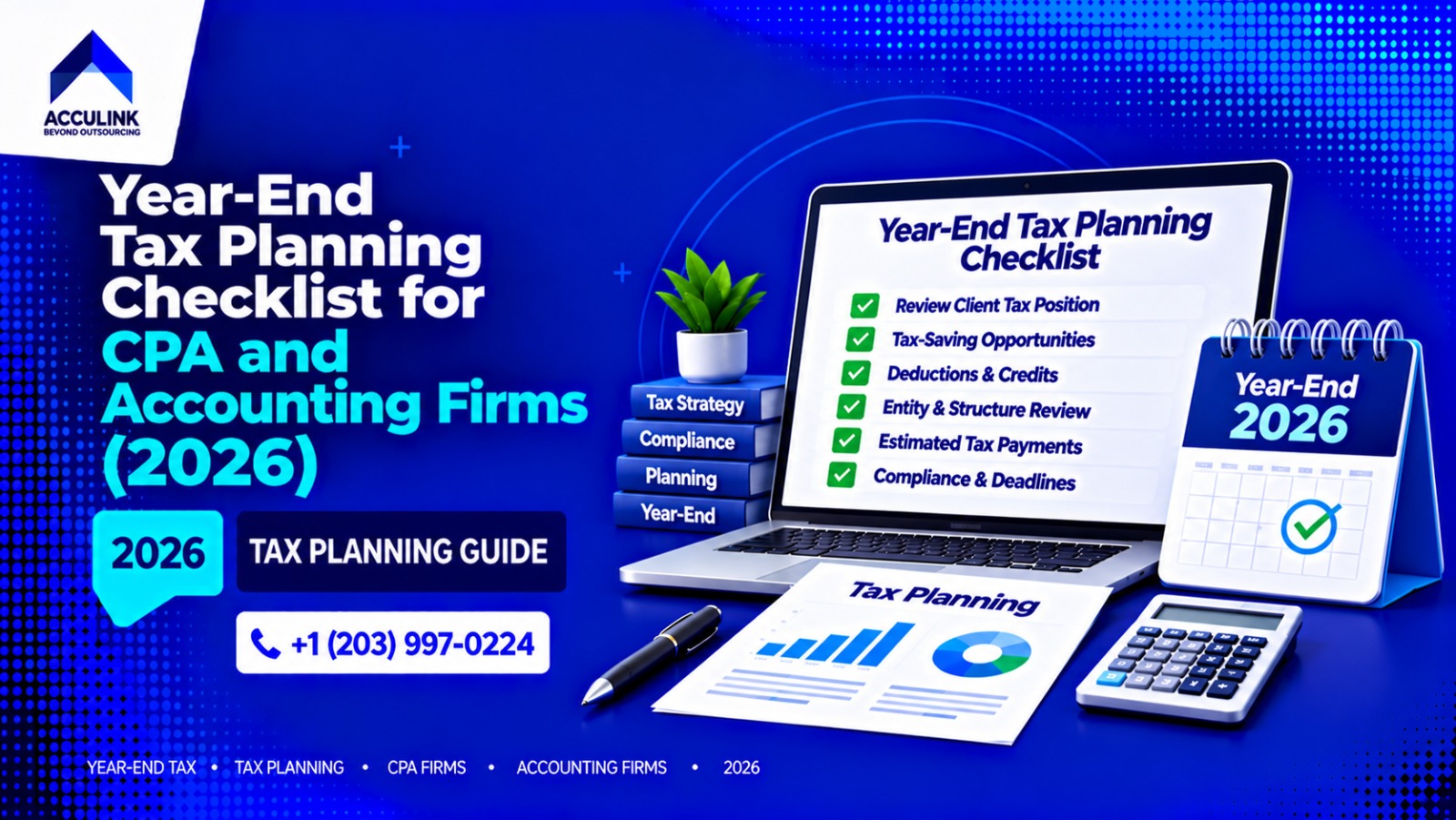
Year-End Tax Planning Checklist for CPA and Accounting Firms (2026)

Summary
This 2026 year-end tax planning checklist helps CPA and accounting firms prioritize clients, prepare projections, review business tax strategies and track approved actions. It also explains how to scope preparation and review support, with Acculink\'s published all-inclusive, role-based staffing rates of $8 to $35 per hour, depending on experience, complexity and scope.
Year-end tax planning for 2026 should give each client a current tax projection, a shortlist of relevant options, and a clear record of what must happen before each deadline. For U.S. CPA and accounting firms, the practical challenge is completing that work across the client portfolio while preserving enough senior time for review and advice.
A useful year-end tax planning checklist connects the books, the business return and the owner's tax position. It also identifies who prepares the analysis, who approves the recommendation and who confirms implementation.
This guide focuses on planning for calendar-year business clients and their owners. Adapt the review for fiscal-year entities, state requirements and individual circumstances.
Key takeaways
- Start with reconciled records and a documented projection.
- Prioritize clients with material changes and decisions that require action soon.
- Model tax effects, cash requirements and state treatment together.
- Separate year-end actions from later payment, contribution and filing deadlines.
- Delegate defined preparation work while the responsible firm retains advice and approval.
Acculink offers all-inclusive, role-based offshore staffing from $8 to $35 per hour. Firms can scope tax planning and advisory support around their client workload, with the experience level and assignment determining the quote.
What should a year-end tax planning checklist include?
A year-end tax planning checklist should cover client selection, financial-data readiness, tax projections, applicable strategies, payment requirements, technical review and implementation. Each recommendation needs supporting assumptions, an owner and a deadline.
The AICPA & CIMA year-end planning toolkit provides practitioner resources for client planning discussions. The operational checklist below organizes the work needed to turn those discussions into completed client actions.
| Step | What the firm checks | Evidence or output |
|---|---|---|
| 1. Confirm scope | Tax year, entity classification, owners, states and planning engagement | Agreed scope and client responsibilities |
| 2. Select priority clients | Profit changes, transactions, payroll, investments and unresolved prior-year issues | Ranked client list |
| 3. Establish the data cutoff | Latest reconciled month and material missing records | Trial balance, financial statements and open-items list |
| 4. Build the baseline | Expected remaining activity, tax adjustments and owner information | Dated 2026 projection |
| 5. Identify relevant options | Asset purchases, compensation, deductions, retirement and state elections | Options with eligibility questions |
| 6. Compare scenarios | Federal and state effects, cash required and effects on other deductions | Consistent scenario schedule |
| 7. Check payments | Estimates, withholding, credits and payment dates | Payment reconciliation and recommendation |
| 8. Review the file | Calculations, assumptions, sources and unresolved technical matters | Review notes and approval |
| 9. Agree client actions | Decision, person responsible, amount and deadline | Written action plan |
| 10. Confirm completion | Payments, payroll, documents and transaction evidence | Implementation log and tax-season handoff |
Use the checklist as a working file. A recommendation awaiting client approval and a payment actually made should have different statuses.
Run year-end planning from one tracker.
Get an editable tracker for client priorities, review dates, approvals and completed actions.
Which clients should receive attention first?
Prioritize by the consequence of delay and the readiness of the records. A small engagement with a decision expiring soon may need attention before a larger client whose options remain open.
Start with clients showing:
- Significant profit changes, unusual income or a business or asset sale.
- Planned equipment purchases, hiring, bonuses or ownership changes.
- S corporation distributions requiring a compensation review.
- Multistate activity, residency changes or pass-through entity tax (PTET) questions.
- Material losses, uncertain basis or significant carryforwards.
- Retirement decisions or household changes that affect the projection.
Give each client a named preparer and reviewer. Record the latest date by which the firm needs missing information to produce a useful recommendation.
Where records are incomplete, scope a separate accounting cleanup assignment. If a decision cannot wait, use a clearly labeled estimate, identify the uncertain balances and show how they could change the result. An unsupported estimate should not become an approved recommendation simply because the deadline is close.
Build the projection from records the reviewer can trace
The minimum planning file normally includes current financial statements, the general ledger or trial balance, prior-year returns, payment records, payroll, asset activity and owner information. Request contracts, debt records and other documents when they materially affect the decision.
Before forecasting the final months, resolve unexplained bank differences, duplicate entries, suspense balances and material payroll discrepancies. Bank and card reconciliation support can address that preparation work before a tax reviewer begins.
Keep three layers visible:
- Actual results: the reconciled period, accounting method and known adjustments.
- Forecast assumptions: expected receipts, expenses, transactions and owner-level items.
- Planning alternatives: proposed actions measured against the same baseline.
Tax planning for business owners extends beyond the entity calculation. Relevant household income, spouse information, investments, withholding and other businesses may change the result. Ask for the information required by the engagement.
Version the projection whenever material facts change. Each scenario should show the same starting balances, the specific change being tested and its effect on both tax and cash.
Year-end tax planning strategies to review for business clients
The following business tax planning strategies are review areas, not recommendations for every client. Select the applicable items and document why an option works for the client's facts.
1. Revisit income, expense and accounting-method assumptions
Evaluate the proposed timing of receipts, deductible expenses, bonuses, bad debts and prepayments under the client's accounting method.
Cash-method clients need constructive-receipt and prepayment checks. Accrual-method clients need the applicable liability and economic-performance analysis. Postponing an invoice or moving a bookkeeping entry alone does not establish the desired tax treatment. The IRS accounting-periods and methods guidance explains the underlying distinctions.
Record the transaction, support, expected recognition year and state treatment. If the proposal requires an accounting-method change, escalate the procedure and filing requirements rather than treating it as an ordinary adjusting entry.
2. Model bonus depreciation and Section 179
For bonus depreciation in 2026, verify the acquisition date, property type, business use and placed-in-service date. Eligible property acquired and placed in service after January 19, 2025 can qualify for the restored 100% special depreciation allowance.
For tax years beginning in 2026, the Section 179 deduction limit is $2,560,000, reduced by qualifying property costs above $4,090,000. Income limits and property-specific restrictions also matter. Compare the available elections and state conformity using IRS Publication 946, including its “What's New for 2026” section.
A December order or deposit does not establish that an asset is placed in service. Obtain evidence that it is ready and available for its intended use.
Show the cash commitment alongside the deduction and any effect on other tax calculations. Include financing and implementation costs when they affect the business decision.
3. Review S corporation compensation and owner payments
For S corp reasonable compensation, reconcile payroll, distributions, shareholder payments and duties before the final payroll cycle. The IRS compensation and medical-insurance guidance requires reasonable compensation for shareholder services and explains special treatment of health premiums for more-than-2% shareholder-employees.
Review accountable-plan reimbursements, substantiation and owner-paid business expenses where applicable. Use the actual facts and governing requirements rather than a fixed salary-to-distribution percentage.
The preparation file should identify the payroll adjustment proposed, supporting calculation, reviewer decision and payroll provider's processing cutoff. Payroll management support can help assemble and reconcile those records.
4. Recalculate QBI and review losses before approving deductions
The qualified business income (QBI) deduction may allow eligible owners to deduct up to 20% of QBI, subject to applicable limitations. Taxable income, business type, wages and qualified-property information can affect the result. The IRS QBI guidance sets out the framework.
Use the 2026 thresholds and minimum-deduction rules where applicable. Recalculate the owner's position after a proposed compensation, depreciation, retirement or state-tax adjustment. A change to business income may also change the QBI calculation.
Where losses matter, request current basis and other applicable limitation schedules. Flag missing contributions, distributions, debt changes and suspended losses. The reviewer should resolve the relevant limitations before relying on a loss in the projection.
5. Coordinate PTET elections with the owner's state position
A PTET election needs state-specific analysis of eligibility, election dates, payments, owner credits and resident-state treatment. IRS Notice 2020-75 describes federal deduction treatment for specified state and local income taxes paid by partnerships and S corporations.
Revisit the comparison under the owner's 2026 state and local tax (SALT) position. The federal individual SALT deduction cap is $40,400, or $20,200 for married filing separately, with reductions above $505,000 of modified adjusted gross income ($252,500 for married filing separately), and a floor of $10,000 ($5,000 for married filing separately). Use the current thresholds in IRS Publication 505.
Prepare an entity-and-owner comparison with cash payments, federal deductions and state credits shown separately. Record each jurisdiction's actual deadline and source. A federal benefit alone does not establish the total result.
6. Separate retirement-plan decisions from contribution funding
For existing plans, confirm compensation, employee eligibility, employer obligations and remaining deferral opportunities. The regular 401(k) elective-deferral limit for 2026 is $24,500. Applicable catch-up amounts and Roth catch-up requirements need a participant-specific check against the IRS 2026 retirement-limit guidance.
Plan establishment, deferral elections, payroll processing and deposits can have different deadlines. Coordinate with the plan administrator rather than assigning every retirement action to December 31.
For example, the IRS SEP FAQs explain that eligible SEP setup and contributions can generally extend to the business return's due date, including extensions. Model employee costs and self-employed calculations before recommending an employer contribution.
7. Check owner-level charitable and investment decisions where scoped
A business-client planning file may also need household-level analysis.
Beginning in 2026, non-itemizers may deduct qualifying cash charitable contributions up to $1,000, or $2,000 for joint filers. Eligibility, recipient and recordkeeping restrictions apply, including exclusions for certain contributions involving donor-advised funds and supporting organizations. The IRS guidance on charitable deductions for non-itemizers explains the rule.
For itemizers, review the new 0.5% of AGI charitable-deduction floor, along with other applicable limits, in Publication 505. Where relevant, coordinate investment gains and losses, Roth-conversion analysis and distribution requirements with the client's other advisers.
Document the scope and obtain the necessary information before including these items in a firm recommendation.
Additional technical review when the client profile requires it
Research-intensive businesses may need a Section 174A review. Current IRS Working Families Tax Cuts guidance distinguishes domestic research-expense treatment from foreign research and identifies transition procedures.
Real estate, international transactions, significant credits, ownership changes and business sales may require specialist work. List those matters separately, with the technical reviewer and required decision date identified.
Estimated Tax Safe Harbor: Reconcile Payments Separately From the Projected Tax Bill
A year-end tax projection should show the expected total liability and the amount still payable. Its payment schedule should also test applicable underpayment-penalty requirements.
For many individuals, the general safe harbor comparison uses 90% of current-year tax or 100% of prior-year tax, whichever is smaller. The prior-year return must cover 12 months. For 2026, the prior-year percentage generally rises to 110% when 2025 adjusted gross income (AGI) exceeds $150,000, or $75,000 if married filing separately. Special rules and exceptions apply. Review IRS underpayment guidance and Publication 505.
Reconcile amounts actually paid, payment dates, withholding and credited overpayments. A catch-up payment does not necessarily eliminate an earlier-period underpayment. Uneven-income clients may need annualized calculations.
Keep corporate estimates on a separate calculation. Individual safe harbor rules should not be applied to a C corporation.
Separate the 2026 action calendar from the 2027 filing calendar
Year-end tax planning in 2026 concerns the current tax year. Preparing the resulting return during the 2027 filing season is a related, later task.
| Timing | Planning checkpoint | What the firm should record |
|---|---|---|
| Before the planning review | Triage clients, reconcile records, prepare projections and reserve review capacity | Missing information, preparer, reviewer and client decision dates |
| Before the final applicable payroll cutoff | Complete approved owner-payroll and deferral actions | Instructions, approval and processed payroll evidence |
| By December 31, 2026, where the rule requires it | Complete qualifying calendar-year transactions and actions | Evidence of completion, not just an intention to act |
| January 15, 2027 | Generally the final 2026 estimated-tax installment for calendar-year individuals | Payment calculation, approval and confirmation |
| Applicable 2027 return due date | Complete permitted later contributions and filing work under the relevant rules | Separate establishment, election, funding and filing deadlines |
January's individual estimated-payment timing comes from Publication 505. State dates, fiscal years, plan rules and applicable relief can change individual requirements. Use the business tax deadline guide for the wider filing calendar.
Set internal review dates early enough to leave time for client approval, bank processing, payroll changes and third-party administration. Those internal dates are firm controls, not statutory deadlines.
Year-end planning queue building up?
Compare preparation and review support around your planning files and internal deadlines.
Example: turn a projection into an approved action
Consider an illustrative calendar-year business with:
| Projection component | Illustrative amount |
|---|---|
| Reconciled profit through October | $240,000 |
| Expected November and December profit, before proposed adjustments | $70,000 |
| Baseline profit before remaining book-to-tax adjustments | $310,000 |
The owner is considering equipment with a $40,000 business-use basis that is not reflected in the baseline. The preparation team produces two scenarios using the same starting figures.
If the reviewer confirms a full $40,000 deduction is available in 2026, that scenario shows $270,000 before other adjustments. If the asset will not be ready and available until January, the file must reflect the later placed-in-service year.
The firm's reviewer still considers state treatment, QBI, applicable limitations, financing and the owner's full tax position. The $40,000 deduction is not a $40,000 reduction in tax.
The client action is specific: approve or decline the purchase, confirm the intended in-service date, provide supporting evidence and assign a follow-up owner. The example illustrates the workflow; it is not a client case study or savings forecast.
What year-end planning work can an external team prepare?
Useful delegation starts with a defined deliverable and acceptance criteria.
| Work package | Preparation support can include | Responsible firm's retained decisions |
|---|---|---|
| Financial-data readiness | Reconciliations, schedules, document indexing and open-items tracking | Accounting treatments and material unresolved balances |
| Projection preparation | Populate approved software, roll forward verified data and document assumptions | Assumptions, methods and accepted limitations |
| Scenario analysis | Compare approved alternatives and reconcile supporting schedules | Technical positions and recommended strategy |
| Review support | Tie calculations to records, clear assigned comments and maintain the issue register | Technical escalation and final approval |
| Implementation tracking | Collect confirmations and update the action log | Client advice, authority and acceptance of completion |
Ask for a complete package: source references, assumptions, calculations, open questions and a change summary. That gives the reviewer a file to assess without reconstructing the preparation.
Measure accepted output and the firm's remaining review effort. A high number of outsourced hours provides little value if coordination and correction consume the senior time needed for client advice. Keep planning and compliance scope clear when pricing tax work.
Before sharing client data, confirm applicable disclosure and use permissions, access controls and contractual responsibilities. The IRS Section 7216 information center explains the tax-return-information framework. The accounting outsourcing process guide provides a practical handoff structure.
How Acculink supports CPA and accounting firms with year-end planning
Acculink's tax planning and advisory service supports year-end projections, deduction analysis and written planning memos. Firms can scope that preparation around their own client portfolio, software, review standards and planning calendar.
Where incomplete books are delaying the analysis, cleanup and reconciliation work can form the first assignment. Where review capacity is limiting progress, outsourced tax review support can be discussed separately from projection preparation.
Acculink supports your firm with:
- Your systems and workflow: Dedicated offshore staff work within your firm's existing systems and reporting structure.
- Preparation and review: Acculink uses a two-tier process for its accounting deliverables, with preparation followed by senior review before delivery.
- Experienced team: Acculink has 300+ qualified team members supporting 80+ accounting firms.
- Flexible engagement: Start with a 40-hour free trial, with no setup or recruitment fees and no long-term contract.
Acculink offers all-inclusive, role-based dedicated staffing from $8 to $35 per hour. A senior planning or review assignment should be quoted for its actual requirements. Compare a defined project with dedicated team capacity where the workload is recurring, and assess the data security controls against your firm's requirements.
Your firm retains responsibility for the engagement, accepted assumptions, recommendations and client advice.
Have planning files waiting on preparation or review? Ask Acculink to scope the workload. Share the client types, software, outstanding work and required completion dates. Agree one representative deliverable before expanding the assignment.
Frequently asked questions
What should a year-end tax planning checklist include?
Include reconciled financial information, a dated tax projection, relevant business and owner-level review areas, payment reconciliation, technical approval and an implementation log. Record each action's owner, actual deadline and completion evidence.
When should CPA and accounting firms start year-end tax planning?
Begin early enough to obtain reliable records, prepare calculations, secure review and leave clients time to act. November and early December can be useful for calendar-year clients, but payroll cutoffs, transaction lead times and state or plan requirements may call for earlier work.
Is 2026 year-end tax planning the same as preparing for the 2027 tax season?
They are connected but serve different purposes. Year-end planning evaluates choices affecting 2026 while relevant options remain available. The 2027 filing process reports the resulting 2026 activity. Preparing the return later does not reopen an expired planning opportunity.
Which business tax planning strategies deserve review before year-end?
Depending on the client, review income and expense timing, depreciation elections, owner compensation, QBI, applicable loss limitations, PTET, retirement arrangements and estimated payments. Model only relevant options and consider federal, state, cash-flow and owner-level effects together.
Is bonus depreciation 100% in 2026?
Eligible property acquired and placed in service after January 19, 2025 can qualify for 100% bonus depreciation. Verify the acquisition rules, property eligibility, business use, elections and placed-in-service evidence. State treatment may differ.
Must every 2026 tax planning action be completed by December 31?
No. Some transactions require calendar-year completion, while certain estimated payments and retirement contributions have later deadlines. Establishment, election, payroll and funding dates can differ. Track each action under its applicable rule rather than assigning one deadline to the whole plan.
Can an offshore team help with year-end tax planning?
Yes. A suitably experienced team can prepare reconciliations, projection inputs, approved scenario schedules, review support and action tracking. The engagement should define access, permissions, evidence and escalation. The responsible firm retains accepted assumptions, recommendations, client advice and final approval.
How much does Acculink's year-end planning support cost?
Acculink offers all-inclusive, role-based dedicated staffing from $8 to $35 per hour. The appropriate planning-support quote depends on experience, complexity, software, review requirements and scope. Its engagement options include a 40-hour free trial.
What should a firm prepare before requesting planning support?
Provide the client and entity mix, accounting and tax software, status of the books, required calculations, unresolved issues, available reviewers and completion dates. Define one representative work package and its acceptance criteria so the scope can be priced and evaluated.
Finish the planning cycle with documented client actions
Proactive tax planning becomes valuable when clients receive decisions they can implement. Start with a reliable baseline, review the relevant alternatives and follow each approved action through to completion.
If preparation or review capacity is holding up that work, discuss a defined year-end assignment with Acculink while there is still time to put the analysis to use.
More planning capacity. Less year-end pressure.
Projection preparation and review support, with your firm retaining advice and final approval.
300+ professionals | 80+ U.S. firms | Two-tier review
Tags:
About the Author

Related Posts
Top Tax Outsourcing Companies for CPA and Accounting Firms (2026 Rankings)
The top tax outsourcing companies for CPA firms in 2026 are Acculink CPA, QX Accounting Services, CapActix, Da…
Top 10 Offshore Staffing Companies for Accounting Firms (2026)
Hiring an offshore team is one of the highest-leverage moves a short-staffed CPA firm can make, but the partne…
Top Outsourced Accounting Firms for CPA Practices (2026)
Choosing an outsourced accounting partner is a high-stakes call because the team touches your clients' data. T…
Top 10 Audit Support Outsourcing Companies for CPA and Accounting Firms (2026)
Compare ten audit support outsourcing companies for U.S. CPA and accounting firms. This guide separates manage…