When Are Business Taxes Due in 2027? A Federal Deadline Guide for CPA and Accounting Firms

Summary
See when common business taxes are due in 2027, including key March 15, April 15 and May 17 deadlines. This guide helps CPA and accounting firms separate filing from payment, plan extensions and align preparation capacity, with Acculink offshore support available at published all-inclusive, role-based rates of $8 to $35 per hour.
The quick answer: For calendar-year businesses filing 2026 federal returns in 2027, partnerships and S corporations generally file by March 15, 2027. Calendar-year C corporations, sole proprietors filing Schedule C, and calendar-year estates and trusts generally file by April 15, 2027. Calendar-year tax-exempt organizations generally file Form 990 by May 17, 2027, because May 15 falls on a Saturday.
A timely extension generally moves the filing deadline to September 15 for Forms 1065 and 1120-S, September 30 for most Forms 1041, October 15 for calendar-year Forms 1120 and 1040, and November 15 for calendar-year Forms 990. An extension to file does not normally extend the time to pay.
The phrase “when are business taxes due?” can refer to several different obligations: the annual return, a balance due with that return, estimated income-tax payments, payroll-tax returns, or information returns. The correct date depends on the entity's federal tax classification, return, year-end and circumstances. This guide separates those dates and then shows CPA and accounting firms how to build preparation and review capacity behind them.
For a month-by-month lookup with selected filing, payment and reporting dates, use Acculink's Tax Due Dates Calendar. This article provides the explanation and firm-level workflow behind the calendar.
Date scope: This article covers common federal deadlines. It is not an exhaustive tax calendar and does not determine any client's filing obligation. Dates were checked against IRS materials available on October 27, 2026, including the IRS draft of Publication 509 for 2027. Confirm final form instructions, state and local dates, special filer rules and current disaster relief before relying on a deadline.
Key takeaways
- There is no single business tax deadline. The return and due date follow the entity's federal tax classification, year-end and circumstances.
- The main calendar-year return dates are March 15 and April 15. Partnerships and S corporations generally file Forms 1065 and 1120-S by March 15; C corporations, Schedule C filers, and estates and trusts generally file by April 15.
- An LLC does not have one universal due date. Its deadline follows whether it is treated as a disregarded entity, partnership, S corporation or C corporation for federal tax purposes.
- Extensions separate filing from payment. Requests are generally due on the original return date, and additional filing time does not normally extend the time to pay.
- A statutory date is not a production plan. Set earlier document, preparation, review, authorization and transmission dates, then compare required preparation and review hours with available capacity by deadline cohort.
Need more preparation capacity? Acculink offers all-inclusive, role-based pricing from $8 to $35 per hour. Firms can use outsourced tax preparation for a defined workload or hire a tax preparer for recurring capacity while retaining final review and filing control.
Business filing deadlines and payment deadlines are different
A useful answer to “when are business taxes due?” must identify the obligation, not only the entity. Track four dates separately:
- Annual return deadline: when the applicable return must be filed.
- Balance-due deadline: when tax associated with the return must generally be paid.
- Estimated-tax deadline: when a current-year installment is due.
- Employment or information-return deadline: when payroll returns, W-2s, 1099s or similar filings are due.
A filing extension usually does not move the payment date. A return can therefore be validly extended while a payment is late, or be on schedule after an information-return obligation has passed.
Plan the work behind every deadline.
Get an editable planner for return counts, preparation hours, review capacity and internal cutoffs.
2027 IRS business tax deadlines at a glance
The table below combines selected IRS tax deadlines for businesses, including common filing, payment, employment-tax and information-return dates. A 2027 filing date often relates to a 2026 tax-year return, while 2027 estimated-tax dates relate to the 2027 tax year. Keeping the filing year and tax year in separate fields prevents a common source of scheduling errors.
| 2027 date | Common federal filing or payment | Extension or next major date |
|---|---|---|
| January 15 | Fourth 2026 estimated-tax installment for individuals, including many sole proprietors and business owners | Reconcile the payment with the 2026 return workpapers |
| February 1 | 2026 Forms W-2 and W-3; Form 1099-NEC; many recipient statements; 2026 Q4 Form 941; 2026 Form 940 | Some employment-tax returns may qualify for a February 10 filing date when deposits were timely, properly and fully made |
| March 1 | Paper filing of many 2026 information returns other than forms with an earlier deadline | Many electronically filed information returns are due March 31; check the specific form |
| March 15 | Calendar-year Form 1065 and partner K-1/K-3 delivery; Form 1120-S and shareholder K-1/K-3 delivery, with K-3 when applicable | Timely Form 7004 generally moves both return deadlines to September 15 |
| March 31 | Electronic filing of many Forms 1097, 1098, 1099, 3921, 3922 and W-2G, subject to form-specific exceptions | Recipient dates may be earlier |
| April 15 | Calendar-year Form 1120; Form 1040 with Schedule C, E or F, as applicable, for sole proprietors and individual-owned disregarded single-member LLCs; calendar-year Form 1041; first 2027 estimated-tax installment for individuals and calendar-year corporations | Form 1120 and Form 1040 generally extend to October 15; most Form 1041 filers receive a 5.5-month extension to September 30 |
| April 30 | 2027 Q1 Form 941 | May 10 may apply when deposits were timely, properly and fully made |
| May 17 | Calendar-year Form 990 series return, moved from Saturday, May 15 | A timely Form 8868 generally extends the filing date to November 15 |
| June 15 | Second 2027 estimated-tax installment for individuals and calendar-year corporations | Continue monitoring changes in projected taxable income |
| August 2 | 2027 Q2 Form 941, moved from Saturday, July 31 | August 10 may apply when deposits were timely, properly and fully made |
| September 15 | Extended calendar-year Forms 1065 and 1120-S; third 2027 estimated-tax installment for individuals and calendar-year corporations | Final K-1 and, when applicable, K-3 delivery is due by the extended return deadline |
| September 30 | Extended calendar-year Form 1041 for most estates and trusts | Confirm the exact extension period and entity type |
| October 15 | Extended calendar-year Form 1120; extended Form 1040 with Schedule C | Tax was generally due on the original filing date |
| November 1 | 2027 Q3 Form 941, moved from Sunday, October 31 | November 10 may apply when deposits were timely, properly and fully made |
| November 15 | Extended calendar-year Form 990 series return after a timely Form 8868 | Form 990-N cannot be extended |
| December 15 | Fourth 2027 estimated-tax installment for calendar-year C corporations | Reconcile payment records before year-end |
The IRS Publication 509 page is the central source for the federal tax calendar. The IRS has also released a processing-year 2027 Form 7004 due-date chart. Neither source replaces the instructions for the particular return.
When are business tax returns due by entity?
The date follows the federal return and year-end, not simply the entity's legal name.
| Entity or filer | Common federal return | Original 2027 deadline for a calendar-year 2026 return | Common extended deadline |
|---|---|---|---|
| Partnership or multi-member LLC taxed as a partnership | Form 1065 | March 15, 2027 | September 15, 2027 |
| S corporation or LLC taxed as an S corporation | Form 1120-S | March 15, 2027 | September 15, 2027 |
| C corporation or LLC taxed as a C corporation | Form 1120 | April 15, 2027 | October 15, 2027 |
| Sole proprietor or individual-owned disregarded single-member LLC | Form 1040 with Schedule C, E or F, as applicable | April 15, 2027 | October 15, 2027 |
| Calendar-year estate or trust | Form 1041 | April 15, 2027 | September 30, 2027 for most filers |
| Calendar-year tax-exempt organization | Form 990, 990-EZ or 990-PF | May 17, 2027 | November 15, 2027 |
These dates assume a calendar year and ordinary federal rules. Short years, specialized filers, elections and disaster relief can change the result.
When are LLC taxes due?
An LLC's deadline follows its tax classification. A calendar-year multi-member LLC taxed as a partnership or an LLC taxed as an S corporation generally files by March 15. An LLC taxed as a C corporation generally files by April 15. A disregarded single-member LLC reports through its owner's return: commonly April 15 for an individual owner, but the owner's applicable deadline when owned by another entity. Confirm ownership, elections and short years before assigning the date.
When are partnership taxes due?
The Form 1065 due date for a calendar-year partnership is March 15, 2027; a timely Form 7004 generally extends filing to September 15. Track required K-1 and, when applicable, K-3 delivery with the entity return because delays affect owner filings. Acculink provides partnership and LLC tax-return support for defined preparation work.
When are S corp taxes due?
The S corp tax deadline for a calendar-year corporation is March 15, 2027; a timely Form 7004 generally extends filing to September 15. Track shareholder K-1 and, when applicable, K-3 delivery, and resolve open basis, state and shareholder issues before release. S corporation tax-return preparation support can cover defined work packages.
When are corporate taxes due?
The corporate tax deadline for a calendar-year C corporation is April 15, 2027. A timely Form 7004 generally extends filing to October 15, not payment. For tax years beginning in 2026, the temporary seven-month extension for certain June 30 year-end corporations has expired; check the Form 7004 instructions. Acculink also provides C corporation return preparation support.
When are sole proprietor and single-member LLC taxes due?
A sole proprietorship, or a disregarded single-member LLC owned by an individual, generally reports on Schedule C, E or F with Form 1040, as applicable. The calendar-year individual deadline is April 15, 2027 and is commonly extendable to October 15. An entity-owned disregarded LLC is reflected on its owner's entity return. See Acculink's individual tax-return preparation support.
When are estate and trust returns due?
The Form 1041 due date for a calendar-year estate or trust is April 15, 2027. Most receive a 5.5-month Form 7004 extension to September 30, although bankruptcy estates and certain related returns differ. Acculink's trust tax-return support can be scoped around preparation and workpapers.
When is Form 990 due?
Forms 990, 990-EZ and 990-PF are generally due on the 15th day of the fifth month after year-end. For a calendar-year organization, the 2027 deadline moves from Saturday, May 15 to Monday, May 17. A timely Form 8868 generally extends filing to November 15; Form 990-N cannot be extended.
What is the business tax extension deadline in 2027?
There is no universal business tax extension deadline. The extension request is generally due by the original deadline for the return being extended.
| Calendar-year filer | Return | File the return or extension by | Common extension form | Common extended filing deadline |
|---|---|---|---|---|
| Partnership or multi-member LLC taxed as a partnership | Form 1065 | March 15, 2027 | Form 7004 | September 15, 2027 |
| S corporation or LLC taxed as an S corporation | Form 1120-S | March 15, 2027 | Form 7004 | September 15, 2027 |
| C corporation or LLC taxed as a C corporation | Form 1120 | April 15, 2027 | Form 7004 | October 15, 2027 |
| Sole proprietor or individual-owned disregarded single-member LLC | Form 1040 with applicable schedule | April 15, 2027 | Form 4868 | October 15, 2027 |
| Estate or trust | Form 1041 | April 15, 2027 | Form 7004 | September 30, 2027 for most filers |
| Tax-exempt organization | Form 990, 990-EZ or 990-PF | May 17, 2027 | Form 8868 | November 15, 2027 |
Form 7004 applies to many business income-tax and information returns, including Forms 1065, 1120-S, 1120 and 1041. Form 8868 applies to many exempt-organization returns. Sole proprietors generally request an individual extension through Form 4868 because Schedule C is part of Form 1040.
A valid extension provides more time to submit the return, commonly six months or 5.5 months for most Form 1041 filers. It generally does not:
- extend the time to pay tax;
- complete elections with separate deadlines or extend other filings automatically;
- correct the return type or year-end, or replace authorization and review; or
- solve an overloaded preparation or review queue.
Form 7004 generally requires a proper estimate, with tax due addressed by the original return date. Retain the extension request, acceptance evidence, payment calculation and extended date.
How fiscal-year business tax deadlines are calculated
Calculate fiscal-year deadlines from the actual year-end:
| Return | General original due-date formula | General extension period |
|---|---|---|
| Form 1065 | 15th day of the third month after year-end | 6 months |
| Form 1120-S | 15th day of the third month after year-end | 6 months |
| Form 1120 | 15th day of the fourth month after year-end | 6 months for tax years beginning in 2026, subject to applicable exceptions |
| Form 1041 | 15th day of the fourth month after year-end | 5.5 months for most estates and trusts |
| Form 990 series | 15th day of the fifth month after year-end | 6 months through Form 8868 for eligible returns |
When a date falls on a Saturday, Sunday or District of Columbia legal holiday, it generally moves to the next qualifying day. Store the formula and calculated date, and review special filer rules and disaster postponements separately.
Build the workflow backward from the filing date
A statutory deadline does not say when work must begin. Set earlier document, preparation-ready, preparation-complete, review-complete and transmission dates.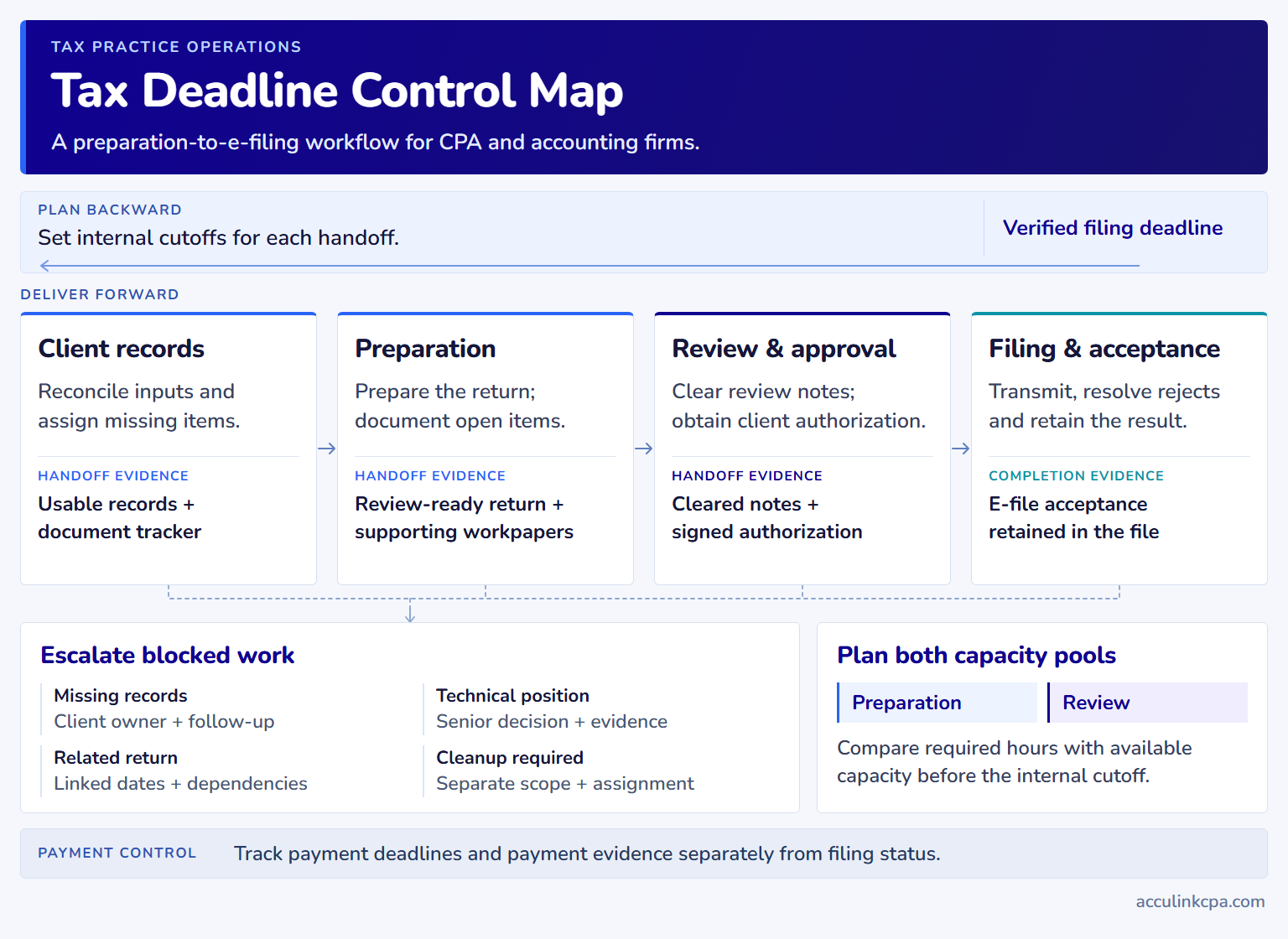
An illustrative reverse schedule
This operating example is not an IRS requirement. Adjust it for complexity, readiness and the firm's review model.
| Time before the filing deadline | Control objective | Evidence of readiness |
|---|---|---|
| 12 to 10 weeks | Confirm entity classification, year-end, return set, extension policy, staffing and reviewer | Approved engagement setup and deadline record |
| 10 to 7 weeks | Issue the tailored request list and receive core records | Document tracker showing received, usable and missing items |
| 7 to 4 weeks | Reconcile inputs and complete preparation | Review-ready return, workpapers and open-item list |
| 4 to 2 weeks | Complete technical and manager review; resolve material questions | Cleared review notes and documented conclusions |
| 2 to 1 weeks | Obtain client approval, signatures and payment instructions | Authorized filing package |
| Final week | Transmit, resolve rejects and retain acceptance | E-file acceptance and payment evidence |
Set the internal transmission target early enough to resolve rejects.
Quick capacity check: For each deadline cohort, total the expected preparation and review hours and compare them with staff hours available before the firm's internal cutoff. If work with complete records still cannot reach review on time, ask Acculink to scope the capacity gap using nonconfidential return counts, complexity, software and target weeks. Acculink can quote a defined project or dedicated role at its published all-inclusive rates of $8 to $35 per hour. The CPA or accounting firm retains its tax positions, final review and filing control.
Manage extensions by cause, not as one queue
Classify why each return moved instead of managing one undifferentiated extension queue:
| Extension reason | Immediate action | Capacity implication |
|---|---|---|
| Missing client information | Name the item, owner and follow-up | More preparer capacity will not fix it |
| Unresolved technical position | Assign a decision owner and evidence date | Reserve senior or specialist time |
| Related return or K-1 | Link upstream and downstream dates | Sequence affected returns together |
| Records require cleanup | Separate cleanup from tax preparation | Scope the added work first |
| Preparation backlog | Reassign standardized work | Add capacity before review is affected |
| Reviewer bottleneck | Protect senior review blocks | More junior output may worsen it |
Measure extension causes by return type, client and reviewer; late K-1s require a different response from insufficient capacity.
Too many returns for the hours available?
Compare project support and dedicated preparer or reviewer capacity against your return mix.
A deadline-control checklist for CPA and accounting firms
- Confirm the name, EIN, classification, accounting period and returns in scope.
- Record original filing, extension-request, payment and extended dates separately.
- Check weekend, holiday, disaster-relief and special-filer rules; link pass-through and owner returns.
- Assign requested items to client and internal owners, and distinguish received from usable.
- Reconcile core records, carry forward elections deliberately and escalate unusual items early.
- Assign preparer and reviewer, document conclusions and clear diagnostics.
- Confirm payment estimates and authorization; retain acceptance or rejection evidence.
- Compare preparation and review hours with capacity by form, complexity, week and reviewer.
What tax work can be delegated before a deadline?
Define the output, evidence, completion criteria and reviewer before delegating repeatable work such as:
- organizer, source-document indexing, prior-year rollforwards and workpaper setup;
- trial-balance mapping and supporting reconciliations;
- fixed-asset, depreciation and K-1 schedule updates;
- preparation of assigned federal and state return sections;
- diagnostics, open-item logs and workpaper cross-referencing;
- first-level review support; and
- e-file package assembly under the firm's controls.
The responsible firm should retain scope, tax positions, professional judgment, client advice, final review, authorization and filing control. Before sharing taxpayer information, address applicable Section 7216 consent requirements, contracts, access restrictions and professional obligations.
Use outsourced tax review support for a defined review queue or hire a tax reviewer for recurring demand. More unfinished work will not solve a reviewer bottleneck.
How Acculink supports a deadline-driven tax workflow
Built for U.S. CPA and accounting firms, Acculink provides offshore preparation and review capacity aligned with the firm's return mix, software, workpapers and internal deadlines. The responsible firm retains the client relationship, tax positions, final review, authorization and filing control.
Firms can use:
- outsourced tax preparation services for a defined return or workpaper queue;
- a dedicated tax preparer or tax reviewer for recurring demand;
- a dedicated offshore team when several recurring roles are required; or
- tax planning and advisory support when compliance capacity must connect with year-round planning work.
Acculink publishes all-inclusive, role-based pricing from $8 to $35 per hour. Its engagement models include project outsourcing and dedicated staffing, with a 40-hour free trial, no setup fee and no long-term lock-in. A two-tier maker-checker process adds senior review before delivery; the firm applies its own approval and filing controls.
Acculink's company overview reports 300-plus professionals supporting 80-plus U.S. accounting firms. Confirm the proposed team's relevant experience, review its IT and data-security controls, and complete the firm's own Section 7216, consent, security and vendor review.
Make the discussion specific. Bring return counts, complexity, software, target weeks, review hours and internal cutoffs. Then ask Acculink to map a project or dedicated staffing model to the deadline cohorts.
Frequently asked questions
When are business taxes due in 2027?
For calendar-year filers, partnerships and S corporations generally file by March 15, 2027; C corporations, Schedule C filers, and estates and trusts by April 15; and Form 990 series filers by May 17. Classification and year-end control the applicable date.
When are corporate taxes due in 2027?
A calendar-year C corporation generally files Form 1120 by April 15, 2027; an S corporation generally files Form 1120-S by March 15. Filing extensions normally do not extend payment.
When are S corp taxes due in 2027?
A calendar-year S corporation generally files Form 1120-S by March 15, 2027. A timely Form 7004 generally extends the deadline to September 15.
When are LLC taxes due in 2027?
An LLC's deadline follows its tax classification. Calendar-year partnership- and S-corporation filers generally file by March 15; C corporations file by April 15. A disregarded LLC follows its owner's return, commonly April 15 when the owner is an individual.
What is the Form 1065 deadline in 2027?
A calendar-year partnership generally files its 2026 Form 1065 by March 15, 2027. A timely Form 7004 generally extends filing to September 15.
What is the business tax extension deadline in 2027?
The request is generally due on the original filing date: March 15 for calendar-year Forms 1065 and 1120-S, April 15 for Forms 1120 and 1041, and May 17 for Form 990 series returns.
Does Form 7004 extend the time to pay business tax?
No. Form 7004 generally extends filing, not payment. The filer must properly estimate and address tax due by the original return date.
What is the Form 1041 due date in 2027?
A calendar-year estate or trust generally files Form 1041 by April 15, 2027. Most can extend filing to September 30 through Form 7004.
What is the Form 990 deadline in 2027?
A calendar-year Form 990, 990-EZ or 990-PF is generally due May 17, 2027 and extendable to November 15 through Form 8868. Form 990-N cannot be extended.
How are fiscal-year business tax deadlines calculated?
Partnership and S corporation returns are generally due on the 15th day of the third month after year-end, Forms 1120 and 1041 on the 15th day of the fourth month, and Form 990 series returns on the 15th day of the fifth month. Apply return-specific and weekend or holiday rules.
Can an IRS disaster declaration change a 2027 business tax deadline?
Yes. The IRS may postpone dates for affected taxpayers in designated areas. Check current IRS disaster-relief announcements for each client.
Can a CPA or accounting firm outsource tax preparation before a deadline?
Yes, when work is clearly scoped and the firm satisfies applicable consent, confidentiality, security, competence, supervision and review requirements. Define the return types, evidence, completion criteria and final reviewer first.
Turn the tax calendar into a capacity plan
A reliable process starts with the correct date, then works backward through preparation, review, authorization and transmission. Test capacity before the peak week arrives.
If the calendar exposes a gap, contact Acculink with nonconfidential return counts, complexity, software and target weeks. Its $8 to $35 per hour pricing allows comparison of a defined project with dedicated recurring capacity while the firm protects senior review and filing control.
More tax capacity. Less deadline pressure.
Tax preparation and review support, aligned with your firm's internal deadlines.
Tags:
About the Author

Related Posts

Tax Preparation Outsourcing for CPA Firms: How It Works, What It Costs, and Where to Start (2026)
Tax preparation outsourcing lets a CPA firm hand routine return preparation to an external team, usually offsh…
Top Tax Outsourcing Companies for CPA and Accounting Firms (2026 Rankings)
The top tax outsourcing companies for CPA firms in 2026 are Acculink CPA, QX Accounting Services, CapActix, Da…

Audit Staffing for CPA Firms: How to Hire Offshore Audit Professionals
Audit staffing should begin with the work and review capacity a CPA firm needs, not a generic headcount reques…

Top 10 Audit Support Outsourcing Companies for CPA and Accounting Firms (2026)
Compare ten audit support outsourcing companies for U.S. CPA and accounting firms. This guide separates manage…