Audit Staffing for CPA Firms: How to Hire Offshore Audit Professionals

Summary
Audit staffing should begin with the work and review capacity a CPA firm needs, not a generic headcount request. This guide compares in-house, contract, and offshore options and provides a practical framework for selecting roles, interviewing candidates, onboarding securely, and supervising audit work.
Audit staffing is the process of matching audit work with people who have the right experience, availability, and level of supervision. For a CPA firm, the real question is not simply how many auditors to hire. It is which roles are constrained, when the capacity is needed, and how the firm will review the work.
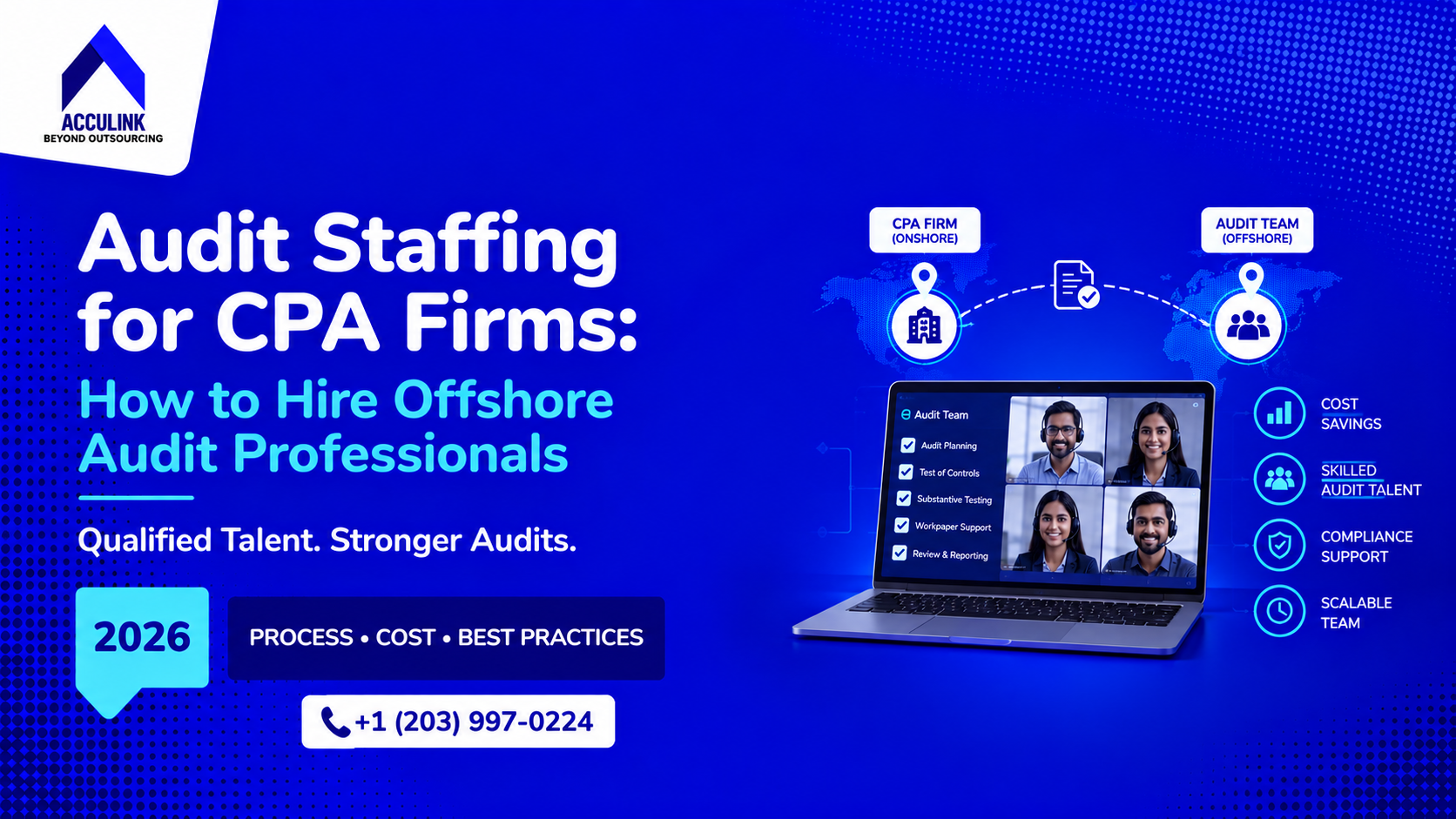
CPA firms can hire an offshore audit professional for dedicated capacity in planning support, testing, workpaper preparation, tie-outs, documentation, and review support. The firm still controls the engagement, applies professional judgment, supervises the work, communicates with the client, and issues the report.
Key Takeaways
- Start with a stage-level capacity gap, not a generic headcount target.
- Match seniority to the work. An associate, senior, reviewer, and manager solve different problems.
- Compare in-house, contract, and offshore staffing by usable capacity, continuity, supervision, and total delivery cost.
- Test technical ability with a realistic work sample, not credentials alone.
- Define access, documentation, review, escalation, and sign-off before client work begins.
- Hiring additional people does not transfer the engagement partner's responsibility for audit quality.
Why Audit Staffing Decisions Begin With the Workflow
Finding qualified staff has remained a leading concern for CPA firms. An AICPA PCPS survey identified finding qualified staff as the top issue for nearly every firm-size category, while effective staff utilization also appeared among the concerns of larger firms.
The operational effect appears inside the audit workflow. Planning may start late, complete client files may wait for testing, workpapers may accumulate before review, or managers may spend too much time correcting repeat documentation issues.
Adding an auditor helps only when the role matches the constraint. If associates are available but senior review is delayed, another entry-level hire can increase the queue. If managers are building routine schedules, adding preparation capacity may release more senior time than hiring another manager.
Map the work through these stages:
- Engagement setup and planning support
- Client requests and PBC coordination
- Walkthrough and control documentation
- Substantive testing and sampling
- Workpaper completion and cross-referencing
- Senior and manager review
- Partner review, communication, and report release
For each stage, track incoming work, completed work, queue age, review notes, and usable staff hours. The constrained stage should determine the first staffing decision.
Calculate the Audit Capacity Gap Before Hiring
Use the firm's own engagement data instead of a universal engagements-per-auditor benchmark. Audit complexity, client readiness, risk, industry, methodology, and reviewer expectations vary too much for one dependable ratio.
Required stage hours = forecast engagements x historical stage hours per engagement + known exception work
Usable stage capacity = scheduled hours - leave - training - administration - other committed work
Stage capacity gap = required stage hours - usable stage capacity
Calculate the gap separately for preparation, fieldwork, and review. Then ask whether the need is temporary, recurring, or uncertain.
| Finding | Likely staffing response |
|---|---|
| Short deadline spike in repeatable work | Seasonal or contract capacity may fit |
| Recurring preparation gap across the year | A dedicated associate or offshore audit professional may fit |
| Persistent review queue | Add senior or manager capacity and improve first-pass quality |
| Highly specialized, intermittent work | Contract expertise may be more practical than a permanent hire |
| Work waits because clients are unprepared | Fix PBC intake and ownership before adding headcount |
This calculation does not replace judgment. It makes the reason for hiring visible and gives the firm a way to test whether the new capacity solves the intended problem.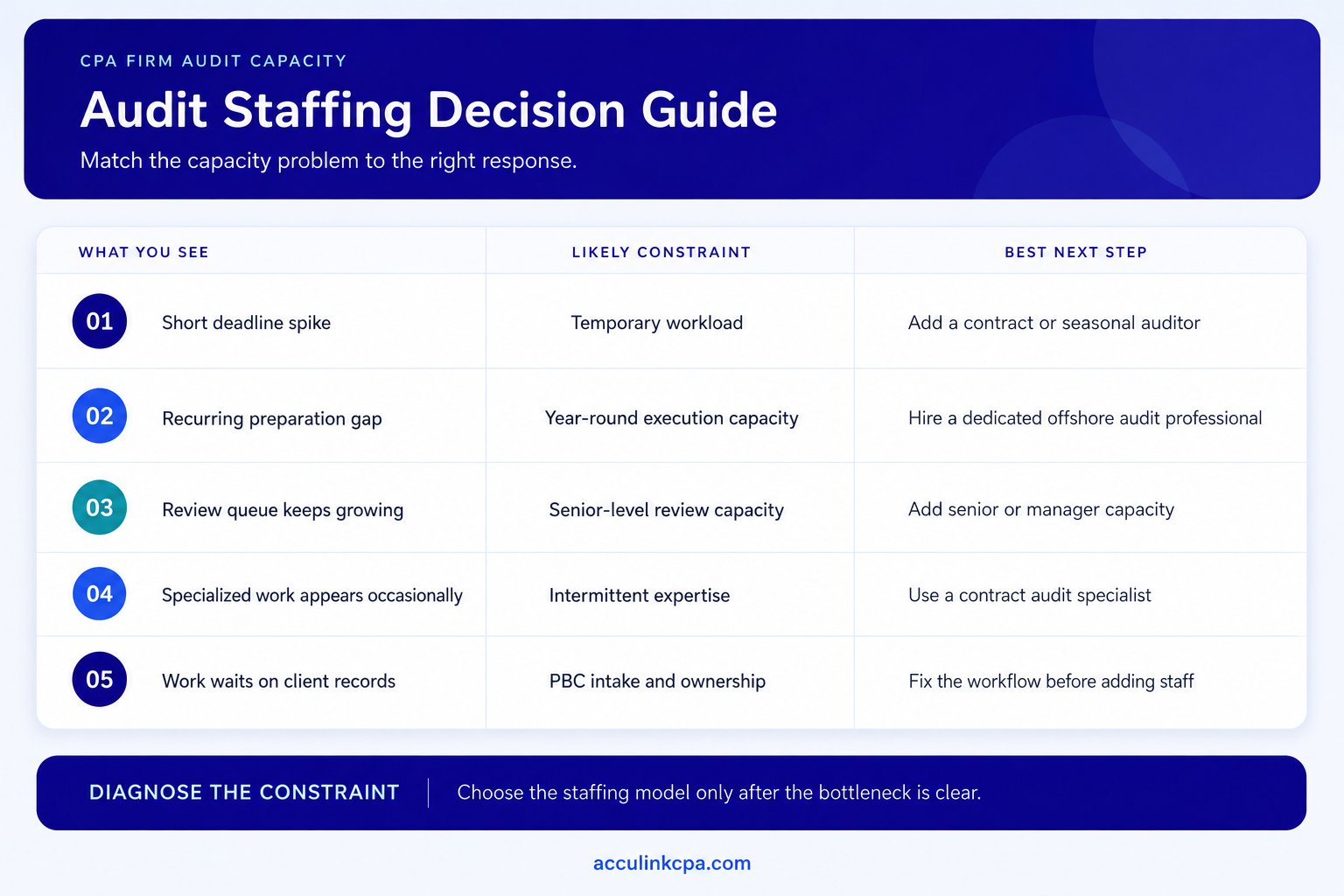
In-House, Contract, or Offshore Audit Staffing?
CPA firms can combine several staffing models. The right choice depends on duration, control, available management time, and how closely the professional must integrate with the firm's methods.
| Model | Best fit | Main tradeoff |
|---|---|---|
| Permanent in-house hire | Stable year-round demand and a long-term leadership pipeline | Recruiting time, fixed capacity, and utilization outside peak periods |
| Temporary or contract auditor | Defined seasonal period or specialist need | Availability, continuity, and repeated onboarding |
| Offshore audit professional | Recurring work that can be documented and performed within the firm's systems | Access design, communication cadence, supervision, and initial calibration |
| Outsourced project or task | Defined deliverable, engagement group, or overflow package | Scope clarity, handoffs, provider controls, and acceptance criteria |
Staffing and outsourcing are related, but they are not identical. With staffing, the firm hires a named professional or team and directs day-to-day work. With project outsourcing, the firm defines a deliverable and the provider organizes the production resources. A CPA firm that wants a person embedded in its workflow should evaluate offshore audit professionals. A firm that wants a defined package of work should evaluate outsourced audit support services.
Which Offshore Audit Role Does the Firm Need?
Do not use one job description for every level. Define the decisions the person may make, the work they may prepare, and the review they require.
| Role | Suitable work | Firm oversight needed |
|---|---|---|
| Audit assistant | PBC tracking, file organization, checklist completion, basic tie-outs | Detailed instructions and close review |
| Audit associate | Lead schedules, routine testing, sampling support, reconciliations, documentation | Procedure-level review and exception escalation |
| Senior audit associate | Complex testing, workpaper review, coaching, issue identification, engagement coordination | Manager review of significant matters and conclusions |
| Audit manager or reviewer | Planning support, risk-focused review, review-note clearance, team supervision | Partner direction, judgment, and final engagement responsibility |
The role must also fit the engagement mix. The following examples show how that requirement changes across Acculink's audit service areas.
Which Types of Audits Can Offshore Professionals Support?
Candidate experience must match the engagement, procedures, software, and review standard.
Audit Support Across Engagements
Outsourced audit support services are useful when repeatable preparation work is consuming the team's available hours across several engagement types. Offshore staff may coordinate PBC requests, organize files, perform tick-and-tie and vouching procedures, administer samples, complete routine testing, cross-reference evidence, and respond to review notes.
Verify that the professional can work in the firm's audit software, follow its documentation conventions, explain the evidence obtained, and escalate exceptions promptly. Example: an audit assistant organizes PBC documents, prepares a testing schedule, and sends missing or contradictory support to the in-charge instead of making an unsupported conclusion.
Financial Statement Audits
Financial audit support can help when associates or managers are spending substantial time building schedules and documenting routine procedures. Suitable work may include trial balance mapping, lead schedules, reconciliations, analytical procedures, confirmations tracking, substantive-testing workpapers, financial statement tie-outs, and disclosure-checklist support.
Look for experience with the applicable reporting framework, relevant assertions, the firm's evidence requirements, and the client's industry. Example: an offshore audit associate prepares the cash workpaper, traces selected items to support, records exceptions, and routes unresolved matters to the in-charge. The CPA firm's qualified professionals assess risk, determine additional procedures, and approve the conclusion.
401(k) Plan Audits
401(k) audit support is most useful when the firm faces a concentrated volume of participant-level data and repeatable plan testing. Offshore staff may organize PBCs, prepare selections, test census data, employee deferrals and employer contributions, document loans and distributions, reconcile payroll to trust activity, and support financial statement and Form 5500 tie-outs.
Candidates should have specific EBP audit experience rather than only general financial-audit experience. Example: an EBP audit associate traces sampled contributions from payroll to remittance support, documents the dates and amounts, and flags a timing difference. The CPA firm evaluates the exception, its significance, and any effect on further procedures or reporting.
Other Employee Benefit Plan Audits
A 401(k) plan is one type of employee benefit plan. EBP audit support may also assist with 403(b), defined benefit, pension, and other plan engagements when the professional has relevant plan-specific experience. Potential work includes plan-document summaries, participant-data testing, contribution and benefit-payment testing, trust-statement reconciliations, investment schedules, and financial statement tie-outs.
The job scorecard should identify the exact plan types, procedures, and reporting requirements involved. Example: an offshore professional prepares a benefit-payment testing schedule, traces selected payments to plan and participant records, and flags missing authorization. The firm's qualified auditor evaluates the evidence, compliance implications, and final conclusion.
These are examples of potential support, not a universal delegation list. In every category, the CPA firm retains engagement responsibility, supervision, professional judgment, final review, client communication, and responsibility for the audit opinion.
Build a Job Scorecard Before Reviewing Candidates
A useful scorecard converts a vague request for an auditor into evidence that can be evaluated consistently.
Include:
- engagement types, industries, and expected volume;
- the audit areas and procedures the person will perform;
- required experience level and examples of comparable work;
- the firm's audit software, document portal, and communication tools;
- work hours and required time-zone overlap;
- who assigns work, answers questions, and reviews deliverables;
- documentation and naming conventions;
- security, confidentiality, and device requirements; and
- success measures for the first pilot and ongoing work.
Separate required skills from trainable preferences. A candidate may learn a firm's file structure, but a person assigned to review complex audit areas needs the technical depth and judgment appropriate to that work.
Define the audit role before you start interviewing.
Get the scorecard for audit tasks, experience, software, supervision, and pilot measures.
How to Evaluate an Offshore Auditor
Use a structured evaluation that reflects the actual role.
1. Review Relevant Experience
Ask for specific engagement types, industries, audit areas, procedures, software, and review responsibilities. Years of experience alone do not show whether the candidate has performed the work your firm needs.
2. Use a Practical Work Sample
Provide a fictional or properly sanitized case. An associate might prepare a lead schedule, document a test, or identify missing evidence. A senior might review a workpaper and explain the review notes they would raise. Never use live client information in a recruiting test.
3. Test Documentation and Communication
Ask the candidate to explain the purpose of a procedure, the evidence obtained, an exception found, and the next question they would raise. Clear escalation is as important as polished formatting.
4. Evaluate Judgment Boundaries
A strong candidate should know when to stop and escalate. Test how the person responds to contradictory evidence, a scope change, an unusual transaction, a potential control deficiency, or an instruction that conflicts with the audit program.
5. Confirm the Working Environment
Verify availability, time-zone overlap, equipment, network controls, permitted work location, confidentiality terms, and how access will be granted and removed.
Supervision and Workpaper Quality Cannot Be Delegated Away
The staffing model does not change the firm's responsibility for the engagement. For audits conducted under PCAOB standards, AS 1201 states that the engagement partner is responsible for the engagement and proper supervision, including relevant team members outside the engagement partner's firm. Supervisors should communicate objectives and procedures, direct significant issues upward, and review whether the work was performed, documented, and supports the conclusions.
The applicable standards depend on the engagement. Each firm should have qualified professionals confirm how its methodology, independence obligations, quality management system, and supervision requirements apply.
A practical review model identifies:
- the preparer and completion date;
- the reviewer and review date;
- the procedure objective and relevant assertion;
- the source and evidence examined;
- exceptions, unresolved questions, and escalation owner;
- the conclusion and its supporting evidence; and
- the person authorized to clear review notes and sign off.
The AICPA's quality management guidance emphasizes monitoring, documenting gaps, assigning accountability, and following through on remediation. Offshore personnel should operate inside the firm's quality management system, not beside it.
A Controlled Offshore Auditor Onboarding Plan
Onboarding should move from access and observation to representative work and measured expansion.
Phase 1: Prepare
Document the role, procedures, templates, naming rules, review levels, communication channels, and escalation thresholds. Set up least-privilege access and confirm that client contracts, disclosures, consent requirements, and professional obligations have been considered.
Phase 2: Calibrate
Walk through a completed example and explain why the procedure was performed, not only where information was entered. Use sanitized materials for training whenever possible.
Phase 3: Pilot
Assign representative work with a defined completion standard. Track turnaround by stage, first-pass acceptance, review notes by cause, open questions, and rework hours. Do not judge performance using only the easiest file.
Phase 4: Expand or Correct
Increase volume only after the professional demonstrates consistent documentation, communication, and escalation. If review notes repeat, determine whether the cause is candidate skill, unclear instructions, poor source data, or inconsistent reviewer expectations.
The accounting outsourcing process provides a broader framework for scoping, access, preparation, review, sign-off, and feedback.
Protect Audit Client Data
Offshore audit staffing may involve financial statements, contracts, payroll, bank information, control descriptions, employee data, and other confidential records. Security needs to be designed before access is granted.
At minimum, confirm:
- named user accounts and multifactor authentication;
- least-privilege access by engagement and role;
- approved devices and work locations;
- encryption in transit and at rest where applicable;
- restrictions on local downloads, removable media, printing, and personal email;
- activity logging and review;
- incident notification and escalation procedures;
- secure offboarding and prompt access removal; and
- contractual confidentiality and data-handling requirements.
Use Acculink's data-security information as one input, then verify the controls, evidence, and contractual terms for the planned engagement. The accounting outsourcing data-security guide and vendor due diligence checklist can help organize that review.
Compare Total Delivery Cost, Not Hourly Rates Alone
The lowest hourly rate is not necessarily the lowest-cost staffing option. Compare:
- recruiting and candidate-evaluation time;
- onboarding, training, and initial ramp time;
- software, equipment, and access administration;
- internal supervision and review hours;
- rework and review-note clearance;
- idle capacity outside peak periods;
- replacement and continuity terms; and
- provider management and security oversight.
Use the same work group and period when comparing models. A fair comparison asks what it costs to produce an accepted, review-ready deliverable, not merely what one scheduled hour costs.
How Acculink Supports Audit Staffing
Acculink helps CPA and accounting firms evaluate and hire offshore audit professionals across associate, senior, reviewer, and manager levels. The professional can work inside the firm's approved systems, templates, review structure, and communication cadence while the CPA firm retains engagement control, professional judgment, client communication, final review, and report responsibility.
The best starting request includes the engagement mix, audit areas, expected workload, software, timing, reviewer capacity, and required experience. Do not send confidential client information during an initial staffing discussion.
Firms can review the offshore auditor roles, consider a dedicated offshore team, or contact Acculink to discuss the role and operating controls.
Frequently Asked Questions About Audit Staffing
What is audit staffing?
Audit staffing is the process of assigning appropriately skilled assistants, associates, seniors, managers, and reviewers to audit work. It includes forecasting demand, matching seniority to procedures, defining supervision, and monitoring whether the team has enough usable capacity at each engagement stage.
What is an offshore auditor?
An offshore auditor is an audit professional located in another country who supports a firm's audit workflow remotely. The person may assist with planning documentation, testing, workpapers, tie-outs, PBC tracking, or review support within the scope and supervision established by the CPA firm.
What is the difference between an offshore auditor and a contract auditor?
A contract auditor is engaged for a defined period or project and may be domestic or offshore. An offshore auditor describes location, not employment structure. An offshore professional may be dedicated, part-time, project-based, or employed through a provider.
Can an offshore auditor sign an audit opinion for the CPA firm?
No staffing arrangement automatically gives an offshore professional authority to sign an audit report. The CPA firm must retain the engagement responsibilities, supervision, professional judgments, final review, and report authority required by the applicable laws and professional standards.
Which audit role should a CPA firm hire first?
The firm should hire against its constrained stage. If complete files wait for testing, an associate may fit. If workpapers wait for review, senior or manager capacity may be needed. If managers are performing routine preparation, an associate may release more senior time.
How should a CPA firm test an offshore auditor's skills?
Use a structured interview and a fictional or sanitized work sample resembling the actual role. Evaluate technical reasoning, documentation, exception handling, communication, and recognition of issues that require escalation.
How should offshore audit work be reviewed?
The firm should define preparer and reviewer roles, procedure objectives, required evidence, completion standards, escalation points, review-note handling, and sign-off authority. The review depth should reflect the assigned work, risk, complexity, and the professional's demonstrated competence.
The Bottom Line
Effective audit staffing starts with the work, the constrained stage, and the level of judgment required. Define the role before comparing candidates. Test skills with representative evidence. Build access, supervision, documentation, and review into onboarding. Then expand only when the added capacity improves accepted output without weakening the firm's quality controls.
To scope the right role, discuss your audit staffing plan with Acculink.
Need audit capacity that fits your review process?
Discuss the role, audit areas, workload, and reviewer capacity before you add another person.
Tags:
About the Author

Related Posts
Top Tax Outsourcing Companies for CPA and Accounting Firms (2026 Rankings)
The top tax outsourcing companies for CPA firms in 2026 are Acculink CPA, QX Accounting Services, CapActix, Da…
Top 10 Offshore Staffing Companies for Accounting Firms (2026)
Hiring an offshore team is one of the highest-leverage moves a short-staffed CPA firm can make, but the partne…
401(k) Audit Requirements: A Checklist for CPA and Accounting Firms
401(k) audit requirements generally depend on participants with account balances, prior filing status, and app…