Tax Preparation Pricing for CPA and Accounting Firms: Fee Models, Benchmarks and Profit Margins

Summary
Learn how CPA and accounting firms can set tax preparation pricing using delivery cost, market benchmarks, cost per return and target contribution margins. This guide compares fee models, shows an illustrative return-level calculation, explains when to raise fees and connects pricing decisions with in-house, project-based and offshore staffing options.
Tax preparation pricing should start with the firm's delivery cost and minimum acceptable contribution margin, then adjust for scope, complexity, urgency and client value. Market fee benchmarks can test whether a price is reasonable, but they cannot tell a firm what it must charge.
A tax preparation price list copied from a survey can look competitive and still lose money after review, rework, software and administration. Pricing only from hours can also undervalue an efficient team. This guide helps CPA and accounting firms set client fees using tax preparation rates, cost per return, target margins and staffing choices. It is not a consumer estimate for one taxpayer's return.
The objective is not to find one perfect market price. It is to build a repeatable pricing method that partners can explain, staff can apply and the firm can deliver profitably through busy season.
Key takeaways
- Calculate delivery cost first. Include preparation, review, software, workflow, expected rework and allocable overhead.
- Use benchmarks only as a range check. Return type, market, scope and client readiness change the fee.
- Define the scope. Keep cleanup, advice, amendments, notices, extra states and rush work out of an undefined fixed fee.
- Measure contribution by return family. Practice growth does not guarantee profitable work.
- Connect pricing with staffing. Assigning preparation to the right level can improve cost per return while the firm retains review, judgment and the client relationship.
A delivery-cost option to model: Acculink publishes all-inclusive, role-based pricing of $8 to $35 per hour for offshore professionals. CPA and accounting firms can use outsourced tax preparation services or hire a tax preparer for recurring capacity. That hourly range is a delivery input, not a recommended client fee.
What should CPA and accounting firms charge for tax preparation?
There is no single correct tax preparation fee. A defensible fee covers the work required for that client, produces the firm's target contribution after delivery costs and reflects the value and responsibility associated with the engagement.
A useful recent public benchmark should be used directionally. The 2025/2026 U.S. Accounting and Tax Pricing Benchmark from Ignition surveyed 219 U.S.-based Ignition accounting customers in July 2025. It reported the following client fees:
| Engagement described in the survey | Most common fee bands | Share in those bands |
|---|---|---|
| Basic individual tax return | $400 to $599 and $600 to $799 | 48.5% combined |
| Business tax return | $1,000 to $1,499 and $1,500 to $1,999 | 55.6% combined |
These are not national fee standards. The individual example was mostly pre-filled, with some deductions and no rental income or capital gains; the report does not identify a particular federal form for the business-return question. Because respondents were Ignition customers rather than a nationally representative sample, firms should treat the fee bands as directional. The report specifically cautions that comparisons between its 2024 and 2025 samples are directional rather than definitive.
The National Association of Tax Professionals' 2025 fee study summary similarly says pricing varies with complexity, geography, credentials, experience and firm size. For Form 1040 pricing, nearly half of respondents established a minimum fee and then adjusted the price based on complexity or value.
The practical answer is therefore:
Client fee = firm-specific delivery floor + scope and complexity adjustments + an appropriate return for judgment, responsibility and value.
A market benchmark tests that calculation; it does not replace it.
Which tax preparation pricing model works best?
For many firms, the strongest tax prep pricing model is a fixed or minimum base fee plus transparent adjustments for complexity, forms, cleanup, states, rush timing or advice. It gives clients predictability without making the scope unlimited.
The Ignition benchmark found this mix among respondents:
| Primary pricing method | Respondents | What to control |
|---|---|---|
| Fixed fee | 37.0% | Scope changes and unrecorded rework |
| Minimum fee plus complexity or value | 23.3% | Consistent, explainable adjustments |
| Value pricing | 18.7% | Discovery and pricing governance |
| Set fee per form or schedule | 5.0% | Record quality, judgment and communication not captured by form count |
| Hourly | 2.7% | Client uncertainty and the penalty placed on efficiency |
Another 3.7% reported other methods and 9.6% selected not applicable.
| Model | Works best when | Main risk |
|---|---|---|
| Hourly | Scope is uncertain or investigative | Client uncertainty |
| Per form | Inputs and returns are standardized | Form count misses hidden complexity |
| Fixed fee | Scope is repeatable and defined | Scope creep |
| Minimum plus complexity | The practice handles mixed work | Inconsistent adjustments |
| Value pricing | Advice, urgency or outcomes drive value | Weak discovery or governance |
| Tiered package | Clients need distinct service levels | Overlapping tiers |
| Subscription | Services genuinely recur year-round | Uncontrolled usage |
These models are not mutually exclusive. A firm may use fixed fees for repeat compliance work, hourly pricing when the scope is unknown and value-informed pricing for planning or urgent decisions. Consistency matters more than forcing every client into one model: define when each method applies, who can approve exceptions and what requires a new quote.
The Intuit Accountants pricing blueprint groups firm pricing into transactional, value-based and subscription structures. A firm can combine them: fixed or minimum-plus-complexity pricing for compliance, value-informed pricing for advice and subscriptions for recurring service.
Know your fee floor before you quote.
Get an editable calculator for delivery cost, target contribution margin and your minimum fee.
How do you build a tax preparation price list?
For consistent tax service pricing, a useful tax preparation price list is an internal decision system, not merely a form menu. It supports consistent quotes and identifies when changed scope requires repricing.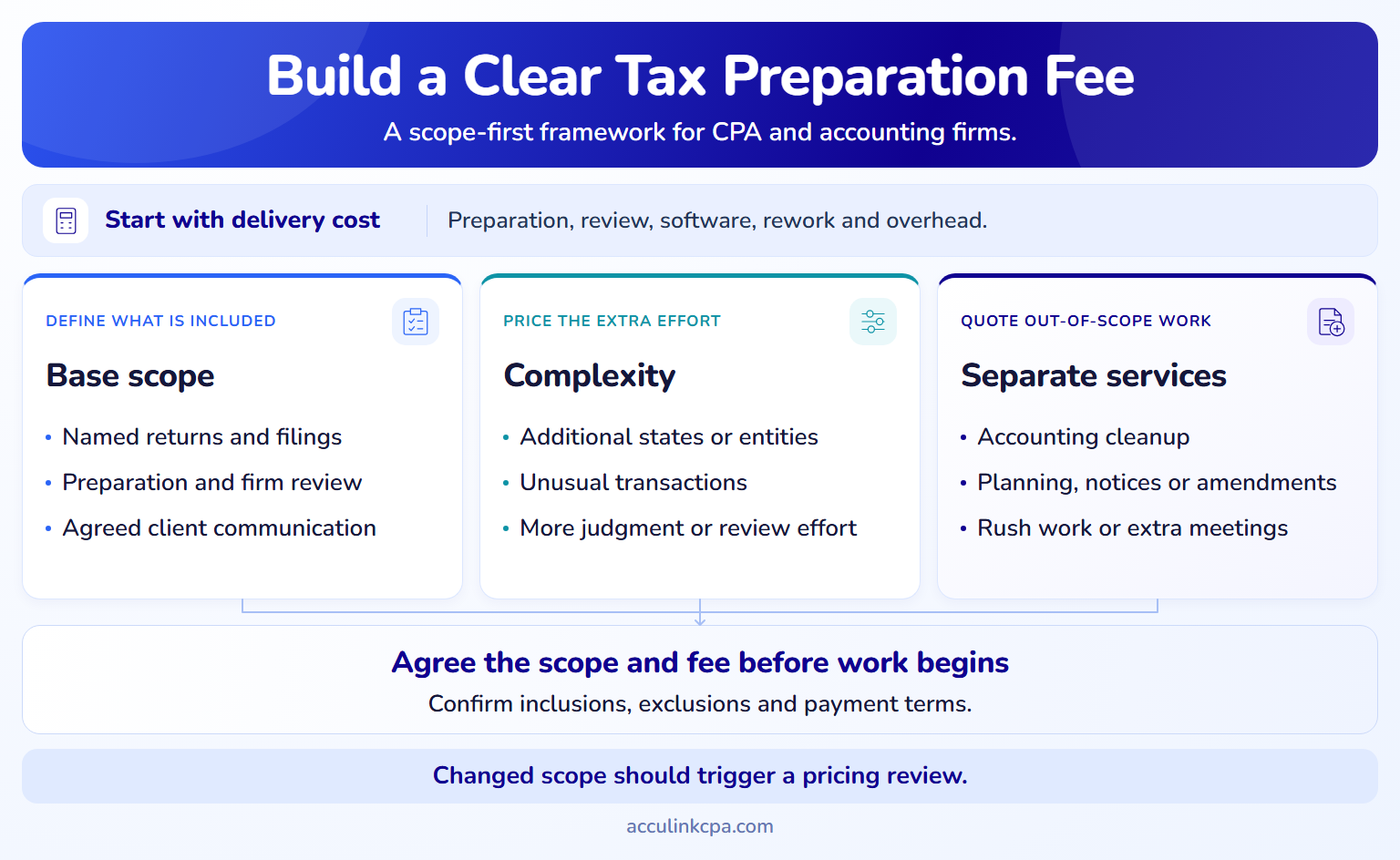
1. Segment the return families
Separate work by skill and review demand: straightforward and complex individual returns, partnership and LLC returns, S corporation returns, C corporation returns and trust returns. A multi-state entity with weak books and late K-1s should not share a price with a stable single-state entity with reconciled records.
Within each family, create a small number of useful tiers rather than a different rule for every return. The tiers should reflect predictable differences in preparation and review effort.
2. Define the standard scope
Define the federal and state returns, intake, communication, e-filing steps and review included in the base fee. List exclusions such as cleanup, amendments, notices, projections, transaction modeling, extra meetings and rush work.
This scope definition is also a client-communication tool. A clear inclusion is easier to defend than an unexplained fee increase after the work has already expanded.
3. Create objective complexity drivers
Use factors the team can identify before work begins:
- Entities, owners, states, local filings and K-1s.
- Record quality, prior-year issues and carryforward reconstruction.
- Rentals, asset sales, foreign reporting, book-to-tax adjustments and unusual transactions.
- Expected communication, partner judgment and rush timing.
These factors prevent materially different work from receiving the same fee by habit.
A simple scoring matrix can turn those factors into low, standard and high-complexity bands. Use professional judgment for exceptions, but record the reason so similar engagements are treated consistently.
4. Establish a minimum fee and named add-ons
The minimum should cover the least complex acceptable engagement. Use named add-ons for work outside that baseline; if one appears on most returns, move it into the base scope.
5. Set payment terms with the service model
In the Ignition survey, 40% collected fully on completion, 31% used a deposit and completion balance, 13% collected upfront and 10% billed monthly. Choose terms for the engagement length, client history and service cadence before work is complete.
Collection timing does not change the engagement's delivery cost, but it affects cash flow, receivables risk and the effort spent chasing payment.
How do you calculate tax preparation cost per return?
Cost per return should include each delivery resource consumed by the engagement:
Cost per return = preparation labor + review labor + software allocation + workflow and administration + expected rework + allocable delivery overhead
Use actual time by role and fully loaded internal rates. The BLS May 2025 wage table reported a $29.30 national mean hourly wage for tax preparers, excluding accountants, auditors and self-employed workers. It is a reference, not a CPA salary benchmark. The BLS June 2026 employer-cost table put benefits at 30.0% of private-industry compensation overall and 32.5% for management, business and financial occupations. Use the firm's actual benefits, taxes, nonproductive time, technology and facilities.
Do not calculate an internal rate by dividing salary by 2,080 hours alone. Training, administration, leave and uneven seasonal utilization reduce productive hours, while software and supervision add to the delivery cost.
An illustrative cost-per-return calculation
Suppose a firm models one representative return as follows:
| Cost component | Illustrative assumption | Cost |
|---|---|---|
| Preparation | 4.0 hours at $18 per hour | $72.00 |
| Firm review | 1.25 hours at a $55 loaded internal rate | $68.75 |
| Tax software, workflow and administration | Allocated amount | $25.00 |
| Expected clarification and rework | Portfolio-based reserve | $15.00 |
| Defined delivery cost | $180.75 |
The $18 preparation rate is an illustrative point within Acculink's $8 to $35 range. The reviewer rate and allocations are assumptions, not benchmarks or a quote. At a $650 collected fee:
Contribution = $650 - $180.75 = $469.25
Contribution margin = $469.25 / $650 = 72.2%
This is not net profit. Firmwide marketing, administration, occupancy, owner compensation and unallocated technology may remain. The calculation is useful because its cost base is explicit.
Use actual portfolio data to refine the assumptions. If a return family consistently requires more review or rework than modeled, adjust the workflow, the assigned role or the price rather than allowing the variance to disappear inside a firmwide average.
To calculate the fee required for a target contribution margin:
Required fee = defined delivery cost / (1 - target contribution margin)
At a 60% target, the $180.75 cost base produces a $451.88 fee floor before rounding. Complexity, risk, urgency or value may support a higher fee. The formula is a floor test, not a ceiling.
What is a good profit margin for tax preparation?
There is no universal healthy CPA firm profit margin because firms classify partner compensation, overhead and profit differently.
Track three levels instead:
- Engagement contribution: Collected fee less the defined delivery cost for that engagement.
- Service-line contribution: Tax revenue less direct and allocated tax-practice costs across the portfolio.
- Firm net profit: Revenue less all costs under the firm's consistent accounting policy.
For pricing, engagement contribution is the most actionable. Review it by return family, client tier and partner alongside preparation, review, rework, write-downs, turnaround and collection lag.
Keep the definition consistent across periods. Comparing one firm's engagement contribution with another firm's net profit produces a misleading benchmark even when both figures are called “margin.”
The 2025 AICPA PCPS and CPA.com National Management of an Accounting Practice Survey reported a median 6.7% increase in total net client fees for fiscal 2024 and a gradual shift toward value and fixed pricing. That is useful evidence about firm pricing direction, not a target profit margin for an individual tax return.
How does the staffing model change tax preparation margins?
Accounting firm profitability also depends on who performs the work, annual capacity cost and the review or correction created.
| Delivery model | Cost behavior | Best use | Margin risk to watch |
|---|---|---|---|
| Full-time in-house staff | Mostly fixed compensation and overhead | Stable year-round demand and close team integration | Paying for unused capacity outside peaks or assigning routine work too high |
| Seasonal or contract staff | Variable, often concentrated around deadlines | Short-term workload spikes | Availability, onboarding time and inconsistent methods |
| Project-based outsourcing | Variable by return, task or work package | Defined overflow or a controlled pilot | Vague scope, hidden rework or weak handoffs |
| Dedicated offshore professional | Recurring role-based capacity | Predictable volume and process continuity | Underutilization or inadequate training and supervision |
| Blended team | Fixed core plus flexible preparation and review capacity | Firms with a recurring base and sharp peak demand | Poor routing between roles and duplicated review |
Lower hourly cost does not guarantee margin. Incomplete records, vague instructions and manager rebuilding can erase the saving. Require intake standards, preparation steps, review criteria, escalation and feedback.
Capacity behavior matters as much as the quoted rate. Full-time staff may be economical at steady utilization but expensive during slower months. Project support can match variable demand, while a dedicated professional may create better continuity when the workload is recurring. Compare each option using complete cost per accepted return and remaining firm-review time.
The firm should retain the client relationship, tax positions, final review, authorization and filing controls. Before disclosing taxpayer information, determine the applicable Section 7216 rules and consent requirements, and limit provider access to the assigned work.
Is review time squeezing your margin?
Explore tax preparation and review support matched to your return mix and workload.
When should a firm raise tax preparation fees?
Review tax preparation fees annually and whenever work changes materially.
Common repricing triggers include:
- Preparation or review exceeds the estimate.
- Cleanup, calls or write-downs hide the real cost.
- States, entities, owners, schedules or transactions increase scope.
- Client delays compress review or create rush work.
- Senior staff perform lower-level tasks, or demand exceeds capacity.
NATP reports that 83% of its fee-study respondents raise fees every one to two years, typically by 6% to 10%. In the Ignition survey, 80% planned to increase fees in 2026; 37% planned a 5% increase and 30% planned a 10% increase. Those findings describe respondent behavior, not a recommendation to apply the same percentage to every client.
Segment clients before repricing. Correct structurally unprofitable work, quote added scope separately and apply a common percentage only to comparable engagements. Explain the new scope, fee and effective date.
How can firms improve tax margins without simply raising prices?
Price increases may be necessary, but operations can also improve cost per return.
Standardize intake before preparation begins
Check completeness before assignment. Move missing trial balances, unreconciled books and incomplete organizers to an exception queue.
Give the client a named list of missing items and restart the turnaround clock when the package becomes complete. This keeps avoidable waiting and follow-up out of productive preparation time.
Separate compliance, cleanup and advice
Tax preparation packages need visible boundaries. A compliance fee should not silently include bookkeeping reconstruction, notices or unlimited planning.
Route work to the right level
Route preparation to preparers, review matters to reviewers and judgment, high-value conversations and final accountability to partners.
If routine questions repeatedly reach a partner, update the procedure or reviewer authority instead of treating the interruption as unavoidable.
Track rework by reason
Classify rework as client-data, preparer, scope, software or reviewer-driven so the firm knows whether to change intake, training, standardization or price.
Review those reasons after each deadline. Rework data is more useful when it leads to a specific owner and corrective action.
Design review into the workflow
Use a consistent checklist, evidence requirements and two-tier review. Acculink describes its broader maker-checker process; the firm retains professional review and approval.
Plan peak capacity before the deadline window
Model returns by type, hours and due date, then compare required weekly capacity with committed internal hours before files arrive.
Plan preparation and review capacity separately. Adding preparers will not solve a bottleneck if managers still receive too many files in the same week.
How can Acculink support a more profitable tax delivery model?
Built for U.S. CPA and accounting firms, Acculink provides preparation and review capacity while the firm retains its client relationship and final responsibility.
Relevant options include:
- Outsourced tax preparation for defined return-preparation capacity.
- Outsourced tax review support when reviewer capacity is the constraint.
- A dedicated tax preparer or tax reviewer for recurring demand.
- A dedicated offshore team when the firm needs multiple roles and continuity.
Acculink's published pricing is $8 to $35 per hour, all-inclusive and role-based, with higher rates for senior roles. Its engagement models include a 40-hour free trial, no setup fee and no long-term lock-in. A controlled sample lets the firm measure preparation time, review notes, turnaround and communication.
Its company overview reports 300-plus qualified team members and 80-plus accounting firms, and Acculink documents its IT and data-security controls. Firms should still complete their own provider, legal, consent, access and security review.
Beyond the hourly rate, ask what the role completes, how many firm review hours remain, which corrections recur and the complete cost per accepted return.
Project support may suit a defined overflow batch; a dedicated preparer or reviewer may suit recurring volume and firm-specific workflows. Measure both against the same acceptance, review-time and turnaround criteria.
Build the business case first. Select a representative return mix, estimate preparation and review hours, and identify the peak-week gap. Then talk to Acculink about project or dedicated capacity and compare the resulting cost per return.
A 30-day tax pricing reset for CPA and accounting firms
Use one month to create a reliable first version:
- Week 1: Pull collected fees, preparation hours, review hours and write-downs for a representative return sample.
- Week 2: Calculate cost and contribution by return family; flag negative or unusually low-contribution work.
- Week 3: Define the base scope, complexity factors, add-ons and payment terms for the next engagement cycle.
- Week 4: Reprice the highest-priority segment and test one workflow or staffing improvement against the same metrics.
Repeat after the next deadline. Good accounting firm pricing becomes more accurate when actual hours, rework and collections inform the next decision.
Frequently asked questions
What is the best tax preparation pricing model for a CPA firm?
For many firms, a fixed or minimum base fee with defined complexity adjustments provides client certainty without absorbing added forms, poor records, extra states, unusual transactions or rush work. Price advice separately and reserve subscriptions for recurring service.
How much do tax preparers charge?
Charges vary by return, complexity, market, credentials and scope. In Ignition's directional survey, 48.5% priced the described basic individual return at $400 to $799, and 55.6% priced the described business return at $1,000 to $1,999. These are survey bands, not recommended fees.
How should a firm calculate cost per tax return?
Add preparation, review, software, workflow, expected rework and allocable delivery overhead using actual time and fully loaded rates. Compare that cost with the collected fee to calculate engagement contribution.
What is a good profit margin for tax preparation?
There is no universal percentage because firms classify overhead, owner compensation and profit differently. Set a target on a defined cost base and measure engagement contribution, service-line contribution and firm net profit separately.
Should tax preparation be billed hourly or at a fixed fee?
Use a fixed fee for predictable, clearly bounded work and hourly billing for uncertain or investigative work. A hybrid can fix the base fee while separately pricing complexity, added scope and advice.
What belongs in a tax preparation price list?
A tax prep price list should include return families, scope, minimum fees, complexity factors, add-ons, rush policy, payment terms and repricing triggers. Keep internal cost and margin assumptions separate from the client-facing service explanation.
How often should accounting firms raise tax preparation fees?
Review fees annually and whenever scope or delivery cost changes materially. Base adjustments on client economics, capacity and market position rather than applying one percentage to every engagement.
Can offshore tax preparation reduce cost per return?
It can when suitable work moves to a lower delivery-cost role and arrives ready for efficient firm review. Measure record quality, review time, rework and utilization, then compare complete cost per accepted return.
How much does Acculink tax preparation support cost?
Acculink publishes all-inclusive, role-based pricing from $8 to $35 per hour depending on experience. A 40-hour free trial lets firms test a defined workflow before choosing project support or a recurring hire.
Can CPA and accounting firms outsource tax return preparation?
Yes. The firm should retain client ownership, tax judgment, final review, authorization and filing controls. Before sharing taxpayer information, determine the applicable Section 7216 consent, disclosure, contractual, access and security requirements.
Price the work, then design the delivery model
Set a clear fee for a clear scope, supported by return-level economics and tested against credible benchmarks. Then assign work across preparers, reviewers and partners using the delivery model that protects quality and margin.
The strongest result is not simply a higher fee or a lower labor rate. It is a portfolio in which the quoted scope, actual work, review effort and collected fee remain aligned.
If capacity is the constraint, contact Acculink with a representative return mix and deadline profile. Start with cost per return and review impact, not a generic savings claim.
More tax capacity. Better cost control.
Tax preparation and review support from $8 to $35 per hour, based on role.
Tags:
About the Author

Related Posts

Top 10 Offshore Staffing Companies for Accounting Firms (2026)
Hiring an offshore team is one of the highest-leverage moves a short-staffed CPA firm can make, but the partne…

Tax Preparation Outsourcing for CPA Firms: How It Works, What It Costs, and Where to Start (2026)
Tax preparation outsourcing lets a CPA firm hand routine return preparation to an external team, usually offsh…
Top Tax Outsourcing Companies for CPA and Accounting Firms (2026 Rankings)
The top tax outsourcing companies for CPA firms in 2026 are Acculink CPA, QX Accounting Services, CapActix, Da…