Accounting Staffing Agencies: What They Cost, When to Use One, and What Else Works

Summary
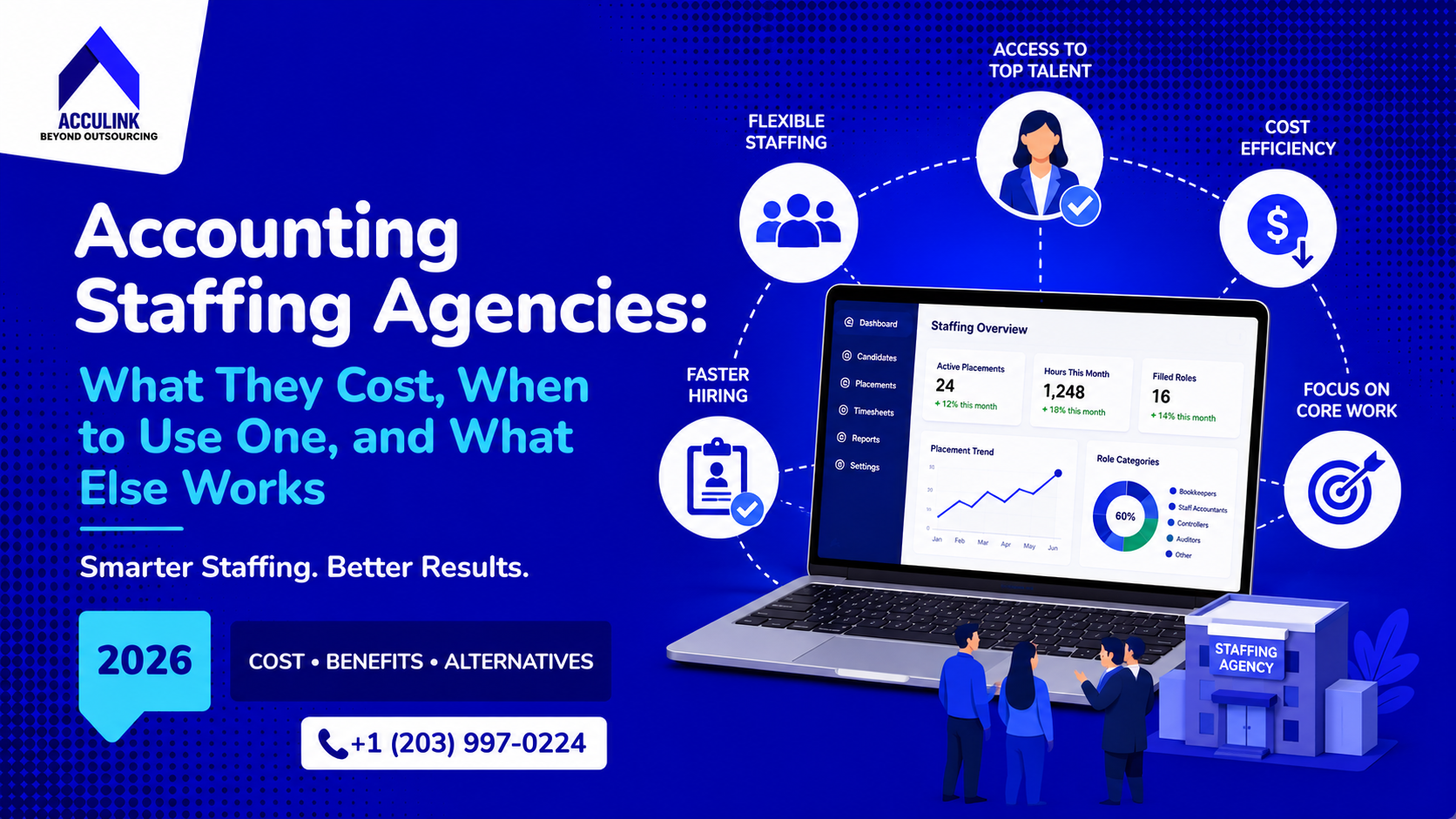
An accounting staffing agency recruits and places accounting professionals into your firm, as temporary contractors or as permanent employees on your payroll. For a permanent placement, most charge a fee of roughly 20 percent of first-year salary, paid on top of the salary you then carry. This guide covers what the main agencies do, what each model costs a firm in year one (about $133,200 through an agency versus $116,900 hiring direct, on public BLS data), when an agency is genuinely the right call, and what CPA firms do when it is not.
Key Takeaways
- An accounting staffing agency solves sourcing, not cost. For a permanent placement you pay a fee of roughly 20 percent of first-year salary, and then you still carry the full salary, benefits, payroll tax and seat. The fee is a surcharge on top of an expensive hire, not a replacement for one.
- Year one for a single accountant works out near $133,200 through an agency versus about $116,900 hiring direct, using BLS median wages and BLS employer-burden data. Every input in that comparison is public.
- Agencies are the right answer for a specific list: roles needing physical presence, partner-track hires, and defined projects with an end date. If your situation is on that list, use one and do not overthink it.
- They are the wrong answer for recurring capacity, because the fee repeats every time the seat turns over and you carry the employment cost in between.
- The constraint is supply, not agency performance. BLS projects about 124,200 openings a year for accountants and auditors, while the AICPA counted 55,152 accounting graduates in 2023-24. Agencies are competing for candidates who are not there.
An accounting staffing agency recruits and places accounting professionals into your firm, either as temporary contractors or as permanent employees on your payroll. For a permanent placement, most agencies charge a contingency fee of roughly 20 percent of the hire's first-year salary, paid on top of that salary. For temporary or contract placements, they bill an hourly rate that covers the worker's pay plus a markup.
This guide covers what the main accounting staffing agencies do, what each model actually costs a firm in year one, when an agency is genuinely the right call, and what CPA firms are doing when it is not.
What an Accounting Staffing Agency Actually Does
Agencies in this space run one of five models, and the model determines the cost more than the brand does.
| Model | How you pay | Typically used for |
|---|---|---|
| Contingency direct hire | A percentage of first-year salary, owed only if you hire | Permanent accounting roles. The most common arrangement |
| Retained search | Upfront retainer plus staged payments, owed regardless of outcome | Controller, CFO, and partner-level searches |
| Temporary or contract | Hourly bill rate: the worker's pay plus a markup for payroll taxes, insurance, and margin | Busy season. This is what temporary accounting staffing usually means |
| Temp-to-hire | Hourly bill rate through a trial period, then a reduced or waived placement fee on conversion | Testing fit before committing to a permanent hire |
| Curated marketplace | Subscription or per-placement against a pre-vetted pool, usually remote | Hiring from a screened bench without running a search |
The distinction that matters for a CPA firm: in every one of these models except temporary staffing, you end up employing the person. You carry the salary, the benefits, the payroll tax, the seat, and the retention risk. The agency solved sourcing, not cost.
The Main Accounting Staffing Agencies in the US
These are the accounting and finance staffing agencies that appear consistently across national search results. They are grouped by model rather than ranked, because the right one depends entirely on which of the five models you need.
| Agency | Model | Best suited to |
|---|---|---|
| Robert Half | Contract, contract-to-hire, permanent placement | Broad coverage across accounting and finance roles; publishes an annual salary guide widely used as a benchmark |
| Creative Financial Staffing (CFS) | Temporary, interim, direct hire | Employee-owned network originally founded by CPA firms; accounting and finance focus |
| Vaco | Staffing plus project consulting | Firms that need project and interim leadership as well as seat-filling |
| Accountingfly | Remote-only placement | CPA firms hiring US-based remote accountants and tax staff |
| Beech Valley Solutions | On-demand project consultants | Short project work, busy-season surge, specialist engagements |
| Ledgent Finance and Accounting | Temporary and direct hire | Accounting and finance specialist arm of a larger staffing group |
| Insight Global | Contract and direct hire | Large generalist with an accounting vertical; volume hiring |
| PrideStaff Financial | Temporary, temp-to-hire, direct hire | Local and regional hiring, clerk through controller level |
Two practical notes. First, several of the biggest names here are generalists with an accounting division rather than accounting specialists, which affects candidate quality more than it affects price. Second, a large share of demand in this category is local, so the agency that ranks in your metro may be a regional firm that never appears in a national list at all. Neither is a criticism. It means the shortlist you build should start from the model you need, not from a national brand ranking.
What an Accounting Staffing Agency Costs
Agencies rarely publish fees, so the honest way to answer this is with industry benchmarks and public wage data rather than any single agency's rate card.
Staffing Industry Analysts, drawing on its North America Staffing Company Survey, found that the most common direct hire fee is 20 percent of salary, reported by 42 percent of staffing firms, and that 20 percent is also the median across all firm demographics. The midrange varies by the type of firm rather than by the role: commercial staffing firms reported 15 to 20 percent, professional staffing firms 18 to 22 percent, and direct hire specialists 20 to 25 percent.
That survey data is from 2021, so read it as the established benchmark rather than today's quote. Current published rate cards sit at the top of that range or above. Frontline Source Group, one of the few agencies that publishes its pricing openly rather than quoting on request, lists 20 to 30 percent of first-year base salary for direct hire and 25 to 35 percent for C-suite search.
The salary that fee sits on top of is public. The Bureau of Labor Statistics puts the median annual wage for accountants and auditors at $81,680 as of May 2024, or $39.27 an hour.
The number most cost comparisons leave out is employer burden. BLS Employer Costs for Employee Compensation data for March 2026 shows that for private industry workers, wages and salaries average $32.60 an hour and account for 69.9 percent of total compensation, while benefits average $14.01 an hour and account for the remaining 30.1 percent. A salary figure represents roughly 70 percent of what an employee actually costs you.
Put those three sourced numbers together for one accountant at the national median:
| Year one cost | Agency placement | Direct hire, no agency |
|---|---|---|
| Base salary (BLS median) | $81,680 | $81,680 |
| Employer burden at 30.1% of total compensation | $35,170 | $35,170 |
| Placement fee at 20% of first-year salary | $16,336 | none |
| Year one total | about $133,200 | about $116,900 |
Note that 20 percent is the conservative end. It is the most common and the median fee in the SIA data, and the bottom of the published rate cards, so the table understates rather than overstates what an agency route costs.
The placement fee is a surcharge. It does not replace any part of the cost structure underneath it, and it recurs every time the seat turns over. That is the single most important thing to understand about the agency model before deciding whether it fits your firm.
For temporary placements the mechanics differ but the direction does not. You pay a bill rate covering the worker's pay plus a markup for payroll taxes, benefits, insurance and margin. Frontline Source Group publishes that markup at 50 to 85 percent depending on skill level and contract length, which is why an hourly bill rate lands so far above what the worker actually takes home.
When a Staffing Agency Is Genuinely the Right Call
Four situations where an agency is the correct answer and no alternative is close:
- The role needs physical presence. Client-facing partners, in-office culture requirements, local licensure, physical document handling.
- The role is partner-track. Someone you intend to develop into ownership belongs on your payroll and in your culture from day one.
- It is a defined project with an end date. A systems conversion, a technical accounting problem, a specialist audit engagement. Project consultancies are built for this and are usually the fastest option available.
- You have a sudden gap and no lead time. An agency with an existing bench moves faster than building any new capability from scratch.
If your situation is on that list, use an agency. The rest of this guide is for firms whose situation is not on it, which in practice means firms whose real problem is recurring capacity rather than one specific unfilled seat.
How to Choose an Accounting Staffing Agency
If an agency is the right route, these are the six things worth checking before you sign, in roughly the order they change the outcome.
| What to check | Why it matters |
|---|---|
| Accounting share of placements | Several large names run an accounting desk inside a generalist business. Ask what proportion of their placements are accounting and finance roles, not whether they "specialize" |
| Who tests technical skill | Ask to see the actual assessment a candidate sits, not a description of the vetting process. A recruiter screening accountants without a technical test is screening resumes |
| Where the candidates come from | A large general database is not an accounting bench. Ask how many placeable candidates they hold for your role and your market right now |
| Fee percentage and what triggers it | Get the number in writing before the search starts, along with what counts as a placement. This is the single most common source of dispute |
| Replacement guarantee | What happens if the hire leaves in month three. Ask for the length of the guarantee and whether it is a replacement or a refund, because those are very different |
| Candidate and client data handling | Agencies touch resumes, compensation data, and sometimes your client information during a search. Ask how it is stored and who has access |
The first three separate a specialist from a generalist. The last three decide what happens when something goes wrong, which is when the relationship is actually tested.
Where the Agency Model Runs Out of Road
An agency competes for candidates in the same national pool as everyone else. That pool is the constraint, and the published numbers are worth sitting with.
The AICPA's 2025 Trends report counted 55,152 students earning a bachelor's or master's degree in accounting in the 2023-24 academic year, a decline of 6.6 percent year over year. Bachelor's degrees fell 3.3 percent to 40,817, and master's degrees in accounting or taxation fell about 15 percent to 14,335. The two preceding years fell 9.6 percent and 7.4 percent.
Against that, BLS projects about 124,200 openings a year for accountants and auditors over the 2024-34 decade, most of them from workers retiring or moving to other occupations.
Those two figures measure different things, and it would be sloppy to subtract one from the other. Not every opening requires a new graduate, and not every accounting graduate enters the profession. But the direction is not ambiguous, and it explains something firms experience directly. Agencies are not slow because they are bad at their jobs. They are slow because the candidates are not there.
One counterpoint deserves airtime, because almost nobody reports it. National Student Clearinghouse data shows two consecutive semesters of 12 percent year-over-year growth in accounting enrollment during the 2024-25 school year. The pipeline is genuinely starting to recover. That relief arrives in three to five years, after those students graduate, sit for the exam, and gain experience. It does not help you staff next busy season.
Firms that have tried to solve the same problem through immigration hit a different wall, which we covered separately in the H-1B alternative for CPA firms.
The Alternative Most CPA Firms Are Now Running
Offshore staffing changed this conversation not because it is cheaper in the abstract, but because it changes what you are buying. Instead of paying a fee to acquire an employee whose full cost you then carry, you engage a full-time dedicated professional as a service. No placement fee, no employer burden, no benefits load, no seat.
For a CPA firm, this form of accounting staffing typically means a dedicated accountant, bookkeeper, or tax preparer who works your hours, in your software, under your review, as an extension of your team rather than as an outside vendor.
Where that capacity sits matters, and it is worth being direct about it. Most established providers serving US CPA firms operate from India, Acculink included, and outsourcing accounting to India has been the default route for US practices long enough that the workflows, the software, and the review conventions are well settled. The Philippines and Latin America are the other two common choices, and they trade cost against time-zone overlap in ways that suit some firms better. That is a genuine decision rather than a formality, so we compare the three locations properly in a separate piece rather than glossing it here.
The distinction to hold on to is that these are not staffing agencies with an overseas address. An agency recruits a person onto your payroll and charges a fee for finding them. An offshore provider delivers the work as a service, and no one joins your payroll at all. Comparing them like for like is what the table below is for.
Set the three routes side by side on year one for a single accounting seat:
| Agency placement | Direct hire | Offshore dedicated seat | |
|---|---|---|---|
| Placement or agency fee | about $16,300 | none | none |
| Salary or service cost | $81,680 | $81,680 | varies by role and seniority |
| Employer burden | about $35,170 | about $35,170 | none |
| Time to productive | weeks to months, subject to candidate supply | weeks to months | about 2 weeks |
| Cost when the seat turns over | fee repeats | rehire from scratch | replacement included |
| Year one total | about $133,200 | about $116,900 | 60 to 70 percent lower |
The salary and burden figures come from BLS. The fee benchmark comes from Staffing Industry Analysts, corroborated against a published agency rate card. Only the offshore line is ours, and it is labeled as ours deliberately, because a cost comparison built entirely out of the vendor's own numbers is worth very little.
How to Decide
Work through these in order. Most cases resolve in about a minute.
- Does the role need physical presence or partner-track development? Yes: use a staffing agency, and stop here.
- Is it a defined project with an end date? Yes: use a project consultancy rather than a placement agency. The fee structure fits the work.
- Is it recurring capacity, the same work every month or every season? Then the real choice is carrying a US employee versus engaging dedicated offshore capacity, and the year one table above is the honest comparison.
- Is cost per seat the binding constraint? Offshore is the only one of the three routes that changes the cost structure rather than adding to it.
- Do you want to grow revenue, not only cut cost? Look at whether the capacity can also serve your own clients under your brand.
If you want to see how offshore providers compare against each other rather than against agencies, we have a separate breakdown of offshore staffing companies for accounting firms, and a comparison of India, the Philippines, and Latin America as delivery locations. If you are weighing the delivery model itself rather than the vendor, nearshore versus offshore versus onshore covers that ground.
Why CPA Firms Choose Acculink
Acculink runs the dedicated model for more than 80 US CPA firms through accounting outsourcing services built specifically around accounting-firm work rather than general business support.
- Built for CPA firms, not small businesses. Multi-client ledgers, monthly close cycles, and review hierarchies are the normal case here, not something the team has to be taught.
- All-in pricing of $8 to $35 per hour by role, quoted as one number covering compensation, software, infrastructure, and supervision.
- About two weeks to productive, and the seat stays filled. Replacement is our problem, with no second placement fee when someone moves on.
- No security breach in over five years, with the controls documented rather than asserted.
There is a second use of this model that firm owners tend to notice before anyone points it out. Once you have dedicated capacity, you can offer accounting and bookkeeping services to your own clients under your own brand, keep the margin, and never make a local hire. That is a revenue line rather than a cost line, and it is why some firms move on this long before their staffing situation becomes urgent.
Frequently Asked Questions
What is an accounting staffing agency?
An accounting staffing agency recruits accounting and finance professionals on behalf of employers and places them either as temporary contractors on the agency's payroll or as permanent employees on yours. Specialist agencies focus only on accounting roles such as bookkeepers, staff accountants, controllers, tax preparers, and CFOs, while larger generalist staffing firms run an accounting division alongside other verticals.
How much do accounting staffing agencies charge?
For permanent placements, Staffing Industry Analysts found the most common direct hire fee is 20 percent of first-year salary, reported by 42 percent of staffing firms, with midranges varying by firm type from 15 to 20 percent for commercial staffing firms up to 20 to 25 percent for direct hire specialists. Current published rate cards run higher, at 20 to 30 percent for direct hire and 25 to 35 percent for C-suite search. For temporary placements, agencies bill an hourly rate covering the worker's pay plus a markup of roughly 50 to 85 percent for payroll taxes, benefits, insurance, and margin. Fees are paid on top of salary, not instead of it.
What is the difference between an accounting staffing agency and outsourced accounting?
A staffing agency finds you a person you then employ, carrying their salary, benefits, and payroll costs. Outsourced or offshore accounting engages a dedicated professional as a service, so there is no placement fee, no employer burden, and no seat cost. The agency solves sourcing. Outsourcing changes the cost structure.
Are accounting staffing agencies worth the cost?
They are worth it when you need physical presence, a partner-track hire, or a specialist for a defined project, because in those cases no alternative does the same job. They are a poor fit when the underlying problem is recurring monthly or seasonal capacity, because the fee recurs every time the seat turns over and you still carry the full employment cost in between.
Why is it so hard to hire accountants right now?
Supply. The AICPA's 2025 Trends report counted 55,152 accounting graduates in 2023-24, down 6.6 percent year over year, while BLS projects about 124,200 openings a year for accountants and auditors through 2034. Accounting enrollment has started to recover, with two consecutive semesters of 12 percent year-over-year growth in 2024-25, but those students are several years away from being experienced hires.
Can offshore accountants work directly under our firm's brand?
Yes. In a dedicated engagement the professional works your hours, in your software, under your review, and your clients deal only with your firm. Firms preparing US tax returns should note that disclosing tax return information to a preparer located outside the United States triggers specific consent requirements under Internal Revenue Code section 7216, and the consent must be obtained before the information is disclosed.
The Bottom Line
Accounting staffing agencies do one thing well and it is worth paying for when you need it: they find people faster than you can. What they cannot do is change what that person costs once they arrive, or conjure candidates out of a pool that is smaller every year.
So the question is not whether agencies are good or bad. It is whether your problem is a specific seat or a recurring capacity gap. For a specific seat, call an agency. For recurring capacity, the fee comes back every time the seat turns over, and a model that removes the fee and the employment cost together is the more durable answer.
If you want to see what that looks like against your own numbers rather than a national median, book a consultation and we will work through it with your actual roles and rates.
Tags:
About the Author

Related Posts
Top Outsourced Accounting Firms for CPA Practices (2026)
Choosing an outsourced accounting partner is a high-stakes call because the team touches your clients' data. T…
Top 10 Offshore Staffing Companies for Accounting Firms (2026)
Hiring an offshore team is one of the highest-leverage moves a short-staffed CPA firm can make, but the partne…
Offshore Accounting: What CPA Firms Need to Know in 2026
A practical 2026 guide to offshore accounting for U.S. CPA firms: what it is, what to safely delegate, what it…