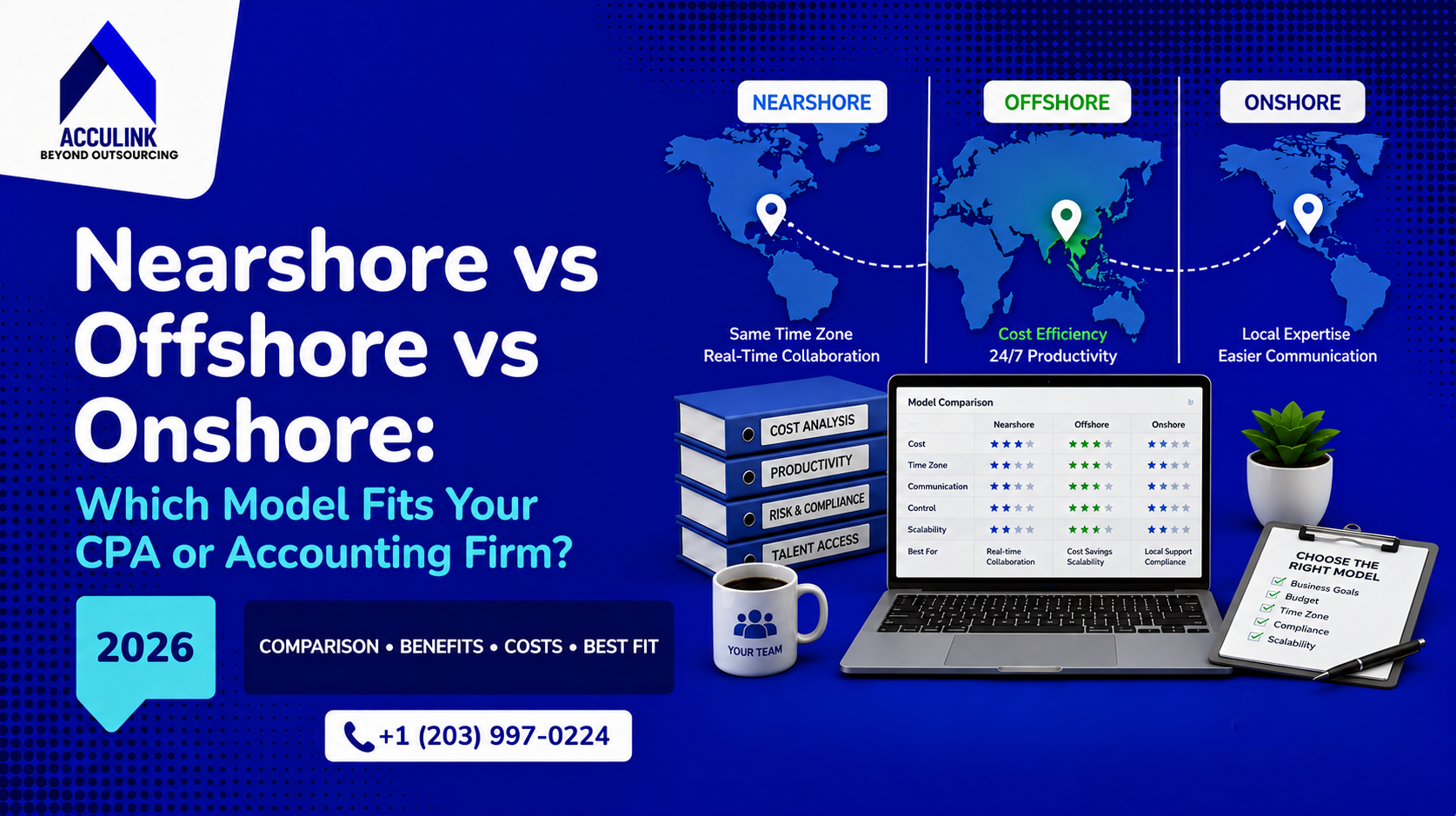
Nearshore vs Offshore vs Onshore: Which Model Fits Your CPA or Accounting Firm? (2026)

Summary
Onshore, nearshore, and offshore describe where your outsourced accounting team sits. Onshore keeps the work in the US: easiest to manage, same time zone, but the most expensive. Nearshore uses a nearby country like Mexico for close time-zone overlap at a moderate saving. Offshore uses a distant country like India or the Philippines for the deepest talent and the biggest saving. This guide compares the three models on cost, control, time zone, talent, and scalability for CPA and accounting firms, and gives you a simple way to choose.
Quick answer: The three models describe where your outsourced accounting team sits. Onshore keeps the work in the United States: easiest to manage, same time zone and rules, but the most expensive. Nearshore uses a nearby country such as Mexico or one in Latin America: close time-zone overlap and a moderate cost saving. Offshore uses a distant country such as India or the Philippines: the deepest talent pool and the largest cost saving, best for scaling through tax season, though it needs a capable partner to handle the time difference and data security. Most CPA and accounting firms end up choosing offshore, or a hybrid that pairs a local point of contact with an offshore team that does the work.
This guide explains what each model actually means for an accounting firm, compares them on the factors that matter, and gives you a simple way to decide.
Key takeaways
- The choice is a trade-off between three things: cost, control, and time-zone overlap. Onshore maximizes control, offshore maximizes cost saving and talent, nearshore sits in the middle.
- Onshore fits firms that need same-day collaboration and hold highly sensitive work in-house. Nearshore fits firms that want real-time overlap without onshore prices. Offshore fits firms that want the biggest cost saving, the widest talent pool, and the ability to scale up for busy season.
- The fastest-growing option is the hybrid model: a U.S. or nearshore relationship manager for communication and review, with an offshore team doing the production work. It captures most of the cost saving while keeping oversight tight.
- The model matters less than the partner. Any of the three can fail with the wrong provider and succeed with the right one, especially on security and quality control.
The three models, defined
Onshoring means keeping the work inside your own country. For a U.S. firm, that is a team based in the United States, whether employed directly or through a domestic outsourcing provider. Everyone shares the same time zone, the same regulatory environment, and the same employment laws.
Nearshoring means moving the work to a nearby country in a similar time zone. For U.S. firms that usually means Mexico, or countries in Central and South America. The appeal is real-time overlap and cultural proximity at a lower cost than hiring at home.
Offshoring means moving the work to a distant country, most often India or the Philippines for accounting. The draw is the largest cost saving and a very deep pool of qualified accountants, in exchange for a wider time gap that has to be managed well.
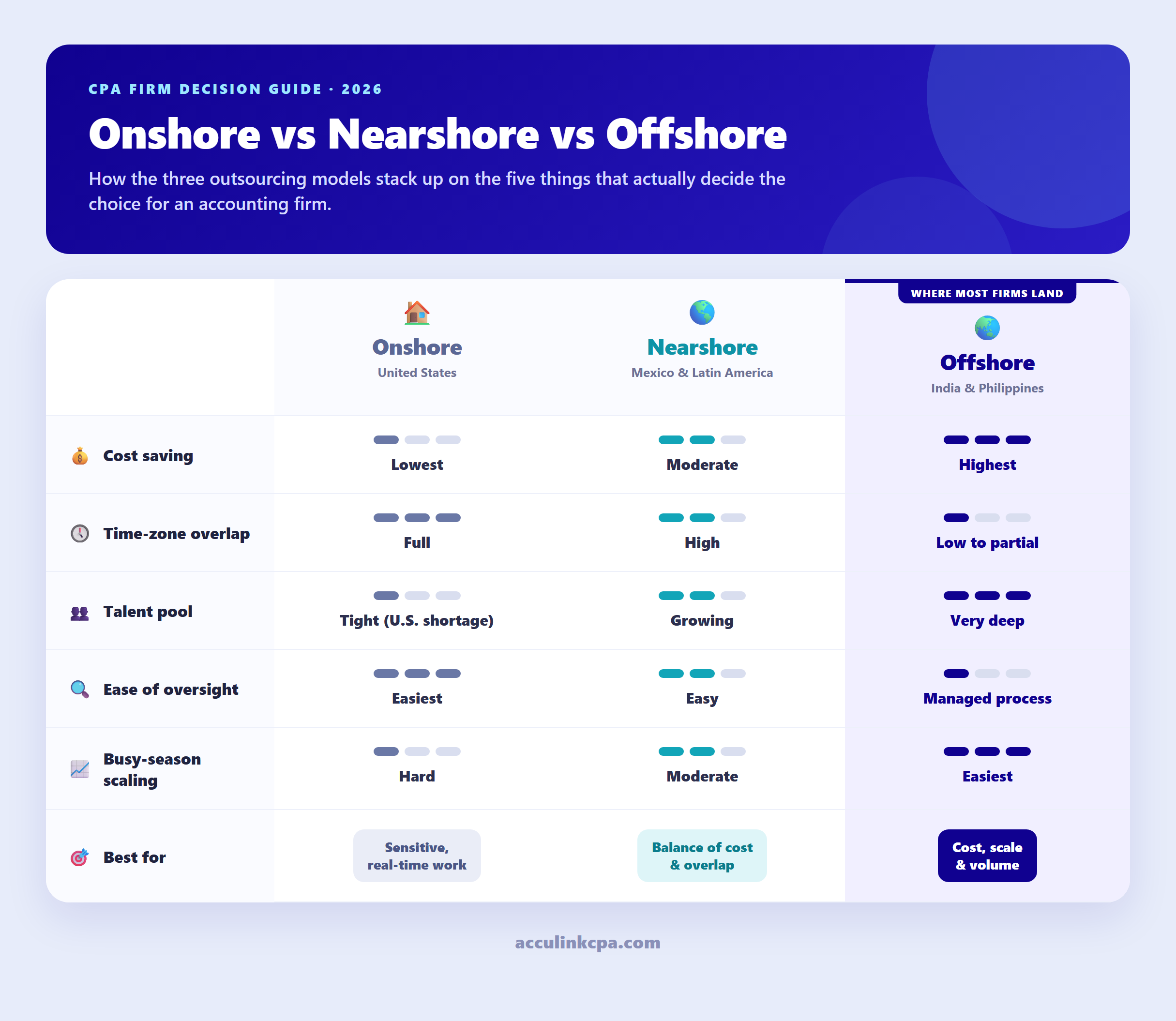
Onshore vs nearshore vs offshore at a glance
| Factor | Onshore (U.S.) | Nearshore (e.g. Mexico, LatAm) | Offshore (e.g. India, Philippines) |
|---|---|---|---|
| Cost saving | Lowest | Moderate | Highest |
| Time-zone overlap | Full | High | Low to partial |
| Talent pool | Tightest (U.S. shortage) | Growing | Very deep |
| Ease of oversight | Easiest | Easy | Needs a managed process |
| Busy-season scaling | Hard | Moderate | Easiest |
| Best for | Sensitive, real-time work | Balance of cost and overlap | Cost, scale, and volume |
Onshore: closest control, highest cost
Onshore keeps everything familiar. The team works U.S. hours, understands U.S. clients out of the box, and sits under the same laws and standards as your firm. Communication is immediate, and for the most sensitive or advisory-heavy work, that closeness has real value.
The catch is cost and supply. U.S. accounting salaries are the highest of the three models, and the profession is in a well-documented talent shortage, so the people you want are both expensive and hard to find. Onshore outsourcing solves the hiring problem but keeps the cost high.
Best for: firms whose work demands same-day, real-time collaboration, or who keep their most sensitive engagements domestic as a matter of policy.
Nearshore: the middle ground
Nearshore trades a little cost saving for a lot of overlap. A team in Mexico or Latin America works most or all of your business day, which makes live calls and quick turnarounds easy, and cultural closeness tends to smooth communication. You give up some of the deeper savings that offshore offers, and the talent pool for U.S. accounting work, while growing, is smaller than India's or the Philippines'.
Best for: firms that want real-time collaboration and are willing to pay a bit more than offshore to get it.
Offshore: deepest talent, biggest saving, most scale
Offshore is where most CPA firms end up, for three reasons. The cost saving is the largest of the three. The talent pool is enormous, with a large, established population of accountants in India and the Philippines who are trained on U.S. GAAP, U.S. tax, and the software your clients use. And it scales: a firm that needs to add a dozen preparers for tax season and release them in May can do that offshore in a way that is very hard to do onshore or nearshore.
The trade-off is the time difference and the need for real security and process. Handled casually, the time gap becomes a delay. Handled well, it becomes an advantage, because work handed off at the end of your day is finished by the time you return. Data security is not a model problem but a partner problem: a serious offshore provider runs named user logins, role-based access, and formal controls that meet U.S. standards, the way we handle IT and data security at Acculink.
If you are weighing offshore locations against each other, our breakdown of India vs the Philippines vs Latin America goes country by country.
Best for: firms that want the biggest cost saving, the widest talent pool, and the ability to flex capacity through the season.
The hybrid model: onshore oversight, offshore execution
The option that is growing fastest is not any single model but a blend of them. A hybrid setup puts a client-facing manager onshore or nearshore, in your time zone, and an offshore team behind them doing the production work. You get near-offshore economics with onshore-style communication and review, because there is always someone in your hours who owns the relationship and checks the output.
For most growing firms this is the practical answer to the whole debate. It keeps the cost advantage that makes offshore worth it, while removing the two things firms worry about most: the time gap and the sense of being hands-off. It is also how a good offshore staffing partner typically structures an engagement.
How the models compare head to head
Most firms do not weigh all three at once. They compare two. Here are the two decisions that come up most.
Nearshore vs offshore
The core trade-off is overlap versus cost and scale. Nearshore gives you near-full time-zone overlap and easy real-time collaboration, which suits firms that want live, same-day back-and-forth. Offshore gives you a deeper talent pool, a larger cost saving, and far easier busy-season scaling, in exchange for a wider time gap you manage with a handoff routine. For most firms chasing margin and the ability to flex for tax season, offshore wins, and a hybrid closes the overlap gap.
Onshore vs offshore
This is the widest gap of the three. Onshore gives you the same time zone, the same rules, and the simplest oversight, at the highest cost and against the U.S. talent shortage. Offshore gives you the largest saving and the deepest pool of trained accountants, but asks for real process and security. The honest answer for most firms is a split: keep sensitive, judgment-heavy, real-time work onshore, and move routine, high-volume work offshore where the economics are decisive.
How to choose
Pick the model by what your firm values most:
- If cost is the priority: offshore, or a hybrid, gives the largest saving.
- If real-time collaboration is non-negotiable: onshore or nearshore, for the time-zone overlap.
- If you need to scale for busy season: offshore flexes up and down far more easily than the others.
- If the work is highly sensitive or advisory-led: keep it onshore, or use a hybrid so a local manager owns the client relationship.
- If you are not sure: start with a hybrid on a defined scope. It hedges the trade-offs and lets you judge quality before you commit more.
Two rules matter more than the grid. First, match the model to the task, not the whole firm: routine, high-volume work (bookkeeping, data entry, tax prep) is ideal for offshore, while judgment-heavy advisory work often stays closer to home. Second, the provider matters more than the model. The security, training, and process discipline of your partner will decide whether any of these three succeeds.
What we see in practice
Placing offshore accounting teams for a range of firms, a few patterns show up again and again.
The firms that pick onshore purely to keep things simple usually hit a wall at busy season, because a domestic team cannot flex fast enough and the existing staff absorb the overflow until they burn out. The cost saving they skipped offshore comes back as a retention problem.
The time-zone objection is real for about two weeks. The firms that struggle with it are the ones that never set up a handoff rhythm. The firms that thrive treat the overnight gap as a second shift: they send work at the end of their day and review finished output in the morning.
When an engagement fails, it is almost never about the country and almost always about the provider. The causes are the same every time: no real access controls, no review layer between the offshore preparer and the client, and junior staff left unmanaged. Change the provider and the same country delivers fine.
Hybrid setups keep firms the longest. When someone in the firm's own hours always owns the relationship and checks the work, the firm never feels hands-off, and the offshore economics still hold.
And the work that offshores most cleanly is the routine, repeatable kind: bookkeeping, payroll, data entry, standard tax prep. Firms that try to hand off judgment-heavy advisory on day one tend to pull it back. The ones that succeed start with volume work, build trust, and move up from there.
What about cost and security?
On cost, the ranking is consistent even though exact figures vary by role and provider: onshore costs the most, offshore the least, and nearshore lands in between. The offshore saving versus a comparable U.S. hire is large enough that it is usually the deciding factor for firms under margin pressure, which is most of them right now.
On security, the model is not the risk, the setup is. Client financial data can be protected or exposed under any of the three. What matters is that whoever does the work uses individual logins rather than shared credentials, sees only what their role requires, and is offboarded cleanly when they roll off, all under a provider that can show its controls. Offshore tax preparation carries the added requirement of IRC Section 7216 client-consent rules, which a reputable provider will already build into its process.
Questions to ask any outsourcing provider
Whichever model you lean toward, the provider decides the outcome. Before you sign, get clear answers to these:
- Data security: Do staff use individual logins with role-based access, and how is access removed when someone rolls off the account? Can you show formal controls such as SOC 2?
- Compliance: For tax work, how do you handle IRC Section 7216 client consent?
- Oversight: Who is my point of contact, and who reviews the work before it reaches me?
- The team: What are your people trained on, specifically U.S. GAAP, U.S. tax, and the software my clients use?
- Time zones: How do you structure the daily handoff so the gap works for me instead of against me?
- Scaling: How quickly can you add and release capacity for busy season?
A provider who answers these clearly is worth more than any particular model. A provider who cannot is a risk in any country, onshore included.
Where Acculink fits
Acculink CPA is built around the offshore and hybrid models. We place accounting professionals in India who are trained on U.S. GAAP, U.S. tax, and the platforms your clients already use, and we structure engagements so your firm keeps clear oversight: named team members, defined scope, and a single point of contact. That is the hybrid advantage in practice, offshore economics with the communication and control of a team that feels like your own.
If you want to see how the offshore side works before committing, our guide to choosing an offshore staffing partner is a good place to start, and our engagement models lay out how an offshore team plugs into your firm. When you are ready to add capacity, you can build a dedicated team with us, and a 40-hour free trial lets you put accountants on real work first.
Frequently asked questions
What is the difference between onshoring, nearshoring, and offshoring?
Onshoring keeps the work in your own country, nearshoring moves it to a nearby country in a similar time zone, and offshoring moves it to a distant country. For U.S. accounting firms that usually means a U.S. team (onshore), a Mexico or Latin America team (nearshore), or an India or Philippines team (offshore).
What is offshoring?
Offshoring means moving work to a distant country, most often India or the Philippines for accounting. Firms do it for the largest cost saving and a deep pool of trained accountants, in exchange for a wider time-zone gap that a good partner manages with a daily handoff.
What is nearshoring?
Nearshoring means moving work to a nearby country in a similar time zone, usually Mexico or Latin America for U.S. firms. It trades some of offshore's cost saving for near-real-time overlap and easier collaboration.
Which model is cheapest for a CPA firm?
Offshore is the least expensive, with the largest saving versus a comparable U.S. hire. Nearshore costs more than offshore but less than onshore, and onshore is the most expensive of the three.
Is nearshore better than offshore for accounting?
Neither is universally better. Nearshore wins on time-zone overlap for firms that need real-time collaboration. Offshore wins on cost, talent-pool depth, and the ability to scale for busy season. Many firms choose offshore, or a hybrid, once they have a partner who manages the time difference well.
Is offshore accounting safe?
Yes, when the provider runs proper controls. Security depends on the setup, not the country: individual logins, role-based access, clean offboarding, and formal compliance with U.S. standards, plus IRC Section 7216 consent for offshore tax work. Ask any provider to show how they handle each.
What is the hybrid outsourcing model?
A hybrid pairs a client-facing manager onshore or nearshore, in your time zone, with an offshore team doing the production work. It keeps most of the offshore cost saving while giving you onshore-style communication and review.
How do I manage an offshore accounting team across time zones?
Set a daily handoff rhythm: send work with clear instructions at the end of your day, and review completed output the next morning. With a defined scope, a shared task list, and a single point of contact who owns communication, the time gap becomes a second shift rather than a delay.
Which model is best for tax season?
Offshore. The large, flexible talent pool lets a firm add capacity for the busy months and scale back afterward, which is difficult to do with onshore or nearshore staff.
Is onshore or offshore better for a small CPA firm?
For most small firms, offshore or a hybrid wins, because the cost saving and the ability to scale for tax season matter most when margins and headcount are tight. Onshore makes sense for the slice of work that is highly sensitive or needs same-day, real-time collaboration.
The bottom line
Onshore, nearshore, and offshore are three points on the same trade-off between cost, control, and time-zone overlap. Onshore buys the tightest control at the highest price, nearshore balances overlap and cost, and offshore delivers the biggest saving, the deepest talent, and the easiest scaling. For most CPA and accounting firms the practical answer is offshore or a hybrid, matched to the task and, above all, run by a partner whose security and process you trust. Get the partner right and the model takes care of itself.
Tags:
About the Author

Related Posts
Top 10 Offshore Staffing Companies for Accounting Firms (2026)
Hiring an offshore team is one of the highest-leverage moves a short-staffed CPA firm can make, but the partne…

Top Outsourced Accounting Firms for CPA Practices (2026)
Choosing an outsourced accounting partner is a high-stakes call because the team touches your clients' data. T…

Offshore Accounting: India vs Philippines vs Latin America, Which Is Best for Your CPA Firm? (2026)
For most CPA firms, India is the strongest all-around choice for offshore accounting: the largest talent pool,…