H-1B Alternative for CPA Firms: Offshore Staffing in 2026


Summary
A new $100,000 fee per H-1B petition has made visa sponsorship unaffordable for most CPA firms. This guide breaks down the practical alternative, offshore staffing: how it works, what it costs versus a U.S. hire, where the fee stands legally right now, and how to choose the right partner.
For U.S. CPA firms, the most practical alternative to an H-1B hire is offshore staffing: hiring qualified accountants who work as a dedicated extension of your firm from another country, with no U.S. work visa required. That matters more than ever in 2026, because a new $100,000 fee per H-1B petition has made visa sponsorship unaffordable for most firms. Offshore staffing sidesteps the visa system entirely, typically at $8 to $35 per hour, all-inclusive, and 60 to 75 percent below the cost of a comparable U.S. hire.
If you have been trying to close your staffing gap by chasing H-1B visas, 2026 is the year to stop. The economics no longer work, and the broader talent picture is only getting tighter.
Finding qualified staff is now the number one concern for CPA firms (2024 AICPA PCPS Top Issues Survey), and the pipeline keeps shrinking: the pool of accounting graduates has fallen roughly 17 percent over the past decade (AICPA-CIMA data, via Journal of Accountancy). Below is what the new fee actually says, where it stands legally right now, and why a growing number of firms are solving the problem without a visa at all.
The $100,000 H-1B Fee: What Changed, and Where It Stands Now
On September 19, 2025, a presidential proclamation (Proclamation 10973) introduced a $100,000 supplemental fee on certain H-1B petitions, applying to petitions filed on or after September 21, 2025. For context, employer filing fees previously ran roughly $2,000 to $5,000 per petition. The fee applies primarily to new petitions for workers outside the United States; petitions filed as a change of status, extension, or amendment for people already in the U.S. are generally exempt.
Current legal status (as of late June 2026): On June 8, 2026, a federal judge in the U.S. District Court for the District of Massachusetts ruled the $100,000 fee unlawful. The federal government appealed, and the fee currently remains in effect under a stay while the U.S. Court of Appeals for the First Circuit reviews the case. This is an active, fast-moving legal matter. Confirm the current status with a qualified immigration attorney or the latest USCIS guidance before making any hiring decision.
Sources for the status above: CBS News, the American Immigration Council, and Ogletree Deakins.
For planning, the point is simpler: whether or not the fee survives appeal, visa-based hiring is now both expensive and unpredictable. That uncertainty alone is a reason to look at a model that does not depend on the visa system at all.
What the Fee Means for a CPA Firm
Even before this fee, hiring accounting talent in the U.S. was the hard part, not paying for it. Finding qualified staff is already the top concern for firms of every size, and the graduate pool keeps shrinking.
Now add a six-figure government fee on top of a full U.S. salary. For most small and midsize practices, that turns H-1B sponsorship from a stretch into a non-starter.
A $100,000 fee on top of an already-expensive U.S. hire doesn't make sponsorship harder. It makes it irrelevant for most firms.
The firms that are pulling ahead were already moving offshore before any of this. According to the 2023 AICPA PCPS/CPA.com MAP Survey (n=1,117 firms), 52 percent of top-performing firms plan to use offshore staffing, compared with 37 percent of all firms. The $100,000 fee simply makes the gap between the two groups wider.
To be fair, an H-1B hire still makes sense in specific cases: a role that genuinely must sit in your U.S. office, or a long-term, client-facing position you intend to convert to a green card. For ongoing preparation and back-office capacity, though, paying a visa premium to import talent is rarely the efficient answer anymore.
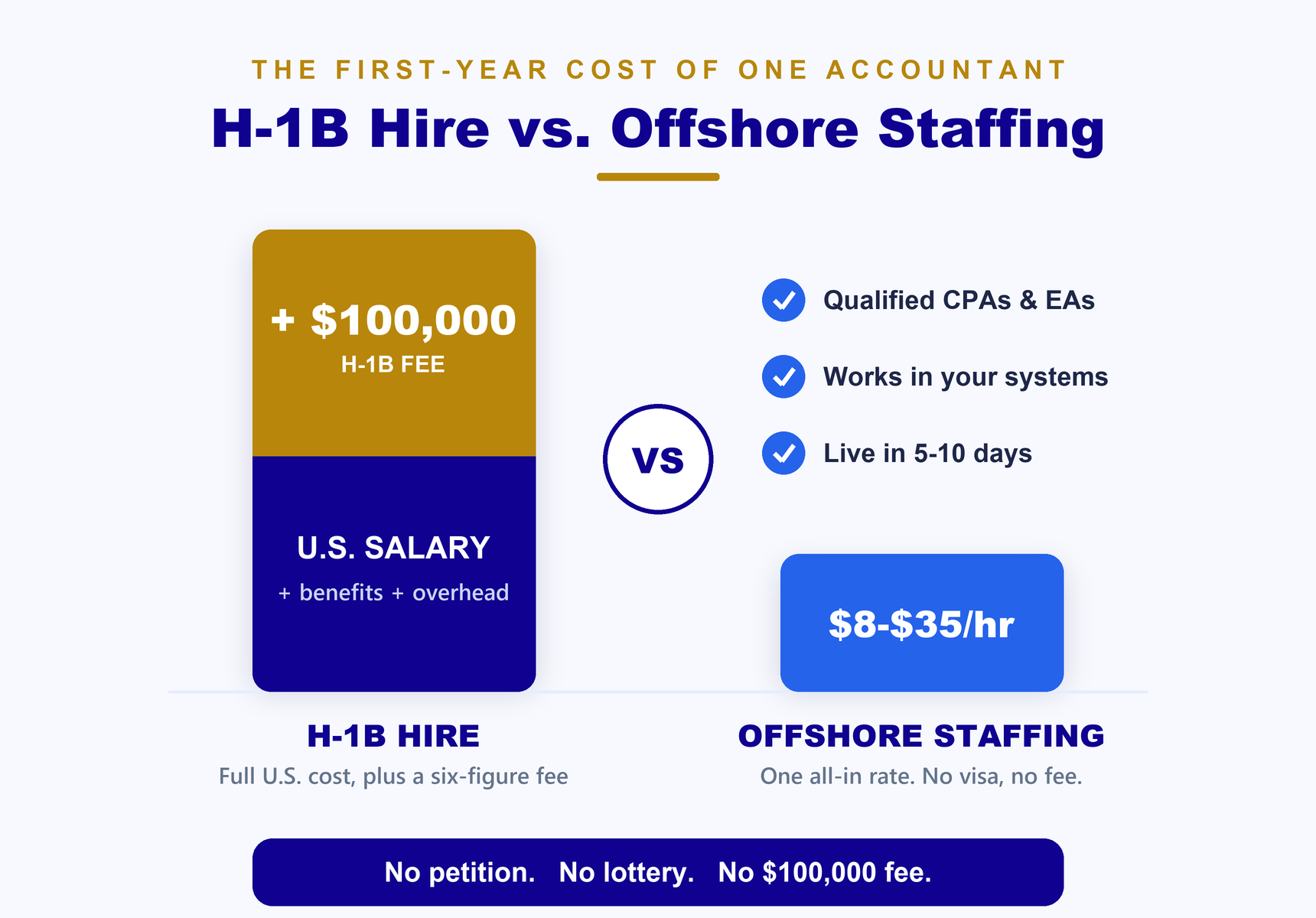
An H-1B hire means a full U.S. salary plus a $100,000 fee. Offshore staffing replaces the whole stack with one all-inclusive rate.
The H-1B Alternative: Offshore Staffing, With No Visa Required
Offshore staffing is the cleanest alternative to H-1B sponsorship because it removes the visa from the equation entirely. Instead of bringing a foreign accountant into the U.S. on a visa, you hire a qualified accountant who works for your firm from their home country, on your software, under your brand, and under your review. There is no petition, no lottery, and no $100,000 fee, because no U.S. work visa is involved.
It looks like hiring in-house, minus the immigration system, the lottery, and the $100,000 fee.
In practice, you get dedicated offshore accountants you direct day to day: bookkeepers, staff accountants, tax preparers, AP and AR specialists, audit support, payroll, and CFO support. The provider handles recruiting, payroll, infrastructure, and data security on their end. Your firm keeps client-facing work, review, and final sign-off.
This is a different model from the old "outsource a task and wait" approach, and it is also distinct from a domestic staffing agency, which still places a U.S.-based hire (and still leaves you exposed to U.S. salary and visa costs). With offshore staffing you are building a team, not buying a transaction.
H-1B Sponsorship vs. Offshore Staffing: Cost and Risk Compared
Here is what adding one qualified accountant looks like under both models in 2026:
| Factor | H-1B sponsorship (2026) | Offshore staffing |
|---|---|---|
| Government fee | $100,000 per petition (currently in effect, under appeal) | None (no visa required) |
| Compensation | Full U.S. salary + benefits + overhead | All-inclusive rate, $8-$35/hr by role |
| Approximate all-in cost | Six-figure salary plus the fee | Roughly 60-75% less than a comparable U.S. hire |
| Visa / legal risk | Lottery odds, processing delays, active litigation | None (outside the immigration system) |
| Time to productive | Months (petition, approval, relocation) | Days to a couple of weeks |
| Talent pool | The same shrinking U.S. pool | A different, larger pool of qualified accountants |
The contrast is plain: H-1B sponsorship adds a large, uncertain cost on top of an already-expensive U.S. hire, while offshore staffing replaces that cost structure with a single, predictable rate and never touches the visa system. For ongoing capacity, that is why the math now favors offshore so heavily.
What to Look For in an Offshore Staffing Partner
Not every offshore provider is built for CPA-firm work. If you are replacing an H-1B plan with an offshore team, hold candidates to five standards:
- CPA-firm specialization. A team that already works with accounting firms understands multi-client books, busy-season cycles, and review hierarchies, with no generalist ramp-up.
- Qualified, vetted talent. You are hiring people, so credentials matter: CPAs, EAs, and Chartered Accountants, screened and tested on real accounting work, not just placed.
- Certified security. Your offshore staff handle client data, so insist on SOC 2 Type II, ISO/IEC 27001, and IRS Section 7216 compliance, plus encrypted devices, no local data storage, two-factor authentication, and role-based access.
- U.S. time-zone overlap and real integration. A team that works in your systems and across several hours of your business day operates as an extension of your firm, not a remote silo.
- A low-risk way to start. A free trial and no long lock-in let you prove the model on real work before you commit.
Run any provider against that list and the field narrows quickly.
Why CPA Firms Choose Acculink
Acculink was built for exactly this moment. It serves U.S. CPA and accounting firms that need qualified capacity without the cost or uncertainty of the visa system:
- Built only for U.S. CPA and accounting firms, with no generalist learning curve.
- Dedicated offshore staff you direct, white-label, working as an extension of your team, with no H-1B, no visa, and no $100,000 fee.
- Fully certified: SOC 2 Type II, ISO 27001, IRS Section 7216, GDPR, AICPA, and FTC Safeguards, with enterprise-grade data-security controls and a five-year record with no data breaches.
- 300+ qualified professionals (CPAs, EAs, Chartered Accountants, and Big-4 alumni) currently supporting 80+ U.S. firms, with overlap into U.S. business hours.
- Transparent $8-$35/hr all-inclusive pricing, generally 60-75% below a comparable U.S. hire.
- 40-hour free trial, no setup fee, no lock-in, live in 5-10 business days.
If you want to see how it works on your own files, you can start a 40-hour trial or book a consultation.
Frequently Asked Questions
Is offshore staffing a legal alternative to an H-1B visa?
Yes. Offshore staff work from their home country, so no U.S. work visa is required, and neither is the $100,000 H-1B petition fee. Your firm directs the work, while the provider handles employment, payroll, and compliance offshore. It is a fundamentally different model from visa sponsorship, not a workaround within it.
Does the $100,000 H-1B fee apply to offshore accountants?
No. The fee applies to H-1B petitions, which are only needed to bring a foreign worker into the United States. Offshore staff never enter the U.S. immigration system, so the petition and its fee do not apply.
Is the $100,000 H-1B fee still in effect in 2026?
As of late June 2026, yes, though it is being litigated. A federal court (the U.S. District Court for the District of Massachusetts) ruled the fee unlawful on June 8, 2026, but it remains in effect under a stay while the government's appeal is heard by the First Circuit. Because this is moving quickly, confirm the current status with a qualified immigration attorney before relying on it.
How much can a CPA firm save versus an H-1B hire?
A meaningful amount. An H-1B hire means a full U.S. salary plus, currently, a $100,000 petition fee. Offshore staffing through a provider like Acculink runs $8 to $35 per hour, all-inclusive, typically 60 to 75 percent below a comparable U.S. hire, with no government fee at all.
Is offshore accounting staffing safe and compliant for a CPA firm?
Yes, with the right controls. Look for SOC 2 Type II, ISO/IEC 27001, and IRS Section 7216 compliance, plus encrypted devices, no local data storage, two-factor authentication, and role-based access. A certified offshore team under these controls is often more secure than ad-hoc in-house handling. Ask any provider for its actual SOC 2 Type II report.
Can offshore accountants do the same work as an H-1B hire?
For most preparation and back-office work (bookkeeping, AP and AR, payroll, tax preparation, audit support, and reporting), yes, as long as the team is qualified and works under your firm's review. Client-facing advisory and final sign-off stay with your U.S. team.
The Bottom Line
The $100,000 H-1B fee changed the calculation, but it only sharpened a decision most firms were already facing: the U.S. accounting talent pool is shrinking, and the cost of competing for it keeps climbing. Importing talent through the visa system now adds a large, uncertain expense on top of an already-expensive hire.
Offshore staffing answers that same need for qualified capacity, without the visa, the fee, or the wait. For a firm that wants to add a team rather than gamble on a lottery, it is the lower-cost, lower-risk move.
If an H-1B plan is on hold because of the new fee, the practical next step is to test an offshore hire on real work. Acculink offers a 40-hour trial and a free consultation to do exactly that.
Tags:
About the Author

Related Posts
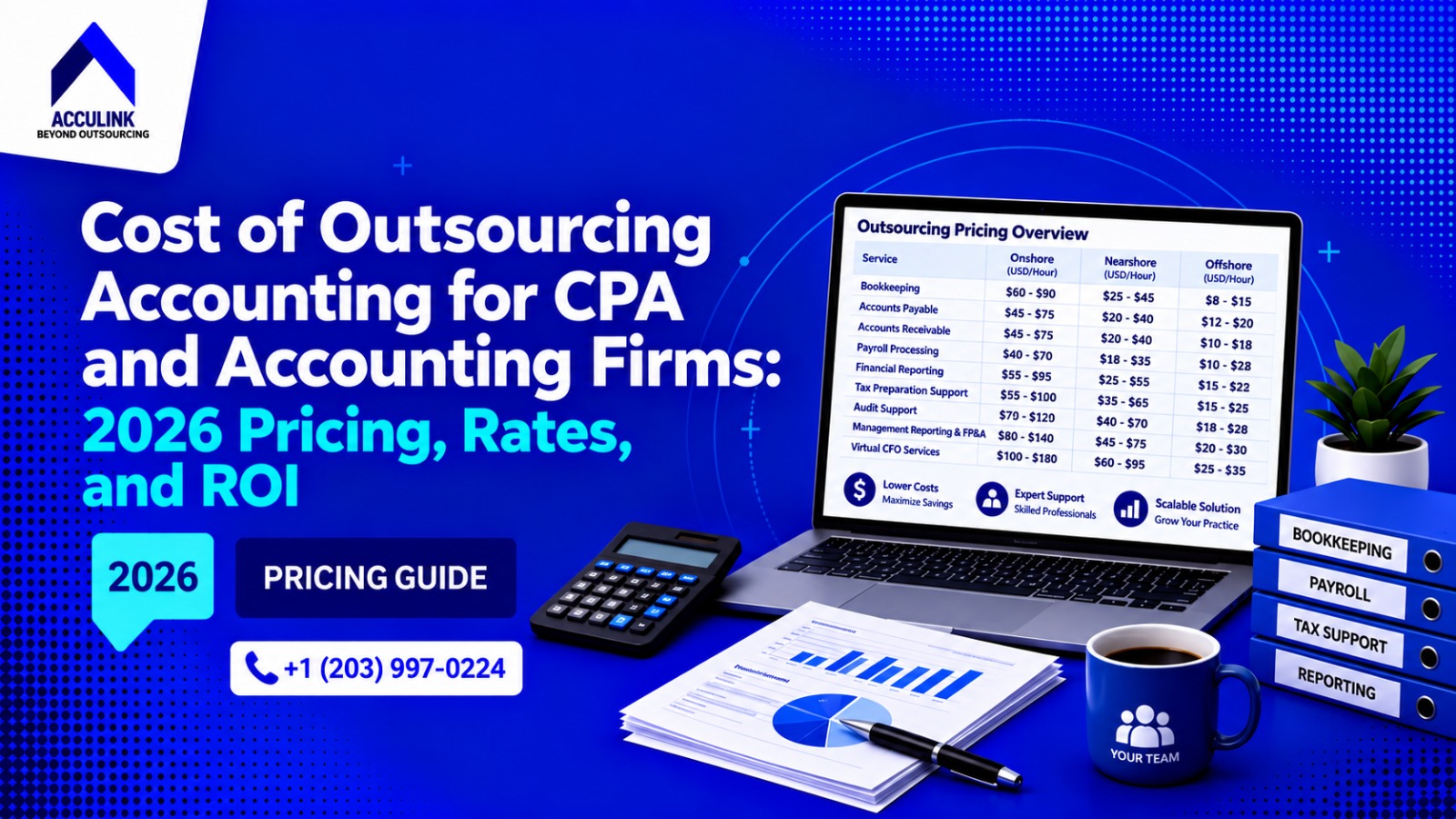
Cost of Outsourcing Accounting for CPA and Accounting Firms: 2026 Pricing, Rates, and ROI
The cost to outsource accounting typically ranges from $8 to $35 per hour, depending on the service, experienc…
15 Profitable Add-On Services CPA and Accounting Firms Can Offer Without Hiring In-House
CPA and accounting firms do not need to build every new service with another in-house hire. This guide compare…
Top 10 Payroll Outsourcing Companies for CPA and Accounting Firms (2026)
This guide compares ten payroll outsourcing companies for U.S. CPA and accounting firms. It separates processi…