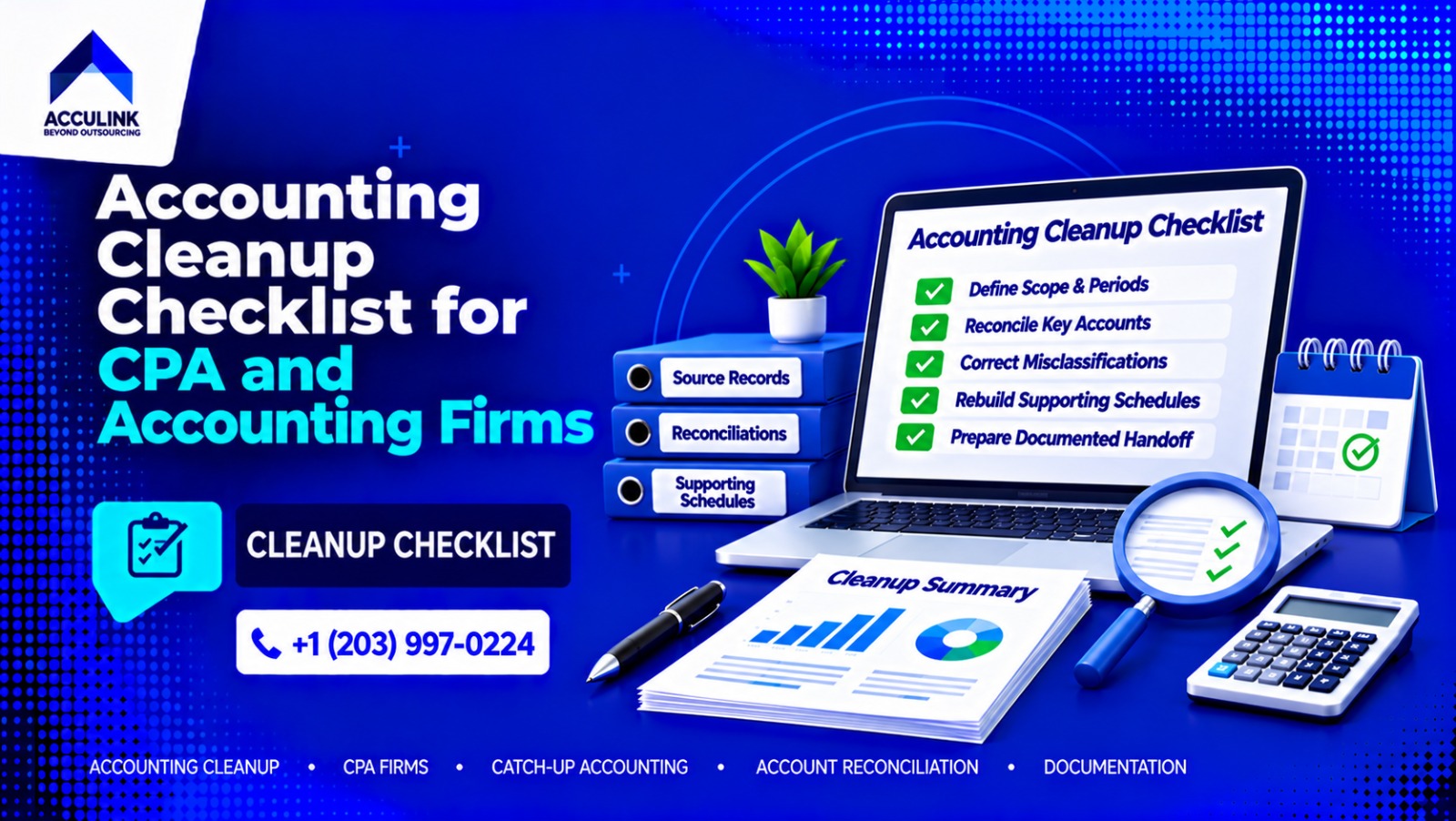
Accounting Cleanup Checklist for CPA and Accounting Firms

Summary
Accounting cleanup corrects unreliable records through ledger adjustments, reconciliations and supporting schedules. This checklist helps CPA and accounting firms scope client files, address QuickBooks issues and review the completed handoff. Acculink quotes cleanup projects after a file assessment and separately offers all-inclusive, role-based staffing at $8 to $35 per hour.
Accounting cleanup corrects and reconciles unreliable financial records so a firm has a supported accounting position for reporting, period-end work and tax preparation. For U.S. CPA and accounting firms, the deliverable should include reconciled balances, documented corrections, supporting schedules and clearly identified open items.
The assignment can extend from transaction coding to general ledger reconciliation, balance-sheet corrections and rebuilding support for historical balances. Its scope depends on what the firm can rely on, what needs correction and how the completed records will be used.
This guide sets out an accounting cleanup checklist, the evidence a reviewer should receive and how to scope preparation support when several client files need attention at once.
Key takeaways
- Separate missing-period catch-up work from corrections to existing records.
- Establish a reliable opening position before changing transactions.
- Review the balance sheet as well as bank and credit-card reconciliations.
- Define the accounting deliverables and review criteria before the cleanup starts.
- Delegate documented work packages while your firm retains accounting decisions and final acceptance.
Acculink offers all-inclusive, role-based offshore staffing from $8 to $35 per hour. Its accounting cleanup service is scoped after a file assessment, with a project quote based on the work required.
Accounting cleanup, catch-up accounting or recurring work?
Distinguish the required work when assessing the file. Missing activity, incorrect postings and unsupported balances create different preparation and review needs.
| Assignment | Main problem | Expected result |
|---|---|---|
| Accounting cleanup | Existing ledger entries, classifications or balances are unreliable | Supported corrections, reconciled accounts and a documented handoff |
| Catch-up accounting | Activity for one or more periods has not been recorded | Missing activity entered, categorized and reconciled |
| Recurring accounting | Accepted records need continuing maintenance | Current-period processing, reconciliations and agreed reports |
Catch-up work is sometimes described as catch-up bookkeeping. It may form part of an accounting cleanup, alongside corrections to opening balances, control accounts and supporting schedules.
A file with six missing months and an incorrect opening bank balance needs both missing-period processing and corrections. A current file with misclassified owner transactions may need targeted work rather than reconstruction of the full year.
Identify the last reliable period and any earlier issues that require separate review. Use the diagnostic findings to define the assignment and quote, rather than relying on a label such as “full-year cleanup.”
Scope the cleanup before you quote.
Get an editable scope sheet for opening balances, ledger issues, missing records and handoff requirements.
Scope the accounting cleanup before assigning it
Start with a diagnostic review of the accounting file and available records. Confirm:
- Entities and periods: which businesses, accounting periods and reporting basis are included.
- Accounts and systems: bank, card, loan, payroll, payment-processor and other relevant records.
- Starting position: the latest reliable reconciliations, opening balances and prior-year adjustments.
- Condition of the file: missing transactions, duplicates, uncategorized items and unexplained balances.
- Filing history: which periods already support filed returns or issued financial statements.
- Responsibilities: who supplies missing information, answers accounting questions and approves changes.
Request source records alongside the accounting reports. Bank and card statements, sales records, invoices, payroll reports, loan statements and asset documents serve different purposes. The IRS guidance on supporting business records explains why underlying documents matter for entries and tax reporting, including records maintained electronically.
Agree exclusions as well. A reconstruction of inventory records, specialist tax analysis or correction of prior filings may require a separate assignment. Record how newly discovered issues will be assessed and priced.
For a portfolio of clients, prioritize by deadline, consequence and readiness. A file awaiting essential statements needs a collection plan. A file with complete records may be ready for immediate preparation. Keep that distinction visible in the work queue.
Accounting cleanup checklist: ten checks before the handoff
For historical files, work period by period from the last reliable opening position so corrections remain traceable. Use the following checks as a framework, adapted to the client's size, accounting method and engagement. Record the preparer, supporting file, open questions and reviewer decision for each relevant area.
1. Preserve the starting position
Retain the original trial balance, balance sheet, profit and loss statement, reconciliation reports and relevant ledger detail before making changes. Use the software's available export, backup and change-history functions appropriately.
Confirm that opening balances agree to the approved prior-period position, including adjustments that should have been carried forward. If a difference affects a filed year, escalate it before posting a correction.
Preserve supporting records under the firm's retention policy and applicable requirements. The IRS record-retention guidance explains why the required period depends on the record and circumstances. A completed cleanup is not a reason to discard the original evidence.
2. Record missing activity and resolve duplicates
Compare available statements and source records with the ledger to identify missing periods, incomplete imports and repeated entries.
Check transactions that may have been recorded through more than one route, such as an imported bank item alongside an existing bill payment. A similar amount or date is a reason to investigate, not sufficient evidence to delete an entry.
For missing activity, record the correct account, date, payee or customer and source reference. Maintain a question log for items requiring client clarification instead of assigning unsupported categories to clear the queue.
3. Reconcile bank and credit-card accounts
Complete bank reconciliation and credit card reconciliation for each account and period in scope. Check opening balances, statement dates, transfers, bank charges and outstanding items.
Investigate old reconciling items rather than carrying them forward automatically. Confirm that transfers are not recorded as income or expense and that both sides of an inter-account transfer are accounted for.
Intuit's reconciliation guidance describes comparing recorded transactions with statements and investigating differences. An unexplained adjustment used to force agreement does not establish that the records are correct.
Where this is the principal backlog, define a separate bank and card reconciliation work package.
4. Review classifications and owner transactions
Review uncategorized activity, suspense accounts, duplicate ledger accounts and material classifications. Apply the firm's approved chart of accounts consistently.
Separate business activity from owner contributions, distributions, reimbursements and loans. The correct treatment depends on the entity and facts, so unclear items need a reviewer decision.
Do not code solely from a bank-feed description or vendor name. The same supplier may provide inventory, equipment and ordinary operating expenses. Retain the information supporting the classification and document any material reclassification.
5. Reconcile sales and payment-processor settlements
Compare sales records, customer receipts, refunds, fees, chargebacks and settlement reports. A net processor deposit should not automatically be treated as gross sales.
Use a clearing-account schedule where appropriate to explain the movement from customer activity to bank deposits. Identify settlement timing differences and unresolved balances.
For clients receiving Form 1099-K, reconcile the information return to the underlying records rather than entering it as additional revenue. The IRS explanation of Form 1099-K notes that reported gross payments are not adjusted for items such as fees and refunds. The cleanup file should explain relevant differences.
6. Reconcile receivables and payables to the general ledger
Complete accounts receivable reconciliation and accounts payable reconciliation by tying the customer and vendor subledgers to their general-ledger control accounts, where the system and reporting basis use those accounts.
Investigate unapplied receipts, duplicate invoices or bills, negative balances, old credits and transactions posted directly to control accounts. Determine whether the issue is missing documentation, incorrect application or a proposed accounting adjustment.
Do not remove an old receivable or payable simply because it has remained outstanding. Record the supporting facts and obtain approval for any write-off or other correction.
7. Complete payroll reconciliation and related-liability checks
Compare payroll reports with wage expense, employer costs, deductions, tax liabilities and bank payments. Identify duplicate payroll entries and amounts posted to the wrong liability account.
Show how outstanding payroll liabilities relate to payroll-provider reports and subsequent payments. Flag differences involving filed payroll returns for the appropriate specialist.
Treat owner payroll and reimbursements separately when their accounting or tax treatment requires review. The preparer's task is to assemble a supported reconciliation and identify exceptions, not to infer the answer from a cash payment alone.
8. Complete balance sheet reconciliation
Perform balance sheet reconciliation for relevant assets, liabilities and equity accounts. Depending on the client, this may include:
- Loans, separating principal, interest and other charges.
- Fixed assets, acquisitions, disposals and depreciation schedules.
- Inventory and cost-of-sales records.
- Prepayments, deposits, accruals and deferred revenue.
- Sales-tax liabilities and other clearing accounts.
- Intercompany and owner balances.
Keep the book treatment and tax adjustments distinguishable. A fully depreciated asset should not be removed solely because its carrying value is zero; review whether it is still owned or has been disposed of.
9. Complete trial balance reconciliation and review adjustments
Check that the trial balance is arithmetically balanced, then complete general ledger reconciliation by tying relevant balances to the reconciliations and supporting schedules. Equal debits and credits alone do not establish accuracy. For example, a duplicated supplier bill can leave the trial balance balanced while overstating both expense and payables.
Prepare the agreed financial statements and supporting reports on the specified basis. Investigate unexpected movements, unusual margins, inconsistent classifications and balances that do not fit the client's activity.
Prepare a schedule of adjusting journal entries showing the reason, source, affected period, preparer and approval status. Check that accepted changes flow consistently into the ledger, statements and supporting schedules.
Escalate corrections that affect earlier filings or issued reports. The responsible firm should assess the effects on accounting records, reports and tax filings before approving a change.
10. Clear review notes and document acceptance
Resolve review notes, or record the remaining issue, its effect, the person responsible and the next action. Distinguish unresolved preparation work from a matter intentionally referred to the tax preparer.
Have the reviewer confirm completion against the agreed scope. Identify the final report version, period covered and any approved limitations.
Agree how subsequent entries will be handled so the receiving team does not work from one trial balance while the accounting file changes without notice. Completion includes a controlled handoff, not merely sending a revised profit and loss statement.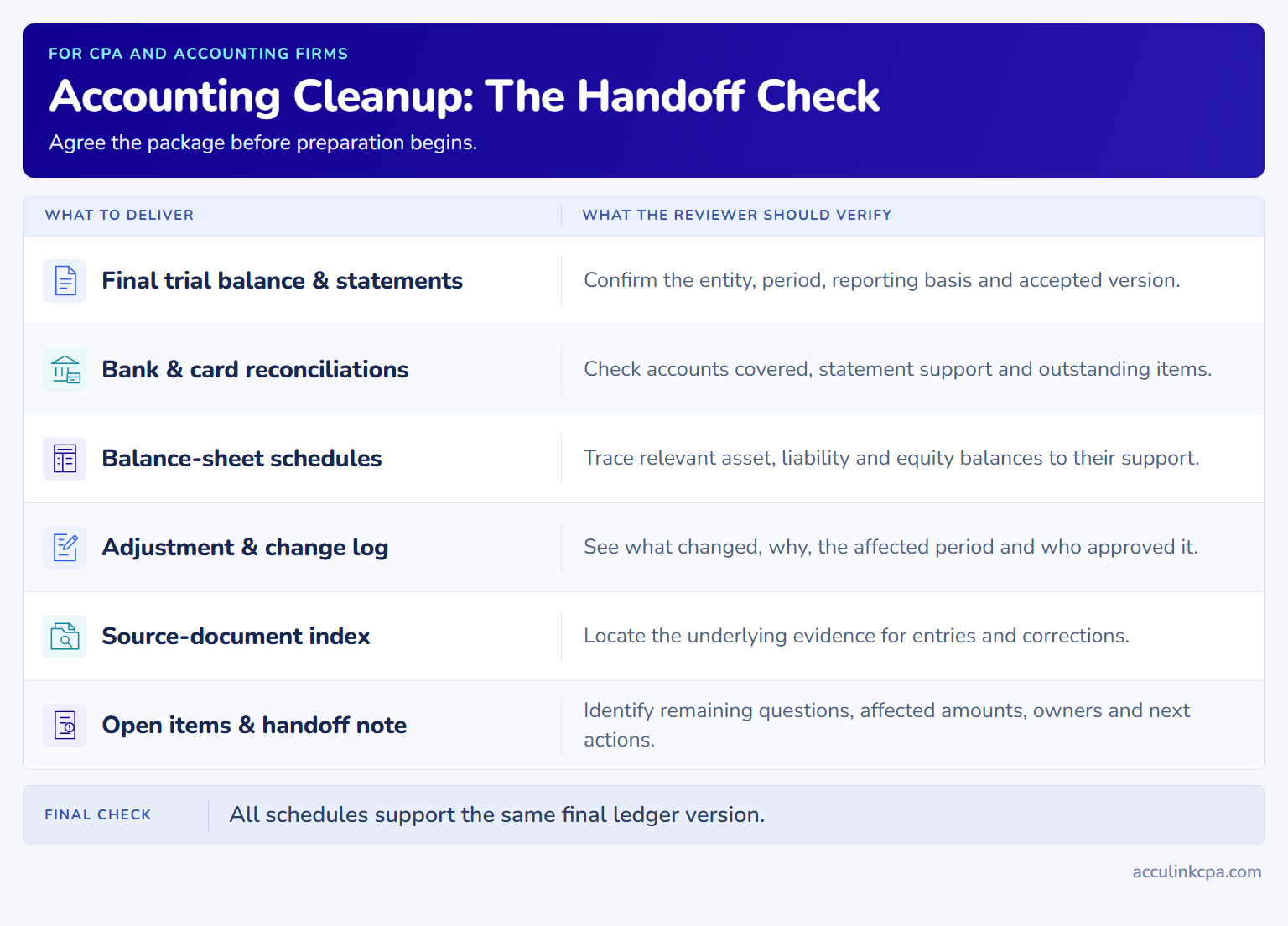
QuickBooks cleanup: controls that deserve particular attention
A QuickBooks cleanup should preserve the connection between source documents, transactions, reconciliations and reports. Bulk changes need a review plan because a correction to one item can affect another period or report.
Check opening-balance entries and Opening Balance Equity, bank-feed matching, duplicate imports, bank rules, Undeposited Funds, unapplied payments and postings to control accounts. Investigate the origin of an unexplained opening balance and obtain approval for its treatment. Determine whether a difference comes from a missing transaction, incorrect posting or a later change to a previously reconciled item.
Use the QuickBooks Online audit log to investigate relevant changes and user activity. Retain the evidence the engagement requires rather than relying on software history as the only record.
Before undoing reconciliations, merging accounts or deleting transactions, assess the effects and obtain the firm's approval where required. Keep material changes identifiable in the handoff.
When evaluating QuickBooks cleanup services, ask how the team will preserve reconciliation history, document corrections and handle queries. Acculink's QuickBooks accounting support provides a relevant route for firms assigning work in that environment.
What should the completed accounting cleanup package contain?
The receiving reviewer needs a supported accounting position and a clear explanation of what changed. Agree the intended next stage, such as financial reporting, resuming a monthly close or preparing tax returns, and the work needed to accept the handoff.
Agree the package before preparation starts:
| Deliverable | What the receiving reviewer should be able to establish |
|---|---|
| Final adjusted trial balance and financial statements | Entity, period, reporting basis and accepted version |
| Bank and card reconciliation files | Accounts covered, statement support and outstanding items |
| Balance-sheet schedules | How relevant balances were derived and reconciled |
| Adjustment and change log | What changed, why it changed and who approved it |
| Source-document index | Where the underlying evidence can be found |
| Open-items and accounting-handoff note | Remaining questions, affected amounts, owners and next actions |
Tie the final schedules to the same ledger version. A correct reconciliation prepared before a subsequent posting may no longer support the delivered balance.
Where cleanup leads into financial statement preparation, agree the reporting basis, schedules and further preparation or review needed under that engagement.
For tax preparation support, identify remaining book-to-tax matters and the point at which the return preparer accepts the accounting package. Tax-ready records still require the appropriate tax adjustments and technical decisions.
How much does accounting cleanup cost?
Accounting cleanup cost depends on the condition of the file and the work required. A full year with reliable records may involve less correction work than a shorter period with unsupported opening balances, duplicate imports and several payment processors.
A useful quote identifies:
- Periods, entities, accounts and transaction volume.
- Missing records and the starting balance assessment.
- Catch-up processing and correction work required.
- Software, integrations and access arrangements.
- Preparer experience, review responsibilities and deliverables.
- Assumptions, exclusions and the process for additional work.
Acculink provides a scoped cleanup project quote following a diagnostic review. It also offers all-inclusive, role-based staffing from $8 to $35 per hour through its dedicated-team model. Confirm which arrangement applies and what its quote includes.
Get cleanup files ready for review.
Scope ledger corrections, balance-sheet reconciliations and a documented handoff around your firm's requirements.
Project cleanup support or dedicated accounting capacity?
Use a defined cleanup assignment when the immediate need is to correct historical records and deliver an accepted accounting package. Consider a dedicated offshore accountant when several client files also require recurring ledger work, reconciliations and period-end preparation.
Match the role to the work. Routine transaction processing and complex balance-sheet corrections can require different experience and supervision.
Either model needs a documented scope, named contacts, posting permissions and acceptance criteria. The accounting outsourcing process guide explains the broader preparation, review and handoff workflow.
For initial work, select a representative file with accessible records. Evaluate the supporting schedules, handling of exceptions and effort your reviewer needs to accept the package before assigning a larger group of clients.
Before access is granted, confirm confidentiality, data permissions and applicable disclosure requirements. Where tax-return information is involved, assess the IRS Section 7216 framework. Your firm retains accounting decisions, client advice and final acceptance.
How Acculink supports accounting cleanup for CPA and accounting firms
Acculink's accounting cleanup service covers work such as historical reconciliations, transaction corrections, chart-of-accounts cleanup, supporting schedules and a documented trial-balance handoff.
Firms can scope catch-up accounting for missing periods, targeted corrections or recurring preparation capacity. Match the assignment to the condition of the records, required accounting work and experience needed.
Acculink supports your firm with:
- Preparation followed by review: Acculink uses a two-tier process for its accounting deliverables, with a senior supervisor checking the preparer's work before delivery.
- Your systems and workflow: Dedicated staff work under your firm's direction, using your existing systems.
- Experienced team: Acculink has 300+ qualified team members supporting 80+ accounting firms.
- Flexible engagement: Acculink offers a 40-hour free trial, with no setup or recruitment fees and no long-term contract.
Review Acculink's data security controls against your firm's requirements. Agree access, evidence, review and escalation arrangements before the first file is assigned.
Frequently asked questions
What does accounting cleanup include?
Accounting cleanup can include historical corrections, bank and card reconciliations, general ledger and balance-sheet reconciliation, receivables and payables tie-outs, and supporting schedules. The agreed deliverable should identify accepted adjustments, unresolved matters and the final accounting records handed back to the firm.
What is the difference between accounting cleanup and catch-up accounting?
For scoping purposes, catch-up accounting records missing-period activity, while cleanup corrects unreliable entries and balances. A client may need both. The wider cleanup can include opening balances, control accounts, supporting schedules and financial-statement effects, with the firm's reviewer approving accounting decisions.
Can accounting cleanup support financial reporting and tax preparation?
Yes. Reconciled records and documented corrections provide a starting point for financial reporting, a regular close or tax preparation. Agree the receiving team's requirements. Further reporting work, book-to-tax adjustments, elections and technical review remain part of their respective engagements.
How long does accounting cleanup take?
The timeline depends on the periods and accounts involved, transaction volume, opening balances, record availability and review complexity. Obtain a file assessment before agreeing dates. Separate preparation time from waiting for client answers, specialist input and reviewer decisions.
How much does accounting cleanup cost with Acculink?
Acculink provides a scoped cleanup project quote after a diagnostic review. It also offers all-inclusive, role-based staffing from $8 to $35 per hour. Confirm which arrangement applies, its deliverables, exclusions and review requirements before work begins.
Can CPA and accounting firms outsource accounting cleanup?
Yes. Firms can delegate defined corrections, reconciliation schedules, catch-up processing and workpaper preparation, including work in QuickBooks where agreed. Set posting permissions, evidence requirements and escalation rules. The responsible firm retains accounting judgments, client advice and final acceptance.
How should prior-year accounting corrections be handled?
Identify the affected periods, balances, reports and filings, then obtain the responsible professional's assessment before posting. Retain the supporting evidence and approval history. A correction to accounting records does not, by itself, determine whether an amended return or another reporting action is required.
What should a firm provide to scope an accounting cleanup assignment?
Provide the entities, periods, software, account list, transaction volume, last reliable reconciliations and intended use of the records. Identify missing documents, prior filings, known issues, the client contact and the firm's reviewer. Agree a representative file or work package for the diagnostic assessment.
After the cleanup: recurring accounting
An accepted cleanup package becomes the starting point for the next reporting period. Assign responsibility for ongoing reconciliations, new transactions and subsequent adjustments so the records continue to support the firm's agreed reporting and tax work.
More cleanup capacity. Less deadline pressure.
Ledger corrections, reconciliations and documented handoffs within your firm's systems.
300+ professionals | 80+ U.S. firms | Two-tier review
Tags:
About the Author

Related Posts
Top Outsourced Accounting Firms for CPA Practices (2026)
Choosing an outsourced accounting partner is a high-stakes call because the team touches your clients' data. T…

Top 10 Offshore Staffing Companies for Accounting Firms (2026)
Hiring an offshore team is one of the highest-leverage moves a short-staffed CPA firm can make, but the partne…

Tax Preparation Outsourcing for CPA Firms: How It Works, What It Costs, and Where to Start (2026)
Tax preparation outsourcing lets a CPA firm hand routine return preparation to an external team, usually offsh…
Audit Staffing for CPA Firms: How to Hire Offshore Audit Professionals
Audit staffing should begin with the work and review capacity a CPA firm needs, not a generic headcount reques…