Financial Audit Process and Checklist for CPA and Accounting Firms

Summary
Use this practical financial audit process and checklist to organize planning, PBC records, risk assessment, testing, workpapers, financial statement review and completion. It also helps CPA and accounting firms identify work suitable for offshore support and compare defined assignments with dedicated audit staffing at Acculink’s published role-based rates of $8 to $35 per hour.
Financial Audit Process and Checklist for CPA and Accounting Firms
Knowing the financial audit steps is not the same as keeping the engagement moving. Evidence can arrive late, preparers and reviewers can duplicate work, and managers can absorb routine file-building as the reporting deadline approaches.
For CPA and accounting firms, that distinction matters. If managers are rebuilding lead schedules, chasing support or clearing basic cross-references before they can review conclusions, the file has a capacity problem as well as a documentation problem. Adding people is most useful when the work, handoffs and acceptance criteria are clear enough for those people to produce review-ready output.
This guide provides a practical financial audit process and checklist for firms conducting or supporting financial statement audit engagements. Use it to control the engagement and to identify work that can be standardized, reassigned or supported without transferring professional judgment. It covers the stages of the audit, the outputs reviewers need, common causes of delay and the work that can receive additional preparation support.
The appropriately authorized responsible audit firm and its professionals retain engagement direction, judgment, supervision, sign-off and responsibility for the audit report. If the constraint is preparation capacity rather than audit methodology, Acculink's financial audit support for CPA and accounting firms provides one route to compare after the firm defines where work is stalling.
Key takeaways for audit leaders
- Protect reviewer time: Partners and managers should spend their constrained hours on risk, exceptions, judgment and conclusions rather than reconstructing routine schedules.
- Keep decisions and evidence connected: Risk assessment, procedures, evidence and conclusions should remain traceable through the file.
- Use a checklist as a workflow control: It can expose missing inputs, ownership gaps and unresolved items, but it does not replace the firm's methodology or professional judgment.
- Match capacity to the work pattern: A defined support assignment can address a bounded backlog. A dedicated audit professional may fit recurring engagements that benefit from continuity.
- Test fit before scaling: Start with a representative work package and measure rework, reviewer time, responsiveness and documentation quality.
- Keep responsibility explicit: Outside support can prepare agreed documentation and perform assigned work under the firm's direction, but it does not issue the opinion or assume the responsible firm's professional obligations.
Considering additional audit capacity? Acculink offers offshore financial audit professionals to CPA and accounting firms at published role-based rates of $8 to $35 per hour, depending on experience and scope.
What is a financial audit
A financial audit, commonly called a financial statement audit in this context, is an independent examination of an entity's financial statements and related evidence. The auditor seeks sufficient appropriate evidence to support an opinion on whether the statements are presented fairly, in all material respects, under the applicable financial reporting framework.
The objective is reasonable assurance, not a guarantee that every error or instance of fraud will be found. The nature, timing and extent of financial audit procedures depend on the engagement, applicable standards, assessed risks, materiality, the entity and the evidence available.
For nonissuer engagements in the United States, the responsible firm should apply the relevant professional requirements, including the AICPA Statements on Auditing Standards currently in effect. PCAOB standards apply in their appropriate jurisdiction and engagement context. A checklist should therefore reflect the firm's governing standards and methodology rather than attempt to create one universal audit program.
Financial audit and financial statement audit
The two phrases are often used interchangeably in general searches. Financial statement audit is the more precise term when the engagement is directed at expressing an opinion on a set of financial statements. Financial audit can also be used more broadly, so the engagement letter, reporting framework and applicable standards should control the scope.
This article uses financial audit as the broader search term while focusing on the financial statement audit workflow relevant to CPA and accounting firms.
Financial audit process at a glance
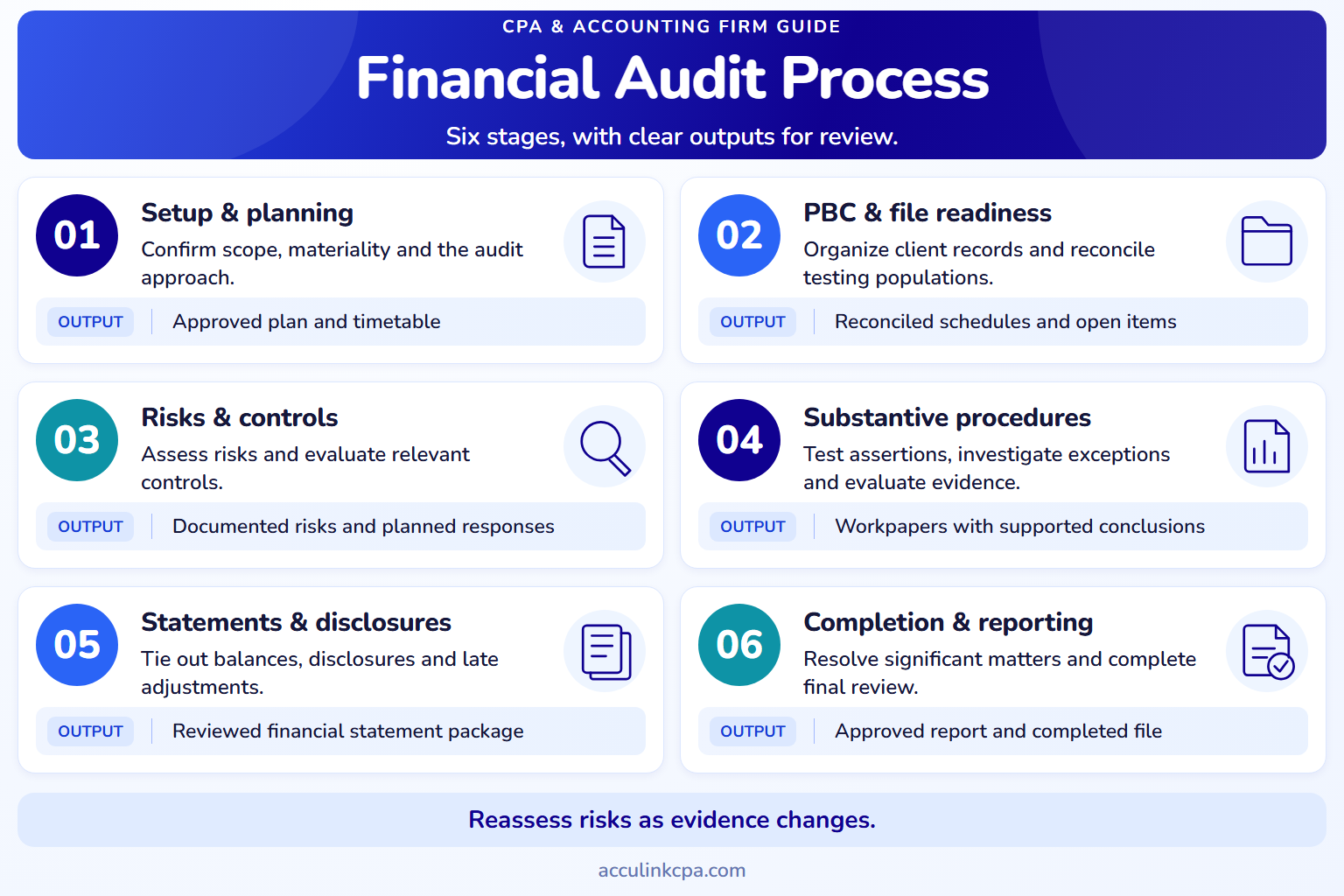
The stages overlap in practice. Planning continues as facts change, procedures respond to assessed risks, and completion can identify matters that require more work. The table is therefore a workflow map, not a rigid sequence.
| Stage | Principal question | Reviewer-ready output |
|---|---|---|
| Engagement setup | What is the firm engaged to report on, under which framework, by when and with what responsibilities? | Approved engagement terms, team structure, timetable and communication plan |
| Planning and risk assessment | Where could material misstatement arise, and how will the audit respond? | Documented understanding, materiality, risk assessment, strategy and audit plan |
| Prepared-by-client (PBC) and file readiness | Are the populations, schedules and supporting records complete, reconciled and usable? | Indexed support, mapped trial balance, lead schedules, reconciliations and open-item log |
| Controls and substantive work | Do the procedures address the assessed risks and relevant assertions? | Completed workpapers with evidence, exceptions, follow-up and conclusions |
| Financial statement review | Do the statements and disclosures agree with the underlying records and applicable framework? | Tie-outs, disclosure review, adjustment tracking and final analytical review |
| Completion and reporting | Has the team resolved significant matters and assembled a complete review trail? | Cleared review notes, completion documentation, required communications and approved report package |
The operational control running through every stage is traceability. A reviewer should be able to move from the identified risk to the planned response, the procedure performed, the evidence obtained, the exception analysis and the conclusion reached.
Get the audit PBC tracker template.
Track document owners, due dates, dependencies, evidence status, open items, and escalation in one controlled workflow.
Common causes of financial audit delays
The visible delay is often not the real constraint. Diagnose the work pattern before adding hours so the firm solves the bottleneck instead of moving it to the review stage.
| What the team sees | What it often indicates | Practical first response |
|---|---|---|
| Managers rebuild lead schedules and routine workpapers | Preparation capacity is below the workload | Separate repeatable preparation from judgment and review work |
| PBC requests dominate status calls | Ownership, format or escalation rules are unclear | Convert the request list into a controlled tracker with dependencies |
| The same review notes recur across files | Templates or acceptance criteria are not calibrated | Complete and approve one representative workpaper before scaling |
| Similar preparation backlogs recur across engagements | The firm has a structural capacity gap | Consider a dedicated professional who can learn the firm's workflow |
| One defined backlog threatens a deadline | The firm has a temporary or project-specific gap | Use a bounded support assignment with clear inputs and outputs |
This distinction matters because extra capacity creates value only when it releases more constrained review time than it consumes in coordination and correction.
Plan financial audit capacity before fieldwork
The audit plan should address people as deliberately as it addresses procedures. Estimate preparation hours and review hours separately. Assign work according to experience, identify the points that require partner or manager judgment, and decide how missing information will be escalated.
A recurring warning sign is a reviewer spending substantial time creating the work that should arrive ready for review. The result is not simply higher labor cost. It compresses the time available for risk decisions, exception evaluation and engagement-level review.
Before adding support, define the deliverable, source records, firm template, expected cross-references, reviewer and escalation path. Those details do more to control rework than a broad request for an additional auditor.
Acculink publishes role-based pricing of $8 to $35 per hour for offshore financial audit professionals, depending on the role and experience required. Treat the rate as one input, not the decision. Compare the proposed professional's experience, included services, supervision model, expected hours and commercial terms against the actual assignment and the internal review time the arrangement is likely to require.
For recurring workloads, firms can also hire an offshore auditor who works within the firm's templates, software and review process. For a discrete backlog, audit support services may be the more direct model. The right choice depends on continuity, workload predictability and the review capacity available inside the firm.
Financial audit checklist by stage
Use this checklist as a control framework. Adapt it to the engagement, applicable professional requirements, firm methodology and the facts identified during the audit. Completion of a box does not establish that the underlying work is sufficient.
1 Engagement setup and audit planning
- Complete the firm's client acceptance or continuance and independence procedures.
- Confirm the reporting entity, period, financial statements, applicable financial reporting framework and intended report.
- Identify the auditing standards and other requirements applicable to the engagement.
- Set the reporting deadline, fieldwork dates, governance meetings and internal review milestones.
- Define management's responsibilities and the information the client must provide.
- Assign the engagement partner, manager, reviewers, preparers and specialists required by the scope.
- Review prior-period financial statements, audit files, adjustments, control matters and unresolved issues where available.
- Document significant changes in the entity, industry, systems, personnel, financing and transactions.
- Establish and document materiality and any related thresholds in accordance with the firm's methodology.
- Identify financial statement-level and assertion-level risks, including significant risks where applicable.
- Develop the overall audit strategy and the planned nature, timing and extent of procedures.
- Create the initial PBC request list with owners, due dates, formats and escalation contacts.
- Confirm how status updates, exceptions, proposed adjustments and review notes will be communicated.
Planning is iterative. New evidence, changes in the client or unexpected results may require the responsible team to revise its risk assessment and planned response.
2 PBC records and file readiness
- Obtain the final or appropriately controlled trial balance and map it to the financial statements and lead schedules.
- Reconcile the trial balance to the general ledger and investigate unexplained differences.
- Obtain current account reconciliations and supporting schedules for relevant financial statement areas.
- Check that populations used for testing cover the intended period and reconcile to the relevant control totals.
- Organize PBC records through a consistent index that links requests, evidence and workpapers.
- Distinguish received, incomplete, superseded and outstanding documents.
- Identify information produced by the entity that will be used in audit procedures and document how its reliability will be evaluated.
- Obtain applicable contracts, debt agreements, board minutes, legal information and related-party information.
- Coordinate confirmations and preserve the responsible auditor's control over the process where required.
- Assign an owner and due date to every open item rather than leaving unresolved requests in email threads.
- Record late changes to the trial balance and identify the workpapers and statements affected.
A document repository is not the same as an audit file. The file becomes usable when the team can identify what each document supports, which version is current and which questions remain unresolved.
3 Risk assessment and controls work
- Update the team's understanding of the entity, its environment and the financial reporting process.
- Document relevant processes, systems, interfaces, reports and responsible personnel.
- Perform and document walkthroughs where required by the audit approach.
- Identify controls relevant to the audit and connect them to the risks and assertions they address.
- Evaluate control design and implementation as required by the engagement.
- Determine whether the audit approach includes reliance on controls and which controls require operating-effectiveness testing.
- Define the population, selection method, period and evidence for assigned controls testing.
- Record deviations clearly and assess their effect on the planned audit response.
- Update the risk assessment when walkthroughs, testing or other procedures reveal new information.
- Keep remediation advice or process-improvement observations separate from the evidence supporting the audit conclusion.
The applicable framework matters. A financial statement audit does not automatically require the same controls work as an integrated audit. The responsible firm should design the work for the actual engagement rather than reuse a checklist without considering scope.
4 Substantive audit procedures
- Confirm that the audit program responds to the assessed risks for each significant account, disclosure and relevant assertion.
- Reconcile each testing population to the applicable ledger, schedule or financial statement control total.
- Document the purpose of the procedure and the assertion or risk it addresses.
- Record the selection method, sample size or specific-item rationale required by the firm's methodology.
- Perform assigned tests of details and retain clear references to the evidence examined.
- Design analytical procedures with documented expectations, thresholds and investigation of significant differences where applicable.
- Complete confirmation procedures and follow-up work under the responsible firm's controls.
- Investigate exceptions rather than treating an isolated explanation as a completed conclusion.
- Consider whether an exception indicates a broader issue in the remaining population.
- Document proposed adjustments, passed differences and their disposition in the appropriate summary.
- Complete required work relating to estimates, related parties, contingencies, subsequent events and going concern as applicable.
- Conclude on the results of the procedure and explain how unresolved matters affect the audit area.
The PCAOB's standard on responses to assessed risks classifies responsive procedures as tests of controls and substantive procedures in the engagements to which that standard applies. Its audit evidence standard also emphasizes the relationship between procedures, evidence and the relevant assertions. Firms should use the standards governing their engagement and their own approved methodology.
5 Financial statement and disclosure review
- Tie each statement line to the final trial balance, consolidation or supporting schedule.
- Cross-reference note disclosures to the supporting audit areas and current authoritative requirements.
- Check that rollforwards, comparative amounts and reclassifications are consistently reflected.
- Recalculate relevant totals, subtotals and earnings-per-share or other presentation amounts where applicable.
- Review the cash flow statement against the audited balances and supporting activity.
- Track proposed adjustments from identification through management's decision and final presentation.
- Verify that late entries are reflected in affected procedures and financial statement versions.
- Complete the applicable disclosure checklist and document items that are not applicable when the reason is not evident.
- Perform the required overall analytical review and investigate relationships that remain inconsistent with the audit evidence.
- Confirm that the final financial statements, notes and report package use the approved version.
Version control becomes an audit issue when teams are reviewing different statements or when a late journal entry does not flow through every affected schedule. One controlled final package reduces avoidable tie-out work and review notes.
6 Review, completion and reporting
- Confirm that every significant audit area has a documented conclusion supported by the work performed.
- Clear review notes through updated workpapers and evidence, not unsupported explanations in a separate message.
- Evaluate identified misstatements individually and in aggregate under the applicable methodology.
- Resolve contradictory evidence and document the basis for significant judgments.
- Complete required consultations, engagement quality reviews and specialist reviews where applicable.
- Complete required communications with management and those charged with governance.
- Obtain the applicable written representations at the appropriate date.
- Perform required subsequent-events procedures through the relevant date.
- Confirm that contingencies, going-concern matters and significant estimates have received the required review.
- Complete the engagement completion document or equivalent summary required by the firm's methodology.
- Confirm that cross-references lead to the actual supporting documentation.
- Approve the final report and financial statements through the firm's release process.
- Assemble and archive the audit file under the applicable retention and completion requirements.
The PCAOB's audit documentation standard requires documentation sufficient to show that the work supports the conclusions reached for engagements within its scope. The practical test is whether an experienced auditor with no previous connection to the engagement can understand the work performed, evidence obtained and conclusions reached.
What makes a financial audit workpaper review-ready
Review-ready does not mean visually tidy. It means the work can be understood, challenged and re-performed to the extent required without the reviewer reconstructing the preparer's reasoning.
State the purpose before the procedure
Identify the risk, assertion or objective the workpaper addresses. A list of documents examined is not a substitute for explaining why the procedure was performed.
Reconcile the population before testing it
Show where the population came from and how it agrees to the relevant accounting records. Testing an unreconciled population creates uncertainty that no amount of formatting can correct.
Keep evidence and conclusions connected
Use specific cross-references. Record what was inspected, what exception was identified, what follow-up occurred and how the result affected the conclusion.
Make unresolved matters visible
An open-item log should identify the matter, owner, requested evidence, due date and effect on other work. Hiding uncertainty inside a workpaper comment increases the risk that completion procedures miss it.
Preserve preparer and reviewer accountability
The file should identify who prepared and reviewed the work and when. Changes made after review should follow the firm's documentation and approval process.
Measure whether additional audit capacity is helping
The number of completed workpapers is not a sufficient measure of success. A useful support arrangement reduces internal preparation and avoidable rework while preserving the firm's ability to review, challenge and conclude.
For the first representative work package, track:
- The percentage of deliverables accepted at first review.
- Recurring corrections and whether they decline after feedback.
- Manager and partner time required per deliverable.
- Turnaround time for open items and review notes.
- Whether hours and delivery dates remain predictable.
If outside assistance produces more files but also creates more reviewer reconstruction, the firm has added activity rather than usable capacity. Tighten the scope, examples and acceptance criteria before expanding the arrangement.
Which financial audit tasks can be outsourced or performed offshore
Audit outsourcing services should be defined by deliverable, input, method, acceptance criteria and reviewer. The suitability of an activity depends on the engagement, applicable requirements, provider competence, access controls and the responsible firm's supervision.
| Potential support area | Example deliverable | Responsibility retained by the firm |
|---|---|---|
| PBC organization | Indexed request tracker and missing-item log | Decide what evidence is required and assess its sufficiency |
| Lead schedules and reconciliations | Schedules tied to agreed control totals | Evaluate significant differences and conclusions |
| Workpaper preparation | Workpaper in the firm's template with references and open items | Set the objective, review the work and approve the conclusion |
| Assigned testing documentation | Recorded selections, evidence, exceptions and follow-up | Design the procedure, supervise performance and evaluate results |
| Confirmation administration | Status tracking and documented follow-up | Maintain required control and determine alternative procedures |
| Analytical schedules | Ratio, trend and variance schedules with source references | Develop expectations, investigate differences and conclude |
| Financial statement tie-outs | Cross-referenced statements and disclosure support | Approve presentation, disclosures and the final report package |
| Review-note updates | Revised workpaper with a response trail | Decide whether the note is resolved and whether more work is required |
The responsible firm should retain client acceptance, independence decisions, material risk and strategy decisions, procedure design, significant judgments, supervision, review, required communications and the audit opinion. Professional audit support services may assist with documentation supporting those decisions, but assistance does not transfer responsibility.
For a deeper treatment of scope, provider evaluation and first-assignment controls, use Acculink's audit outsourcing guide for CPA and accounting firms.
See where audit support can release reviewer time.
Map one representative work package by task, software, timing, handoff, and review requirements.
Choose defined audit support or a dedicated offshore auditor
The best model follows the work pattern rather than the urgency of the moment.
| Work pattern | Likely starting model | Why it fits |
|---|---|---|
| A bounded PBC, tie-out or workpaper backlog | Defined support assignment | Inputs, outputs and acceptance criteria can be specified in advance |
| Recurring preparation work across engagements | Dedicated offshore auditor | Continuity allows the professional to learn the firm's templates, software and review feedback |
| A new provider relationship or uncertain scope | Representative pilot package | The firm can measure documentation, responsiveness, rework and reviewer time before scaling |
Use the same test for every model: does the arrangement produce work the firm's reviewers can use, and does it release more constrained time than it consumes in coordination and rework?
Acculink offers defined audit support and dedicated staffing options. A useful comparison should include a representative work package, expected monthly volume, required experience, software, working-hour overlap, internal reviewer availability and the process for applying review feedback.
How Acculink supports CPA and accounting firms
The strongest provider fit is not the one promising the most capacity. It is the one that can work inside the firm's methodology, accept precise review feedback, protect client information and supply the level of continuity the workload requires.
Acculink is built specifically for U.S. CPA and accounting firms. Its published financial audit scope includes planning-documentation support, workpaper and lead-schedule preparation, analytical-procedure calculations, confirmation tracking, sampling support, internal-control documentation and financial statement formatting. The exact assignment should be agreed with the firm and matched to the proposed professional's experience.
Across its business, Acculink reports 300 or more qualified professionals supporting more than 80 accounting firms. Those are company-wide figures, not a claim about the size of its financial audit team.
Audit data can include financial records, contracts, control documentation and personally identifiable information. Acculink publishes details of its data-security controls, giving firms a starting point for examining access, evidence, incident procedures and offboarding before granting access. Confirm what is current and applicable to the proposed engagement rather than relying on a logo or general compliance statement.
Acculink states that firms can begin with a 40-hour free trial, with no setup fee or long-term lock-in. The practical value of a trial is not the free hours alone. It allows a firm to test one representative work package, observe how review feedback is applied and calculate the internal effort required before making a broader commitment. Confirm current eligibility, availability and the work included when requesting a proposal.
An initial discussion does not require confidential client data. Share the engagement type, expected work, approximate volume, software, timing, reviewer structure and recurring pain points. Acculink can then map that information to a defined support scope or candidates for a dedicated role.
Ask Acculink to map one representative financial audit work package.
Frequently asked questions
What is the financial audit process
The financial audit process generally includes engagement setup, planning and risk assessment, obtaining and evaluating evidence, controls and substantive procedures, financial statement review, completion and reporting. The stages interact, so new evidence may require the audit team to revise its risk assessment or perform additional procedures.
What is the difference between a financial audit and a financial statement audit
Financial statement audit is the more precise term for an engagement directed at expressing an opinion on a set of financial statements. Financial audit is often used as a broader or shorter label. The engagement terms, reporting framework and applicable standards determine the actual scope.
What should a financial audit checklist include
A useful financial audit checklist covers engagement terms, planning, risk assessment, PBC records, population completeness, controls work, substantive procedures, financial statement tie-outs, disclosures, misstatements, review notes, required communications and file completion. It should also name the owner, reviewer, due date and evidence expected for each important item.
What are common financial audit procedures
Financial audit procedures can include inspection, observation, inquiry, confirmation, recalculation, reperformance and analytical procedures. The responsible auditor selects the nature, timing and extent of procedures based on the assessed risks, relevant assertions, applicable standards and evidence needed for the engagement.
What commonly delays a financial audit
Common delays include incomplete PBC records, unreconciled schedules, changing trial balances, unclear ownership, exceptions without follow-up, inconsistent financial statement versions and repeated review notes. A controlled request tracker, reconciled populations and clear escalation rules help expose those problems earlier.
Can financial audit work be outsourced
CPA and accounting firms can use outside support for appropriately scoped preparation, documentation and assigned procedures under the responsible firm's direction and review. The arrangement must fit the engagement, applicable requirements, provider competence and the firm's supervision and data-security controls.
Which financial audit tasks can be performed offshore
Depending on the engagement and the professional's competence, offshore support may assist with PBC organization, lead schedules, workpaper preparation, tie-outs, assigned testing documentation, confirmation tracking, analytical schedules and review-note updates. The firm should define the objective and acceptance criteria, supervise the work and evaluate the evidence and conclusions.
Who retains responsibility when an offshore team supports the audit
The appropriately authorized responsible audit firm and its professionals retain engagement direction, professional judgment, supervision, review, required communications, sign-off and responsibility for the audit report. Using an offshore team does not transfer those obligations.
How much does offshore financial audit support cost
Acculink publishes role-based pricing of $8 to $35 per hour. The applicable rate and total cost depend on the professional's experience, scope, expected hours, engagement model, software and review requirements. Compare the complete delivery cost, including internal coordination and rework, rather than the hourly rate alone.
Should a firm choose defined support or hire a dedicated offshore auditor
Defined support generally fits a specific backlog or work package. A dedicated professional may fit recurring audit workloads where continuity and familiarity with the firm's methodology matter. The better model is the one that produces usable work while preserving enough internal review capacity.
How should a firm test an audit support provider before committing
Start with one representative work package that has defined inputs, outputs, examples, acceptance criteria and a named reviewer. Measure first-review acceptance, recurring corrections, response time and internal review effort. Scale only after the provider shows that it can apply feedback and produce usable work consistently.
Give reviewers more time for judgment.
Defined audit support or dedicated auditors from $8 to $35 per hour.
Tags:
About the Author

Related Posts

401K Audit Outsourcing for CPA & Accounting Firms – Your Guide to EBP Audits
How outsourcing 401(k) plan audit support helps CPA firms clear Form 5500 audits — participant, contribution, …

Top 10 Offshore Staffing Companies for Accounting Firms (2026)
Hiring an offshore team is one of the highest-leverage moves a short-staffed CPA firm can make, but the partne…

White Label Accounting for CPA and Accounting Firms: How It Works, What to Hand Off, and What It Costs
White label accounting helps CPA firms expand capacity while keeping control of their brand, client relationsh…