401K Audit Outsourcing for CPA & Accounting Firms – Your Guide to EBP Audits
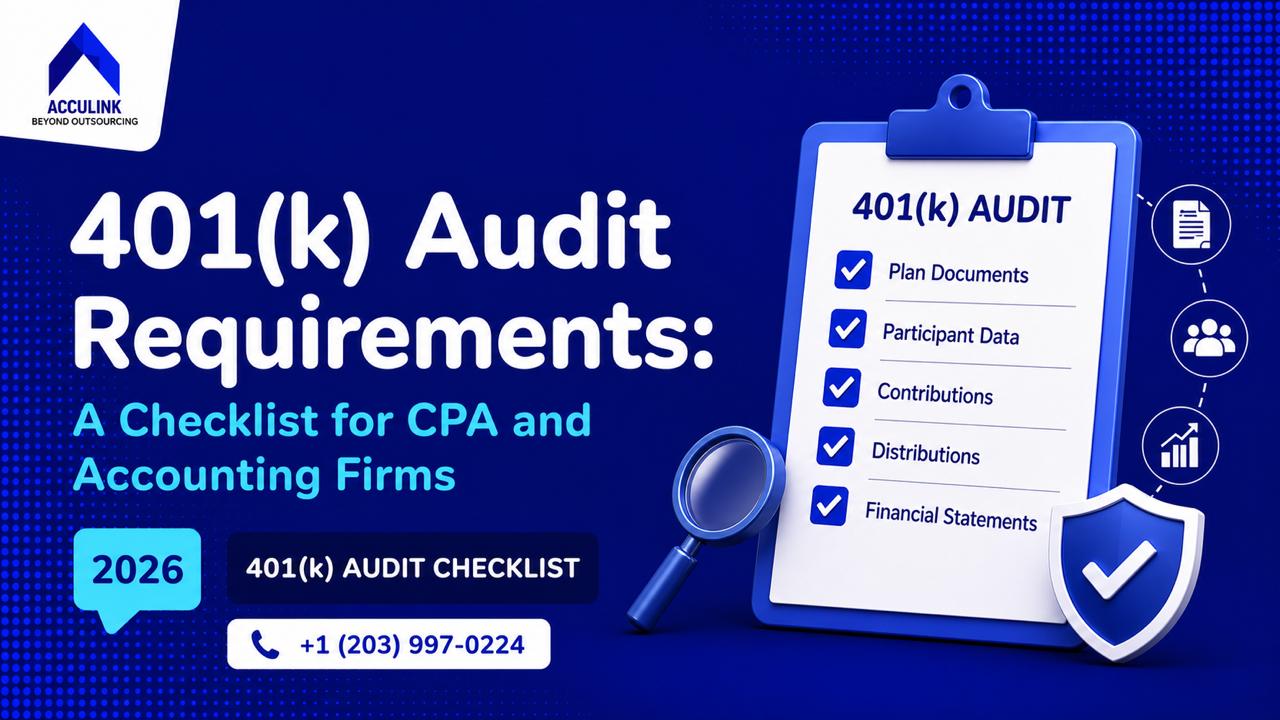
A 401(k) audit, formally known as an Employee Benefit Plan (EBP) audit, is an independent examination required for certain qualified retirement plans to ensure financial accuracy and regulatory compliance. Under ERISA Section 103(a)(3)(C) and Department of Labor (DOL) regulations, retirement plans that generally have 100 or more eligible participants at the beginning of the plan year must include audited financial statements with their annual Form 5500 filing. These audits must be performed by an Independent Qualified Public Accountant (IQPA) in accordance with Generally Accepted Auditing Standards (GAAS). A 401(k) / EBP audit typically involves testing plan assets and participant account balances, verifying employer and employee contributions, reviewing benefit payments and distributions, evaluating internal controls over financial reporting, and assessing compliance with ERISA and IRS requirements. The objective is to provide reasonable assurance that the plan’s financial statements are fairly presented and that fiduciaries are meeting their legal and reporting obligations. The Department of Labor emphasizes audit quality due to the critical role these audits play in protecting plan participants and beneficiaries.
U.S. Department of Labor Audit Quality and Plan Audits: https://www.dol.gov/general/topic/retirement/employee-benefit-plan-audits
Why CPA Firms Outsource 401(k) Audits
Managing Regulatory and Technical Complexity
401(k) and other Employee Benefit Plan audits require specialized expertise in ERISA regulations, Department of Labor reporting rules, IRS qualification standards, and plan-specific documentation. These audits involve complex eligibility rules, contribution limits, vesting provisions, prohibited transaction testing, and detailed financial statement disclosures. CPA firms that perform EBP audits infrequently often face a higher risk of audit deficiencies due to limited exposure to these technical requirements. The U.S. Department of Labor has consistently highlighted that audit quality issues are more common among firms with smaller EBP practices, making specialization critical. Outsourcing to experienced EBP audit professionals helps firms navigate this complexity and maintain compliance with evolving regulatory expectations.
Scaling Audit Services Without Building Full In-House Teams
Building and sustaining a dedicated EBP audit team requires significant investment in hiring, training, and ongoing professional development. For many CPA firms, the volume of 401(k) audits does not justify maintaining a year-round specialized department. Outsourcing provides a flexible solution, allowing firms to scale audit capacity during peak Form 5500 filing seasons without increasing fixed overhead. This approach enables firms to accept more engagements, respond to client demand efficiently, and manage workload fluctuations without straining internal resources.
Controlling Risk and Strengthening Compliance
401(k) audits are subject to heightened scrutiny from the Department of Labor, AICPA peer reviewers, and Employee Benefit Plan Audit Quality Center (EBPAQC) standards. Any deficiencies can expose firms to regulatory inquiries, peer review findings, and reputational risk. Outsourcing to specialists who focus exclusively on EBP audits reduces the likelihood of technical errors, incomplete procedures, or inadequate documentation. While execution may be outsourced, CPA firms retain full responsibility for planning, supervision, review, and opinion issuance, ensuring compliance with professional standards and maintaining audit integrity.
Improving Profitability and Engagement Economics
Employee benefit plan audits often require more time, senior-level involvement, and documentation than standard audit engagements, sometimes without proportionately higher fees. When handled entirely in-house, this can compress margins and strain firm resources. Outsourcing allows CPA firms to shift highly specialized, execution-intensive work to teams structured for efficiency and cost control. This enables partners and managers to focus on higher-value activities such as risk assessment, client advisory, and final review, ultimately improving engagement economics while preserving client relationships and service quality.
Key Compliance and Quality Standards for EBP Audits
Department of Labor (DOL) and ERISA Requirements
The U.S. Department of Labor (DOL), through the Employee Benefits Security Administration (EBSA), is the primary regulator overseeing employee benefit plan reporting and audit requirements under ERISA. Retirement plans that meet the audit threshold—generally 100 or more eligible participants—must file audited financial statements as part of their annual Form 5500 submission within prescribed deadlines. These audits play a critical role in protecting plan participants by ensuring that plan assets are properly reported, transactions are accurately recorded, and fiduciaries are meeting their legal obligations. The DOL places significant emphasis on audit quality, and deficiencies can result in rejected filings, regulatory inquiries, and potential penalties. As a result, CPA firms must ensure that EBP audits fully support accurate financial reporting, internal control evaluation, and compliance with participant protection requirements established under ERISA.
AICPA’s Employee Benefit Plan Audit Quality Programs
The AICPA Employee Benefit Plan Audit Quality Center (EBPAQC) is a voluntary membership program designed to improve the quality and consistency of EBP audits across the profession. Firms that participate in the EBPAQC commit to maintaining specialized competencies in ERISA audits, including ongoing staff training, access to technical resources, and the implementation of EBP-focused quality control policies. Membership signals to regulators, peer reviewers, and clients that the firm prioritizes audit quality and stays current with evolving professional standards. The AICPA also provides best-practice guidance, audit tools, and interpretive resources that help firms align their methodologies with regulatory and professional expectations, reducing the risk of audit deficiencies and peer review findings.
Useful official resources include:
Independence and Ethical Guidance
Independence and professional ethics are foundational to the credibility of employee benefit plan audits. Auditors must comply with the AICPA Code of Professional Conduct as well as the Department of Labor’s specific independence rules applicable to ERISA audits. These requirements are often more restrictive than general audit independence standards and address both financial and non-financial relationships with plan sponsors and service providers. Any impairment of independence can invalidate the audit, expose the firm to regulatory action, and undermine stakeholder trust. CPA firms must therefore implement strict independence monitoring, engagement acceptance procedures, and ongoing ethical compliance reviews to ensure that all EBP audits meet both AICPA and DOL independence expectations. Adhering to these standards protects the firm’s reputation, supports audit defensibility, and reinforces confidence among plan fiduciaries and participants.
How Outsourcing 401(k) Audits Helps CPA and Accounting Firms
Outsourcing 401(k) and other Employee Benefit Plan (EBP) audits has become a strategic operating model for many CPA and accounting firms. Given the heightened regulatory scrutiny, technical complexity, and seasonal workload pressures associated with EBP audits, outsourcing enables firms to deliver compliant, high-quality audits while protecting internal capacity, profitability, and risk management standards. Firms typically adopt one of the following outsourcing approaches, each offering distinct benefits depending on firm size, expertise, and growth objectives.
Full EBP Audit Outsourcing
In a full outsourcing model, the outsourced specialist handles the majority of the technical audit work, including detailed planning support, substantive testing, audit fieldwork, workpaper preparation, and documentation of conclusions in accordance with GAAS and ERISA requirements. The primary CPA firm remains the engagement partner of record, maintains independence, and retains responsibility for client communication, supervision, review, and final opinion issuance. This model allows firms to offer EBP audit services without maintaining a dedicated internal EBP department, significantly reducing staffing and training burdens while ensuring access to specialized expertise. It is particularly effective for firms with limited EBP audit volume or those seeking to expand services quickly without increasing fixed overhead.
Co-Sourced Model
The co-sourced model is the most commonly used approach among growth-oriented CPA firms. Under this structure, the firm retains responsibility for audit planning, risk assessment, client interaction, and overall engagement management, while outsourcing specific technical components such as internal control testing, participant sampling, contribution testing, roll-forwards, and documentation assembly. This model strikes a balance between control and efficiency, allowing senior internal staff to focus on high-judgment areas while delegating execution-heavy procedures to specialists. The result is improved turnaround time, reduced staff burnout, and stronger audit quality without compromising regulatory accountability.
Consulting and Specialist Support
Some CPA firms use outsourcing selectively by engaging external EBP specialists for targeted support rather than full execution. This may include staff training, ERISA technical consultations, risk assessment assistance, complex plan issue resolution, or independent quality reviews before report issuance. Consulting support is especially valuable for firms that perform EBP audits infrequently but want to ensure compliance with DOL expectations, AICPA standards, and peer review requirements. This approach strengthens audit defensibility, enhances internal competency, and reduces the likelihood of deficiencies while preserving the firm’s existing audit structure.
Overall Impact on CPA Firms
Across all models, outsourcing 401(k) audits helps CPA and accounting firms improve audit quality, manage regulatory risk, scale services efficiently, and optimize engagement economics. By aligning internal oversight with specialized external execution, firms can meet increasing compliance demands while remaining agile, profitable, and client-focused in an increasingly complex audit environment.
Final Thoughts:
As regulatory demands intensify and audit quality scrutiny increases, 401(k) audit outsourcing has emerged as a practical and strategic service model for CPA and accounting firms of all sizes. By leveraging outsourcing, firms can expand service offerings, enhance audit quality, manage compliance risk, and free internal resources to focus on core services and higher-value advisory work.
To succeed, firms should begin with a clear strategic plan, well-documented audit standards, and strong oversight protocols. Partnering with experienced specialists who understand the complex technical, regulatory, and compliance requirements of ERISA and 401(k) audits is essential.
For CPA and accounting firms seeking reliable, high-quality support in EBP and 401(k) audits, Acculink CPA stands out as a trusted partner. With deep expertise, proven methodologies, and a commitment to compliance and client service, Acculink CPA enables firms to deliver accurate, timely, and defensible audit results while optimizing internal efficiency and profitability.