White Label Accounting for CPA and Accounting Firms: How It Works, What to Hand Off, and What It Costs

Summary
White label accounting helps CPA firms expand capacity while keeping control of their brand, client relationships, review, and professional responsibility. Learn which services can be delegated, how pricing and profitability work, what compliance and security controls apply, and how to evaluate a provider.
White Label Accounting for CPA Firms: Compliance, Pricing, and Profitability
Last updated: September 2026
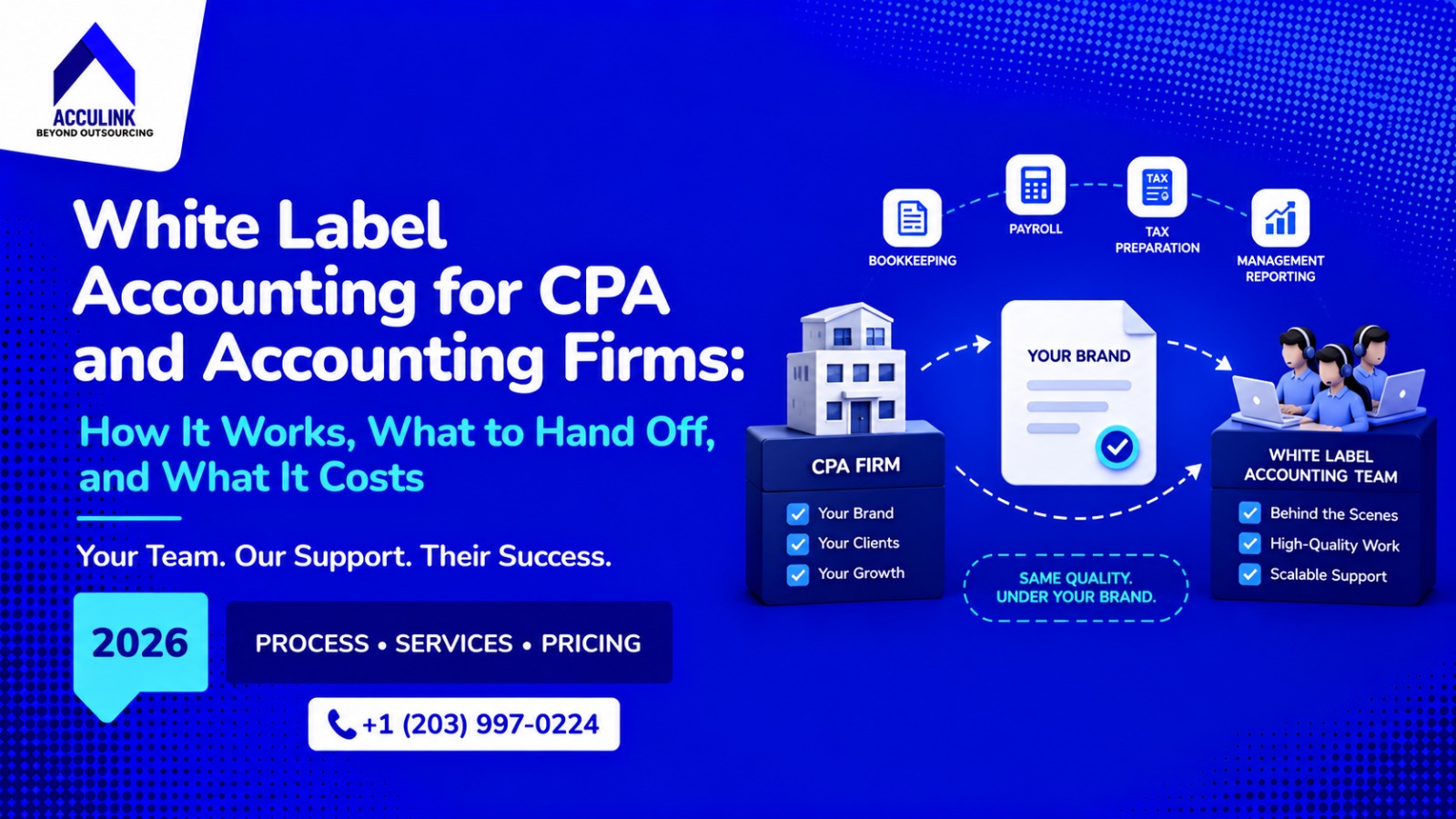
White label accounting is an arrangement in which an outside team performs accounting work that a CPA firm delivers under its own brand. The firm manages the client relationship, sets service standards, reviews the work, and retains professional responsibility. The provider supplies the capacity to prepare it.
For a partner turning away work or spending evenings completing files, the appeal is practical: accept more clients without recruiting for every additional role. White label accounting services can support recurring accounting, tax preparation, reporting, and audit work. Firms can use outsourced accounting services or hire a dedicated offshore team, depending on how much daily management they want to retain.
Key Takeaways
- Keep control of the client experience. Agree on branding, communication, access, and review before work begins.
- Calculate the margin after review. Include provider fees, internal review, software, and corrections.
- Settle disclosure and security requirements early. White-label delivery still involves professional obligations and, for offshore tax work, Section 7216 requirements.
- Start with one service. Test a representative workflow before increasing the scope.
When White Label Accounting Makes Sense
The model fits firms with client demand and insufficient delivery capacity. Recurring close work may be slipping, extension returns may need tax preparation support, or partners may want to introduce management reporting services they cannot currently staff.
It works best when the firm has a repeatable process and an available reviewer. If missing client records, unclear scope, or slow partner approval cause most delays, address those issues alongside staffing. Additional preparers alone will not clear a review bottleneck.
White label accounting vs outsourcing vs staff augmentation
These terms describe different parts of the delivery model:
| Model | Who manages daily work? | What the provider supplies | Typical client experience |
|---|---|---|---|
| Staff augmentation | The CPA firm | A dedicated professional or team | The professional works inside the firm's process |
| Managed outsourcing | The provider manages the agreed process, subject to firm oversight | A completed process or deliverable | Provider visibility depends on the agreement |
| White-label delivery | Either model can be used | Work delivered under the CPA firm's brand and standards | The CPA firm remains the primary client relationship |
A firm that wants direct task control may prefer dedicated staffing. A firm that wants an entire recurring process managed may prefer outsourcing. White-label delivery can operate with either arrangement. Branding alone does not determine employment, ownership of workpapers, or client-notification obligations.
What Services Can CPA Firms White Label?
Good candidates have clear source documents, instructions, and review criteria. The correct boundary depends on the engagement, professional standards, staff competence, client consent, and the firm's quality policies.
| Work area | Possible provider support | Responsibility retained by the CPA firm |
|---|---|---|
| Monthly accounting | Coding, reconciliations, close schedules, workpapers, draft reporting | Policies, unusual entries, review, client interpretation |
| AP and AR management, plus payroll support | Processing, matching, aging reports, payroll journals | Approval authority, segregation of duties, exceptions |
| Financial statement preparation | Lead schedules, tie-outs, draft statements and disclosures | Reporting framework, material judgments, final issuance |
| Tax preparation | Organizers, workpapers, data entry, diagnostics, draft returns | Client consent, tax positions, review, signature, filing authorization |
| Audit support | Organizing client documents, confirmation support under auditor control, sampling schedules, rollforwards | Independence, risk assessment, audit judgment, conclusions, report |
| Advisory support | Data preparation, forecasts, dashboards, research, scenario models | Recommendations, assumptions, client advice, final judgment |
Some firms begin with recurring accounting or white label bookkeeping because the workflow repeats each month. Others use white label tax services through outsourced tax preparation during extension season. Start with work that has dependable records, a clear deadline, and an agreed definition of completion.
Which service should you white label first?
Get the checklist for scope, review capacity, security, and margin before work moves.
How Does a White Label Engagement Work?
A practical onboarding sequence has six stages:
- Scope the work. Define entities, services, deadlines, volume, exclusions, required experience, software, and who communicates with the client.
- Assign responsibility. Name the preparer, provider reviewer, CPA-firm reviewer, approver, and escalation contact.
- Configure secure access. Set permissions, multifactor authentication, approved devices, file-transfer rules, logging, and access-removal procedures.
- Run a representative pilot. Include normal exceptions and one complete workflow so the trial reflects the work you will actually send.
- Review the results. Check accuracy, completeness, turnaround, responsiveness, and the internal time needed to approve the file.
- Expand in stages. Add clients or processes after the first workflow performs consistently.
For a detailed implementation sequence, see the accounting outsourcing process for CPA firms.
The review chain to require
A useful sequence is preparer, provider reviewer, then CPA-firm reviewer. The provider's senior reviewer should check completeness, supporting documents, reconciliations, and compliance with your instructions before delivery. Exceptions should arrive with the affected amount, supporting evidence, and the decision needed.
For example, a completed reconciliation should show the source balance, ledger balance, reconciling items, and unresolved differences. An unexplained spreadsheet merely transfers the investigation back to your manager.
Client Disclosure, Section 7216, and Data Security
Set the client communication and access rules before sharing records. Branding, professional ethics, tax-data consent, and security each address a different part of the arrangement.
Client notification, competence, and confidentiality
The AICPA Code of Professional Conduct includes three relevant provisions for members:
- ET 1.150.040: Inform clients, preferably in writing, before sharing confidential information with a third-party provider. If a client objects, do not use the provider for that engagement or decline the engagement. Specified administrative services have an exception.
- ET 1.300.040: Assess the provider's qualifications and resources, then plan and supervise the work under applicable professional standards.
- ET 1.700.040: Obtain a confidentiality agreement with reasonable assurance of safeguards, or specific client consent, before disclosure.
A confidentiality contract does not replace the separate notification requirement. Check state-board rules and engagement terms as well.
Offshore tax work and Section 7216 consent
The IRS Section 7216 information center explains the restrictions on a preparer's disclosure or use of tax return information and applicable exceptions. For offshore return-preparation support, arrange the required taxpayer consent before disclosing information to the overseas preparer.
Revenue Procedure 2013-14 prescribes consent requirements for Form 1040-series taxpayers, including foreign-disclosure wording. Additional language and safeguards apply when an unmasked Social Security number is included. Non-1040 situations require separate consideration under the regulations.
The AICPA Section 7216 sample consent forms illustrate different disclosure and use scenarios. They need adaptation to the engagement and current requirements. Confirm your approach with your attorney and professional-liability carrier.
Security controls to verify
The FTC Safeguards Rule guidance includes tax preparation firms among covered financial institutions and requires covered firms to oversee service providers. IRS Publication 4557, Safeguarding Taxpayer Data, provides practical guidance for protecting taxpayer information.
Ask the provider to demonstrate how staff access files, what they can download, and how access is removed. Check multifactor authentication, encryption, activity logs, staff training, backups, incident response, and continuity arrangements. Establish incident-notification responsibilities and insurance coverage in writing.
Acculink's data-security program explains its approach. Our accounting outsourcing security guide covers the evidence to request.
What Does White Label Accounting Cost?
Pricing may be hourly, monthly, per return, per entity, or fixed by process. Compare the total cost of accepted work, including your firm's review time.
The U.S. Bureau of Labor Statistics reports a median annual wage of $83,680 for accountants and auditors in May 2025. That is a wage benchmark, not the full cost of employing someone. Include your firm's benefits, recruiting, software, equipment, and supervision when comparing a domestic hire with provider pricing.
For white-label delivery, calculate:
Contribution = client fee - provider cost - internal review cost - other direct delivery costs
A simple profitability example
Suppose a monthly reporting engagement earns $1,800. The provider spends 30 hours at $20 per hour, costing $600. Your reviewer spends three hours at an internal cost of $75 per hour, adding $225. Another $75 covers directly attributable software and administration.
The engagement contributes $900, or 50% of revenue, before shared overhead and tax. These are illustrative assumptions, not an Acculink case study. If review takes six hours instead, contribution falls to $675. That difference is why review effort belongs in every pricing decision.
Also confirm minimum hours, seasonal pricing, overtime, replacement costs, software charges, and termination terms. These details determine whether white label accounting solutions improve the firm's margin as volume grows.
See whether white-label delivery improves your margin.
Start with 40 hours of defined work and measure quality, review time, and contribution before you scale.
How to Choose a White Label Accounting Provider
Use the same questions with each shortlisted provider:
- Does the team regularly support U.S. CPA and accounting firms?
- Can the assigned professionals work in your software, templates, and workflow?
- Who prepares, who reviews, and who resolves exceptions?
- Can you review the current SOC 2 Type II report and ISO/IEC 27001 certificate?
- How are access, local storage, incidents, backups, and offboarding controlled?
- How will client notification and Section 7216 procedures work?
- What happens if an assigned professional leaves during busy season?
- Is pricing all-inclusive, and what are the notice and exit terms?
- Can you speak with a reference from a similar CPA firm?
The AICPA due diligence checklist for evaluating offshoring vendors adds questions on financial stability, legal standing, technology, workforce, service levels, independent assessments, and insurance. Our CPA-firm vendor due-diligence guide explains how to evaluate the responses.
Also agree on workpaper ownership, permitted client contact, restrictions on soliciting your clients, and the handover process at exit. A white label accounting firm should make these terms clear before onboarding.
Why CPA Firms Choose Acculink
Acculink is built around U.S. CPA and accounting firms, with professionals familiar with the deadlines, workpapers, and review expectations of U.S. practices. Firms can use dedicated offshore staffing, white-label delivery, or another suitable engagement model, with professionals working as an extension of their team.
- Security and compliance: Acculink has SOC 2 Type II attestation and ISO/IEC 27001 certification, with enterprise data-security controls and processes supporting compliance with IRS Section 7216, GDPR, the AICPA Code, and the FTC Safeguards Rule. See its certifications and compliance credentials.
- Scale and experience: More than 300 qualified professionals, including CPAs, EAs, CAs, and Big Four alumni, support more than 80 U.S. firms, with a five-year record of no data breaches.
- Your existing software: Acculink accountants work in QuickBooks, Xero, Sage Intacct, NetSuite, and common tax and workflow tools.
- Two-tier review: Every engagement uses a maker-checker process, with preparation followed by senior review before delivery to the CPA firm.
- A practical starting point: Firms receive a 40-hour free trial, with no setup fee and no long-term lock-in. Teams can go live in 5 to 10 business days, depending on access readiness and role availability.
- Transparent pricing: All-inclusive role-based rates range from $8 to $35 per hour, typically 60 to 75 percent below a comparable U.S. hire.
Select one representative workflow and test performance on real work. Request your 40-hour free trial with your expected monthly workload, software, and target start date so Acculink can recommend a role and scope.
Frequently Asked Questions
What is white label accounting?
White label accounting is an arrangement in which an outside team performs agreed accounting or tax production work that a CPA firm delivers through its own brand. The CPA firm keeps the client relationship, supervision, review, professional judgment, and final responsibility.
Is white label accounting the same as outsourcing?
Outsourcing describes who performs or manages the work. White label describes how the service is presented and delivered to the client. A white-label model can use either dedicated staff augmentation or managed outsourcing.
Must a CPA firm tell clients it uses a white label provider?
The AICPA Code says members should inform clients, preferably in writing, before disclosing confidential information to a third-party service provider, subject to a limited administrative-services exception. Separate confidentiality, state-board, engagement, and Section 7216 requirements may also apply.
What work can be white labeled?
Common examples include reconciliations, close schedules, AP and AR processing, payroll support, draft financial statements, tax workpapers and draft returns, audit-support schedules, reporting packages, and cleanup work. The CPA firm retains approval authority, final review, professional judgment, and signing responsibilities.
How much do white label accounting services cost?
Pricing depends on role, experience, scope, volume, software, turnaround, seasonality, and delivery model. Providers may charge hourly, monthly, per return, or by process. Compare provider fees plus internal review, rework, and software costs. Acculink's all-inclusive hourly rates range from $8 to $35.
How can a CPA firm protect client data when using an offshore team?
Use a provider with controlled access, multifactor authentication, encryption, restricted local storage, activity logging, secure devices, staff training, incident response, and continuity procedures. Review independent security evidence and insurance coverage, document the requirements in the contract, and reassess the provider periodically.
How quickly can a white label team start?
Timing depends on role availability, access setup, software permissions, training, and reviewer availability. Acculink can go live in 5 to 10 business days and offers a 40-hour free trial. Initial go-live and full productivity are different milestones, so agree on both during onboarding.
Start With One Service You Can Measure
White label accounting can help a CPA firm add capacity and grow profitable services. The model succeeds when the firm defines the scope, informs clients appropriately, controls access, supervises the provider, and understands the cost of reviewing the work.
Choose a workflow with dependable records and an available reviewer. Measure quality, review hours, turnaround, and contribution across a complete cycle. Then expand the services that meet your standards and support the client experience you want to offer.
Ready to add capacity without giving up your brand?
Start with one workflow, retain final review, and expand only after the work meets your standards.
Tags:
About the Author

Related Posts
Top Tax Outsourcing Companies for CPA and Accounting Firms (2026 Rankings)
The top tax outsourcing companies for CPA firms in 2026 are Acculink CPA, QX Accounting Services, CapActix, Da…
Top 10 Offshore Staffing Companies for Accounting Firms (2026)
Hiring an offshore team is one of the highest-leverage moves a short-staffed CPA firm can make, but the partne…
Top Outsourced Accounting Firms for CPA Practices (2026)
Choosing an outsourced accounting partner is a high-stakes call because the team touches your clients' data. T…