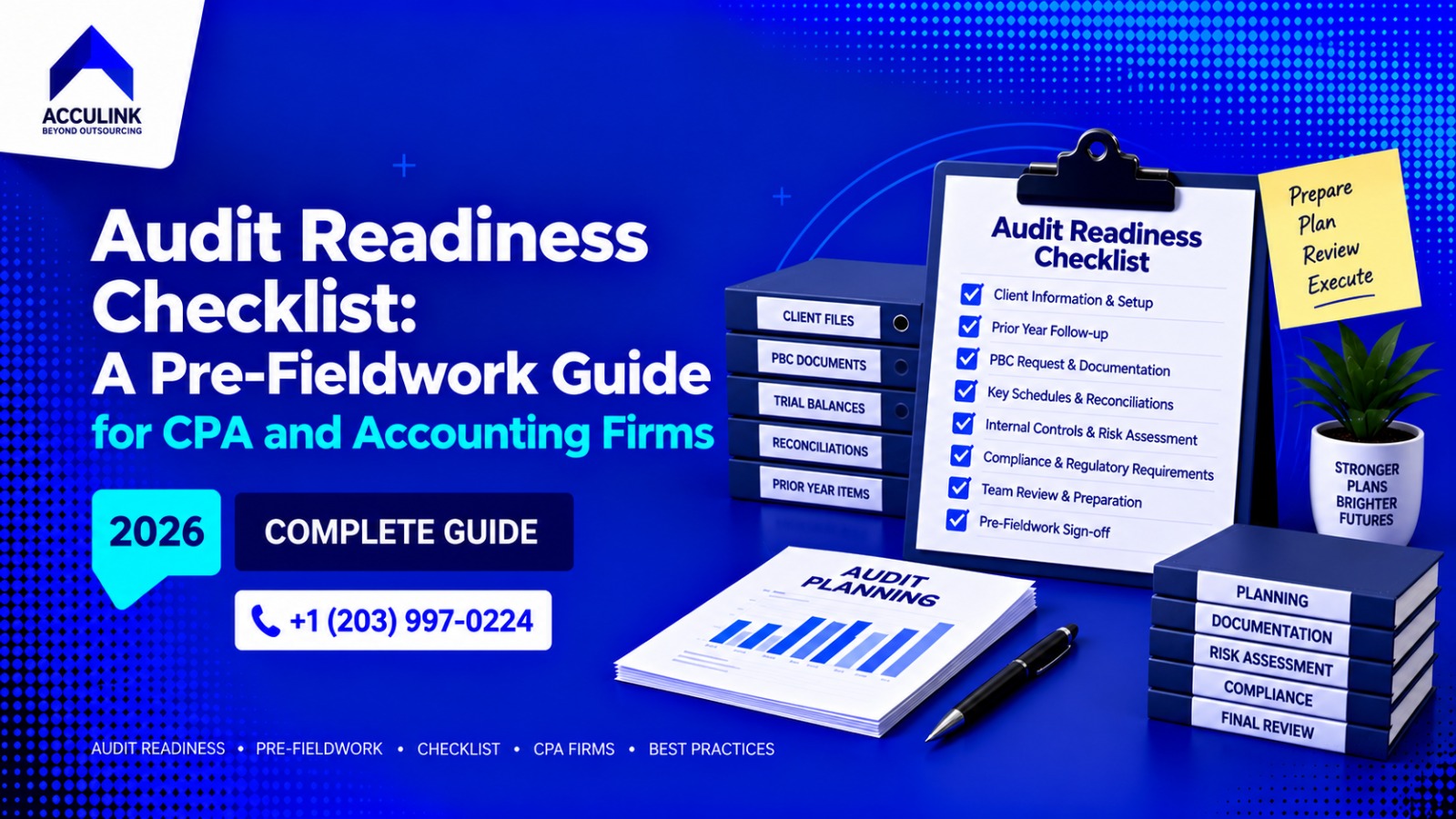
Audit Readiness Checklist: A Pre-Fieldwork Guide for CPA and Accounting Firms

Summary
Use this 36-point audit readiness checklist to confirm scope, organize records, reconcile balances, prepare supporting schedules, control document requests and approve the pre-fieldwork handoff. It helps CPA and accounting firms identify blockers, assign owners and choose project support or a dedicated offshore professional.
Audit readiness means financial records, reconciliations, supporting schedules and responsible people are prepared for the planned audit work. An audit readiness checklist helps CPA and accounting firms identify missing information, unfinished preparation and scheduling dependencies before fieldwork begins.
For partners and managers, readiness determines how much reserved staff time goes toward planned engagement work. A changing trial balance or an unreconciled receivables listing can absorb that time while the reporting deadline stays fixed.
Assess what is usable, what remains unresolved and who will complete the preparation. That makes the decision to reassign work or add support specific enough to act on.
Key takeaways
- Assess readiness by workstream. Identify the unfinished items that block dependent work.
- Reconcile before handoff. Show each schedule's source, period, ledger balance and unresolved differences.
- Assign every open item. Name its owner, next action and required date.
- Identify the actual constraint. Missing client decisions, preparation backlogs and limited review capacity need different responses.
- Define support around outputs. Specify the deliverable, reviewer and acceptance criteria before assigning a package.
Acculink publishes role-based pricing of $8 to $35 per hour for offshore professionals. Explore audit preparation and documentation support or hire a dedicated offshore audit professional according to your workload. The range is a starting point for scoping support, not a fixed fee for an audit or readiness assessment.
What audit readiness means for financial statement audits
Financial audit readiness combines usable records, traceable supporting schedules, approved access and people available to resolve questions. An uploaded bank reconciliation, for example, still needs the correct date and supporting information for its intended use.
This guide addresses financial statement audit preparation. Cybersecurity, SOC, ISO and other compliance audits have different evidence requirements.
Preparation can support management's accounting records or work assigned by the responsible audit firm. Keep those roles clear: management retains responsibility for its records and financial statements; the auditor retains audit judgments, evidence evaluation and the opinion. An attest firm providing nonattest preparation services must evaluate independence and avoid management responsibilities. See AICPA & CIMA's nonattest services and independence guidance.
For the engagement sequence beyond preparation, use the financial audit process and checklist.
Start with an audit readiness assessment
An audit readiness assessment identifies the information, preparation and people needed for planned work. Assess audit preparedness by workstream using five questions:
- Is scope clear? Confirm entities, reporting periods, locations and systems.
- Are accounting records usable? Identify pending entries, mapping changes and unresolved reconciliations.
- Do supporting schedules tie? Check dates, source references, control totals and differences.
- Who resolves questions? Name the management contact, preparer and reviewer.
- Is capacity available? Compare remaining preparation and review effort with dependency dates.
Use specific statuses: not received, awaiting preparation, awaiting review, returned for correction, and accepted for the next task. A completion percentage can hide one critical blocker. Acceptance is a workflow decision; it does not establish that sufficient appropriate audit evidence has been obtained.
Spot the gaps before fieldwork.
Get an editable tracker with owners, review status and next actions already set up.
The 36-point audit readiness checklist
Copy this audit preparation checklist into your engagement tracker. Add an owner, due date, reviewer and evidence link. Record a reason for items marked not applicable, and tailor the checks to the engagement.
1 Confirm engagement scope and responsibilities
- 1. Confirm the reporting period and entities. List included entities, locations, currencies and consolidation requirements.
- 2. Confirm the reporting framework. Identify the basis of accounting and relevant presentation requirements.
- 3. Establish the timetable. Record planned fieldwork, management review and report delivery dates.
- 4. Name decision-makers and reviewers. Assign contacts for records, accounting questions, adjustments and preparation review.
- 5. Identify changes since the prior period. Flag new systems, entities, financing, contracts, personnel changes and unusual transactions.
Agree on these facts before assigning preparation. Entity or reporting-period changes can affect almost every schedule.
2 Assemble the core accounting records
- 6. Obtain a dated trial balance. Identify its version and distinguish posted balances from pending adjustments.
- 7. Obtain the required general ledger. Record period, account coverage, extraction date, system and report parameters.
- 8. Prepare account mapping. Connect ledger accounts to statement captions and explain mapping changes.
- 9. Reconcile opening balances. Connect current opening records to the applicable prior-period closing information.
- 10. Assemble prior-period references. Include relevant financial statements, adjustments and unresolved matters available under the engagement's access arrangements.
- 11. Maintain an adjustment register. Separate proposed, approved, posted and declined entries, with support and outstanding decision owners.
Control trial balance versions. When balances change, identify the schedules and statements requiring updates.
3 Reconcile balances and explain differences
- 12. Reconcile cash and card accounts. Include statements, outstanding items and explanations of differences.
- 13. Reconcile receivables and payables. Tie relevant aging reports or subledgers to control accounts.
- 14. Reconcile fixed assets and depreciation. Connect opening balances, additions, disposals and depreciation to closing balances.
- 15. Reconcile debt and interest. Tie balances to schedules and relevant lender records or agreements.
- 16. Reconcile payroll-related balances. Explain accruals, taxes, benefits and differences between payroll records and the ledger.
- 17. Reconcile intercompany and equity movements. Identify unmatched balances, eliminations, distributions and movements requiring explanation.
Retain source totals, ledger totals and the disposition of differences. Keep unexplained balancing entries visible. Recurring cash-account workloads may suit separately scoped bank and card reconciliation support.
4 Prepare supporting schedules by account area
- 18. Prepare receivables support. Include the agreed aging, subsequent receipts information and support for management's allowance assessment, as applicable.
- 19. Prepare inventory records. Identify quantities, locations, valuation schedules and arrangements for planned observation or other required work.
- 20. Prepare payables and accruals. Include relevant supplier records, subsequent disbursements and explanations of significant accruals.
- 21. Prepare fixed-asset detail. Link additions and disposals to records and document depreciation methods used.
- 22. Prepare debt, lease and equity schedules. Include agreements, amendments, payment schedules and relevant approvals.
- 23. Prepare revenue and prepaid-expense schedules. Tie movements to the ledger and retain supporting contracts or calculations.
The engagement team specifies required populations and support. Adapt preparation to the entity's operations rather than assuming one template covers every area.
5 Assemble financial statement and disclosure support
- 24. Tie draft statements to the identified trial balance. Explain reclassifications and record the statement version.
- 25. Prepare disclosure support. Organize applicable debt, lease, commitment and other disclosure schedules.
- 26. Identify related parties and transactions. Obtain management's information and support explaining relationships and balances.
- 27. Gather significant agreements and minutes. Include relevant financing, ownership, governance and transaction documents.
- 28. Assign follow-up for estimates and developments. Identify management assumptions, pending decisions and later information requiring consideration.
Draft statements can reveal missing information early. They remain subject to management approval and applicable requirements. Recurring assembly work can be scoped through financial statement preparation support.
6 Control access and document requests
- 29. Establish the request list. Give each item a reference, period, description, owner and required delivery date.
- 30. Confirm approved access. Use authorized systems and appropriate permissions for clients, firm staff and external support.
- 31. Apply naming and version conventions. Identify periods, request references and superseded files.
- 32. Record deficiencies and next actions. Explain what is missing or unusable, who must respond and which work depends on it.
Check usability before closing a request. Clear report parameters and a named contact help reduce replacement uploads.
7 Approve the preparation handoff
- 33. Review critical schedules. Check tie-outs, source references and unresolved differences before handoff.
- 34. Document blockers. Identify their effect on planned work and who can resolve or escalate them.
- 35. Confirm preparation and review capacity. Reserve time for questions, corrections and subsequent updates.
- 36. Agree which work can proceed. Record the responsible person's decision and any conditions.
Retain the handoff record so changes reach the people relying on the affected information.
Turn checklist items into assigned work
For each item, record the entity, period, required output, owner, reviewer, due date, status, evidence location and dependency.
This illustrative extract shows how to make the next action explicit:
| Item | Required output | Status and next action |
|---|---|---|
| Receivables | Dated aging tied to the ledger | Awaiting preparation; preparer reconciles the total |
| Bank reconciliation | Reconciliation, statement and outstanding-item support | Returned; accounting contact explains an old item |
| Fixed assets | Movement schedule tied to opening and closing balances | Awaiting review; reviewer checks supporting records |
Prioritize the inputs needed for the next planned procedure. Across engagements, similar preparation can be grouped while retaining entity, period and owner identification.
What makes a schedule ready for handoff
A usable schedule identifies its entity, period and source, reconciles to accounting records and exposes unresolved matters.
Illustrative example: A receivables ledger totals $1,240,000, but the supplied aging totals $1,215,000. Keep the $25,000 difference open. A preparer can investigate report parameters, omitted accounts and supporting records, then document the explanation and authorized correction.
Retain the original export, settings, reconciliation and revised version. The auditor determines what procedures are needed to evaluate the information.
For PCAOB engagements, AS 1105 on audit evidence addresses accuracy, completeness and the detail of company-produced information used as evidence. Other engagements follow their applicable standards.
When tools clean or transform data, preserve the source and maintain a change log. The Journal of Accountancy illustrates these practices in its data-cleaning and reconciliation example. Review the resulting information before using it.
Plan preparation backward from fieldwork
Allow for client responses, preparation, review and corrections before dependent work starts.
This four-week sequence is an illustrative plan, not a standard lead time or professional deadline:
| Before fieldwork | Priority |
|---|---|
| Four weeks | Confirm scope, request records and assign owners |
| Three weeks | Reconcile available records, build schedules and allocate capacity |
| Two weeks | Review packages, resolve deficiencies and reassess affected dates |
| Final week | Confirm versions, access, open items and follow-up availability |
First audits, migrations or incomplete closes may need substantially earlier preparation. The engagement team can assess whether unaffected workstreams may proceed while other items remain open.
Firms serving clients throughout the year can distribute recurring close and schedule work through year-end accounting support, with a defined handoff to the independent auditor.
Keep recurring preparation in the monthly close where practical. Update asset movements, reconcile control accounts and retain explanations when the information is available. At year-end, the team can then concentrate on changes, outstanding matters and the schedules specific to the audit.
Carry unresolved items forward with their owners and supporting records. Review whether the next close needs a better report, different assignment or earlier client request. This turns repeated audit preparation into a manageable routine rather than rebuilding the same schedules each year.
Match support to the actual constraint
Identify what prevents progress before choosing additional preparation capacity.
| Constraint | Immediate response | Potential support |
|---|---|---|
| Missing records or approvals | Escalate to the accountable client contact | Track requests and organize incoming records |
| Unreconciled records | Investigate differences and agree scope | Prepare reconciliations and schedules |
| Unformatted or unindexed support | Define the output and acceptance criteria | Map, index and assemble files |
| Unresolved accounting questions | Assign a qualified decision-maker | Assemble facts and calculations |
| Preparation backlog | Reserve supervision and review time | Assign defined packages |
| Exhausted review capacity | Address reviewer availability | Improve preparation while resolving the review constraint |
Historical ledger issues may call for accounting cleanup support. Organized records awaiting preparation may fit financial audit support within the firm's methodology.
If complete records are waiting because preparers are committed elsewhere, discuss the backlog with Acculink. A defined package lets the firm evaluate delivery before adding recurring capacity.
Records ready. Preparation still waiting?
Discuss a defined package of reconciliations, schedules or tie-outs within your firm's workflow.
Scope audit preparation services around outputs
Audit preparation services can cover record organization, reconciliations, lead schedules, trial balance mapping and supporting documentation. Define whether the assignment supports management's records or the audit firm's engagement work.
Start with a representative package: one entity and period, specified cash and receivables schedules, agreed source records, templates and an exception log.
Agree on:
- available inputs and how missing information is reported;
- output formats, permitted systems and delivery dates;
- who approves entries and resolves accounting questions;
- preparation review and correction responsibilities; and
- handling of version changes, confidentiality and access.
Evaluate completeness, traceability, unresolved-item clarity and reviewer effort. After the first package, record preparation hours, corrections requested and internal review time. Compare those results with the agreed output before expanding the assignment. If corrections repeat, determine whether the cause is missing source information, unclear instructions or preparation quality, then adjust that part of the process.
Where delivery must fit the firm's brand and client relationship, see the white-label audit support guide.
Choose project support or a dedicated professional
Project support suits a bounded package or short backlog. A dedicated professional can suit recurring work where familiarity with templates, systems and reviewer preferences has ongoing value.
Estimate portfolio demand, record arrival dates, complexity and review effort. Acculink offers full-time, part-time and flexible engagement models. Use the audit staffing guide to define role requirements.
The responsible audit firm retains direction, supervision, evidence evaluation and reporting responsibilities. Management retains its accounting responsibilities. AICPA & CIMA's private company audit explanation outlines the auditor's independence and professional obligations.
Compare total preparation cost
Budget for external preparation, internal coordination, review and corrections.
Illustrative calculation: Assume 60 offshore preparation hours at $20 per hour, four internal review hours at an assumed loaded cost of $90 per hour, and two internal coordination hours at $45 per hour.
- Preparation: 60 x $20 = $1,200.
- Internal review: 4 x $90 = $360.
- Internal coordination: 2 x $45 = $90.
- Estimated total: $1,650, before additional corrections, software or other engagement costs.
These are assumptions, not a customer result or quote. Internal coordination is the firm's own effort. Acculink's published $8 to $35 hourly range provides an initial reference; scope and professional level determine the proposal.
Compare alternatives using equivalent deliverables and review expectations.
How Acculink supports audit readiness
Acculink supports U.S. CPA and accounting firms with offshore staffing and preparation, including PBC organization, reconciliations, financial statement tie-outs, lead schedules and workpapers.
A firm can start with a specific preparation package and evaluate the proposed professional against its entity types, software and output requirements. Acculink reports 300+ qualified team members and 80+ accounting-firm clients.
Its published terms include a 40-hour free trial and flexible staffing options; confirm the terms for the assignment. Review its data-security information when agreeing permissions, confidentiality and offboarding.
Share nonconfidential workload details: entity types, periods, available records, outstanding preparation, target dates and reviewer availability. Ask Acculink to scope preparation support or a dedicated audit-support role. Client files can follow through the agreed secure process.
Frequently asked questions
What is audit readiness
For a financial statement audit, audit readiness means records, reconciliations, schedules, access and responsible people are prepared for planned work. The team can identify information sources and unresolved items. Readiness supports the audit; it does not establish that required audit procedures are complete.
What should an audit readiness checklist include
Include scope, accounting records, reconciliations, supporting schedules, disclosure information, document requests, access and preparation handoff. Assign owners, dates and reviewers, and link supporting records. Tailor the checklist to the engagement.
How do CPA and accounting firms prepare for an audit
Confirm scope, obtain the request list, control trial balance versions, reconcile balances and assemble schedules. Assign people to resolve missing information and accounting questions. Review packages before handoff and reserve time for corrections.
Which documents are required for a financial audit
Common requests include the trial balance, ledger, relevant prior statements, bank records, reconciliations, aging reports, asset schedules, agreements and governance records. The documents required for audit depend on the entity and planned procedures; follow the engagement-specific request list.
What is an audit readiness assessment
It reviews the information, preparation status and people needed for planned audit work. The assessment identifies gaps, dependencies and next actions, distinguishing client information needs from preparation and review capacity.
How far in advance should audit preparation start
Start early enough to complete close activities, obtain records, prepare schedules and resolve review comments before dependent work. There is no universal period. First audits, system changes and incomplete reconciliations can need substantially longer preparation.
Can fieldwork begin while preparation remains incomplete
The engagement team decides which workstreams can proceed. Some open items do not affect other work; others prevent use of a population or review of a balance. Record dependencies, owners and required decisions.
Can audit preparation be outsourced
Appropriately scoped organization, reconciliation, schedule and documentation work can be assigned to suitable professionals. Preserve management responsibilities, applicable independence requirements and the responsible auditor's direction and review.
Are audit readiness services the same as an audit
No. Audit readiness services prepare information and workflows. An audit involves independent procedures, evidence evaluation and reporting. Completing a readiness checklist does not provide an opinion or assure a particular outcome.
Should a firm choose project support or an offshore auditor
Choose according to workload: a bounded package can suit project support; recurring volume may justify a dedicated professional. Assess relevant experience, supervision and reviewer availability in either arrangement.
How much does Acculink's audit preparation support cost
Acculink publishes role-based offshore-professional pricing from $8 to $35 per hour. Request a proposal specifying professional level, effort, deliverables and terms. Include your firm's coordination and review costs when comparing options.
Get audit prep moving.
Reconciliations, schedules and tie-outs, with two-tier review.
Tags:
About the Author

Related Posts
Top 10 Audit Support Outsourcing Companies for CPA and Accounting Firms (2026)
Compare ten audit support outsourcing companies for U.S. CPA and accounting firms. This guide separates manage…
Employee Benefit Plan Audit Guide for CPA and Accounting Firms: Requirements, Process and Outsourcing Support
This employee benefit plan audit guide helps CPA and accounting firms assess Form 5500 and ERISA requirements,…
Financial Audit Process and Checklist for CPA and Accounting Firms
Use this practical financial audit process and checklist to organize planning, PBC records, risk assessment, t…
White-Label Audit Support for CPA and Accounting Firms: How the Delivery Model Works
Evaluate white-label audit support for CPA and accounting firms against reviewer capacity, total delivery cost…