White-Label Audit Support for CPA and Accounting Firms: How the Delivery Model Works

Summary
Evaluate white-label audit support for CPA and accounting firms against reviewer capacity, total delivery cost, security, and client control. Learn what an offshore team can prepare, how dedicated staffing and secure handoffs work, and how to scope a representative first assignment. Acculink provides audit support from $8 to $35 per hour, depending on role and experience.
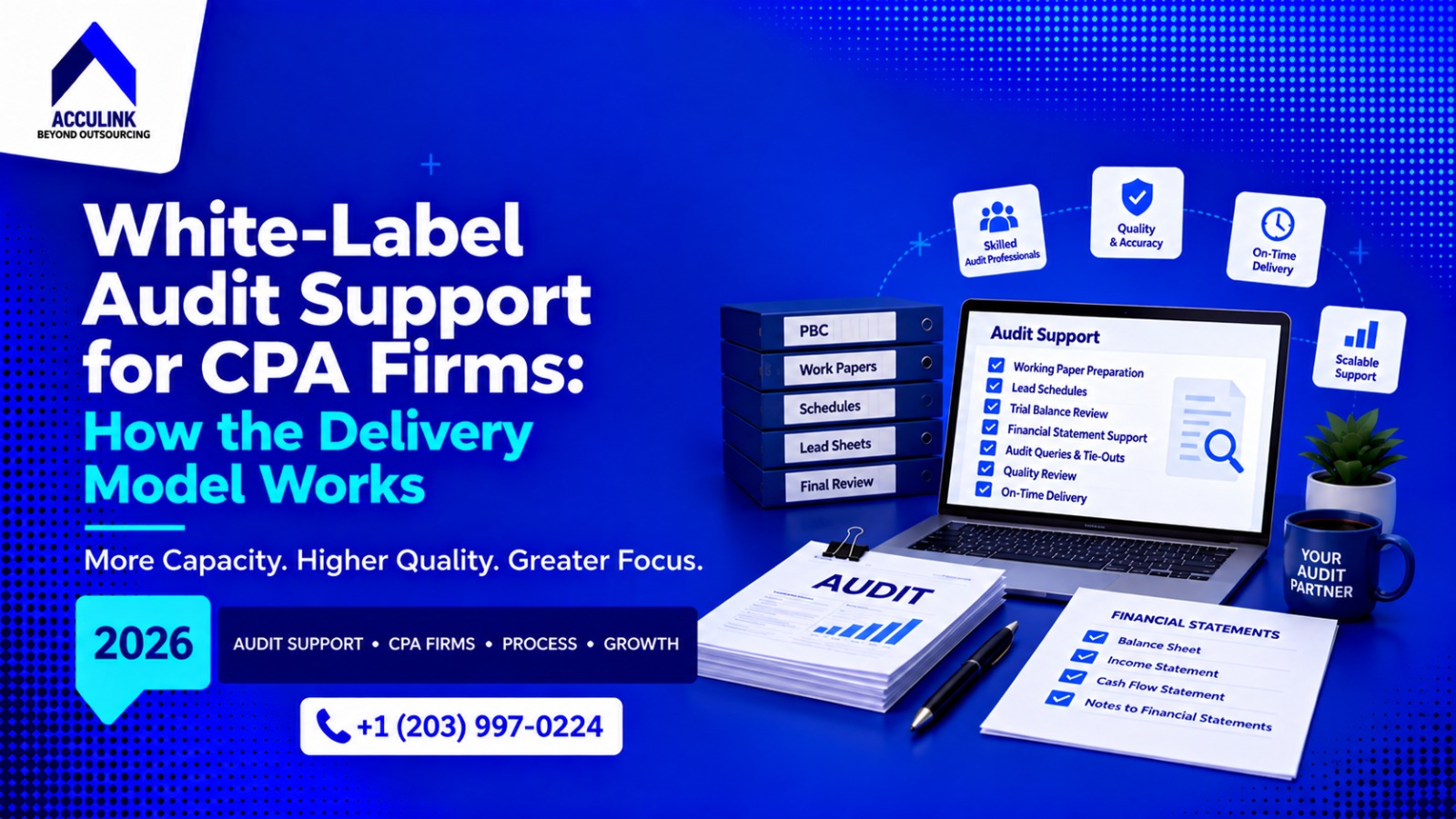
White-label audit support gives CPA and accounting firms external preparation and documentation capacity within their branded service. The provider works within the agreed methodology; the responsible audit firm retains engagement direction, review and responsibility for its audit report.
When audit managers are completing schedules before they can review them, the preparation backlog is consuming the capacity needed to move engagements forward. The commercial case for outside support is whether it releases that constrained time at an acceptable total delivery cost. More preparer hours alone do not establish that value.
For firms evaluating Acculink's audit support services for CPA and accounting firms, the decision comes down to work quality, staff continuity and control of the client relationship. This guide sets out how to assess those factors before committing recurring work or hiring a dedicated offshore professional.
Key takeaways for CPA and accounting firm leaders
- Protect review capacity: Evaluate white-label audit support by the work your reviewers can use and the internal hours it releases, not simply the hours purchased.
- Match the resource to the workload: A defined assignment can address a preparation backlog; a dedicated offshore auditor may suit recurring engagements that benefit from continuity.
- Keep client control explicit: Agree communication authority, brand use and escalation rules alongside the work scope. White-label delivery does not transfer audit-report responsibility.
- Test the economics before expanding: Compare provider fees with coordination, review and rework costs on a representative assignment before committing a larger workload.
How white-label audit support fits your firm's delivery model
In a white-label arrangement, an outside provider contributes to your firm's service rather than marketing a separate audit engagement to your client. The parties agree how work is prepared, presented, reviewed and communicated.
The support may involve workpaper preparation, schedule tie-outs, document organization or documentation of assigned testing. Client-facing materials can follow your firm's approved format and branding. Behind that presentation, you still need a clear record of the people who prepared and reviewed the work.
White-label is a commercial delivery description, not a professional license or a separate auditing standard. It does not automatically include direct client communication, a particular pricing model or unrestricted use of your firm's name. Those details belong in the agreement.
It is one way to organize audit support outsourcing when the firm wants outside preparation capacity integrated into its own client-service process.
It also does not mean hiding third-party involvement. Client notification and confidentiality requirements remain relevant even when your firm is the only client-facing brand.
White-label support, offshore delivery and dedicated staff
These terms describe different parts of an arrangement, so they can apply together.
| Term | What it describes | What to clarify |
|---|---|---|
| White-label audit support | How external work fits into your firm's branded service | Templates, communications, client contact and presentation |
| Offshore audit support | Where the people performing the work are located | Working-hour overlap, access locations and data handling |
| Dedicated audit staffing | How a professional's capacity is assigned to your firm | Availability, supervision, continuity and workload management |
| Defined-task support | A bounded set of outputs to be delivered | Inputs, exclusions, acceptance criteria and revision terms |
When does a dedicated offshore auditor make sense?
If your firm needs support across recurring engagements, you can hire an offshore auditor through Acculink to work within your agreed white-label process. A dedicated professional can build familiarity with your templates, file conventions and review feedback as the relationship develops.
Match the experience level to the work: schedule preparation and testing documentation require a different profile from assignments involving complex workpapers or team coordination. Before selecting a candidate, discuss relevant engagement experience, software proficiency and working-hour overlap.
Acculink lists full-time, part-time and ad hoc audit staffing options. Confirm availability and the arrangement that fits your workload. For a one-off preparation backlog, a defined task assignment may be sufficient. Either way, agree the branding and client-contact boundaries separately, and keep supervision and review within your firm's process.
Acculink offers offshore audit support from $8 to $35 per hour, depending on the role and experience required. Discuss your audit workload to request a proposal for defined support or a dedicated professional, with the scope, availability and pricing inclusions confirmed upfront.
Get the audit support handoff template.
Define scope, reviewer responsibilities, client-contact limits, return packages, and escalation steps before sending work out.
What can a white-label audit support team prepare?
Define professional audit support services by the outputs your reviewers need to move an engagement forward. A useful scope connects each assigned activity to a deliverable and an acceptance standard:
- Document organization: Indexing prepared-by-client, or PBC, records and tracking missing information.
- Lead schedules and tie-outs: Connecting account balances, schedules and supporting documents in your required format.
- Assigned testing documentation: Recording the procedures performed, evidence references and exceptions.
- Financial statement support: Completing agreed cross-references and draft presentation work for review.
- Review-note responses: Updating preparation work and showing how individual comments were addressed.
Acculink lists these types of preparation, testing and documentation activities within its audit-support scope. The exact assignment should match the engagement and the skills of the proposed team.
Confirm specialist experience where needed. Support for a financial statement audit may involve different records and procedures from 401(k) audit support or other employee benefit plan audit support. Ask about the relevant engagement type, not just years of general accounting experience.
How the white-label delivery model works
1. Agree on what the firm is buying
Specify the work package, source records, required outputs and acceptance criteria, with a named reviewer. For lead schedules, that means identifying the accounts, source files, tie-out requirements and treatment of unresolved differences before estimating effort.
Document which questions the provider can resolve and which require your team. Also agree what happens when records arrive late or the scope changes. A fee and deadline based on complete inputs should not silently become an open-ended assignment.
2. Set the client and brand boundaries
Decide whether the support team works only with your internal staff or has an approved role in client communications.
If your firm handles all requests, name the person who consolidates missing-item questions and sends them to the client. If direct contact is allowed, define the permitted subjects, communication channels and escalation rules.
Specify the use of your templates, logos and email accounts. Do not assume white-label means a non-solicitation commitment, exclusivity or permission to represent your firm in every context. Put the agreed restrictions in writing.
These choices help prevent clients receiving conflicting requests or commitments from different people.
3. Establish the working environment
Before access is granted, provide current templates, file conventions and an example of acceptable work. Confirm that the assigned people can use your actual software and documentation process.
Set up individually attributable access rather than shared logins. Decide where files remain, which information the team needs and how access ends when an assignment closes.
Define practical communication expectations: the overlap window, the daily status format and the route for urgent questions. Cross-time-zone work needs a plan for decisions that cannot wait until the next scheduled handoff.
4. Make the return package easy to review
A white-label handoff should tell your reviewer what is ready, what is unresolved and what needs a decision.
For an initial assignment, request a package with:
- The agreed workpapers in the required file structure.
- References to the supporting information.
- An open-item list with an owner and next action.
- Exceptions and matters requiring escalation.
- Preparation and review status.
- A change record for resubmitted work.
Agree whether a provider-side reviewer checks the work before submission. Specify the purpose of that check and the evidence of completion. A provider's internal review and your engagement review are separate stages.
5. Refine the arrangement using actual review feedback
Start with a manageable assignment and evaluate the output before transferring a larger workload.
Record why work comes back: missing records, unclear instructions, preparation errors or matters requiring judgment. Each cause needs a different response. More training will not solve a missing client document, and adding preparers will not resolve an unassigned review queue.
Use the first cycle to refine instructions, staff selection and the division of work. Expand when the arrangement is producing usable deliverables and predictable communication.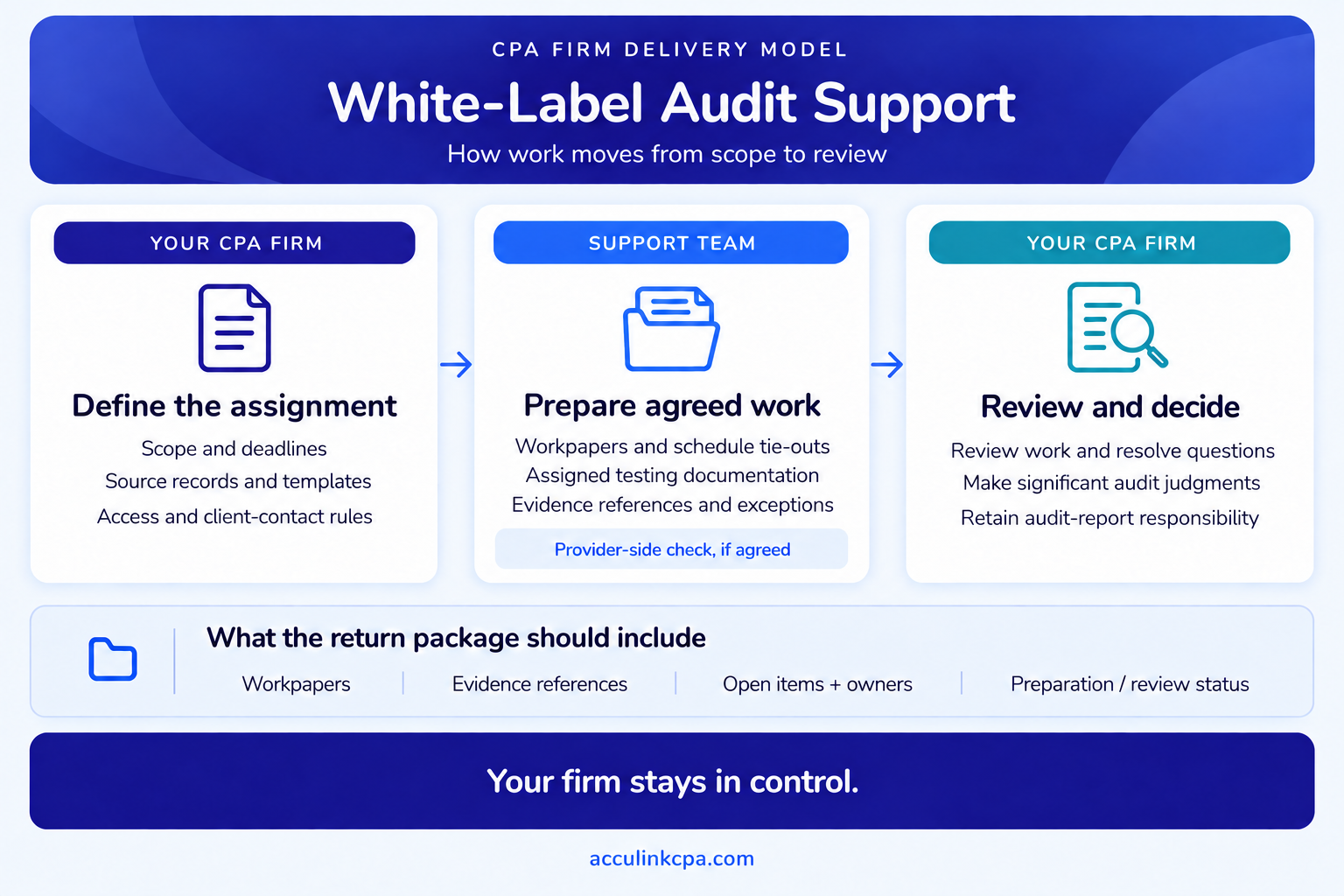
A practical white-label handoff example
Suppose your firm wants outside assistance with a group of audit lead schedules. The following is an illustrative assignment, not an Acculink client case study or a guaranteed outcome.
| Handoff item | Example instruction |
|---|---|
| Work package | Prepare the lead schedules listed in the assignment register |
| Inputs | Approved trial balance, current source schedules and firm templates |
| File convention | Use the firm's references and named preparer accounts |
| Exception rule | Flag unsupported balances and unresolved differences; do not force a tie |
| Client communication | Route additional information requests through the named firm contact |
| Return package | Prepared schedules, evidence references and an open-item list |
| Review | Provider check if agreed, followed by the firm's assigned reviewer |
| Completion | Reviewer accepts the assigned preparation work or returns specific comments |
This handoff separates completed preparation from unresolved evidence and judgment calls. Reviewers can prioritize the matters requiring their attention without first reconstructing the assignment's status.
Use this example as a starting structure and adapt it to your firm's methodology. It is not a substitute for an engagement-specific audit program.
Who controls the client relationship and audit decisions?
In the support arrangement described here, your firm controls the client relationship and the outside team contributes agreed work under your direction. The responsible audit firm retains authority over audit decisions and responsibility for its report.
Keep the commercial and operating arrangements consistent. If your firm owns client communications, the provider should not independently change deadlines, expand scope or promise a resolution to an audit issue. If a professional identifies a concern, the escalation route should be clear.
Within your team, assign responsibility for approving instructions, answering questions and reviewing returned work. White-label delivery is harder to manage when every preparer receives different directions from different managers.
For the broader decisions about whether and what to delegate, see our audit outsourcing guide for CPA firms.
Do clients need to know about white-label support?
Client notification and confidentiality obligations apply independently of the branding arrangement.
AICPA ET section 1.150.040 addresses client notification before confidential information is shared with a third-party service provider, with an exception for specified administrative support. Section 1.700.040 separately addresses confidentiality safeguards or specific consent. An NDA alone does not settle every notification obligation. Check the AICPA Code of Professional Conduct and obtain advice for the proposed arrangement.
Keep the client-facing explanation accurate: your firm uses external assistance for defined activities and manages the engagement. Have the appropriate professional adviser approve the actual engagement language and any additional legal requirements before information is shared.
What should a white-label audit support agreement cover?
Use these questions to make a provider discussion specific:
- Scope: Which outputs are included, and what is explicitly excluded?
- People: Who is assigned, who checks the work and how are replacements handled?
- Client contact: Who can communicate with clients, about what and through which channels?
- Brand use: Which templates, logos and representations are permitted?
- Timing: What starts the delivery clock, and how are dependencies reported?
- Revisions: Which corrections are included, and what constitutes additional work?
- Information handling: Where can information be accessed, stored and transferred?
- Exit: How are files returned, access removed and any retention obligations addressed?
Ask for evidence where a claim affects your decision. That can include an authorized work sample, a review checklist, a continuity plan or security documentation.
When reviewing Acculink, use its published data-security information to identify the evidence your firm requires for the proposed access arrangement. Assess the scope of the controls and supporting documentation against your own vendor requirements.
Test your audit workflow before you expand.
Discuss a defined assignment with clear handoffs, reviewer expectations, software, and target dates.
How should CPA and accounting firms compare white-label support costs?
Compare the cost of accepted work, not hourly rates in isolation. An apparently lower fee can lose its advantage if managers spend additional time correcting, clarifying or reconstructing the output. Establish whether the quote buys hours, a dedicated resource or a defined package, and compare equivalent scopes.
Ask specifically about onboarding, provider review, software access, minimum commitments, urgent work and revision charges. Include the time your own managers will spend explaining, reviewing and following up.
The capacity test is equally important: which constrained internal hours does the arrangement release, and can the firm use them for review, client decisions or additional engagements? Track that alongside total cost, separating provider rework from delays caused by incomplete client information.
Use Acculink's published $8 to $35 per hour range as a starting point, then compare the proposed role, hours and inclusions for your workload. Its engagement options provide a basis for discussing recurring or seasonal capacity and the terms of your white-label arrangement.
Where white-label audit support can create commercial value
The strongest case is a specific delivery constraint that appropriately skilled preparation support can address:
- Senior time is being absorbed by preparation. Assigning schedules and documentation to a suitable preparer can allow managers to concentrate on review and exceptions. Measure whether their time is actually released after coordination and rework.
- Committed engagements exceed available preparation capacity. Scoped support or a dedicated professional can add capacity against identified work. Confirm supervision and review availability before using that capacity to accept further engagements.
- Recurring work needs continuity without changing the client-facing team. A dedicated professional can learn the firm's templates and working conventions while communication remains under the agreed white-label arrangement.
Where the bottleneck is missing client evidence or unavailable partner review, adding preparers may not improve delivery. Identify a representative assignment with complete inputs, a named reviewer and measurable acceptance criteria. That gives the firm a basis for deciding whether to expand.
Why consider Acculink for white-label audit support?
Acculink combines offshore staffing and white-label delivery for CPA and accounting firms. Across its business, the company reports 300+ professionals supporting 80+ accounting firms. For an audit partner, the relevant question is how that operating model supports the work, coordination and continuity your engagements need.
- Dedicated capacity with staffing administration handled by Acculink. Under its dedicated staffing model, the assigned professional follows your firm's workflows while Acculink manages HR, payroll and IT. Your firm retains direction of the audit work without taking on those employment-administration tasks.
- Experience with your audit workflow. Acculink's offshore auditor offering identifies experience with CaseWare and ProSystem fx Engagement. Assess the proposed professional against your templates, engagement types and review expectations rather than introducing a separate documentation process simply to accommodate a provider.
- A defined coordination structure. Acculink describes a dedicated manager or point of contact, status reporting and US working-hour overlap in its delivery and client-support approach. Agree the actual overlap window and escalation contacts for your assignment so questions reach the right person.
- Published controls for client information. Acculink's data-security framework describes role-based access, individual credentials, company-managed encrypted devices and two-factor authentication. Review the supporting evidence against your firm's requirements before granting access to client files.
Acculink also advertises a 40-hour free trial. Ask how the trial applies to your proposed audit assignment and agree the scope and terms upfront. A representative work package gives your reviewers a practical basis for assessing preparation quality, communication and fit before expanding the arrangement.
For recurring requirements, explore hiring a dedicated offshore auditor. For a defined assignment, request an audit-support proposal from Acculink with the engagement type, tasks, approximate hours, software and target dates. Ask the proposal to identify the role, pricing inclusions and handoff expectations. Share nonconfidential requirements only; client records should move through an approved secure process.
Frequently asked questions
How can outsourced audit support services help CPA and accounting firms manage busy season?
Outsourced audit support services can add preparation and documentation capacity against committed engagements, allowing managers to concentrate on review and exceptions. Acculink offers full-time, part-time and ad hoc staffing options. Match the resource to the backlog, agree handoff dates and reserve internal review time so additional preparation does not simply create a larger review queue.
Which stages of the audit process can CPA and accounting firms outsource support for?
Support can span planning preparation, fieldwork documentation and engagement completion. Acculink's audit support services include PBC organization, risk-assessment documentation, assigned testing, schedule tie-outs and review-note support. Define the procedures and deliverables for each stage; the responsible audit firm retains audit strategy, significant judgments, supervision and report responsibility.
Which audit engagement types can Acculink support?
Acculink lists financial statement, 401(k) and other employee benefit plan audit support. Confirm the proposed professional's experience with your engagement type, applicable framework and assigned work areas. Plan-audit experience, for example, should be evaluated against the actual records and procedures involved rather than a general accounting background.
Is audit support outsourcing more cost-effective than hiring additional in-house audit staff?
It can be, particularly where workload is seasonal or does not require a full-time hire. Acculink publishes audit-support rates from $8 to $35 per hour. Compare the total cost of equivalent accepted work, including onboarding, supervision, review and rework, with your in-house alternative. The business case depends on workload and usable capacity, not the hourly rate alone.
How can outsourced audit support improve audit efficiency and workpaper quality?
Appropriately skilled preparers can take on schedules, evidence referencing and testing documentation that would otherwise consume senior time. Consistent templates, clear exception logs and an agreed provider-side check can make returned work easier to review. Assess the result through first-pass acceptance, internal review hours and repeated preparation errors; additional staff alone do not establish better quality.
How does Acculink protect client data during offshore audit support?
Acculink's published security controls and IT infrastructure include role-based access, individual credentials, two-factor authentication, encrypted company-managed devices, activity logging and secure backups. It also describes controlled premises and restrictions on personal devices and transfers. Validate the applicable controls and evidence for your arrangement, then agree access permissions, incident communication and offboarding requirements before sharing client records.
Is white-label audit support the same as outsourcing the audit opinion?
No. This article describes preparation and documentation support for CPA and accounting firms. The external provider prepares agreed work; the responsible audit firm retains its report responsibility. A different arrangement involving another audit firm requires separate consideration.
Can we use our own templates and software?
Yes, if the provider can work within them and the necessary access and licenses are arranged. Check the actual assigned team's experience and test the output against your firm's conventions before scaling.
Will the provider communicate directly with our clients?
Only within the arrangement you agree. Some firms route all questions through their own managers; others authorize limited direct contact. Define the channels, subjects and approval requirements in writing.
Can we combine white-label support with a dedicated offshore auditor?
Yes. White-label describes the delivery relationship, while dedicated staffing describes how capacity is allocated. Agree both the resource commitment and the operating boundaries.
What should we provide to obtain a useful quote?
Provide engagement types, a nonconfidential task list, approximate volume, software, required dates and review expectations. Ask the provider to specify assumptions, exclusions, staffing and revision terms in its proposal.
Test audit support before you expand.
Dedicated auditors or defined support from $8 to $35 per hour.
Tags:
About the Author

Related Posts
Top 10 Offshore Staffing Companies for Accounting Firms (2026)
Hiring an offshore team is one of the highest-leverage moves a short-staffed CPA firm can make, but the partne…
Top Outsourced Accounting Firms for CPA Practices (2026)
Choosing an outsourced accounting partner is a high-stakes call because the team touches your clients' data. T…
Audit Staffing for CPA Firms: How to Hire Offshore Audit Professionals
Audit staffing should begin with the work and review capacity a CPA firm needs, not a generic headcount reques…