AI in Auditing for CPA and Accounting Firms: Data Analytics, Automation and Human Review
Summary
See how CPA and accounting firms can combine AI in auditing, audit data analytics, analytical procedures and automation with reliable data and human review. This guide covers practical examples, workflow controls, responsible AI safeguards, offshore support and a seven-step pilot for improving audit efficiency.
AI in auditing can help organize information, analyze large datasets, identify unusual activity and accelerate defined audit tasks. It does not remove the need for reliable data, professional skepticism, documented procedures, human review or the responsible auditor's judgment.
That distinction matters for CPA and accounting firms. Technology may identify an unexpected revenue movement in seconds, but someone still has to confirm the source data, understand the business explanation, obtain support, document the work and decide whether further procedures are necessary.
The practical question is not whether AI will replace auditors. It is how a firm should combine audit data analytics, automation and trained people so that technology produces reviewable work instead of more exceptions for managers to resolve.
Key takeaways
- Start with the audit objective. Select technology only after defining the question, population, expected output and reviewer.
- Consider AI on both sides of the engagement. Assess how a client's use of AI affects financial reporting and how the audit team's own AI tools affect procedures, evidence and documentation.
- Treat data preparation as part of the work. Incomplete, duplicated or poorly mapped information can make a fast analysis unreliable.
- Separate analytics from judgment. Technology can compare, classify, extract and flag. The responsible audit team evaluates evidence and reaches conclusions.
- Design the review before the task begins. Retain the source, logic, parameters, exceptions and reviewer disposition.
- Solve capacity and technology together. Automation may reduce repetitive effort, but people are still needed to prepare data, investigate differences and document the result.
Acculink provides offshore audit-support professionals at published role-based pricing of $8 to $35 per hour. Firms can use defined support, part-time capacity or a dedicated professional for preparation, analysis support and documentation. The responsible firm retains supervision, professional judgment and responsibility for its report. Explore audit support services or hire an offshore auditor.
What does AI in auditing mean?
AI in auditing means using artificial-intelligence capabilities to assist defined activities within the audit workflow. Depending on the tool and its approved use, those activities may include extracting information from documents, organizing records, identifying patterns, comparing populations, summarizing exceptions or preparing information for human review.
Artificial intelligence in auditing covers more than generative AI. The wider audit technology stack can include machine learning, natural-language processing and intelligent document tools alongside rules-based automation. Rules-based automation is not necessarily AI, and generative AI brings distinct concerns involving accuracy, traceability, confidentiality and appropriate use.
This guide focuses on technology-enabled financial audit support for CPA and accounting firms. For the wider engagement sequence, use the financial audit process and checklist. Internal audit programs, IT audits and assurance over AI systems involve different objectives and are outside this scope.
The Journal of Accountancy's discussion of AI in audit describes applications such as processing large datasets, identifying unusual transactions and reading documents. The value of any application depends on the procedure being performed and the firm's ability to review the output.
The responsible auditor remains accountable for the procedure, evidence evaluation and conclusion. A tool cannot accept the engagement or assume responsibility for the auditor's report.
AI, audit data analytics, analytical procedures and automation are related but different
Firms often use these terms together, but they do not describe the same thing.
| Term | Practical meaning | Example | Main control question |
|---|---|---|---|
| AI in auditing | AI assists a defined part of planning, preparation, analysis or documentation | Extracting fields from contracts for review | Can the firm verify the output and protect the data? |
| Audit data analytics | Data is analyzed to identify patterns, relationships, anomalies or other useful information | Comparing revenue by month, location and product | Is the population complete, accurate and relevant? |
| Analytical procedures | Recorded amounts or ratios are compared with expectations developed by the auditor | Comparing recorded payroll expense with an expectation based on headcount and pay rates | Is the relationship plausible and the expectation sufficiently precise? |
| Audit automation | Repeatable steps are performed through configured rules or connected workflows | Importing a trial balance and applying an approved mapping | Are the rules current, controlled and operating as intended? |
| Human audit support | Professionals prepare, investigate, document and route work for review | Resolving mapping questions and documenting unusual movements | Is the work assigned to someone with the right experience and supervision? |
The distinction matters when diagnosing a delivery problem. A firm looking for audit automation software may need a platform. A firm with software but insufficient preparation and review capacity has a people-and-workflow problem. Buying another tool does not necessarily address that constraint.
AI changes the audit in two directions
The AICPA's October 2026 AI considerations for financial statement auditors addresses two separate questions: how an entity's use of AI can affect financial reporting and the audit response, and how an audit firm's use of AI-enabled technology can affect performance of the engagement.
| Direction | What can change | Audit-team focus |
|---|---|---|
| The client uses AI in financial reporting or related processes | AI may influence transaction processing, classifications, estimates, reconciliations, journal entries or controls | Understand the use case, data sources, human approvals, change controls and third-party dependencies; identify the resulting risks and design an appropriate response |
| The audit firm uses AI-enabled technology | The firm may use AI for research, extraction, risk assessment, audit data analysis or documentation support | Approve the use case, evaluate team competence and data reliability, protect client information, validate outputs and retain a reviewable evidence trail |
These directions can interact. Information produced by a client's AI-enabled process may become information the auditor plans to use, while an audit firm's AI output may affect how it performs or documents a procedure. Neither situation should be treated as a software checkbox.
First identify which direction applies and which professional requirements govern the engagement. Offshore support can organize records, prepare reconciled populations, execute firm-approved analyses and document exceptions. The responsible audit team determines the risk response, evaluates the evidence and reaches the conclusion.
Where technology fits in the audit workflow
Technology works best when each use has a defined input, action, output and reviewer. The following workflow keeps those elements connected.
1. Define the audit question
Begin with the engagement objective rather than a feature demonstration. Specify the account, assertion, population, period and reason for the analysis.
Map the proposed use to the relevant stage in the firm's approved audit methodology before selecting a tool or assigning support work.
For example, “find unusual revenue” is too broad. A usable instruction might identify the approved population, relevant fields, periods, locations and characteristics that should be flagged for the engagement team's evaluation.
The responsible firm determines which procedures are appropriate. The technology and support team operate within that approved scope.
2. Obtain and understand the data
Record where the data came from, how it was generated, the period covered and the report parameters. Identify whether totals reconcile with the relevant ledger, subledger or control report.
Large files do not automatically provide better evidence. If a dataset omits locations, duplicates transactions or uses inconsistent account mappings, the resulting analysis may be precise but wrong.
Use an audit-readiness checklist to surface missing records, changing populations and unresolved reconciliations before the analysis enters the review queue.
The AICPA & CIMA Guide to Audit Data Analytics includes data reliability as an explicit consideration and addresses analytics across risk assessment, substantive procedures, tests of details and the overall conclusion.
3. Prepare the population
Preparation may include standardizing dates, currencies, identifiers and account labels; identifying blank fields; preserving source values; and reconciling record counts and totals.
Keep a record of transformations. A reviewer should be able to understand how the source became the analysis-ready population and which records were excluded, combined or changed.
This stage often determines whether the promised efficiency is realized. Technology may accelerate cleaning and classification, but ambiguous mappings and unexplained differences still require someone who understands the accounting records and the firm's instructions.
4. Perform the approved analysis
Apply the firm's approved rules, calculations or models. Retain the settings and thresholds used. When AI helps generate a formula, classification or summary, validate it against the source and test representative cases.
The output should distinguish between:
- Items that met the defined criteria.
- Items that require investigation.
- Records that could not be processed.
- Changes made after the first run.
A clean chart or concise AI summary is not a substitute for a controlled population and reproducible logic.
5. Investigate exceptions
An exception is a starting point for follow-up, not a conclusion. Assign an owner, obtain relevant support and document the disposition.
Some differences will reflect legitimate business events, timing or data limitations. Others may require revised expectations or additional procedures. Keep open items visible until the responsible reviewer determines the next step.
6. Prepare the review package
Return the analysis with enough context for efficient review:
- Objective and population.
- Source and reconciliation information.
- Method, parameters and thresholds.
- Results and unresolved exceptions.
- Supporting references.
- Preparer and review status.
- Changes from the previous version.
This is where trained capacity matters. A reviewer should receive an understandable work package, not a folder containing raw exports, screenshots and unexplained AI output.
7. Record the reviewer disposition
The reviewer evaluates whether the work addresses the objective, whether the underlying information is suitable and whether further work is necessary. Document the questions raised, changes made and final disposition under the firm's methodology.
For issuer audits, the PCAOB's technology-assisted analysis amendments update AS 1105 and AS 2301 for procedures that analyze electronic information with technology-based tools. They apply to audits of financial statements for fiscal years beginning on or after December 15, 2025. PCAOB AS 2305 addresses substantive analytical procedures. Applicable requirements differ by engagement, so firms should apply their governing standards and approved methodology rather than treating one generic workflow as sufficient for every audit.
See what your reviewer should receive.
Get a worked revenue-analysis sample with source tie-outs, exception follow-up and reviewer notes.
Practical audit analytics examples
The following examples show how audit data analysis and human review can work together. They are workflow examples, not prescribed audit procedures.
Revenue trend and fluctuation analysis
Question: Which monthly, location-level or product-level revenue movements require engagement-team attention?
Technology can assist with: Calculating period changes, disaggregating results, comparing recorded amounts with approved expectations and displaying outliers.
People are needed to: Reconcile the revenue population, understand changes in pricing or volume, obtain support for explanations, distinguish data issues from business events and document unresolved matters.
Review package: Reconciled source totals, the expectation and threshold approved by the firm, exception details, supporting references and reviewer disposition.
Payroll expense analysis
Question: Are payroll expense movements consistent with headcount, compensation changes and the periods in which employees worked?
Technology can assist with: Comparing payroll expense with headcount and pay-rate information, identifying duplicate identifiers and flagging unusual period movements.
People are needed to: Confirm the reliability of payroll and headcount data, understand bonuses or restructuring, investigate timing differences and document the relationship used.
Review package: Data-source description, reconciliation, expectation, results by period or population segment and follow-up on significant differences.
Accounts payable and disbursement review
Question: Which transactions match the firm's approved exception criteria?
Technology can assist with: Finding duplicate invoice numbers, round-dollar items, unusual dates, new vendors or payments outside configured parameters.
People are needed to: Resolve false positives, obtain supporting records, understand vendor-master changes, document the reason for each disposition and escalate matters requiring judgment.
Review package: Complete population control, rule definitions, exception list, support obtained and unresolved items.
Document extraction and organization
Question: Can defined information be collected from contracts, invoices or statements and organized for review?
Technology can assist with: Extracting dates, names, amounts and clauses; matching documents to a request list; and identifying missing fields.
People are needed to: Validate extracted values, resolve low-confidence results, identify amendments, confirm document completeness and connect the information to the approved procedure.
Review package: Source-document references, extracted fields, validation status and a list of missing or ambiguous items.
Analytical procedures require more than variance calculations
Analytical procedures involve studying plausible relationships among financial and nonfinancial information. A year-over-year percentage calculation may help identify a movement, but it does not by itself establish a substantive analytical procedure.
A well-designed substantive analytical procedure ordinarily requires the responsible auditor to consider the suitability of the procedure, reliability of the data, plausibility and predictability of the relationship, precision of the expectation and the amount of difference requiring investigation. Significant unexpected differences need appropriate evaluation and follow-up.
Technology can calculate faster and across more detail. It cannot decide whether a relationship is appropriate for the assertion or whether the evidence obtained is sufficient. Those decisions depend on the engagement, assessed risks and applicable professional requirements.
That boundary also protects the value of offshore support. A qualified support professional can prepare reconciled populations, compute firm-approved analyses, assemble evidence references and document exceptions. The responsible audit team sets the procedure, reviews the work and reaches the conclusion.
What audit automation can and cannot solve
Audit automation is most useful when the task is stable, repeatable and governed. Import routines, standardized mappings, document indexing, status updates and defined calculations may be suitable candidates for audit technology.
Automation becomes fragile when inputs change without notice, exceptions are common or rules depend on facts that the system cannot evaluate. Firms should avoid automating an unclear process. That merely makes inconsistent work happen faster.
Before automating a step, ask:
- Is the input structured and controlled?
- Is the rule explicit enough to test?
- What should happen when the rule cannot be applied?
- Can the firm trace the output to the source?
- Who reviews exceptions and approves changes?
- How will the process be monitored when systems or engagement facts change?
Software remains part of the firm's environment, not a replacement for governance or staffing. A team still needs to maintain mappings, resolve failed records, investigate exceptions and respond to reviewer questions.
Is exception follow-up slowing your team?
Add support for data preparation, evidence references and exception tracking within your firm's approved workflow.
Seven controls for responsible AI use in auditing
Generative AI can produce plausible but incorrect answers, and confidential client information can be exposed if people use unapproved systems. The PCAOB's observations on generative AI emphasize supervision and risks involving data privacy and security. Firms should translate those concerns into operating controls.
1. Approve the use case
Define permitted tasks, prohibited tasks and the level of human review required. Avoid open-ended instructions such as “use AI to finish the workpaper.”
2. Control the information entered
Use only firm-approved tools and environments. Determine whether client information may be entered, where it is processed, whether it is retained and whether it may be used to train a model. Address applicable consent, confidentiality and contractual obligations before use.
The Journal of Accountancy's discussion of AI and accounting ethics explains why public tools can create confidentiality, competence and independence concerns.
3. Retain source traceability
The reviewer should be able to connect an extracted value, classification or summary to the underlying record. A confident answer without a source reference is difficult to test.
4. Validate accuracy and completeness
Test representative records, edge cases and exceptions. Reconcile relevant totals. Human review should challenge the output rather than simply approve it because the formatting looks complete.
5. Preserve the audit trail
Record the tool or system used, the approved input, material settings, version where relevant, output reviewed, corrections made and reviewer disposition.
6. Restrict access
Apply individual accounts, least-privilege access and appropriate segregation. Remove access when a role or assignment ends. Acculink describes its IT and data-security controls for firms evaluating offshore access arrangements.
7. Monitor changes
AI systems, prompts, integrations and vendor terms can change. Review approved uses periodically and when the technology, data flow or engagement scope changes.
Where offshore audit support and audit staffing fit
Firms often discover that adopting technology changes the workload rather than eliminating it. Less time may be spent on manual extraction, while more attention is needed for data preparation, exception handling, documentation and review.
Offshore audit support can address that execution layer when the scope is clear. Depending on experience, supervision and the engagement, support may include:
- Organizing client-provided documents and request status.
- Preparing and reconciling analysis-ready schedules.
- Applying approved mappings and calculations.
- Preparing ratio and variance analysis for review.
- Supporting approved analytical procedures for revenue and expenses.
- Documenting exceptions and evidence references.
- Updating files in response to review notes.
- Maintaining open-item and change logs.
The responsible firm should retain procedure design, risk assessment, evaluation of evidence, professional skepticism, material judgments, conclusions, supervision and responsibility for its report.
Project support or a dedicated professional?
| Delivery need | Suitable model | Why it may fit |
|---|---|---|
| A defined backlog with clear outputs | Project or ad hoc support | Scope can be limited to specified schedules or documentation |
| Recurring work across several engagements | Part-time or dedicated support | The professional can learn the firm's templates and review expectations |
| Seasonal increase in volume | Time-bound capacity | The firm can add preparation support around known workload periods |
| Ongoing workflow improvement | Dedicated team | Continuity can help standardize handoffs, feedback and file conventions |
Acculink offers engagement models that include full-time, part-time and ad hoc options. Confirm the proposed role, experience, availability, scope, systems, review process and pricing before assigning live work.
A practical operating model for technology-enabled audit support
Use a simple responsibility map before work begins.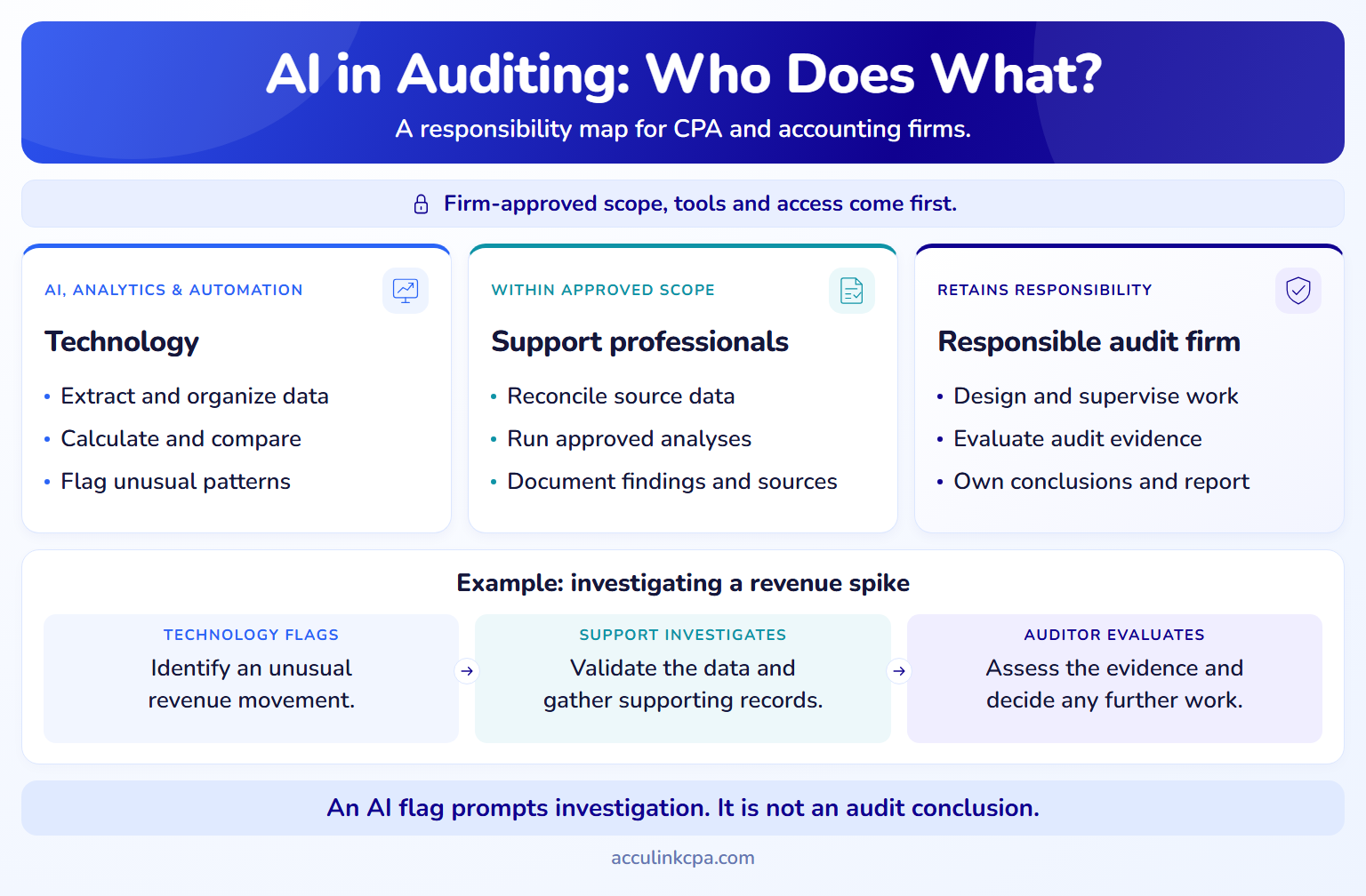
| Activity | Responsible firm | Support professional | Technology |
|---|---|---|---|
| Define objective and procedure | Approves | Provides scoped preparation input | Does not decide |
| Obtain and reconcile data | Specifies requirements and reviews | Prepares, maps and reconciles | Imports, compares or validates defined fields |
| Run approved analysis | Approves logic and thresholds | Executes and documents | Calculates, classifies or flags |
| Investigate exceptions | Directs and evaluates | Obtains support and records findings | Organizes and prioritizes defined exceptions |
| Reach audit conclusion | Owns | Does not conclude | Does not conclude |
| Prepare review package | Sets format and reviews | Assembles documentation | Supports repeatable formatting and traceability |
This model helps prevent two common failures. The first is asking technology to make a decision that belongs to the auditor. The second is buying capacity without defining the outputs the reviewer needs.
How to evaluate whether the workflow is improving
Audit efficiency should not be measured only by the number of automated steps or hours purchased. Use operational measures tied to review and completion:
- Time from receipt of usable data to first review.
- Percentage of assigned packages accepted on first review.
- Reviewer hours spent correcting preparation issues.
- Open exceptions without an owner or next action.
- Rework caused by source-data or version changes.
- Turnaround time for review-note responses.
- Recurring tasks completed using the approved process.
Establish the baseline before changing the process. A faster first submission has limited value if reviewers spend more time correcting it.
How to start without redesigning every engagement
Choose one representative work package with understandable inputs, repeatable steps and a named reviewer.
- Select the work package. Use a recurring area with enough volume to test the workflow.
- Document the current process. Record inputs, transformations, handoffs, review points and recurring problems.
- Define the permitted technology. Approve the tools, data boundaries, logic and escalation rules.
- Assign the people. Name the responsible reviewer, preparer and support roles.
- Run one controlled cycle. Retain the original data, output, exceptions, review notes and revisions.
- Compare the result with the baseline. Assess turnaround, first-pass acceptance, reviewer effort and unresolved items.
- Expand only after the controls work. Standardize the successful workflow, then adapt it to other engagements.
Questions to ask before adding technology or support
Ask these questions before signing a software contract or assigning work to an external team:
- Which engagement problem are we solving?
- What data is required, and how will completeness and accuracy be evaluated?
- What decisions remain with the responsible audit team?
- Which tools and environments are approved for client information?
- Can each output be traced to its source and reproduced?
- Who investigates exceptions and who closes them?
- What does an acceptable review package contain?
- How will preparer and reviewer activity be identified?
- How will access be granted, monitored and removed?
- What happens when the population, system or engagement scope changes?
- Are we buying software, people, a defined deliverable or some combination?
- Which measures will show whether reviewer capacity actually improved?
Clear answers make technology and offshore support easier to evaluate on the same workflow rather than as unrelated purchases.
Why CPA and Accounting Firms Choose Acculink for Audit Support
Acculink CPA supports U.S. CPA and accounting firms with offshore audit professionals who work within their systems and review processes. For firms using AI and audit data analytics, that support covers the preparation, analysis and documentation needed to turn technology output into work managers can review.
Acculink audit support pricing: $8 to $35 per hour, all-inclusive and role-based.
- Relevant audit support: Reconciled schedules, ratio and variance analysis, support for approved analytical procedures, evidence references and workpaper updates.
- Experience with audit technology: Firms can hire an offshore auditor for assignments involving analytics, IDEA/ACL script support and workflow automation, matched to the professional's experience and the firm's approved tools.
- Flexible engagement models: Choose a defined assignment or dedicated full-time, part-time or on-demand capacity through Acculink's engagement options.
- Two-tier review: Acculink describes a maker-checker process in which preparation is followed by senior review before delivery. Your firm retains engagement supervision, professional judgment and final sign-off.
- Experience and scale: Acculink reports 300+ qualified professionals supporting 80+ accounting firms across its business.
- Documented data security: Its security framework describes individual access, multifactor authentication, encrypted devices and controlled handling of client information.
- 40-hour free trial: Start with a defined assignment, with no setup fee or long-term lock-in, and assess preparation quality, communication and reviewer effort before expanding.
Start with a recurring task that takes time away from your managers, such as preparing a reconciled analysis schedule and documenting its exceptions. Request your 40-hour audit-support trial with your software, workload and target dates so Acculink can recommend a suitable role and scope. The hourly range applies to support capacity; independent audit fees and software costs are separate.
Frequently asked questions
What is AI in auditing?
AI in auditing is the use of artificial-intelligence capabilities to assist defined audit activities such as document extraction, data organization, pattern identification, exception summarization and workflow support. The responsible auditor still evaluates the evidence, exercises professional judgment and reaches the audit conclusion.
What is audit data analytics?
Audit data analytics is the analysis of data related to an audit to identify patterns, anomalies and other useful information for planning or performing audit work. It may involve descriptive, diagnostic or more advanced techniques, depending on the objective, data and approved methodology.
Are audit data analytics and analytical procedures the same?
No. Audit data analytics describes techniques used to analyze audit-related data. An analytical procedure has a specific audit purpose and involves evaluating plausible relationships, developing an expectation and investigating significant differences under the applicable methodology. Analytics may support an analytical procedure, but the terms are not interchangeable.
What can audit automation handle?
Audit automation can assist repeatable, rules-based steps such as imports, approved mappings, calculations, document routing and status updates. Exceptions, changing facts and judgment-dependent matters still require human involvement.
Can AI perform an audit without an auditor?
No. AI can assist selected tasks, but it cannot accept professional responsibility, exercise professional skepticism or issue an audit report. The authorized responsible firm and professionals retain those duties.
How can a client's use of AI affect a financial statement audit?
A client's use of AI may affect transaction processing, estimates, classifications, reconciliations, internal controls or information supplied as audit evidence. The audit team should understand the use case and its data, governance, human oversight and third-party dependencies, then identify the related risks and design procedures under the standards governing the engagement.
Can CPA firms enter client information into generative AI tools?
Only after the firm determines that the tool, use and data handling comply with its policies and applicable confidentiality, privacy, contractual and professional obligations. Public AI tools should not receive confidential client information merely because they are convenient. Use approved environments and obtain any required authorization or consent.
Can analytical and documentation support be outsourced?
Defined preparation and documentation activities may be assigned to qualified support professionals when permitted and appropriately supervised. Examples include preparing reconciled schedules, applying firm-approved calculations, documenting exceptions and organizing evidence references. The responsible firm retains procedure design, review, judgment and conclusions.
Does a firm need new audit software before using data analytics?
Not always. The appropriate tools depend on the objective, data volume, existing systems and controls. Some firms can begin with approved capabilities already available in their environment. The firm should first define the procedure and data requirements.
How should a firm measure audit-automation success?
Measure whether the workflow improves first-pass acceptance, turnaround, reviewer effort, exception resolution and completion consistency. Counting automated steps alone does not show whether audit delivery improved.
How much does offshore audit support cost?
Acculink publishes role-based pricing of $8 to $35 per hour. The applicable rate depends on role, experience, scope and delivery model. Ask for a proposal that states the assigned professional, included work, availability and review process.
How can a firm begin with Acculink?
Provide nonconfidential information about the engagement type, systems, workload, required outputs and timing. Acculink can then discuss defined support or a dedicated professional. The firm should interview the proposed resource and agree on access, responsibilities, review and acceptance criteria before live work begins.
Build the audit workflow around evidence, review and capacity
AI, audit data analytics and automation can improve how firms process information and identify matters requiring attention. Their value depends on the controls around the data, the clarity of the procedure and the quality of the human review.
For CPA and accounting firms, the most durable model combines approved technology with trained people and explicit responsibility boundaries. Technology handles repeatable processing and analysis. Support professionals prepare and document the work. The responsible audit team evaluates the evidence and reaches the conclusion.
If preparation and documentation are consuming the time your managers need for review, discuss audit-support capacity with Acculink. Scope the first assignment around a defined population, output, reviewer and target date so the firm can evaluate the actual working relationship before expanding.
Less audit prep. More time to review.
Data preparation, analysis support and documentation within your firm's approved workflow.
Tags:
About the Author

Related Posts
Top 10 Audit Support Outsourcing Companies for CPA and Accounting Firms (2026)
Compare ten audit support outsourcing companies for U.S. CPA and accounting firms. This guide separates manage…
Audit Readiness Checklist: A Pre-Fieldwork Guide for CPA and Accounting Firms
Use this 36-point audit readiness checklist to confirm scope, organize records, reconcile balances, prepare su…
Audit Staffing for CPA Firms: How to Hire Offshore Audit Professionals
Audit staffing should begin with the work and review capacity a CPA firm needs, not a generic headcount reques…
401(k) Audit Requirements: A Checklist for CPA and Accounting Firms
401(k) audit requirements generally depend on participants with account balances, prior filing status, and app…