Virtual Bookkeeping Services: How It Works, What It Costs, and Is It Safe? (2026)

Summary
A practical 2026 guide to virtual bookkeeping services for firms adding capacity and businesses alike: how the remote model works, the tools behind it, whether it is safe, and what it costs, with the offshore option at 60-70% below an in-house hire.
Virtual bookkeeping is bookkeeping done remotely through cloud accounting software, rather than by someone on-site. For a growing CPA or accounting firm, it is the fastest way to add bookkeeping capacity: an offshore bookkeeper, or a full dedicated team, working in your clients' books under your own brand, without a local hire. For a business, it is how you keep accurate, current books online instead of an in-house bookkeeper. This guide covers how virtual bookkeeping works, the tools behind it, whether it is safe, and what it costs, with a focus on firms adding capacity.
What Is Virtual Bookkeeping?
Virtual bookkeeping is the practice of having a remote bookkeeper or firm manage your financial records through cloud-based software, rather than hiring someone on-site. The terms virtual, remote, and online bookkeeping all describe the same thing: your books are kept from another location, in the cloud, with nothing tied to a physical office.
Because everything runs in cloud accounting tools, you and your bookkeeper work from the same live file at the same time. That is the real shift from traditional bookkeeping. Instead of handing over folders of receipts and waiting for a monthly visit, the work happens continuously and you can check the numbers whenever you want.
For an accounting firm, virtual bookkeeping is how you deliver outsourced bookkeeping for CPA firms: an offshore bookkeeper works in your clients' books, under your brand and your review. For a business, it is simply a way to keep your own books without an in-house hire. Either way, this guide focuses on how the remote model works and whether you can trust it.
How Virtual Bookkeeping Works
Virtual bookkeeping runs entirely online, and the day-to-day is more hands-off than most owners expect. A typical setup looks like this:
- You grant secure access to your cloud accounting software (QuickBooks Online, Xero, or similar) and connect your bank and card feeds, so transactions flow in automatically.
- Bills, receipts, and statements move through a secure portal or app, with an audit trail, not through scattered email attachments.
- Your bookkeeper works in the same live file you do, categorizing transactions, reconciling accounts, and running payables and receivables.
- You see a real-time dashboard of cash flow and key numbers, updated as the work happens, rather than waiting for a month-end packet.
- You communicate on a set cadence with a named point of contact. With an offshore team, you typically have three to four hours of daily US time-zone overlap for real-time questions.
For an accounting firm, the same setup runs across multiple client files at once, with the offshore bookkeeper working in each client's software under the firm's supervision. The result is counterintuitive: a good remote bookkeeper gives you more visibility than a traditional once-a-month bookkeeper, not less, because the books are always current and you can open them any time.
The Tools Behind Virtual Bookkeeping
Virtual bookkeeping is only as good as the software it runs on, and a capable team works inside the platforms you already use:
- Cloud accounting. QuickBooks Online and Xero are the standard. A serious provider is certified on them. Acculink's bookkeepers are QuickBooks Advanced Certified ProAdvisors and Xero Certified Advisors, so there is no learning curve on your stack.
- Bank and card feeds. Automatic transaction imports keep the ledger current without manual data entry.
- Secure document management. A client portal, or a tool like Notion or Hubdoc, handles receipts and bills with a clear audit trail.
- Live reporting. Profit and loss, balance sheet, and cash-flow dashboards you can open at any time.
Because these are cloud tools, nothing depends on a particular office or machine. That is exactly what makes the model work remotely, and, done right, securely.
Is Virtual Bookkeeping Safe?
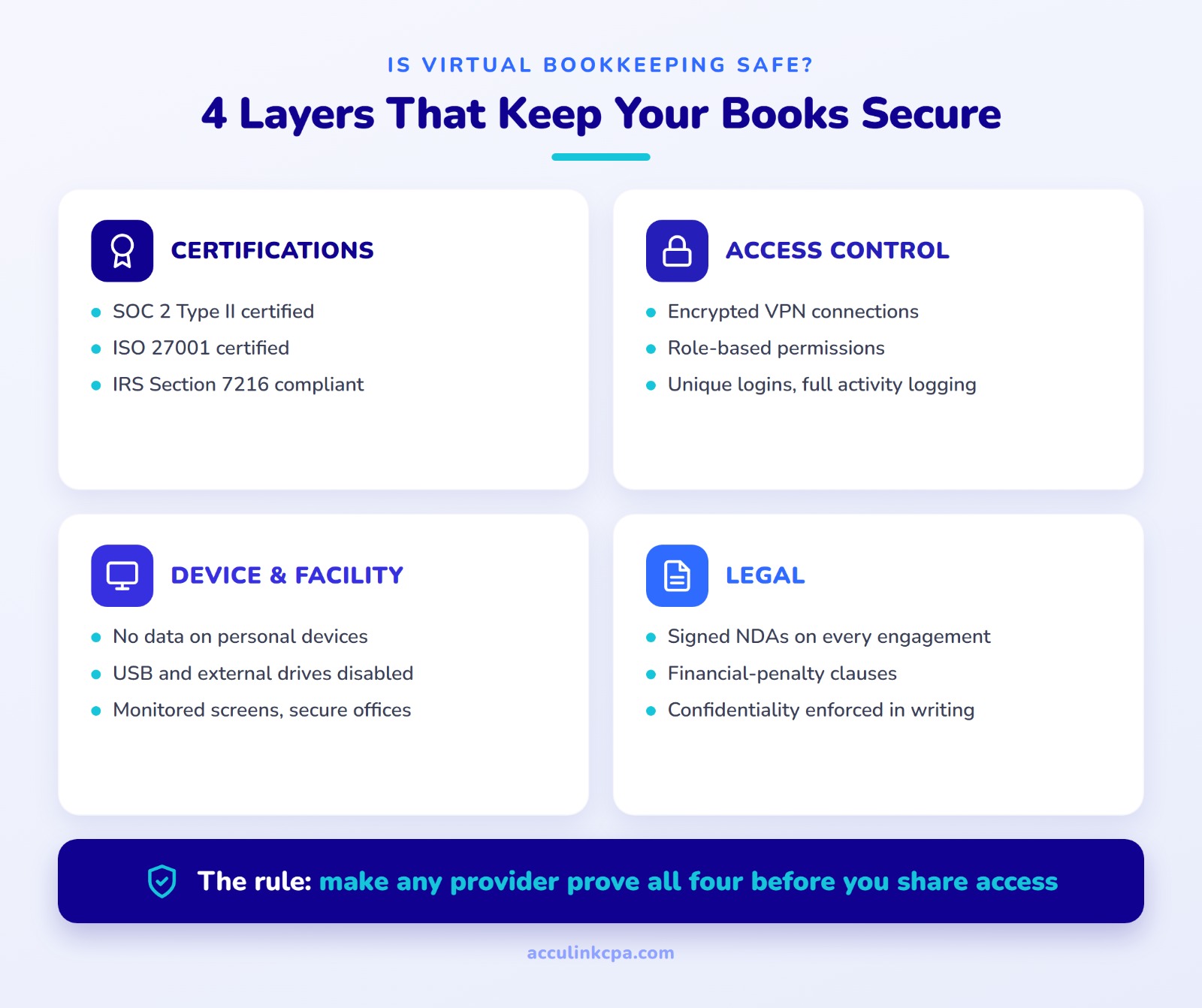
It is the first question most owners ask, and a fair one: you are giving an outside team access to your financial data. For an accounting firm the bar is even higher, because it is your clients' data on the line. Handled properly, virtual bookkeeping can be more secure than a single in-house hire working on an unmonitored laptop. Here is what a serious provider puts in place, and what you should demand before sharing access:
- Recognized certifications. SOC 2 Type II and ISO 27001, plus IRS Section 7216 compliance for anyone who touches tax data.
- Locked-down access. Encrypted VPN connections, role-based permissions, unique logins with full activity logging, and no client data stored on personal devices.
- Hardware controls. Disabled USB and external drives, monitored screens, and secure facilities.
- Legal protection. Signed NDAs, often with financial-penalty clauses.
Ask any provider for their actual SOC 2 Type II report and certifications before you begin; a real one will share them. Acculink, for example, is SOC 2 Type II certified and ISO 27001 certified, works over encrypted connections with role-based access and full activity logging, and has recorded zero data breaches in more than five years. You can see the full data-security setup here.
Virtual vs. Traditional In-House Bookkeeping
The trade-off is not really about quality. It is about access, cost, and how current your numbers are.
| Traditional in-house | Virtual bookkeeping | |
|---|---|---|
| Location | On-site employee | Remote, cloud-based |
| Cost | Full salary, benefits, software, overhead | Pay for hours used, from $8 an hour offshore |
| Visibility | Month-end reports | Real-time dashboard, always current |
| Coverage | One person (vacations, turnover) | A team with built-in review |
| Setup | Hire, equip, and manage | Onboard in about two weeks |
An in-house bookkeeper makes sense when the volume fills a full-time role and you want someone on-site. For most accounting firms adding capacity, and for most small and mid-sized businesses, virtual wins on cost and on visibility, since the books are never sitting on one person's desk.
How Much Do Virtual Bookkeeping Services Cost?
Virtual bookkeeping is usually priced hourly, as a monthly fixed fee, or as a dedicated bookkeeper, and the rate depends mostly on where the team sits.
A full-time in-house bookkeeper earns a median of $49,210 a year, about $24 an hour before you add benefits, software, and management overhead, according to the US Bureau of Labor Statistics. A domestic virtual bookkeeper costs less than a full hire but still carries US rates. An offshore bookkeeper delivers the same work at all-inclusive rates of roughly $8 to $35 an hour depending on the role, around 60 to 70 percent below an in-house hire, while still working in your software and overlapping your business hours.
The number that matters is the all-in cost. Ask whether security, software, and review are built into the rate or billed on top.
Why Businesses and Firms Choose Acculink's Virtual Bookkeeping
Acculink's bookkeeping outsourcing services already support 80+ US CPA firms with virtual bookkeeping from $8 an hour, all-inclusive and about 60 to 70 percent below an in-house hire.
- Certified on your software: QuickBooks Advanced Certified ProAdvisors and Xero Certified Advisors, working in your existing stack.
- Secure by design: SOC 2 Type II and ISO 27001 certified, with encrypted access, role-based permissions, full activity logging, and zero data breaches in five-plus years.
- Real-time collaboration: three to four hours of daily US time-zone overlap and a named point of contact.
- Predictable delivery: month-end close by the 12th business day.
- Built for accounting firms: offer virtual bookkeeping to your own clients under your brand and keep the margin, without adding a domestic salary.
- A low-risk start: a free trial, no setup fee, and no long lock-in.
Ready to see it on your own books? You can hire a dedicated bookkeeper or book a free consultation to scope the work.
Frequently Asked Questions
What is virtual bookkeeping?
Virtual bookkeeping is when a remote bookkeeper or firm manages your financial records through cloud-based software instead of working on-site. They record transactions, reconcile accounts, handle bills and invoices, and deliver reports, all online, so you and the bookkeeper see the same live data.
How does virtual bookkeeping work?
You grant secure access to your cloud accounting software and connect your bank feeds, documents move through a secure portal, and the bookkeeper works in your live file. You get a real-time dashboard and communicate with a named contact on a set cadence, often with a few hours of daily time-zone overlap.
Is virtual bookkeeping safe?
Yes, with the right provider. Look for SOC 2 Type II and ISO 27001 certification, IRS Section 7216 compliance, encrypted connections, role-based access, unique logins with activity logging, and no data stored on personal devices. Ask to see the actual certifications before you share access.
What is the difference between virtual, remote, and online bookkeeping?
They describe the same thing: bookkeeping done from another location through cloud software rather than on-site. The label varies by provider, but the model is identical. Offshore virtual bookkeeping simply means the team is based in another country, which is where the largest cost savings come from.
What software do virtual bookkeepers use?
Most work in cloud accounting platforms, primarily QuickBooks Online and Xero, along with bank feeds, secure document tools such as Hubdoc or a client portal, and live reporting dashboards. A strong provider is certified on the platform you use.
Virtual vs. in-house bookkeeping: which is better?
In-house suits a business with enough volume for a full-time role that wants someone on-site. For most small and mid-sized businesses, virtual wins on cost and on real-time visibility, and you get a team with built-in review rather than relying on one hire.
How much do virtual bookkeeping services cost?
It depends on volume and where the team sits. A US in-house bookkeeper runs about $24 an hour in base salary before overhead, while an offshore virtual team delivers the same work at roughly $8 to $35 an hour, all-inclusive, around 60 to 70 percent below an in-house hire.
Can a CPA firm offer virtual bookkeeping to its clients?
Yes, and many do. A firm can use a remote offshore team to deliver virtual bookkeeping under its own brand, keeping the client relationship while adding capacity without a local hire. It is a common way for firms to grow their bookkeeping line profitably.
The Bottom Line
Virtual bookkeeping lets a firm add bookkeeping capacity, or a business keep its own books, without an on-site hire, run through the cloud tools you already use and visible to you in real time. The main question is trust, and the answer comes down to the provider's certifications, access controls, and track record, not the fact that the work is remote. For a firm serving its clients, and for most businesses, the offshore virtual model takes it furthest on cost while keeping the work secure and in your software.
If you want to see how it would run on your books, the practical next step is a small, scoped engagement. Acculink offers a free consultation to map the work to your needs before you commit.
Tags:
About the Author

Related Posts
Top 10 Offshore Staffing Companies for Accounting Firms (2026)
Hiring an offshore team is one of the highest-leverage moves a short-staffed CPA firm can make, but the partne…
Outsourced Bookkeeping: What to Delegate, What It Costs, and How to Hire (2026)
A practical 2026 guide to outsourced bookkeeping: what it is, which tasks to hand off, how it works, what it c…
Offshore Accounting: What CPA Firms Need to Know in 2026
A practical 2026 guide to offshore accounting for U.S. CPA firms: what it is, what to safely delegate, what it…