Top 5 Ways Outsourced Accounting Helps CPA Firms Scale Faster


Summary
Discover the 5 most powerful ways outsourced accounting enables CPA firms to scale client capacity, reduce overhead, and grow revenue without hiring domestically.
KEY TAKEAWAYS
- CPA firms using offshore staff consistently grow capacity faster than firms scaling through domestic hiring alone, with clients reporting 60–70% staffing cost savings within the first year.
- Tax season surge staffing is the highest-ROI entry point, letting firms add prep capacity exactly when needed and remove it when the season ends, with no severance or bench costs.
- Offshore staff handling bookkeeping, write-up, and tax prep frees U.S. CPAs for advisory and client relationship work, the highest-margin activity in the firm.
- Data security concerns, the most common barrier to adoption, are addressed by ISO 27001 certified providers operating under SOC 2 controls and IRS §7216 compliance.
- Acculink CPA supports 80+ accounting firms with 300+ dedicated offshore professionals at $8–$35 per hour, with a 40-hour free trial and no setup fees.
The CPA profession is in the middle of a structural talent crisis. The AICPA 2025 Trends Report confirms that U.S. universities awarded just 55,152 accounting bachelor's and master's degrees in the 2023–24 academic year, down 6.6% year over year and roughly 24,000 below the mid-2010s peak. Master 's-level degrees fell 15% in a single year. At the same time, 75% of public accounting firms surveyed plan to hire at least as many graduates in 2025 as they did in 2024. Supply is shrinking. Demand is rising. Salaries, recruiting fees, and retention costs are climbing in lockstep.
For CPA firm owners, this creates a hard ceiling on growth. You cannot scale a practice when you cannot hire. You cannot expand into advisory or CAS when your staff is buried in compliance work. And you cannot raise margins when domestic staff costs are accelerating faster than client fees.
This is why offshore staffing for CPA firms has shifted from a fringe cost-cutting tactic to a core growth strategy. The firms that have learned how to scale a CPA firm with offshore staff are growing capacity, margins, and advisory revenue at rates their domestic-only peers simply cannot match. They are billing more tax returns per season, expanding into Client Accounting Services, taking on larger audit engagements, and pricing their advisory work for value rather than time.
In this guide, the Acculink CPA team walks through the five highest-leverage ways CPA firms use offshore accounting staffing to scale in 2026: tax season surge staffing, write-up and bookkeeping delegation, Client Accounting Services capacity expansion, audit support, and advisory services growth through back-office offloading. Each section includes the specific economics, the implementation roadmap, and the controls that protect client data along the way.
Way 1: Tax Season Surge Staffing
Tax season is the highest-pressure, highest-value period for any CPA firm and the most resource-constrained. Most firms enter March with a filing backlog and exit April with burned-out staff, lost weekends, and a long list of returns they pushed to extension. The traditional solution, hiring seasonal preparers, is harder every year. Experienced seasonal staff are scarce, recruiting cycles are slow, and retention between seasons is poor.
Offshore tax preparers from Acculink solve this problem cleanly. The firm provides IRS Enrolled Agents, Chartered Accountants with U.S. tax training, and tax preparers with 5–15 years of experience across forms 1040, 1041, 1065, 1120, and 1120-S. They use the same software your firm already runs: CCH Axcess, UltraTax CS, Lacerte, Drake, ProConnect, and GoSystem. They work to U.S. GAAP and IRS standards, follow detailed preparation checklists, and deliver returns ready for U.S. CPA review.
The economics are compelling. According to Salary.com 2025 compensation data, a domestic seasonal tax preparer costs $25–$45 per hour plus recruiting fees, benefits when offered, and the cost of management time spent screening and training. An Acculink offshore tax preparer costs $12–$25 per hour all-inclusive: no recruiting fees, no setup costs, no benefits. For a firm preparing 1,200 returns in season, even a partial shift of 400 returns to offshore preparation can free 800–1,200 partner-level hours during the most valuable weeks of the year.
Why Surge Staffing Works So Well Offshore
· Capacity matches demand. Offshore staff scale up in February and scale down in May. No severance. No bench cost.
· Quality control sits with your firm. Offshore preparers handle the preparation work. Your U.S. CPAs sign off, review judgment calls, and own the client relationship.
· Compliance is built in. Acculink staff work under documented IRS §7216 consent processes and signed engagement letters that mirror your firm's requirements.
· Same-software workflows. No data migration, no rebuild, offshore staff log into your existing tax stack.
Way 2: Write-Up and Bookkeeping Delegation
Write-up work, including bank reconciliation, transaction categorisation, financial statement preparation, and month-end close, is the lowest-margin, highest-time-consuming work in most CPA firms. It is also the least leverageable for your senior staff. A CPA partner billing at $250–$400 per hour should not be coding transactions at midnight to keep small-business clients current. Yet many firms find their senior people doing exactly that because junior staff cannot keep up.
Delegating write-up and bookkeeping to dedicated offshore bookkeepers from Acculink frees CPA staff to focus on review, advisory, and client relationship work. Acculink bookkeepers are QuickBooks Advanced Certified ProAdvisors and Xero Certified Advisors with 3–10 years of U.S. small business accounting experience. They handle the full bookkeeping stack: bank and credit card reconciliations, payables, receivables, payroll journals, and monthly financial reporting.
The implementation is straightforward. Offshore bookkeepers receive read-only or limited-user access to client accounting software via secure cloud login. They reconcile, categorise, and prepare monthly financial statements according to your firm's standards. Your U.S. team reviews exceptions, signs off on financials, and handles all client communication. The offshore staff member is invisible to the end client unless your firm chooses to introduce them.
Typical Write-Up Delegation Patterns
· Bank and credit card reconciliations across QuickBooks Online, Xero, and Sage Intacct.
· Transaction categorisation against your firm's chart of accounts standards.
· Monthly close including accruals, prepaid amortisation, and depreciation entries.
· Financial statement packages formatted to your firm's template, ready for partner review.
· AP/AR management, including vendor bill entry, customer invoicing, and ageing analysis.
Way 3: Client Accounting Services (CAS) Capacity Expansion
Client Accounting Services is the fastest-growing service line in public accounting. The 2024 CPA.com & AICPA PCPS CAS Benchmark Survey reported a 17% median revenue growth rate for participating firms, with respondents projecting a further 15% growth in the following year and 99% median growth over the next three years. CAS net client fees per professional rose 29% to $156,250. The category now represents a meaningful share of firm revenue, particularly at firms that have invested in standardised processes and recurring fixed-fee pricing.
Building a CAS practice with domestic staff runs into the same talent shortage and cost challenges as traditional CPA firm hiring. Offshore staffing for accounting firms solves the capacity equation. A typical CAS engagement involves transaction processing, bill pay, billing, payroll coordination, monthly close, and management reporting, work that can be cleanly split between an offshore production team and a U.S.-based CAS controller or advisor who owns the client relationship.
A profitable CAS model with offshore augmentation typically looks like this: one U.S.-based CAS lead manages 8–15 client relationships, each supported by 0.25–1.0 FTE of offshore production capacity from Acculink's outsourced accounting services. The economics work because the offshore production cost is fixed and predictable, while the U.S. leads advisory time bills at premium rates. Firms typically see CAS gross margins improve by 15–25 percentage points within the first two engagements.
Way 4: Audit Support and Working Paper Preparation
Audit engagements involve enormous volumes of preparation work: tick-and-tie, schedule preparation, workpaper indexing, confirmation requests, client document follow-up, sampling, and detailed substantive testing. Most of this is process-driven and supervisable, exactly the kind of work where offshore audit staff create the largest leverage for your senior auditors and audit partners.
Acculink's audit support staff include Chartered Accountants and CPA-equivalent professionals with Big 4 and top-25 firm training (PCAOB-aware, U.S. GAAS-aligned). They prepare workpapers to U.S. GAAS standards, perform tick-and-tie on schedules, draft confirmation requests, document control testing, and assist with substantive procedures. A typical engagement model has offshore auditors preparing 60–70% of workpapers, with U.S. seniors and managers reviewing, signing off, and performing all judgment-based procedures.
For employee benefit plan audits specifically, Acculink's EBP audit support team has experience with 401(k), 403(b), and defined benefit plan audits under ERISA and DOL guidance. The firm also supports financial statement audits, single audits, and general audit support engagements. Capacity is typically deployed at 30–60% of a U.S. audit team's cost basis, which directly expands audit gross margin and lets firms accept additional engagements during peak audit season without overcommitting senior staff.
What Offshore Audit Support Typically Includes
· Lead schedule and trial balance tie-out.
· Vouching, tracing, and substantive testing documentation.
· Confirmation preparation, mailing, and follow-up tracking.
· Workpaper indexing, cross-referencing, and sign-off coordination.
· Internal control walkthrough documentation and testing support.
· Single audit, EBP, non-profit, and financial statement audit support.
Way 5: Advisory Services Capacity Through Back-Office Offloading
Advisory services like CFO advisory, business valuation, M&A support, tax planning, and strategic consulting are the highest-margin work in CPA firms and the area most firms want to expand. The barrier is a rare market demand. It is capacity. Senior CPAs and partners cannot focus on advisory work while they are buried in compliance, review queues, and bookkeeping fire drills.
Offshore staffing creates a structural solution. Every compliance task offloaded to offshore accounting staff frees partner and senior manager time for advisory work. The math is simple: if a partner currently spends 1,500 hours per year on advisory and 800 hours on compliance, and offshore augmentation shifts even 400 of those compliance hours to an offshore team, that partner can now bill an additional 400 advisory hours per year. At $400–$700 per hour, that is $160,000 to $280,000 of additional revenue per partner, against an offshore cost typically below $20,000 for those hours.
For firms expanding into Virtual CFO services, the model becomes even more powerful: senior CPAs lead the client advisory relationship while offshore accountants handle the underlying monthly close, KPI reporting, and operational accounting. Acculink supports this exact pattern for dozens of CPA firms operating advisory practices. For a deeper walkthrough, read How CPA Firms Are Using Offshore Teams to Shift From Compliance to Advisory Services for a complete walkthrough of how to operationalise this shift.
CPA Firm Offshore Staffing: ROI by Service Line
The table below summarises the typical cost structure and margin impact of shifting each function to a dedicated offshore staff model. Figures reflect typical mid-sized CPA firm engagements and are conservative; many Acculink clients report higher savings depending on local labour markets.
|
Service Line |
Domestic Cost / Year |
Acculink Cost / Year |
Annual Saving |
Margin Impact |
|
Tax preparation (seasonal) |
$80,000–$110,000 |
$20,800–$41,600 |
$45,000–$85,000 |
High: peak season capacity |
|
Write-up/bookkeeping |
$55,000–$75,000 |
$16,640–$33,280 |
$22,000–$55,000 |
Medium: frees CPA time |
|
CAS client accountant |
$65,000–$85,000 |
$20,800–$41,600 |
$25,000–$60,000 |
High: CAS margin expansion |
|
Audit support |
$70,000–$90,000 |
$20,800–$41,600 |
$29,000–$65,000 |
Medium: audit margin |
|
Staff accountant (general) |
$60,000–$80,000 |
$16,640–$33,280 |
$27,000–$60,000 |
Medium: overhead reduction |
Domestic salary ranges reflect BLS occupational data for accountants and auditors and Robert Half 2026 Salary Guide midpoints. Acculink ranges assume $10–$20 per hour at 2,080 hours, all-inclusive, with no benefits or recruiting fees added.
Addressing the Security Concern
The most common barrier to offshore adoption is data security: "Can I really share client financial data with an offshore team?" It is a legitimate question. Acculink CPA addresses it head-on with documented, audit-ready controls:
· ISO 27001:2013 certified. Information security management standard. Certificate available on request.
· SOC 2 Type II aligned. Data-handling controls are tested and documented across security, availability, and confidentiality.
· IRS §7216 compliant. Legally required for sharing client tax information with third-party preparers, all consents and disclosures are documented in the workflow.
· GDPR compliant. Relevant for U.S. firms with international clients or EU data.
· FTC Safeguards Rule aligned. Documented written information security program (WISP) covering offshore operations.
· Zero security breaches in 5+ years of operations serving 80+ CPA firms and 4,000+ professionals in the extended network.
· Secure remote access only. All client data is accessed via your existing software via VPN and role-based credentials. No client data is downloaded or stored on offshore devices.
Acculink operates from a single, monitored, work-from-office facility in India with biometric access controls, no removable media on the floor, no personal phones in secure zones, and 24/7 network monitoring. For the full security framework, see Acculink's IT and Data Security policy.
How to Onboard Offshore Staff Into Your CPA Firm
Most CPA firms can stand up their first offshore staff member in 2–3 weeks. Acculink delivers candidate profiles within 5–7 business days of the kickoff call, and selected staff can start within 24–48 hours of selection. The dedicated team engagement model is the same one used across 80+ firm relationships, and the execution framework below is the proven path.
1. Identify the first function to offshore. Start with tax preparation or bookkeeping: the highest-volume, most standardised work where leverage shows up fastest.
2. Run the 40-hour free trial. Acculink assigns a dedicated staff member, and you assess quality on real work before committing.
3. Establish the review workflow. Define what offshore prepares versus what your U.S. team reviews. Typical: offshore prepares through trial balance and draft returns; U.S. reviews and signs.
4. Provision secure access. Add the offshore staff member as a limited user in your tax software (UltraTax, CCH Axcess, Drake, ProConnect, Lacerte) and accounting platforms (QuickBooks, Xero, Sage). Document all access in the engagement WISP.
5. Set the communication cadence. Daily 15-minute check-in or weekly video call to review WIP, address questions, and prioritise the work queue. Use Slack, Teams, or your existing PM tool.
6. Measure and iterate. Track turnaround time, review rework rate, and capacity utilisation for the first 60 days. Most firms see clean quality by week 4 and full leverage by week 8.
Which CPA Firms Benefit Most From Offshore Staffing?
Offshore staffing is not equally valuable to every firm. The model produces the strongest results in specific firm profiles:
· Solo CPAs and small firms (2–10 people) who cannot justify a full-time domestic hire but need 20–40 hours of consistent support per week, particularly during tax season.
· Growing firms (10–50 people) that have hit a capacity ceiling and cannot scale advisory or CAS without offloading compliance work.
· Mid-market firms building specialised practice groups (CAS, EBP audit, business valuation) that need flexible production capacity.
· Firms with seasonal spikes, tax-heavy, audit-heavy, or year-end-close-heavy practices that need surge staffing without permanent payroll.
· Firms preparing for succession or PE transaction, where higher EBITDA margins and a documented offshore operating model materially improve valuation.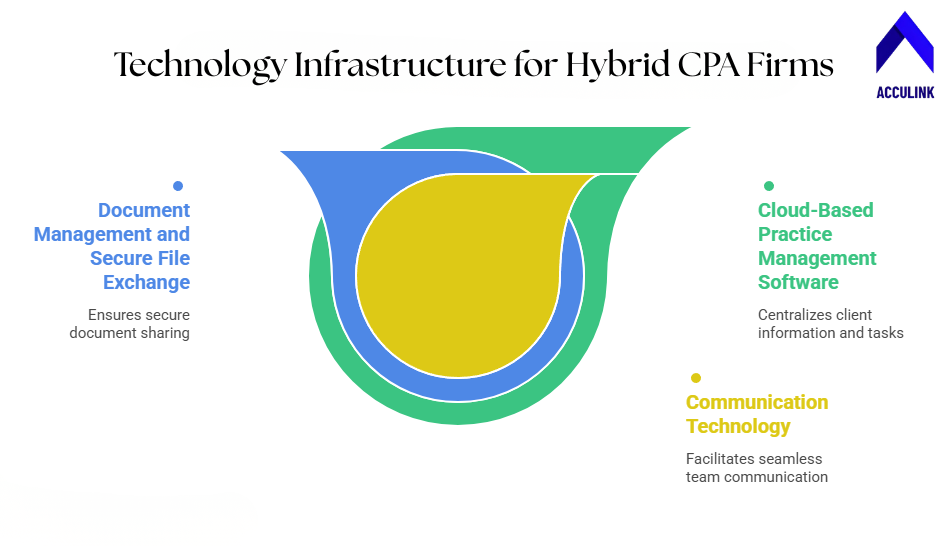
Common Mistakes CPA Firms Make When Scaling With Offshore Staff
Most failed offshore implementations fail for predictable reasons, not because the model is broken. The most common failure patterns:
1. Choosing freelancers or marketplaces instead of dedicated staff
Freelance tax preparers and bookkeeping marketplaces offer the lowest hourly rates, but they introduce turnover, inconsistent quality, weak security controls, and zero accountability. Dedicated offshore staff working under documented compliance frameworks deliver substantially better outcomes at modestly higher cost.
2. Skipping the review workflow design
Firms that drop offshore staff into a workflow without defining handoff points, review standards, and exception protocols see rework rates climb to 25%+. Firms that design the workflow first (defining what offshore prepares, what U.S. reviews, and what flags an exception) see rework drop below 5% by week 8.
3. Treating offshore staff as a cost centre, not a capability
The firms getting 70%+ cost savings are not the firms that get the best results. The best results go to firms that use offshore capacity to expand revenue: more tax returns, more CAS engagements, more advisory hours. Cost savings alone produce a marginal win. Capacity-driven revenue growth produces compounding value.
4. Not investing in onshore-offshore team culture
Offshore staff perform best when treated as part of the firm: included in team calls, rrecognisedfor good work, given visibility into firm priorities. Firms that hide their offshore team and treat them as anonymous production capacity see motivation, quality, and retention drop within months.
A Real-World Example: How a $1.8M Firm Doubled Capacity
A 12-person CPA firm in the Southeast U.S. came to Acculink in early 2025 with a familiar problem: they had a six-month hiring freeze on their senior staff search, partner billable hours over 2,200 per year, and a tax season backlog that pushed 30% of returns to extension. They were turning away CAS opportunities they wanted to accept because they had no production capacity.
The engagement started with two dedicated offshore staff: one IRS Enrolled Agent for tax preparation and one Acculink bookkeeper for write-up work. The 40-hour free trial validated quality and workflow fit in week one. By week four, both staff were fully integrated and delivering at production targets.
Twelve months later, the firm had added four more offshore staff (two tax preparers, one CAS associate, one audit support associate). Outcomes: 42% more tax returns prepared in the 2026 season, three new CAS engagements onboarded (adding $180,000 in annual recurring revenue), partner billable hours reduced from 2,200 to 1,650, and overall firm operating margin up 14 percentage points. Domestic headcount remained the same. The firm did not hire a single new U.S. accountant during that 12-month window.
Frequently Asked Questions
Are Acculink's offshore tax staff qualified to prepare U.S. tax returns?
Yes. Acculink's offshore tax preparation team includes IRS Enrolled Agents, Chartered Accountants with U.S. tax training, and tax preparers with 5–15 years of experience on forms 1040, 1041, 1065, 1120, and 1120-S. All work is reviewed and signed by your U.S. CPA staff, and Acculink follows IRS §7216 consent and disclosure protocols for every engagement.
How do offshore staff access our tax and accounting software securely?
Offshore staff access your software via secure remote login using role-based user accounts with restricted permissions. They cannot download or export client data. All access flows through your existing software (UltraTax, Drake, ProConnect, QuickBooks, Xero, etc.) and is logged at both the application and network level. Acculink's ISO 27001:2013 controls require monitored, work-from-office access only, no remote work, no personal devices, and no removable media.
Can offshore staff join client calls or attend client meetings?
Typically no. Client-facing communication is handled by U.S. CPA staff. Offshore team members operate in a production and preparation role under U.S. CPA supervision. Where firms want greater visibility, Acculink offers client-facing engagement models with longer time-zone overlap (6–7 hours), but most CPA firms prefer to keep client relationships entirely on the U.S. side.
What is the ramp-up time for offshore CPA staff?
For tax preparation, most Acculink staff are productive within 1–2 weeks once software access is established and work samples are reviewed. For bookkeeping and CAS work, full productivity typically takes 2–3 weeks because of client-specific chart-of-account learning. Audit support staff usually take 3–4 weeks because of engagement-specific procedures. The 40-hour free trial period lets firms validate fit before committing.
How does Acculink handle peak season capacity without quality degradation?
Acculink maintains a bench of trained tax and accounting professionals: 300+ qualified staff with 4,000+ in the extended professional network, who are allocated to CPA firm clients during peak periods. Staff assignments are managed at the engagement level, so your firm always has the same primary contact and the same primary preparers across a season. Surge capacity supplements your dedicated team rather than replacing it.
How much does it cost to hire offshore staff for a CPA firm?
All-inclusive pricing at Acculink ranges from $8 to $35 per hour, depending on role and seniority: $8–$15/hour for bookkeepers, $12–$25/hour for tax preparers, $15–$30/hour for staff accountants, and $25–$35/hour for senior tax reviewers and CFO-level professionals. There are no setup fees, no recruiting fees, and no long-term contracts. See engagement models and pricing for full details.
Related Acculink Resources
Continue your offshore staffing research with these in-depth Acculink guides on closely related topics:
· How CPA Firms Are Using Offshore Teams to Shift From Compliance to Advisory Services, the operational playbook for moving partner time off compliance work.
· The CPA Firm Staffing Crisis: Understanding the Accountant Shortage, the demographic and pipeline data behind the talent gap and what firms can actually do about it.
Conclusion: The Firms That Scale in 2026 Are the Ones That Use Offshore Staff Strategically
The CPA talent crisis is not ending. The AICPA pipeline data, the BLS hiring projections, and Accounting Today's coverage of firm hiring all point to a multi-year supply-demand gap. The firms that grow capacity, margins, and advisory revenue through this period will be the ones that have learned how to scale a CPA firm with offshore staff the right way: dedicated staff, documented security controls, well-designed review workflows, and a deliberate focus on freeing senior staff for higher-leverage work.
Tax season surge staffing, write-up and bookkeeping delegation, CAS capacity expansion, audit support, and advisory growth through back-office offloading: these are the five highest-leverage applications of offshore staffing for CPA firms, and they are proven across 80+ Acculink engagements. Acculink CPA makes the model accessible with all-inclusive pricing from $8–$35 per hour, a 40-hour free trial, candidate profiles in 5–7 business days, no setup fees, and no long-term contracts.
If your firm is hitting a hiring ceiling, a margin ceiling, or a capacity ceiling, or you simply want to stop pushing tax returns to extension, reach out to the Acculink team or schedule a 45-minute strategy call to design the right offshore augmentation plan for your firm.
References
1. AICPA: 2025 Trends Report: Accounting Graduates and CPA Exam Data
2. Journal of Accountancy: The Accounting Graduate Pipeline: Where Do Things Stand?
3. CPA.com & AICPA PCPS: 2024 CAS Benchmark Survey: 17% Growth
4. Bureau ofLabourr Statistics: Accountants and Auditors Occupational Outlook
5. IRS: Enrolled Agent Information
6. IRS: Section 7216 InformatioCentreer
7. IRS: Circular 230 Requirements for Tax Professionals
8. Accounting Today: Accounting Grad Numbers Continue to Decline
9. ISO: ISO/IEC 27001 Information Security Management Standard
10. Robert Half: 2026 Salary Guide for Accounting and Finance
• • •
About Acculink CPA
Acculink CPA is a premier offshore staffing and outsourcing company purpose-built for CPA firms, accounting firms, and tax firms in the United States, Canada, and the UAE. With 300+ qualified professionals across accounting, tax, audit, and advisory, and 4,000+ professionals in the extended network, Acculink serves 80+ accounting firms with dedicated offshore staff at $8–$35 per hour, all-inclusive.
Acculink is ISO 27001:2013 certified, SOC 2 Type II aligned, GDPR compliant, IRS §7216 compliant, and FTC Safeguards Rule aligned, with zero security breaches across 5+ years of operations. The team includes CPAs, Enrolled Agents, and Chartered Accountants with Big 4 and top-25 firm backgrounds (Deloitte, PwC, EY, KPMG, RSM, BDO, Grant Thornton, and others), proficient in CCH Axcess, UltraTax CS, Lacerte, Drake, QuickBooks, Xero, and Sage.
Website: acculinkcpa.com · Schedule: calendly.com/acculinkcpa/45min
Email: Info@acculinkcpa.com · Phone: +1 (203) 997-0224
LinkedIn: linkedin.com/company/acculinkcpa
• • •
© 2026 Acculink CPA · All Rights Reserved · T.R.U.S.T., Transparency · Reliability · Understanding · Security · Teamwork
Tags:
About the Author

Related Posts

Accounting Outsourcing Services for CPA & Accounting Firms – Why Outsourcing Works
Accounting outsourcing lets CPA firms add capacity without adding headcount. Why outsourced accounting service…
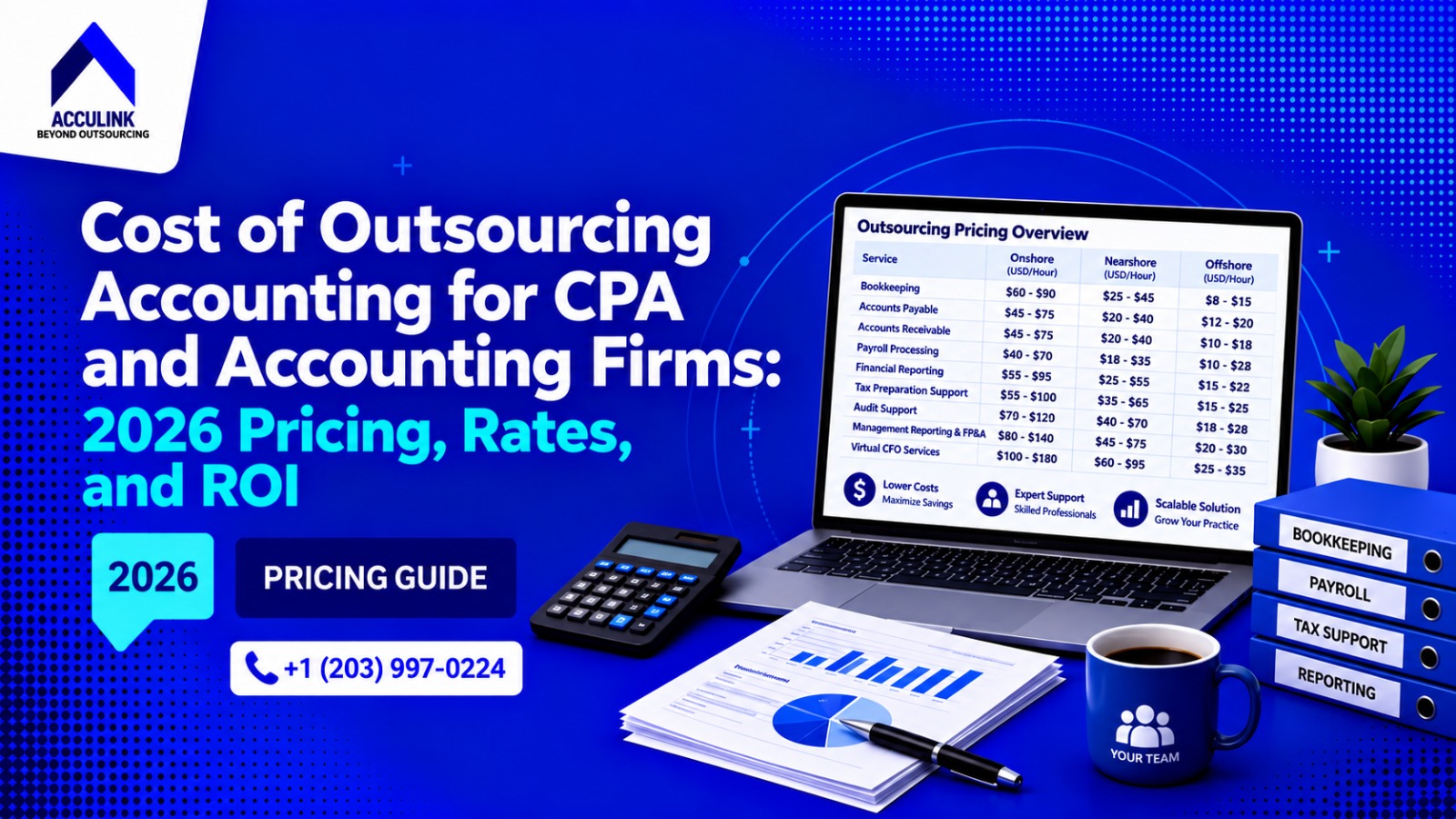
Cost of Outsourcing Accounting for CPA and Accounting Firms: 2026 Pricing, Rates, and ROI
The cost to outsource accounting typically ranges from $8 to $35 per hour, depending on the service, experienc…
15 Profitable Add-On Services CPA and Accounting Firms Can Offer Without Hiring In-House
CPA and accounting firms do not need to build every new service with another in-house hire. This guide compare…