Payroll Outsourcing Cost for CPA and Accounting Firms: Pricing, Models, and ROI

Summary
This guide explains what it costs a CPA or accounting firm to outsource payroll, how pricing models differ, which fees change the total, and how to calculate cost per client, margin, break-even pricing, and ROI.
The cost to outsource payroll depends on the pricing model, service scope, client count, employee count, pay frequency, jurisdictions, software, and review required. Public U.S. payroll pricing can range from a base fee plus a per-employee charge to hourly, per-pay-run, fixed monthly, or percentage-based pricing. Acculink's payroll outsourcing services use all-inclusive, role-based pricing of $8 to $35 per hour for CPA and accounting firms.
For a CPA firm, the useful number is not the provider's headline rate. It is the total delivered cost per client after software, filings, year-end work, corrections, internal review, and exceptions are included. This guide shows how to calculate that number and compare payroll outsourcing quotes on equal terms.
Key Takeaways
- The provider's headline price is not the firm's total cost. Software, setup, filings, year-end work, corrections, internal review, and exceptions must be included before comparing quotes.
- Public payroll pricing commonly uses base-plus-employee, per-employee-per-month, per-pay-run, hourly, dedicated-resource, or fixed managed-service models. A PEO is a separate model and should not be priced as ordinary payroll processing.
- Acculink's pricing is $8 to $35 per hour, all-inclusive and role-based. Firms can use a managed payroll outsourcing service or hire a payroll expert who works within the firm's process.
- A CPA firm should calculate cost per client, cost per pay run, gross profit per client, and gross margin before choosing a provider.
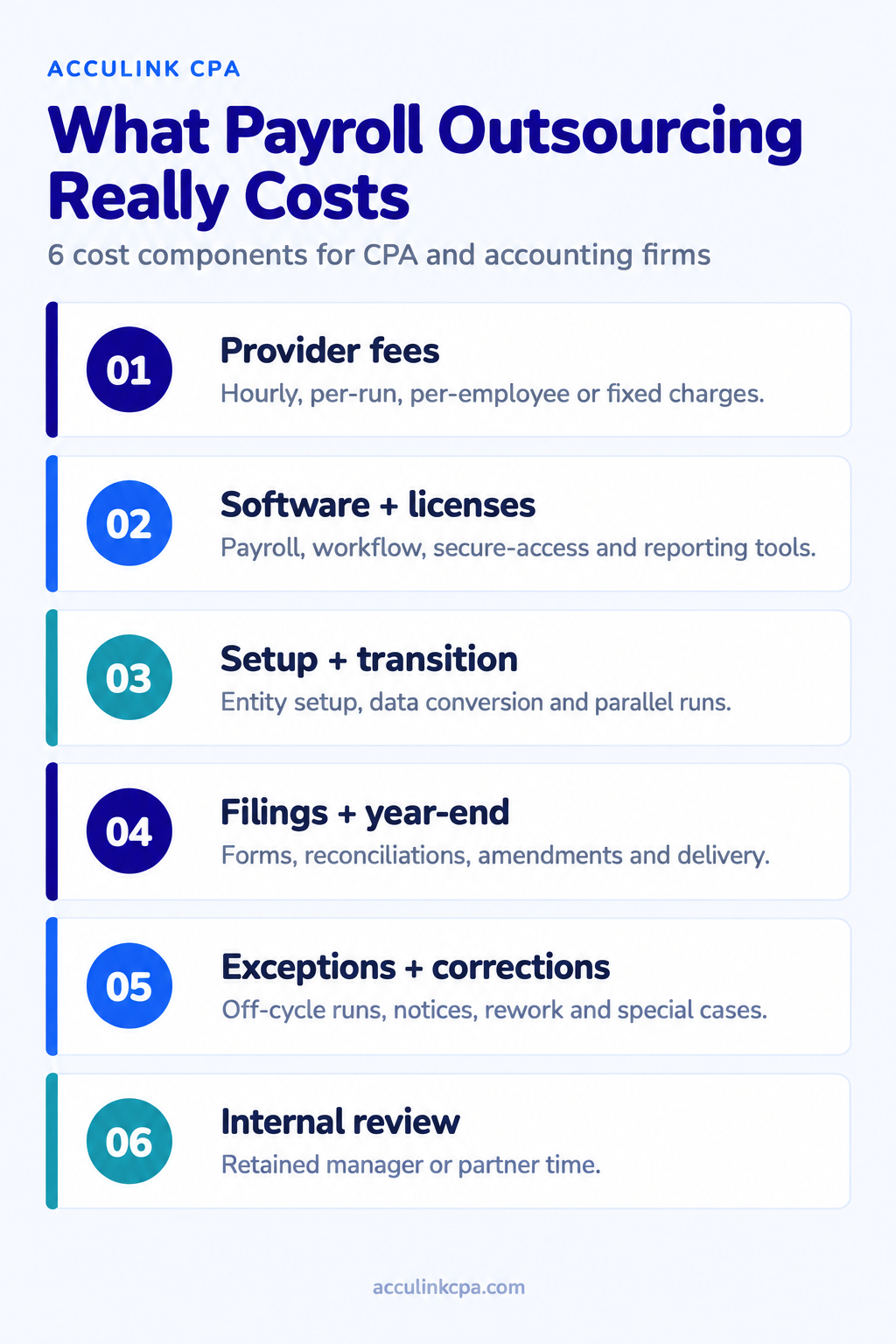
- The most commonly missed costs are implementation, software, minimum commitments, extra states, year-end forms, off-cycle runs, corrections, notices, internal review time, and parallel-run effort.
- Outsourcing payroll does not automatically transfer the employer's federal employment-tax responsibility. The agreement, authorization, and third-party payer type determine who can do what.
How Much Does It Cost to Outsource Payroll?
There is no single payroll outsourcing price because vendors sell different services under the same label. What payroll services cost depends on the work included, the billing unit, and the complexity of the client portfolio. Payroll outsourcing for CPA firms may cover dozens of entities, calendars, platforms, and approval paths, so portfolio complexity matters as much as employee count.
Xero's U.S. payroll outsourcing guide gives a broad public market range of $20 to $200 per employee per month. It also identifies common structures of $30 to $150 as a base fee plus $4 to $15 per employee, $20 to $50 per employee for basic services, or 2% to 10% of gross payroll. These are broad employer-market benchmarks, not CPA-firm wholesale rates, and scope can differ materially.
ADP's payroll outsourcing guide notes that providers may combine a per-payroll fee with an annual base fee. Others charge hourly, per client, per employee, per run, or through a fixed monthly commitment.
For CPA and accounting firms, the cost of payroll services becomes useful only when every quote is converted to the same workload. Four numbers matter more than a market average:
- Total monthly cost: All recurring and allocated delivery fees.
- Cost per client: Monthly delivery cost divided by active clients.
- Cost per pay run: Monthly delivery cost divided by completed runs.
- Gross margin: Client revenue minus delivery cost, divided by client revenue.
Payroll Service Pricing and Outsourcing Models Compared
The pricing unit changes both the invoice and the risk carried by the CPA firm. A payroll service cost comparison must therefore use both price and scope. A low unit price can be expensive when the agreement excludes frequent work. A higher fixed price can be economical when it includes review, corrections, and backup coverage.
| Pricing model | How the provider charges | Best fit for a CPA or accounting firm | Main item to verify |
|---|---|---|---|
| Hourly, role-based | Hours used multiplied by the assigned role's rate | Variable volume, seasonal demand, mixed-complexity work | What is included in the rate and how time is approved |
| Dedicated resource | Monthly or hourly charge for an assigned professional | Stable recurring workload that can fill a part-time or full-time role | Productive hours, backup coverage, supervision, and leave |
| Base plus per employee | Monthly platform or service base plus a fee for each employee | Standardized client payrolls on one platform | Minimums, extra pay runs, states, and year-end forms |
| Per client or per pay run | Set fee for each entity or completed payroll cycle | Firms with predictable client counts and clear scope | Employee limits, frequency, exceptions, and corrections |
| Fixed managed service | One monthly fee for an agreed function and volume band | Firms that want predictable spending and provider-managed capacity | Volume bands, exclusions, service levels, and overage rates |
| Percentage of payroll | Fee based on gross payroll, often within broader PEO or HR arrangements | Employers seeking bundled payroll, HR, and benefits administration | Whether the quote is a PEO, CPEO, or ordinary payroll service |
Choose the operating model before comparing providers. The payroll outsourcing companies guide separates processing partners, platforms, and PEOs. Hourly pricing fits variable demand, while a dedicated offshore payroll team fits stable recurring work. Base-plus-employee and per-run pricing suit standardized scope. Compare PEO pricing separately because it may include HR, benefits, workers' compensation, or co-employment.
What should you charge for payroll?
Get an editable calculator for payroll cost per client, retained review time, and target margin.
Acculink Payroll Outsourcing Cost at Different Capacity Levels
Acculink payroll outsourcing pricing is $8 to $35 per hour, all-inclusive and role-based.
The following table converts the published hourly band into simple capacity references. It is arithmetic based on the ends of the range, not a quote. The actual rate depends on the role and experience required.
| Monthly capacity | Cost at $8 per hour | Cost at $35 per hour | Annual range at the same hours |
|---|---|---|---|
| 40 hours | $320 | $1,400 | $3,840 to $16,800 |
| 80 hours | $640 | $2,800 | $7,680 to $33,600 |
| 160 hours | $1,280 | $5,600 | $15,360 to $67,200 |
The benefit of role-based pricing is that a firm can align work with the appropriate level. Payroll setup, routine processing, reconciliations, multi-state filings, exception research, and management do not require the same experience. A proposal should show the expected role mix instead of applying one blended label to all work.
Acculink's engagement models let a firm choose dedicated payroll capacity or functional delivery. This makes it possible to compare a standing team with a flexible volume-based model using the same workload.
What Changes Payroll Outsourcing Cost for an Accounting Firm?
Two firms with the same employee count can receive different quotes because headcount is only one cost driver.
| Cost driver | Why it changes the price |
|---|---|
| Client entities | Each entity can add setup, calendars, bank authorization, tax accounts, reconciliations, approvals, and forms. |
| Pay frequency | Weekly payroll creates more runs and cutoffs than semimonthly or monthly payroll. |
| Employees and contractors | Volume affects data maintenance, deductions, garnishments, direct deposits, W-2s, and 1099 work. |
| States and localities | More jurisdictions can add registrations, tax accounts, filings, reciprocity issues, and notices. |
| Software and integrations | Timekeeping, benefits, general-ledger, HR, and banking connections require setup and support. |
| Service scope | Calculation-only work costs less than filing, deposits, journals, reconciliation, notices, and year-end support. |
| Review requirements | Preparer-reviewer separation, approval, exception logs, and sign-off add controlled work. |
| Data quality | Missing authorizations, unreconciled liabilities, and incomplete filings increase transition effort. |
| Service levels | Same-day changes, client contact, U.S. overlap, and urgent off-cycle payroll require capacity. |
| Continuity | Backup coverage and quarter-end or year-end capacity may be included or priced separately. |
Hidden Payroll Outsourcing Costs to Put in the Quote
Payroll processing fees are not always the same as total payroll processing costs. A proposal can look inexpensive because the charge that appears on page one does not include the complete workflow. Ask the provider to mark every item as included, excluded, pass-through, or priced separately.
| Potential cost | Questions to ask |
|---|---|
| Setup and implementation | Is entity setup, employee conversion, tax-account validation, and opening-balance review included? |
| Software and licenses | Who owns and pays for payroll, workflow, secure-access, and reporting licenses? |
| Minimum commitment | Is there a monthly minimum, seat minimum, annual contract, or unused-capacity charge? |
| Additional jurisdictions | Are state and local setup, registrations, filings, and notices separate? |
| Extra and off-cycle runs | How are bonuses, terminations, corrections, and emergency payrolls billed? |
| Quarter-end and year-end | Are Forms 941, 940, W-2, W-3, 1099, reconciliation, amendments, and distribution included? |
| Corrections and rework | Who pays when source data, the firm, or the provider causes an error? |
| Notices | Does the fee include research, reconciliation, draft responses, calls, and amended filings? |
| Banking and delivery | Are direct-deposit, check, courier, or wire charges passed through? |
| Custom reporting | Are client-specific registers, department reports, journals, and integrations included? |
| Internal review | How many partner, manager, or payroll-lead hours will the firm retain? |
| Parallel run | Is test processing during transition included or added to the first invoice? |
| Backup and turnover | Is named backup coverage included? What happens when the assigned person changes? |
| Exit and data return | Are offboarding, data exports, access removal, and transition support included? |
Hidden fees are not always improper. Some work is genuinely outside the standard scope. The problem is discovering that distinction after the payroll calendar is live. Acculink's published, all-inclusive role-based rate reduces initial pricing uncertainty, while a written scope still ensures that both sides understand the workload and responsibilities.
How to Compare Payroll Outsourcing Quotes on Equal Terms
Normalize every proposal to one representative monthly workload. Give each provider the same client count, employee count, pay frequencies, jurisdictions, platforms, filing scope, service levels, and expected exceptions.
Use this formula:
Normalized monthly payroll cost = recurring provider fees + pay-run fees + employee fees + state and local fees + allocated setup + allocated year-end work + software + expected exception fees + internal review cost
Where:
- Allocated setup is one-time implementation cost divided across the period the firm uses for comparison.
- Allocated year-end work is the expected annual form, reconciliation, and distribution cost divided by 12.
- Expected exception fees include a realistic allowance for off-cycle runs, corrections, notices, amendments, and unusual client events.
- Internal review cost is the firm's retained review hours multiplied by the loaded hourly cost of the reviewer.
Then calculate:
Cost per client = normalized monthly payroll cost / active payroll clients
Cost per pay run = normalized monthly payroll cost / completed pay runs
Payroll cost per employee = normalized monthly payroll cost / employees paid
All three unit costs are useful. Cost per client supports pricing decisions. Cost per pay run exposes the effect of frequency. Cost per employee helps compare platform-style proposals.
How CPA Firms Calculate Payroll Margin and Break-Even Pricing
An outsourced payroll service can produce revenue and deepen the client relationship, but volume alone does not create profit. The firm needs a margin model that includes retained work.
Gross profit per client
Gross profit per client = client payroll fee - outsourced production cost - software allocation - internal review cost - exception allowance
Gross margin percentage
Gross margin % = gross profit per client / client payroll fee x 100
Required client fee for a target margin
Required client fee = total delivery cost per client / (1 - target gross margin)
For example, if total delivery cost is $131 per client and the target gross margin is 50%, the required fee is $262. A $225 client fee would produce $94 of gross profit and a 41.8% margin after rounding, not the target 50%.
This example is illustrative. It is not an Acculink quote or a market benchmark. The purpose is to show why firms should price from total delivery cost rather than marking up only the provider's invoice.
Firms offering payroll behind their own brand should also review the commercial and control considerations in the white-label accounting guide.
Payroll Outsourcing Cost Versus an In-House Payroll Employee
The May 2025 national wage data from the U.S. Bureau of Labor Statistics lists a mean wage of $28.67 per hour and $59,630 per year for payroll and timekeeping clerks. Wage is only the starting point for an in-house cost comparison.
The distinction matters. BLS employer-cost data for June 2026 shows that private-industry employers paid an average of $32.82 per hour in wages and $14.07 in benefits, for total compensation of $46.89 per hour. This is an economy-wide average, not a payroll-clerk cost estimate, but it demonstrates why salary alone understates the cost of an employee.
An in-house calculation should add payroll taxes, benefits, recruiting, equipment, software, management time, training, turnover, and absence coverage. An outsourced calculation should add setup, software, internal review, exceptions, and any excluded services.
Do not compare an offshore production rate with a U.S. wage unless the responsibilities, experience, review, software, backup, and productive capacity are equivalent. Outsourcing often fits repeatable work and variable capacity. An internal hire can fit continuous client contact, firm-specific judgment, or a consistently full workload.
A Practical CPA-Firm Payroll Cost Example
Assume an accounting firm charges one client $250 per month for payroll. Its delivery model includes the following illustrative monthly costs:
| Cost component | Illustrative amount |
|---|---|
| Outsourced production allocation | $75 |
| Payroll software allocation | $20 |
| Internal review, 0.4 hours at $65 | $26 |
| Exception and correction allowance | $10 |
| Total delivery cost | $131 |
| Gross profit | $119 |
| Gross margin | 47.6% |
The provider's $75 production cost is only 30% of client revenue, but the true delivery cost is 52.4% once software, review, and exceptions are included. If the firm's target margin is 50%, it needs to raise the monthly fee to $262 or reduce total delivery cost to $125.
Repeat the calculation for different client types. A simple monthly payroll, a weekly multi-state payroll, and a restaurant client with tips and variable schedules should not share one cost assumption.
Talk through your client volume, software, and workflow to find the right payroll support model.
See what payroll capacity could cost your firm.
Does Payroll Outsourcing Transfer Tax Responsibility?
Usually, no. The IRS guidance on outsourcing payroll and third-party payers explains that employers using an ordinary payroll service provider remain responsible for federal employment-tax deposits and timely returns if the provider defaults. Reporting agents, Section 3504 agents, and certified professional employer organizations can have different authority and liability structures.
IRS Publication 15 for 2026 explains employer responsibilities for withholding, depositing, reporting, paying, and correcting employment taxes. It also describes third-party payer arrangements. The service agreement and IRS authorization forms should match the work performed.
Cost comparisons should include the controls needed to define preparation, review, approval, filing, and funding. Employers should monitor federal deposits through EFTPS, reconcile payroll liabilities and deposits, retain confirmations, and define notice and correction procedures.
The IRS failure-to-deposit guidance applies graduated rates based on how late a required deposit is, with penalty rates ranging from 2% to 15%. A cheap service that lacks timely deposit controls can create a much larger cost than its invoice.
Payroll recordkeeping also remains important. The U.S. Department of Labor's FLSA recordkeeping guidance says covered employers must keep specified records for nonexempt workers and preserve payroll records for at least three years.
What to Ask Before Accepting a Payroll Outsourcing Quote
Use one written workload and require each provider to answer the same questions.
- Which entities, employees, pay frequencies, states, and localities does the quote cover?
- What billing unit, minimum commitment, setup fee, and contract term apply?
- Which tasks are included from employee setup through year-end reconciliation?
- Who prepares, reviews, approves, files, funds, and handles notices?
- Are software, integrations, secure access, and workflow tools included?
- How are extra states, off-cycle runs, amendments, corrections, and notices billed?
- What work remains with the firm's manager, partner, or client contact?
- Who covers absence, turnover, quarter-end, year-end, and volume spikes?
- What security evidence, access controls, and incident procedures apply?
- Can the provider price a representative pilot and compare estimated hours with actual output?
The firm's vendor due-diligence checklist should cover background, workforce, controls, references, insurance, and service levels. During onboarding, use the accounting outsourcing process to establish scope, access, review, sign-off, and a representative pilot before expanding.
Why CPA and Accounting Firms Choose Acculink
Payroll services for accountants need to support multiple client entities, calendars, approval paths, and software environments. Acculink CPA is built specifically for U.S. CPA and accounting firms, with payroll delivery designed around those requirements rather than a single-employer payroll purchase.
Acculink payroll pricing: $8 to $35 per hour, all-inclusive and role-based.
- Two delivery options: Firms can use managed payroll outsourcing services or hire a payroll expert who works within the firm's procedures.
- Flexible capacity: Firms can use full-time, part-time, or on-demand support through the relevant engagement model.
- Existing-software delivery: Acculink works across ADP, Gusto, Paychex, QuickBooks Payroll, and other systems used by accounting-firm clients.
- Two-tier review: A preparer completes the work and a senior reviewer checks it before delivery to the CPA firm.
- Documented security: Acculink's security controls are supported by SOC 2 Type II and ISO/IEC 27001 evidence. Acculink has maintained a five-year breach-free record.
- Delivery capacity: Acculink has 300+ qualified professionals supporting 80+ U.S. accounting firms.
For a firm comparing payroll outsourcing costs, the advantage is visibility. The published hourly band can be converted into capacity, cost per client, and target margin before a sales conversation or pilot. Combined with multi-client specialization, flexible delivery, existing-software support, two-tier review, and documented security, that transparency makes Acculink particularly well suited to firms that want to retain client control while adding payroll capacity. Price still needs to be matched to the exact role mix and responsibility matrix.
Frequently Asked Questions
How much does payroll outsourcing cost?
Payroll outsourcing may be priced hourly, per employee, per run, per client, per dedicated resource, monthly, or as a percentage of payroll. CPA firms should compare total cost for their actual multi-client workload.
What does Acculink charge for payroll outsourcing?
Acculink charges $8 to $35 per hour for all-inclusive, role-based payroll support. The rate depends on the role and experience required.
What is the cheapest payroll outsourcing pricing model?
There is no universally cheapest model. The right answer is the model with the lowest normalized total cost for the required scope, volume, and controls.
How should a CPA firm calculate payroll outsourcing cost per client?
Add provider fees, software, allocated setup, year-end work, exceptions, and internal review. Divide that monthly total by active payroll clients.
What payroll outsourcing fees are commonly excluded?
Common exclusions include implementation, extra jurisdictions, year-end forms, off-cycle runs, corrections, notices, bank charges, integrations, and transition support.
Is payroll outsourcing cheaper than hiring an employee?
It can be when a firm needs flexible capacity. Compare the employee's fully loaded cost with the complete provider fee plus retained internal review for equivalent work.
What is a good gross margin for outsourced payroll services?
There is no universal target. Calculate gross margin from all direct delivery costs, then set the target based on overhead, risk, software, and partner involvement.
Does outsourcing payroll transfer payroll-tax liability?
Not automatically. An employer using an ordinary payroll service provider generally remains responsible for federal employment-tax obligations. Other third-party payer arrangements can differ.
Should a CPA firm choose per-employee or hourly payroll pricing?
Per-employee pricing fits standardized work with stable headcount. Hourly pricing fits variable volume, mixed systems, exceptions, and several skill levels.
How can an accounting firm reduce payroll outsourcing cost without weakening quality?
Standardize onboarding, group clients by complexity, clean source data, document cutoffs, use consistent workpapers, and assign routine work to the right role.
The Bottom Line
Payroll outsourcing cost is not one rate. It is the combined cost of production, software, filings, year-end work, corrections, internal review, exceptions, and control. Payroll outsourcing for accounting firms works best when each quote is normalized, cost per client and pay run is calculated, the target margin is tested, and responsibilities are verified before choosing a provider.
Acculink gives CPA and accounting firms a clear starting point with all-inclusive, role-based pricing of $8 to $35 per hour, managed or dedicated delivery, existing-software support, two-tier review, documented security controls, and established accounting-firm capacity. That transparency makes it easier to model the economics before moving a client portfolio.
Flexible payroll support from $8 to $35 per hour.
Build payroll capacity with clear costs.
Tags:
About the Author

Related Posts
Top 10 Payroll Outsourcing Companies for CPA and Accounting Firms (2026)
This guide compares ten payroll outsourcing companies for U.S. CPA and accounting firms. It separates processi…
Top 10 Offshore Staffing Companies for Accounting Firms (2026)
Hiring an offshore team is one of the highest-leverage moves a short-staffed CPA firm can make, but the partne…
Top Outsourced Accounting Firms for CPA Practices (2026)
Choosing an outsourced accounting partner is a high-stakes call because the team touches your clients' data. T…