Form 5500 Due Dates for 2027: Filing Deadlines, Extensions and 401(k) Audit Planning for CPA and Accounting Firms


Summary
Calendar-year 2026 Form 5500 filings are due August 2, 2027, or October 15, 2027 with a timely Form 5558 extension. This guide gives CPA and accounting firms a due-date table, extension rules, a 401(k) audit timeline, late-filing guidance and a checklist for planning internal or outsourced preparation capacity.
The quick answer: The Form 5500 due date is generally the last day of the seventh month after the plan year ends. For a calendar-year plan ending December 31, 2026, the ordinary deadline falls on Saturday, July 31, 2027, so the filing deadline moves to Monday, August 2, 2027. A timely and valid Form 5558 generally extends that filing deadline to Friday, October 15, 2027.
When a plan filing Schedule H must include an independent qualified public accountant's report, that report is generally attached to the Form 5500 filing. That makes the filing date the practical outside 401(k) audit deadline as well. An extension adds filing time; it does not remove the audit requirement, make incomplete evidence sufficient or create reviewer capacity.
For CPA and accounting firms, the real planning question is therefore not only, "When is Form 5500 due?" It is, "What must be ready, reviewed and resolved before that date across every plan in the portfolio?"
Key takeaways
- Calendar-year 2026 plans are due August 2, 2027. July 31 falls on a Saturday, so the ordinary deadline moves to the next business day.
- The standard extended deadline is October 15, 2027. Form 5558 must generally be filed on or before the ordinary deadline to obtain the one-time extension.
- A required audit report is generally part of the filing package. The audit does not have a universally later deadline separate from Form 5500.
- Not every Form 5500 filing needs an audit. Plan type, filing status, participant count, prior filing category and exemptions must be assessed separately.
- The statutory date should be the last date in the workflow, not the first date on the project plan. Set earlier PBC, preparation, manager review, partner review and filing-readiness dates.
- Q4 2026 work and 2027 planning compete for the same capacity. Clear current backlogs without sacrificing the preparation and review time needed for the next EBP cycle.
- Capacity should follow the deadline cohort. If several plans will enter preparation or review together, define outside support before the bottleneck reaches the partner.
Planning 2027 EBP audit capacity? Acculink publishes role-based pricing of $8 to $35 per hour for offshore professionals and offers both defined 401(k) audit support and a dedicated auditor hiring model. The useful comparison is the cost of review-ready work within your firm's methodology, including supervision and rework, not the hourly rate alone.
2027 Form 5500 due dates at a glance
The following dates cover four common plan year-ends. They apply the general seven-month filing rule and the standard Form 5558 extension. Dates that fall on a Saturday, Sunday or legal holiday move to the next day that is not one of those days. The month-by-month rule and weekend/holiday treatment appear in the IRS Form 5500 filing due-date chart.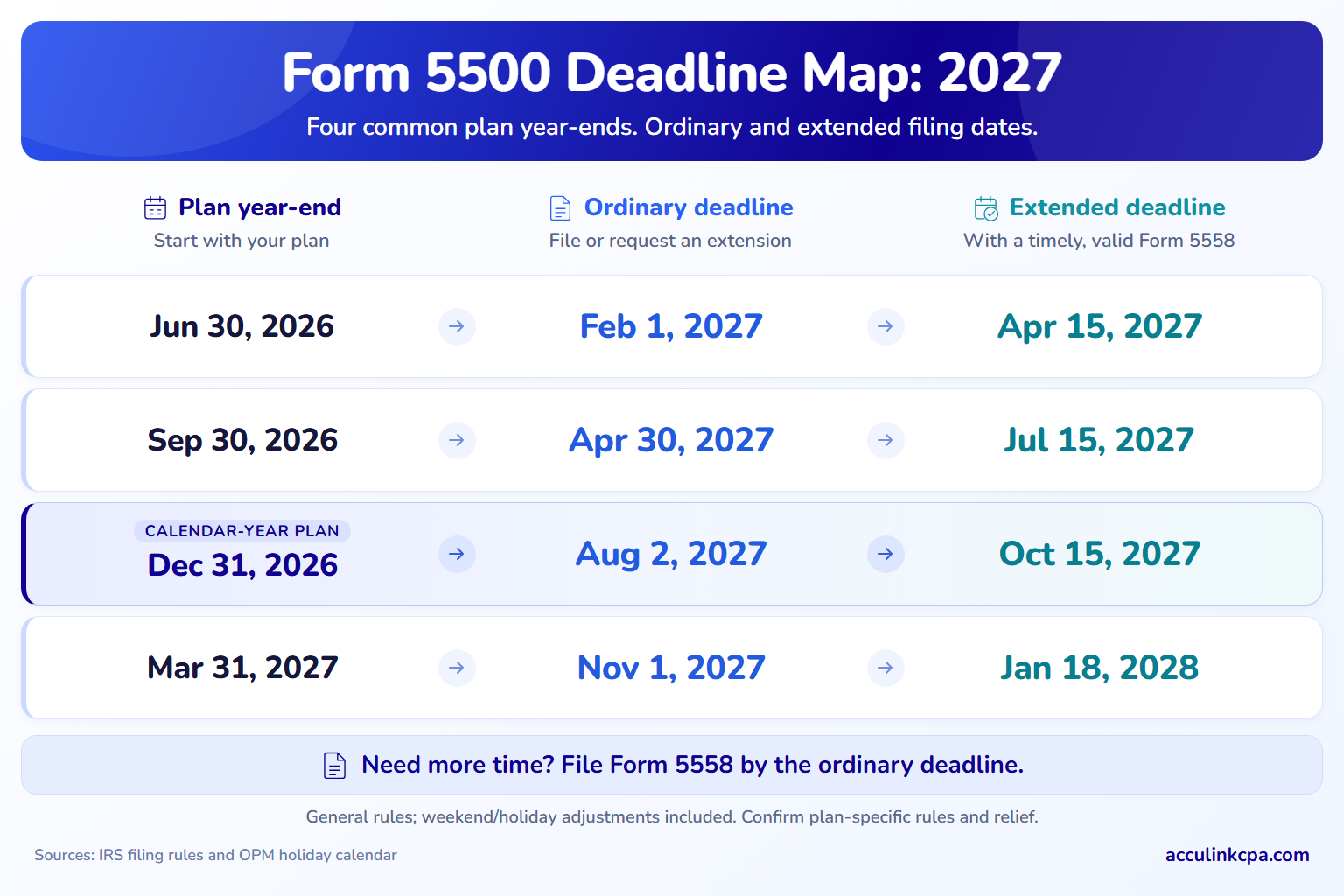
| Filing deadline | Plan year-end | Filing status | What should be ready if an audit is required |
|---|---|---|---|
| February 1, 2027 | June 30, 2026 | Ordinary deadline, moved from Sunday, January 31 | Final audit report and complete Form 5500 filing package |
| April 15, 2027 | June 30, 2026 | Extended deadline after a timely, valid Form 5558 | Final audit report and extended filing package |
| April 30, 2027 | September 30, 2026 | Ordinary deadline | Final audit report and complete Form 5500 filing package |
| July 15, 2027 | September 30, 2026 | Extended deadline after a timely, valid Form 5558 | Final audit report and extended filing package |
| August 2, 2027 | December 31, 2026 | Ordinary deadline, moved from Saturday, July 31 | Final audit report and complete Form 5500 filing package |
| October 15, 2027 | December 31, 2026 | Extended deadline after a timely, valid Form 5558 | Final audit report and extended filing package |
| November 1, 2027 | March 31, 2027 | Ordinary deadline, moved from Sunday, October 31 | Final audit report and complete Form 5500 filing package |
| January 18, 2028 | March 31, 2027 | Extended deadline, moved from Saturday, January 15; Monday, January 17 is a legal holiday | Final audit report and extended filing package |
Use this table as a planning aid, not as the sole filing determination. Short plan years, plan termination, direct filing entities, one-participant plans, special relief and other facts can change the form, supporting schedules or deadline. Confirm the applicable plan-year instructions and any current IRS or DOL relief before filing.
For the governing rule and current filing resources, use the IRS Form 5500 Corner and the Department of Labor Form 5500 Series page.
Keep every plan deadline in one place.
Get an editable tracker for filing dates, extension confirmations, PBC progress and review milestones.
Why the October-December 2026 window matters
The 2027 EBP schedule does not begin in January. For calendar-year 2025 plans with a timely Form 5558 extension, October 15, 2026 is the extended Form 5500 filing deadline. Other audit and reporting deadlines also fall across the final quarter, although they arise under different rules and may involve private funds, broker-dealers or SEC issuers rather than employee benefit plans.
Those obligations should not be combined into one filing calendar or treated as the same service. They can, however, compete for the same preparers, managers and partners inside a CPA or accounting firm. A Q4 workpaper backlog can consume the people who should be closing prior engagements, confirming 2027 EBP requirements and issuing early PBC requests.
Use the October-December window to make four decisions:
- separate missing client records from work that is ready to prepare;
- reserve qualified reviewer time for the current deadline cohort;
- package repeatable preparation, reconciliation and documentation tasks that can be assigned under the firm's supervision; and
- decide whether the next cycle needs short-term project support or recurring dedicated capacity.
Only assign work that fits the engagement, applicable standards and the demonstrated competence of the proposed professional. Do not infer private-fund, broker-dealer or SEC audit capability from general audit experience.
Already carrying a Q4 audit backlog? Acculink offers defined audit-support capacity and dedicated offshore auditors at published role-based rates of $8 to $35 per hour. Discuss the current backlog and the 2027 preparation plan using nonconfidential workload details.
How to calculate a Form 5500 filing deadline
The basic calculation is simple. The facts around it may not be.
- Identify the actual plan year-end. Do not assume every client uses December 31. Confirm the period on the plan document, prior filing and current engagement records.
- Count to the last day of the seventh month after year-end. That is the ordinary Form 5500 filing deadline for most filers.
- Check weekends, federal holidays and applicable relief. A weekend or legal-holiday filing date generally moves to the next business day. Disaster relief can affect particular filers or locations.
- If more time is needed, file Form 5558 by the ordinary deadline. A qualifying request can provide a one-time extension of up to two and one-half months.
- Build the audit and review dates backward. If an audit report must accompany the filing, the audit team needs a materially earlier completion target.
Example 1: calendar-year plan ending December 31, 2026
Seven months after year-end leads to July 31, 2027. Because that date is a Saturday, the ordinary filing deadline moves to Monday, August 2, 2027. The standard extended deadline is October 15, 2027 when a valid Form 5558 is filed on time.
Example 2: plan ending September 30, 2026
The ordinary deadline is April 30, 2027. The standard extended due date is July 15, 2027. A firm with both September and December year-end plans should not treat these as unrelated jobs: the July 15 completion cycle can consume the same managers needed to prepare the larger August 2 calendar-year cohort.
Example 3: plan ending March 31, 2027
The calculated ordinary due date is October 31, 2027. Because that date is a Sunday, the filing deadline moves to Monday, November 1, 2027. The standard Form 5558 extension date is January 15, 2028. Because January 15 is a Saturday and the following Monday is a legal holiday, the adjusted extended deadline is Tuesday, January 18, 2028. Confirm current instructions and any plan-specific relief before filing.
Is the 401(k) audit deadline different from the Form 5500 deadline?
Usually, there is no separate federal date that lets a required 401(k) audit finish after Form 5500 is due. For a plan filing Schedule H that must include an independent qualified public accountant's report, the report is generally attached to the Form 5500 filing. The audit therefore needs to be complete before the plan's ordinary or validly extended filing date.
That does not mean the plan administrator and auditor have the same responsibilities:
| Party | Typical deadline responsibility |
|---|---|
| Plan administrator or sponsor | Determines and satisfies the filing obligation, supplies complete records, authorizes the filing and retains its plan responsibilities |
| TPA, recordkeeper, trustee or custodian | Supplies assigned plan, participant, filing, investment or certification information according to its role |
| Independent CPA firm | Plans and performs the audit, evaluates evidence and issues its report when required |
| Outside audit support team | Performs only defined preparation or support work under the responsible firm's direction and review |
The deadline belongs on a shared schedule, but ownership should not become blurred. An offshore provider does not become the plan administrator or signing auditor merely because it prepares reconciliations, workpapers or draft schedules.
Does every Form 5500 need an audit report?
No. Filing Form 5500 does not automatically mean an independent audit is required. Many ERISA-covered plans filing as large plans need an audit, while eligible small plans may qualify for an audit waiver. Form 5500-SF and Form 5500-EZ have separate eligibility and filing considerations.
For defined contribution plans, current small-plan counting generally focuses on participants with account balances rather than total employee headcount. The 80-120 participant rule may also allow an eligible plan to remain in the prior filing category. These are screening points, not a universal decision tree.
Use Acculink's detailed guide to 401(k) audit requirements for the threshold, 80-120 rule, small-plan waiver conditions and special situations. For other plan types, see the broader employee benefit plan audit guide. Keeping those decisions in their own resources prevents a deadline article from oversimplifying a plan-specific audit determination.
The practical sequence is:
- identify the correct filer and form;
- determine whether an audit report is required;
- establish the ordinary and possible extended deadlines;
- confirm the audit scope and reporting framework; and
- schedule records, preparation and review backward from the filing date.
How the Form 5558 extension works
Form 5558 is the extension form used for Form 5500, Form 5500-SF, Form 5500-EZ and Form 8955-SSA. It can provide a one-time extension of up to two and one-half months when the applicable requirements are met.
Beginning January 1, 2025, the IRS states that Form 5558 may be filed electronically through EFAST2 or on paper with the IRS. Form 5500 and Form 5500-SF themselves must be filed electronically through EFAST2. Follow the current Form 5558 instructions, because the filing method and form details should not be inferred from last year's process.
Use a separate Form 5558 for each plan. The same form may request extensions for that plan's Form 5500 series filing and Form 8955-SSA, and a signature is not required for those extension requests. Match the plan name, EIN, plan number and plan year-end to the eventual return; a mismatch can delay or prevent processing.
Form 5558 deadline
The extension request generally must be filed on or before the normal due date of the return or report. For a calendar-year 2026 plan, that means the request should be filed no later than August 2, 2027, after applying the weekend rule to the July 31 date.
Do not treat an internal note saying "extend" as evidence that the extension was filed. Retain the submitted form, confirmation or other appropriate evidence with the deadline record. If the request was rejected or not received on time, the IRS may treat a filing after the ordinary due date as late.
The instructions also describe an automatic extension tied to the employer's federal income tax return. It applies when the plan year and employer tax year are the same and the IRS has granted the employer a tax-return extension to a date later than the normal Form 5500 due date. When both conditions are met, the Form 5500 deadline moves to the employer's extended federal income tax return due date without a Form 5558. A parallel rule may apply to an eligible tax-exempt sponsor with an approved Form 990-series extension. Do not assume either route applies, and do not try to combine it with Form 5558 to obtain more time. Confirm the plan's facts and the current instructions.
What the extension does not do
A Form 5500 extension:
- does not eliminate a required employee benefit plan audit;
- does not make missing records or unresolved exceptions acceptable;
- does not extend every other plan, tax or regulatory deadline;
- does not transfer filing responsibility to the auditor or support provider; and
- does not guarantee that the filing will pass EFAST2 validation or later government checks.
An extension can be a legitimate scheduling tool, but it should not be the firm's only capacity plan. If every engagement moves to October 15, the firm has moved the bottleneck rather than solved it.
Build the audit schedule backward from the filing date
The statutory deadline is too late to serve as the team's working deadline. A reverse calendar makes dependencies visible while there is still time to act.
The example below is not a prescribed audit timetable. Adjust it for plan type, first-year work, record quality, risk, complexity, staffing and the firm's methodology.
| Illustrative timing before filing | Planning objective | Evidence that the stage is controlled |
|---|---|---|
| 20 to 16 weeks | Confirm engagement acceptance, independence, plan type, filing status, audit requirement, ordinary deadline and extension plan | Approved engagement setup and deadline record |
| 16 to 12 weeks | Issue the tailored PBC request; confirm recordkeeper, TPA, trustee and client owners | PBC tracker with owner, due date, required format and dependencies |
| 12 to 9 weeks | Receive core records; reconcile the census, trust activity and key totals; identify gaps | Reconciled populations, visible exceptions and updated missing-item log |
| 9 to 6 weeks | Complete assigned procedures and workpapers; escalate exceptions while evidence is still obtainable | Review-ready workpapers linked to source evidence |
| 6 to 3 weeks | Complete manager and partner review, clear review points and resolve reporting issues | Closed review log or documented open matters with owners |
| 3 to 1 weeks | Finalize financial statements, supplemental schedules, report and Form 5500 tie-outs | Agreed reporting package and authorized filing version |
| Filing week | Validate, sign, submit and confirm filing status | Submission confirmation and status check retained in the file |
The schedule should contain at least five separate dates: complete PBC, preparation complete, manager review, partner/report approval and filing. Collapsing all five into one "due date" hides the work that creates deadline risk.
A deadline-readiness checklist for CPA and accounting firms
Use this checklist at the portfolio level and within each engagement. It is intentionally focused on deadline control. It does not replace the firm's audit program or the fuller EBP PBC checklist.
Filing identity and requirement
- Confirm plan name, sponsor name, EIN, plan number, plan year and prior filing.
- Confirm whether Form 5500, Form 5500-SF, Form 5500-EZ or another filing applies.
- Document the large-plan or small-plan conclusion and whether an audit report is required.
- Record the ordinary due date, extension decision, extension deadline and extended date.
- Retain evidence of any submitted Form 5558 and any applicable special relief.
Engagement and evidence readiness
- Confirm engagement acceptance, independence and the responsible engagement team.
- Identify first-year, opening-balance, plan-merger, termination or short-year complications early.
- Assign PBC owners across the plan administrator, TPA, recordkeeper, trustee, payroll and the firm.
- Validate that the participant population, payroll, trust statements and plan documents cover the right period.
- Obtain and assess any certification relevant to an ERISA Section 103(a)(3)(C) audit early enough to change the plan if it is inadequate.
Preparation and review control
- Define each preparer's output, source references, completion criteria and escalation route.
- Separate records that are merely received from records that are complete and reconciled.
- Track exceptions by owner, age, effect and next action.
- Reserve manager and partner review time by deadline cohort, not one engagement at a time.
- Tie the final financial statements, supplemental schedules, auditor's report and filing data before authorization.
- Validate the electronic filing and confirm its status after submission.
The DOL's EFAST2 filing tips are useful for form-level consistency, required attachments and post-submission status checks.
Plan the portfolio, not only the individual audit
Deadline risk often appears at portfolio level. Ten well-planned audits can still fail operationally if they all reach the same two reviewers in the same week.
Create one deadline-control table with these columns:
| Field | Why it matters |
|---|---|
| Client and plan | Prevents confusion across similarly named plans |
| Plan year-end | Drives the statutory calculation |
| Ordinary and extended due dates | Shows the final filing options |
| Audit requirement status | Separates confirmed audits from unresolved assessments |
| PBC completeness | Distinguishes missing evidence from staff capacity |
| Preparation owner and target | Shows who is producing the file and when |
| Manager and partner reviewer | Exposes review conflicts before work arrives |
| Open critical matters | Prevents a percentage-complete label from hiding a blocker |
| Filing status | Confirms submission rather than assuming completion |
Then group plans by expected preparation month and review month. Estimate both preparer hours and reviewer hours. More preparation capacity will not help if the real constraint is partner review, an unresolved certification or late client records.
Three signals justify an earlier capacity decision:
- the forecasted work exceeds available qualified hours for two or more consecutive weeks;
- recurring preparation is using manager time that should be reserved for review and judgment; or
- several plans have the same dependency, such as late census files, and no owner is actively resolving it.
This is where audit staffing planning for CPA firms becomes more useful than reacting to a missed internal date.
Is audit preparation taking up your review time?
Explore support for reconciliations, workpapers and tie-outs within your firm's workflow.
What if the Form 5500 deadline was missed?
A missed deadline needs prompt, plan-specific review. Do not backdate an extension, assume that a late filing is harmless or submit an incomplete package merely to create the appearance of timeliness.
Start with these steps:
- Verify the actual deadline. Check the plan year, form, weekend or holiday rule, valid extension evidence and any applicable disaster relief.
- Determine the filing status. Confirm whether a submission was attempted, accepted, rejected or never sent.
- Identify missing components. A missing required audit report, schedule or signature issue may need a different response from a return that was simply not transmitted.
- Escalate to qualified advisers. Involve the plan administrator, engagement partner, TPA and ERISA counsel or other appropriate adviser.
- Assess available correction or relief. The DOL's Delinquent Filer Voluntary Compliance Program may reduce exposure for eligible delinquent Form 5500 filers that satisfy its conditions.
- File and retain evidence as directed. Document the decision, submission, payment where applicable and final status.
The official DFVCP calculator can help estimate and submit a program payment, but a calculator does not establish eligibility or resolve an incomplete audit. Penalty amounts and relief rules can change, so use the current government program rather than copying a figure from an older article.
Where outsourced audit support can protect the schedule
Outside support is most valuable when the work is defined before the team is already late. A CPA firm can assign suitable preparation and coordination work while retaining the audit decisions and report.
| Deadline pressure point | Possible support deliverable | What remains with the responsible CPA firm |
|---|---|---|
| PBC requests arrive in several channels | Indexed folder, status tracker, duplicate check and missing-item list | Decide whether evidence is sufficient and address significant matters |
| Census and trust data do not align | Reconciliation with source references and exceptions | Assess completeness, risk and the response to unresolved differences |
| Routine testing and workpapers consume manager time | Firm-program workpapers for assigned procedures | Set the approach, supervise, review evidence and conclude |
| Financial statements and filing data are out of sync | Draft tie-outs and discrepancy log | Resolve accounting and disclosure judgments; approve final reporting |
| Review notes are accumulating | Updated workpapers, linked support and resolution tracker | Determine whether each matter is resolved |
| Several plans share one deadline | Portfolio dashboard and daily dependency follow-up | Set priorities, communicate with clients and approve changes |
The assignment should name the plan, period, procedure, source records, expected output, reviewer, due date and escalation rule. "Help with 401(k) audits" is not a controllable scope. "Prepare the approved contribution reconciliation, preserve the source population, document differences and return the workpaper by Tuesday for manager review" is.
Acculink's audit support services describe support for workpapers, testing and related preparation. Firms with a mixed benefit-plan portfolio can separately review employee benefit plan audit support. In every model, the CPA firm retains engagement acceptance, independence, audit strategy, risk assessment, materiality, supervision, evaluation of evidence, final review and responsibility for its report.
Project support or a dedicated offshore auditor?
Choose the model from the shape of the workload rather than from the deadline alone.
| Workload pattern | Better starting model | Main control |
|---|---|---|
| One bounded backlog or a few defined workstreams | Project-based support | Fixed inputs, deliverables, review criteria and completion date |
| A recurring portfolio with predictable monthly work | Dedicated offshore auditor | Plan-specific experience, utilization, continuity and reviewer cadence |
| Stable base demand plus seasonal deadline peaks | Blended model | Clear ownership between the dedicated professional and surge team |
| Missing records or unresolved scope decisions | Resolve internally before adding capacity | Outside staff cannot prepare evidence that does not exist or make the firm's judgments |
For a recurring deadline portfolio, a dedicated offshore auditor can learn the firm's templates, naming conventions and review preferences. For a bounded cohort, project support may avoid adding capacity beyond the period of need. If the work must fit the firm's own branded delivery and client relationship, the white-label audit support guide explains the additional communication, branding and responsibility controls to define. In either case, test a representative work package before moving several plans.
Provider diligence should cover relevant EBP experience, work samples, supervision, reviewer qualifications, access controls, data location, subcontractors, incident response, continuity and commercial terms. The AICPA & CIMA due diligence checklist for evaluating offshoring vendors, available through Acculink, can help structure that review. The checklist is an illustrative, nonauthoritative resource rather than a substitute for legal or professional advice. Apply your firm's own professional, legal, independence, confidentiality and client-authorization requirements as well.
How Acculink supports 2027 audit deadline planning
Acculink is built around CPA and accounting firm delivery, which matters when a support team must work inside another firm's methodology and client relationship. The practical starting point is not a generic promise to "handle the audit." It is one defined deadline cohort with known plan types, records, workstreams and reviewers.
Acculink publishes:
- project, part-time and dedicated engagement models for different workload patterns;
- role-based pricing of $8 to $35 per hour, based on the work and experience required;
- a two-tier maker-checker process, which should be confirmed for the proposed audit assignment;
- a 40-hour free trial and no long-term lock-in for eligible engagements, subject to confirmed terms;
- IT and data-security controls that firms can evaluate against the sensitivity of participant records; and
- a company-reported team of 300 or more qualified professionals supporting more than 80 U.S. CPA and accounting firms. These are company-wide figures, so the proposed EBP professional's direct experience should still be assessed.
At the published $8 to $35 hourly range, a sensible commercial comparison includes the preparer's hours, the firm's onboarding and supervision, first-review acceptance, rework and the manager time released. A low quoted rate does not help if the work reaches review late or without an evidence trail.
A controlled pilot can answer the questions that matter: Can the professional follow the firm's program? Are exceptions surfaced rather than hidden? Can the reviewer trace each conclusion to source evidence? Does the handoff arrive early enough to protect the filing schedule?
For an initial scope, share nonconfidential facts such as plan types, year-ends, estimated workstreams, software, ordinary and extended deadlines and available reviewer hours. Do not send participant-level data through a general enquiry form.
Ask Acculink to map the preparation workload behind one 2027 deadline cohort. The result should be a defined support plan, not a transfer of the CPA firm's audit responsibility.
Frequently asked questions
When is Form 5500 due?
Form 5500 is generally due on the last day of the seventh month after the plan year ends. A calendar-year plan is ordinarily due July 31. If that date falls on a weekend or legal holiday, the deadline generally moves to the next business day.
What is the Form 5500 due date for a calendar-year 2026 plan?
The calculated date is July 31, 2027. Because that date falls on a Saturday, the filing deadline moves to Monday, August 2, 2027. Confirm current instructions and any plan-specific relief before filing.
Is the 2026 or 2027 Form 5500 used for a calendar-year plan ending in 2026?
The plan year, not the calendar year in which the return is submitted, drives the filing version. A calendar-year plan covering January 1 through December 31, 2026 generally uses the applicable 2026 form even though its deadline falls in 2027. Fiscal-year, delinquent and amended filings can require a different form version. Use the DOL Form 5500 Version Selection Tool rather than inferring the version from the filing date.
What is the extended Form 5500 deadline for a calendar-year 2026 plan?
A timely and valid Form 5558 generally extends the deadline to Friday, October 15, 2027. The extension request must generally be filed by the ordinary due date.
Is the Form 5500 extension automatic?
Form 5558 generally provides an automatic one-time extension when it is timely and properly filed and the requested date is within the permitted period. Retain submission evidence and check any notice or filing status. An intention to extend is not an extension.
Can Form 5558 be filed electronically?
Yes. The IRS states that beginning January 1, 2025, Form 5558 can be filed electronically through EFAST2 or submitted on paper to the IRS. Use the current instructions for the applicable filing.
Does a Form 5558 extension also extend the audit deadline?
When a required audit report must accompany Form 5500, extending the filing date changes the date by which the complete filing package is due. It does not waive the audit, reduce the work required or extend unrelated obligations. The firm should still set earlier internal audit and review dates.
When is a 401(k) audit due?
A required 401(k) audit report generally accompanies Form 5500, so the plan's ordinary or validly extended filing deadline is the practical outside date. The CPA firm should target report completion earlier to leave time for final tie-outs, authorization and electronic filing.
Does every 401(k) plan need an audit before filing Form 5500?
No. The requirement depends on filing status, participant counts under current rules, prior filing category, the 80-120 rule and applicable audit-waiver conditions. Employer headcount alone does not decide the issue.
What happens if Form 5500 is filed late?
Late or incomplete filings can result in DOL or IRS consequences. Verify the actual deadline and filing status promptly, then assess correction and relief with qualified advisers. Eligible ERISA filers may be able to use the DOL's DFVCP, but eligibility and the required steps must be confirmed.
Can a CPA firm outsource Form 5500 audit preparation?
A CPA firm may use qualified outside professionals for defined support work when permitted and appropriately controlled. Possible work includes PBC tracking, data organization, reconciliations, assigned testing support, workpaper preparation, tie-outs and review-note updates. The responsible firm keeps its professional judgments, supervision, final review and report responsibility.
How early should a firm arrange 401(k) audit support?
Arrange support when the firm can define the plan cohort, records, workstreams and reviewers, ideally before the PBC and preparation stages become constrained. The exact lead time depends on plan complexity, record readiness, first-year issues, team experience and review capacity. Starting earlier does not guarantee completion, but it preserves more options.
Should a CPA firm plan every calendar-year audit for the October 15 extension?
No. An extension can provide legitimate filing time, but making it the default for every engagement can concentrate work and review into a single later bottleneck. Forecast each plan's readiness, document the extension decision and preserve enough capacity for exceptions and final review.
More audit capacity. Less deadline pressure.
401(k) and EBP audit preparation support, with two-tier review.
Tags:
About the Author

Related Posts

Top 10 Audit Support Outsourcing Companies for CPA and Accounting Firms (2026)
Compare ten audit support outsourcing companies for U.S. CPA and accounting firms. This guide separates manage…
401(k) Audit Requirements: A Checklist for CPA and Accounting Firms
401(k) audit requirements generally depend on participants with account balances, prior filing status, and app…

Audit Staffing for CPA Firms: How to Hire Offshore Audit Professionals
Audit staffing should begin with the work and review capacity a CPA firm needs, not a generic headcount reques…