Accounting Virtual Assistants for CPA Firms: What They Do, What They Cost, and How to Hire One (2026)

Summary
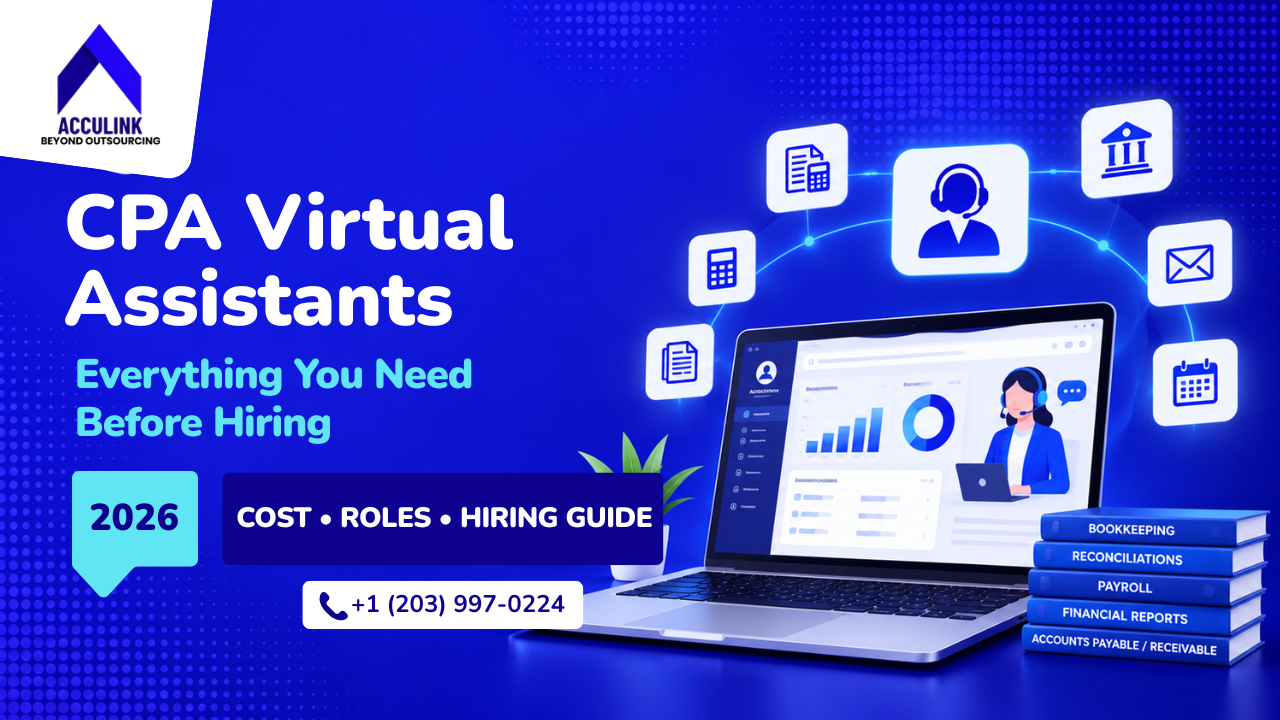
An accounting virtual assistant is a remote professional who handles a firm\'s recurring bookkeeping and administrative work, from data entry and bank reconciliations to accounts payable, invoicing, and report preparation, working inside your own software. Your credentialed staff keep the review and the client work. This guide covers what one does, how the role differs from a bookkeeper, what it costs, and how to hire one without the arrangement going sideways.
Your most expensive people are doing your cheapest work, and not by choice. The associate who should be on client engagements spent Thursday keying in receipts; a manager is behind on reconciliations again; a partner is chasing a client for a bank statement that should have arrived weeks ago. None of it needs their training, all of it has to get done, and there is no one cheaper on the payroll to hand it to. That is the trap a growing firm walks into: the routine work multiplies faster than you can justify hiring for it, so it lands on the people you can least afford to have doing it. An accounting virtual assistant is the way out. It moves that recurring, rules-based work to someone hired to do exactly it, so your qualified people get their hours back for the review, advisory, and client work you actually bill for.
This guide is written for firm owners deciding whether to hire one: what an accounting virtual assistant actually does, how the role differs from a bookkeeper or an accountant, what it costs, and how to bring one on without the arrangement going sideways.
Key takeaways
- An accounting virtual assistant is a remote team member who absorbs the recurring, rules-based work (data entry, reconciliations, accounts payable and receivable, invoicing) that clogs a qualified person's day.
- A VA supports your team; it does not replace judgment. Review, sign-off, and client advice stay with your firm, always.
- Offshore VAs run $8 to $35 an hour, all in, roughly 60 to 70 percent below a US admin hire, and you pay for the hours you use rather than a full salary.
- The fit is about the work, not the firm size: the more of your load is high-volume and repeatable, the more a VA gives back.
- Before you commit, write down the tasks you would hand over, then trial one VA on a real workload and see the output before you scale.
What Is an Accounting Virtual Assistant?
An accounting virtual assistant is a remote professional who handles a firm's recurring bookkeeping and administrative work, from data entry and bank reconciliations to accounts payable, invoicing, and report preparation, working inside the firm's own software. The point is leverage: routine production moves to the assistant, and your credentialed staff keep the work that needs their expertise.
The label causes some confusion, so it helps to place the role. A virtual assistant for accountants is task-support, hired to execute defined, repeatable work. A bookkeeper owns a set of books end to end. An accountant makes judgment calls, prepares financials, and advises. A VA can do a lot of what a junior bookkeeper does, but you keep the review and the client relationship. Think of a virtual assistant for your accounting practice as capacity you rent by the hour, not a salary you carry all year.
"Virtual" simply means remote. The assistant works through cloud accounting tools rather than a desk in your office, which is what makes the model flexible and, when the team is offshore, dramatically cheaper.
What Does an Accounting Virtual Assistant Do?
Most of what buries a firm is not hard; it is just constant, and constant is what quietly eats a qualified person's week. That is the work an accounting virtual assistant is built to take:
- Data entry and categorization of transactions, receipts, and bills, kept current instead of batched into a month-end scramble.
- Bank and credit card reconciliations, matched and documented on a set cadence.
- Accounts payable and receivable: entering bills, preparing payment runs, sending invoices, and following up on what is owed.
- Invoicing and expense management, including chasing the missing documentation clients never send on time.
- Payroll support, gathering hours and preparing payroll runs for your review.
- Catch-up and cleanup bookkeeping, working through a backlog until the books are usable again.
- Software upkeep in QuickBooks Online or Xero, keeping the ledger clean and the feeds connected.
- Report preparation, assembling the profit and loss, balance sheet, and management reports for a reviewer to finalize.
What a virtual assistant does not do is the judgment work. They do not sign off, they do not decide a treatment, and they do not give the client advice. That line is the whole point: the assistant clears the production so your team has room for the work only they can do. For a fuller build across a client's books, our bookkeeping outsourcing services cover the same ground at a team level.
Virtual Assistant vs. In-House Admin vs. Outsourced Team
Firms usually weigh three ways to cover this work. They are not the same purchase.
| In-house admin hire | Accounting virtual assistant | Full outsourced team | |
|---|---|---|---|
| Cost | Full salary, benefits, overhead | Hourly or part-time, from $8/hr offshore | Dedicated team, priced per role |
| Commitment | Year-round employee | Pay for hours used | Ongoing engagement |
| Best for | Steady full-time load | Overflow and recurring tasks | Multiple clients, larger scope |
| Ramp-up | Recruit, hire, train | About two weeks | About two weeks per role |
| Coverage | One person | One assistant, with backup | A team with built-in review |
An in-house admin makes sense when the volume genuinely fills a full-time seat and you want someone at the desk. A virtual assistant for accounting fits the far more common case: real, recurring work that does not justify a whole salary, plus the seasonal spikes that break a fixed headcount. When the need grows past one person, a full dedicated team is the next step, and a good provider scales you from one assistant to a team without you restarting the search. At that point, our rundown of the top offshore staffing companies for accounting firms lays out who does what.
How Much Does an Accounting Virtual Assistant Cost?
Accounting virtual assistants are usually priced by the hour, as a set number of part-time hours a month, or as a dedicated assistant, and the rate depends mostly on where the assistant sits.
A US-based assistant carries US wages: the median wage for bookkeeping, accounting, and auditing clerks was $49,210 a year, about $24 an hour, in May 2024, according to the US Bureau of Labor Statistics, and that is before benefits, software, and management overhead push the real cost higher. An offshore virtual accounting assistant delivers the same recurring work at all-inclusive rates of roughly $8 to $35 an hour depending on seniority, around 60 to 70 percent below an equivalent in-house hire, while still working in your software and overlapping your business hours. Because you pay for hours used, a firm that needs twenty hours of reconciliation and data entry a week is not carrying a forty-hour salary to get it.
The figure that matters is the all-in rate. Ask whether security, software access, and a second-line quality review are inside the hourly number or billed on top. A low headline rate with three line items underneath is not the bargain it looks like.
When Should Your Firm Hire One, and How?
The signs you are ready are usually already on your desk: qualified staff doing data entry, a reconciliations backlog that never clears, invoices going out late, client cleanup piling up, or a busy season you covered last year only by burning people out. If any of those are familiar, the work exists; the question is only who does it.
Giving an outside assistant access to your financial data is a fair thing to pause on, so vet it the way you would any provider handling client information. Ask for the SOC 2 Type II report, confirm the assistant works over encrypted connections with role-based access and no data on personal devices, and check the certifications before you share a login. If the assistant will touch any tax data, the provider also needs to be compliant with IRS Section 7216, which governs how tax return information is handled. A serious provider shows you all of it; Acculink, for one, is SOC 2 Type II and ISO 27001 certified with zero data breaches in more than five years, and the full setup is on our data security page.
From there, hiring a virtual assistant for your accounting work runs in a few steps:
- Write down the tasks you would hand over, with any firm-specific rules attached.
- Choose a provider that works with accounting firms specifically, not a general staffing agency; an offshore virtual assistant is where the cost advantage is.
- Trial the assistant on a real, low-stakes workload before you commit to a schedule.
- Onboard into your software with access, prior-period files, and a short walkthrough of how your firm likes the work done.
- Set a cadence: a named point of contact, a regular check-in, and clear turnaround times.
The first week or two is a learning curve while the assistant picks up your conventions. Past that, a good virtual assistant for a CPA firm becomes the quiet reason your seniors stop doing juniors' work.
Why CPA Firms Choose Acculink
Acculink works exclusively with US CPA, accounting, and tax firms, which is why our assistants already know how firm work runs, and it is why firms choose us to take the recurring load off their teams.
- Trained on your work: 300+ professionals including CPAs, EAs, and CAs, supporting 80+ US CPA firms, so a virtual assistant for accountants here is not learning the basics on your time.
- Certified on your software: QuickBooks Advanced Certified ProAdvisors and Xero Certified Advisors, working in your existing stack.
- A second set of eyes built in: a two-tier maker-checker process, so the work is reviewed before it reaches you.
- Secure by design: SOC 2 Type II and ISO 27001 certified, IRS Section 7216 compliant, encrypted access, and zero breaches in five-plus years.
- Priced all-in: $8 to $35 an hour depending on the role, around 60 to 70 percent below an in-house hire, with three to four hours of daily US overlap.
- A low-risk start: a 40-hour free trial, no setup fee, and no long lock-in.
You can hire an accounting virtual assistant for a defined scope, or add a dedicated offshore bookkeeper if the work is closer to full books than task support.
Frequently Asked Questions
What is an accounting virtual assistant?
An accounting virtual assistant is a remote professional who handles a firm's recurring bookkeeping and administrative work, such as data entry, bank reconciliations, accounts payable and receivable, invoicing, and report preparation, working inside the firm's own accounting software. They take the routine production off your qualified staff, who keep the review and client work.
What does an accounting virtual assistant do?
They handle high-volume, repeatable tasks: entering and categorizing transactions, reconciling bank and credit card accounts, managing payables and receivables, invoicing, payroll support, catch-up bookkeeping, and preparing reports for a reviewer. They do not sign off on work, make accounting judgments, or advise clients directly.
What is the difference between a virtual assistant and a bookkeeper?
A bookkeeper typically owns a set of books end to end, while a virtual assistant is task-support hired to execute defined, repeatable work under your direction. In practice the roles overlap, but with a VA you keep the review and the client relationship, and you pay for the hours you use rather than a full-time seat.
How much does an accounting virtual assistant cost?
An offshore accounting virtual assistant typically costs $8 to $35 an hour, all-inclusive, roughly 60 to 70 percent below a US in-house hire once salary, benefits, software, and management overhead are counted. Pricing is usually hourly, a set block of part-time hours, or a dedicated assistant. Ask whether security, software, and quality review sit inside the rate.
Is it safe to give a virtual assistant access to my books?
Yes, with the right provider. Look for SOC 2 Type II and ISO 27001 certification, IRS Section 7216 compliance for anyone touching tax data, encrypted connections, role-based access, and no data stored on personal devices. Ask to see the certifications before you grant access, and use unique logins with activity logging.
What software do accounting virtual assistants use?
They work in your existing cloud accounting platform, most commonly QuickBooks Online or Xero, along with your document portal and reporting tools. A strong provider is certified on the platform you already use, so there is no learning curve on your stack.
When should a CPA firm hire a virtual assistant?
When qualified staff are doing routine data entry, reconciliations are backlogged, invoicing slips, cleanup piles up, or seasonal volume overwhelms your fixed headcount. If the recurring work exists but does not justify a full-time salary, a virtual assistant is usually the most efficient way to cover it.
Can a virtual assistant work in my time zone?
Yes. An offshore assistant typically overlaps your business hours by three to four hours a day for real-time questions, and because much of the work happens while your office is closed, it is often ready for review by the morning.
The Bottom Line
An accounting virtual assistant is not a grand strategic move. It is a practical one: you stop paying qualified people to do routine work, and you cover the recurring load without carrying a full-time salary for it. The firms that get the most from it are simply the ones drowning in repeatable tasks, which is most growing firms.
Start small. Write down what you would hand over, trial one assistant on real work, and judge it by whether your seniors get their time back. If they do, you scale from there.
If you want to see how it would run on your own workload, Acculink offers a 40-hour free trial so you can test a virtual assistant on real tasks before committing.
Tags:
About the Author

Related Posts
Top 10 Offshore Staffing Companies for Accounting Firms (2026)
Hiring an offshore team is one of the highest-leverage moves a short-staffed CPA firm can make, but the partne…
Fractional CFO Services: What They Do, What They Cost, and How to Hire (2026)
A practical 2026 guide to fractional CFO services: what a fractional CFO does, the signs you need one, what it…
Tax Preparation Outsourcing for CPA Firms: How It Works, What It Costs, and Where to Start (2026)
Tax preparation outsourcing lets a CPA firm hand routine return preparation to an external team, usually offsh…