Fractional CFO Services: What They Do, What They Cost, and How to Hire (2026)

Summary
A practical 2026 guide to fractional CFO services: what a fractional CFO does, the signs you need one, what it costs, and how to hire the right fit, including the offshore virtual CFO option that delivers the same expertise for 60-70% less than an in-house hire.
A fractional CFO is an experienced chief financial officer who works for your business part-time, usually remotely, instead of as a full-time hire. You get senior financial leadership (forecasting, cash-flow management, and board-ready reporting) for a fraction of the cost of a full-time CFO, often 60 to 70 percent less when the role is delivered by an offshore team. This guide covers what a fractional CFO actually does, how the "fractional," "virtual," and "outsourced" labels differ, what one costs, the signs you need one, and how to hire the right fit.
What Is a Fractional CFO?
A fractional CFO is a seasoned finance executive who takes on the CFO role for your company on a part-time or as-needed basis. Instead of paying one person a full-time executive salary, you bring in that expertise for the slice of time your business actually needs, whether that is a few days a month or a few days a week.
The model exists because most growing companies hit the same gap. The books are being kept, a bookkeeper or controller handles the day-to-day, but no one owns the forward-looking, strategic side of finance: cash-flow planning, fundraising, margin analysis, board reporting. That is CFO work, and hiring it full-time is expensive long before a company is large enough to justify it. A fractional CFO fills that gap at a cost that fits your stage.
It is also why fractional CFO services have become one of the fastest-growing advisory lines in accounting itself. Firms that once referred this work out now deliver it in-house, because clients increasingly expect their accountant to own the strategic finance conversation, not just the compliance one.
Fractional CFO vs. Virtual CFO vs. Outsourced CFO
These terms get used interchangeably, but they describe three different things:
| Term | What it describes | Plain meaning |
|---|---|---|
| Fractional CFO | Time commitment | Part-time, a fraction of a full-time role, often shared across a few companies |
| Virtual CFO | Delivery | Works remotely, through cloud accounting tools and video, not from your office |
| Outsourced / offshore CFO | Who provides them | Supplied by an outside firm rather than employed directly; offshore means overseas talent, which is the main reason the cost drops |
The simple version: fractional answers "how much" (part-time), and virtual answers "where" (remote). In practice they overlap. A fractional CFO is almost always virtual, and an outsourced CFO is usually both. The label matters less than the substance: are you getting genuine CFO-level expertise, for the hours you need, at a cost that fits your stage?
What Does a Fractional CFO Do?
A fractional CFO owns the strategic side of your finances. Typical responsibilities include:
- Cash-flow forecasting and management, so you can see what is coming and avoid surprises.
- Budgeting and financial planning and analysis, turning goals into numbers and tracking against them.
- KPI dashboards and management reporting, so leadership sees the metrics that actually drive the business.
- Board and investor reporting, in the format funders expect.
- Fundraising and lender support, including the models and clean financials a raise or loan requires.
- Margin, pricing, and profitability analysis, finding where you make and lose money.
- Financial systems and controls, tightening the processes behind the numbers.
What a fractional CFO does not do is the day-to-day bookkeeping. That stays with your bookkeeper or controller. The CFO sits above it, turning the numbers into decisions.
Signs Your Business Needs a Fractional CFO
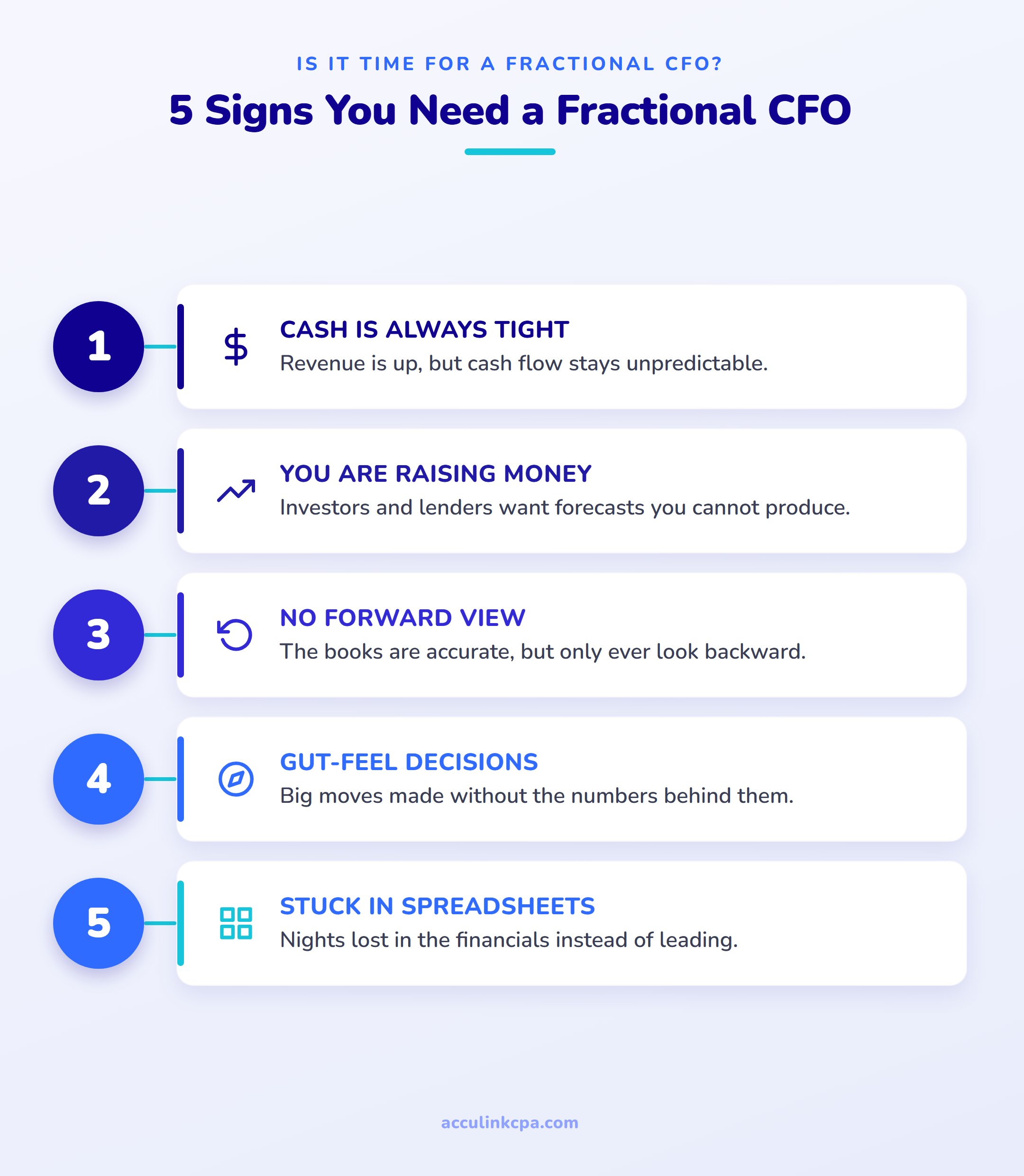
You may not need a full-time CFO yet, but you have likely outgrown DIY finance if any of these sound familiar:
- You are growing fast, yet cash feels tight even when revenue is up.
- You are raising capital, or a lender or investor wants forecasts and clean reporting you cannot easily produce.
- Your books are accurate but backward-looking. No one is modeling what happens next.
- Big decisions (a key hire, a price change, a new location) are made on gut feel rather than numbers.
- You are spending nights in spreadsheets instead of running the business.
Any one of these is a signal. Several together usually means the gap is already costing you money.
How Much Does a Fractional CFO Cost?
The honest answer: far less than a full-time CFO, with the range depending on the model.
- Full-time, in-house CFO: the most expensive option. According to the Robert Half 2026 Salary Guide, an experienced CFO's total compensation runs from around $195,000 at a smaller company to more than $420,000 at a large one.
- Domestic fractional CFO: a fraction of that, billed monthly or hourly and scaled to the hours you use. You skip the full salary, but onshore senior rates are still high.
- Offshore virtual CFO: the lowest cost. Because the talent is based overseas, the same expertise comes in around 60 to 70 percent below the cost of an in-house hire, while still working in your software and overlapping your business hours. It is the same offshore staffing model that firms already use to build full accounting teams, applied at the CFO level.
The better question is not just price, it is value per dollar. A strong fractional CFO usually pays for itself through better cash management, cleaner fundraising, and smarter decisions.
How to Hire a Fractional CFO
Once you have decided you need one, evaluate candidates on five things:
- Relevant experience. Look for someone who has done CFO-level work for companies at your stage and in your industry.
- Credentials. A CPA, EA, or chartered accountant signals verified expertise, not just a title.
- Data security. Your CFO will see everything. Confirm SOC 2 Type II controls, encrypted devices, and proper access controls before sharing access.
- Time-zone overlap and integration. You want someone who works inside your systems and shares enough of your day to collaborate, not a black box.
- A low-risk start. A defined scope, a short initial engagement, or a strategy session lets you prove the fit before committing.
The same checklist applies whether you are a business hiring a CFO for yourself, or an accounting firm bringing in an offshore CFO to deliver this work to your own clients under your brand. Start small, then expand the scope as the relationship proves out.
Why Businesses and Firms Choose Acculink's Offshore Virtual CFO
Acculink provides offshore virtual CFOs to U.S. businesses and accounting firms, delivering senior financial leadership at roughly 60 to 70 percent less than an in-house hire.
- Pre-vetted senior talent: CPAs, EAs, and qualified finance professionals, screened before they reach you.
- Full CFO scope: forecasting, cash flow, KPIs, FP&A, and board-ready reporting.
- Secure by design: SOC 2 Type II certified and IRS Section 7216 compliant, with encrypted devices and role-based access.
- Works as part of your team: your software, U.S.-hours overlap, and no lock-in. For accounting firms, that means adding a CFO or advisory line to your clients without carrying a senior salary.
- A low-risk start: a free strategy session to scope the role before you commit.
If you want to see how it fits, you can hire a dedicated virtual CFO or book a free strategy session.
Frequently Asked Questions
What is a fractional CFO?
A fractional CFO is an experienced chief financial officer who works for your business part-time or on an as-needed basis, rather than as a full-time employee. You get senior financial leadership, forecasting, cash-flow planning, and reporting, for the slice of time your company actually needs.
What is the difference between a fractional CFO and a virtual CFO?
Fractional refers to time (part-time, a fraction of a full-time role). Virtual refers to delivery (the CFO works remotely rather than on-site). Most fractional CFOs are also virtual, so the terms are often used interchangeably. An offshore virtual CFO adds a third element, overseas talent, which is what lowers the cost the most.
What does a fractional CFO actually do?
A fractional CFO owns the strategic side of finance: cash-flow forecasting, budgeting and FP&A, KPI dashboards and management reporting, board and investor reporting, fundraising support, and profitability analysis. Day-to-day bookkeeping stays with your bookkeeper or controller; the CFO turns those numbers into decisions.
How much does a fractional CFO cost?
Far less than a full-time CFO, whose total compensation commonly runs from around $195,000 to well over $420,000 a year. A fractional CFO is billed for the hours you use, and an offshore virtual CFO can deliver the same expertise at roughly 60 to 70 percent below the cost of an in-house hire.
When should a business hire a fractional CFO?
When your books are accurate but no one owns the forward-looking finance, when cash feels tight despite growth, when you are raising capital and need clean forecasts, or when major decisions are being made without solid numbers. It is the stage between needing a bookkeeper and being able to justify a full-time CFO.
Fractional CFO vs. full-time CFO: which is right for me?
If you need CFO-level strategy but not 40 hours a week of it, fractional is usually the better value: you get the expertise without the full salary. A full-time CFO makes sense once the role is genuinely full-time, with a large finance team, complex operations, or frequent transactions.
Can an accounting firm offer fractional CFO services to its clients?
Yes, and a growing number do. A firm can add a CFO or advisory line using an offshore virtual CFO to deliver the forecasting, modeling, and reporting, while the firm keeps the client relationship and delivers the advice under its own brand. It adds a high-value service without the cost of a senior domestic hire.
Can a fractional CFO work remotely or offshore?
Yes. Most fractional CFOs work virtually through cloud accounting software and video. An offshore virtual CFO works the same way from overseas, typically with several hours of U.S. time-zone overlap, which is how the model delivers senior expertise at a much lower cost.
How do I hire a fractional (virtual) CFO?
Define the scope you need, then evaluate candidates on relevant experience, credentials (CPA, EA, or chartered accountant), data-security controls, time-zone overlap, and whether you can start small. Begin with a defined, short engagement and expand as it proves out.
The Bottom Line
A fractional CFO gives a growing company the financial leadership of a full-time hire without the full-time cost. Whether you call it fractional, virtual, or outsourced, the value is the same: someone senior owning your forecasting, cash flow, and strategy. The offshore model takes it furthest on cost, around 60 to 70 percent below an in-house CFO, while keeping the expertise and the time-zone overlap.
If your business or firm has outgrown DIY finance, the practical next step is a short, scoped engagement. Acculink offers a free strategy session to map the role to your needs before you commit to anything.
Tags:
About the Author

Related Posts
Top 10 Offshore Staffing Companies for Accounting Firms (2026)
Hiring an offshore team is one of the highest-leverage moves a short-staffed CPA firm can make, but the partne…
Top Outsourced Accounting Firms for CPA Practices (2026)
Choosing an outsourced accounting partner is a high-stakes call because the team touches your clients' data. T…
Virtual CFO Services: What They Are, Who Needs Them, and How to Hire One Offshore
A virtual CFO (vCFO) provides the strategic financial leadership of a full-time CFO — cash flow management, bu…