The Rise of Private Equity in Accounting: What Small Firms Should Do


Summary
Private equity investment in accounting has surged dramatically, with PE-backed firms representing a growing share of Accounting Today’s Top 100 — reshaping competitive dynamics for small and mid-size practices nationwide.
The Rise of Private Equity in Accounting: What Small Firms Should Do
Key Takeaways
• Private equity investment in accounting has surged dramatically, with PE-backed firms representing a growing share of Accounting Today’s Top 100 — reshaping competitive dynamics for small and mid-size practices nationwide.
• PE brings capital and operational discipline, but also loss of autonomy, margin pressure on partners, culture changes, and equity dilution that many independent firm owners find unacceptable after decades of building their practice.
• Small and mid-size CPA firms don’t need PE capital to compete — they need operational efficiency, scalable capacity through offshore staffing, and the ability to deliver advisory services without drowning in compliance work.
• Offshore staffing provides the same capacity expansion and margin improvement PE investors demand — at $8–$35/hour through Acculink CPA — without surrendering equity, autonomy, or the firm culture you’ve spent decades building.
• The firms that thrive in the PE era achieve PE-level efficiency through smart operations: outsourced tax preparation, bookkeeping, and compliance work handled offshore while partners focus on advisory.
If you’ve attended an accounting conference, read Accounting Today, or talked to peers in the last year, you’ve heard the conversation: private equity is coming for accounting. It’s not a future threat — it’s here, and it’s moving fast.
PE-backed firms have been on an acquisition tear, rolling up regional practices, consolidating specialities, and building national platforms with capital, technology, and growth velocity that independently owned firms struggle to match. Billions of dollars have flowed into accounting firm acquisitions over the past three years, and the pace shows no signs of slowing in 2026. The AICPA has published guidance on PE investment considerations for practitioners, and industry analysts at the Journal of Accountancy are covering the trend extensively.
For small and mid-size CPA firm owners, this raises uncomfortable questions: Should I sell? Should I merge with a PE-backed platform? Or is there another path — a way to compete effectively, grow profitably, and maintain independence without surrendering equity?
This blog is for firm owners who want the alternative. We’ll examine what PE is doing, why small firms feel the pressure, the honest pros and cons of PE money, and how offshore staffing through Acculink CPA provides the operational advantages PE promises — without the strings attached. Over 80 CPA firms across the United States already use this model to compete with PE-backed competitors while maintaining full ownership and control.
The PE Wave: What’s Happening in Accounting
Private equity’s interest in accounting is not new, but its scale in 2025–2026 is unprecedented. What was once a handful of experimental investments has become a flood of capital reshaping the entire profession’s structure.
The appeal for PE firms is straightforward from an investment perspective. Accounting practices have predictable, recurring revenue — tax season annually, bookkeeping monthly, audits yearly, and payroll ongoing. Client retention rates exceed 90% year over year because switching accounting firms involves significant friction. And the industry’s ownership structure is highly fragmented, with thousands of small and mid-size firms operating independently — creating a textbook consolidation opportunity.
The Securities and Exchange Commission has examined PE investment in professional services through its regulatory lens, and Accounting Today has documented deals where well-positioned practices command valuations of 2–3x revenue — levels unthinkable five years ago. Transactions include full acquisitions, majority stakes, minority investments with growth commitments, and platform-plus-tuck-in models where smaller practices integrate into larger PE-backed platforms.
For sellers, the appeal centres on succession. Many partners approaching retirement face limited internal succession options — the talent crisis documented by the AICPA means there aren’t enough young CPAs willing to buy them out at fair valuations. PE offers an exit at a premium, along with capital for growth and technology. The result is a rapidly consolidating industry where PE-backed firms invest in AI, marketing, technology, and — critically — offshore staffing at a scale that independent firms struggle to match on their own.
Why PE Targets Accounting Firms
Understanding PE’s attraction to accounting helps independent firm owners identify their own competitive advantages and vulnerabilities.
PE investors love recurring revenue above almost everything. Tax preparation is annual. Bookkeeping is monthly. Audit engagements repeat. Payroll services generate ongoing fees. This predictability makes accounting firms attractive because future cash flows are visible and stable, unlike deal-driven professional services.
PE investors love high margins with an expansion opportunity. Well-run firms operate at 30–50% partner margins. PE sees opportunity to expand further through operational efficiency and labour arbitrage — including offshore staffing, which PE-backed firms adopt aggressively as a primary margin lever. The Bureau of Labour Statistics data on domestic accountant salaries confirms the cost differential that makes offshore staffing so compelling: $55,000–$80,000+ domestic versus $8–$35/hour through Acculink CPA’s engagement models.
PE investors love client stickiness. Switching costs are high — new firms must learn financial history, transfer records, and rebuild relationships. Once acquired through a practice purchase, clients tend to stay, creating stable revenue that justifies acquisition premiums.
PE investors love fragmentation. Thousands of small firms with modest market shares create a consolidation opportunity. Buy multiple practices, combine operations, cross-sell services, and create a scaled entity worth more than the sum of parts.
Here’s the critical insight for independent owners: the operational improvements PE implements after acquisition — technology upgrades, process standardisation, offshore staffing, advisory service development — are all strategies independent firms can adopt without giving up equity. PE brings capital to force these changes quickly. Independent firms can implement the same changes at their own pace, keeping 100% of the resulting value.
Impact on Small and Mid-Size Firms
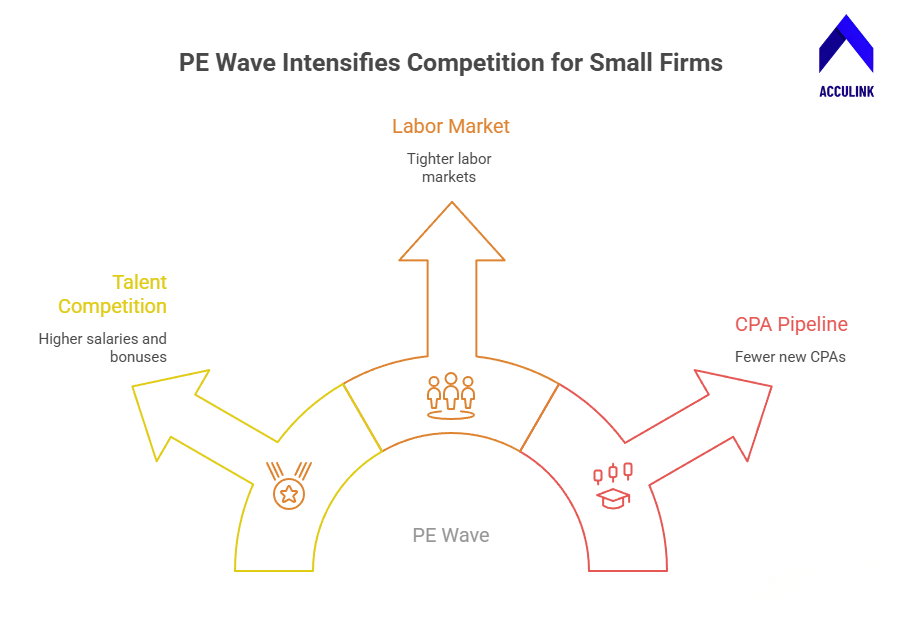
The PE wave creates real competitive pressure on independent firms, even if you have zero interest in selling. These pressures are cumulative and accelerating.
Talent competition intensifies in an already-tight market. PE-backed firms offer higher salaries, signing bonuses, and career paths within larger organisations. Independent firms already struggling to hire face even tighter labour markets. The NASBA CPA exam pipeline data shows fewer new CPAs entering the profession each year — and PE-backed firms are capturing a disproportionate share of available talent.
Client acquisition becomes harder as PE capital funds professional marketing teams, SEO strategies, content programs, and business development at scale. Technology gaps widen when PE funds invest in practice management platforms, AI tools, client portals, and workflow automation. Accounting Today analysis shows PE-backed firms outspending independent practices 3–5x on technology per professional.
Pricing pressure increases as PE-backed firms leverage lower cost structures — often achieved through offshore tax preparation and technology automation — to compete on price for compliance work while building higher-margin advisory practices.
Succession planning becomes more complex. As PE-level valuations become the benchmark expectation, internal buyouts grow more expensive, potentially destabilising succession plans that were designed around lower, pre-PE-era multiples.
The danger isn’t that PE steals every client overnight. It’s those cumulative competitive advantages that gradually erode the market position, margins, and talent access of independent practices that don’t adapt operationally.
Should You Take PE Money? An Honest Assessment
For some firm owners in specific situations, PE is the right answer. For many, it’s not. Here’s an honest look beyond the marketing materials.
The genuine pros include immediate liquidity for partners seeking an exit, capital for technology investments the firm couldn’t fund internally, operational expertise from PE teams who’ve scaled professional services businesses, a broader platform for recruiting talent, and potentially higher valuations at a future secondary exit.
The cons are significant and often underappreciated until after closing. Loss of autonomy is the most cited regret — PE targets 3–5x returns over 5–7 years, creating relentless pressure to grow revenue, cut costs, and optimise metrics. Partners who built careers on independence may find PE governance stifling.
Culture change is inevitable. PE’s focus on metrics, standardisation, and efficiency KPIs can fundamentally alter the collegial environment that attracted both clients and staff. Staff who joined a small, relationship-driven firm may not thrive under corporate PE management.
Margin pressure on continuing partners is frequently misunderstood. Many PE structures require reinvestment at lower effective compensation during the hold period, betting on a larger exit payday. If that exit doesn’t materialise at expected valuations, partners may end up financially worse off than maintaining independence.
The fundamental question: do you need PE capital, or can you achieve equivalent efficiency through strategies you implement and control? For most small and mid-size firms, the answer is clear: offshore staffing delivers PE-level operational improvement without PE-level strings.
The Alternative: Organic Growth with Offshore Teams
The core thesis: every operational advantage PE brings — lower labour costs, scalable capacity, process standardisation, improved margins, advisory capacity — can be achieved through offshore staffing without surrendering equity.
PE-backed firms use offshore staffing aggressively. It’s their primary margin expansion lever. They hire dedicated offshore teams through providers like Acculink CPA to handle tax preparation, bookkeeping, audit support, and other compliance work at $8–$35/hour instead of $55,000–$80,000+ per domestic hire. Cost savings flow directly to the bottom line.
Independent firms can do the same thing tomorrow. No PE capital required. Acculink CPA charges no setup fees, no recruitment fees, and requires no long-term contracts. Start with a 40-hour free trial, evaluate the fit, and scale based on your needs. A single offshore tax preparer at $15/hour saves $40,000–$60,000/year versus a domestic hire — pure retained equity.
Scale the math: five offshore professionals save $200,000–$300,000/year. Over five years, that’s $1M+ in accumulated savings — capital PE would require significant equity to provide. You achieve the same capacity expansion, margin improvement, and ability to redeploy partner time toward virtual CFO advisory work billed at premium rates.
The offshore model provides PE-level scalability, too. Need tax season capacity? Add offshore team members in 5–7 days. New client with complex partnership returns? Add a senior offshore preparer. Ready to expand into advisory? Free your partners from compliance by shifting preparation to your offshore team.
Building a Firm That Grows Without Selling Equity
The firms that thrive in the PE era build operational models so efficient that selling becomes unnecessary.
Start with your cost model. Analyse staffing costs, utilisation rates, and capacity constraints. Identify roles where offshore professionals deliver equivalent quality at lower cost — tax preparation, bookkeeping, data entry, financial statement preparation, audit workpaper support. Transition these roles to dedicated offshore team members through Acculink CPA, and redeploy domestic staff to client-facing advisory work.
Invest the savings strategically. Every dollar saved on labour is available for technology (Karbon, Canopy, AI tools), marketing and business development, staff retention, or partner distributions. The Small Business Administration research shows that firms investing in technology and capacity simultaneously see the strongest growth trajectories.
Develop your advisory offering. The compliance work consuming 60–80% of partner time is precisely what offshore teams handle. Reclaim that time for management reporting advisory, virtual CFO services, tax planning, and business advisory — the work commanding premium fees and deepening client loyalty.
Build succession on operational strength. A firm with efficient operations, scalable offshore capacity, diversified services, and strong client relationships can fund internal succession without PE capital. Junior partners buying into a well-run practice is more sustainable for everyone — partners, staff, and clients.
Learn more about how firms structure their offshore operations through Acculink’s engagement models and why 80+ CPA firms choose Acculink as their growth partner.
Frequently Asked Questions
Can a small firm really compete with PE-backed firms?
Yes — on service quality, client relationships, and operational efficiency. Offshore staffing provides the same cost advantages PE firms use. Modern technology is available to firms of all sizes. And personal client relationships are an advantage that PE-backed firms struggle to maintain at scale.
How much can I save by going offshore instead of taking PE?
A firm with 5 offshore professionals saves approximately $200,000–$300,000/year versus domestic hiring. Over 5 years, that’s $1M+ in retained value — capital PE would require significant equity to provide. See Acculink’s pricing and engagement models.
What if PE approaches my firm for acquisition?
Evaluate the offer against your independent growth potential with offshore staffing and operational improvements. If your firm can achieve similar margins organically, maintaining independence often delivers better long-term outcomes.
What roles should I offshore first?
Start with tax preparation, bookkeeping, and data entry — the highest-volume, most cost-sensitive roles. Scale into audit support, financial reporting, and payroll as confidence builds.
How do I start building PE-level efficiency without PE capital?
Start with Acculink CPA’s 40-hour free trial to test the offshore model with zero risk. Invest savings in technology and advisory development. Build standardised processes that create scalable, repeatable operations.
References
Accounting Today — Top 100 Firms — Accounting Today
American Institute of CPAs (AICPA) — American Institute of CPAs (AICPA)
Journal of Accountancy — Journal of Accountancy
National Association of State Boards of Accountancy (NASBA) — National Association of State Boards of Accountancy (NASBA)
Bureau of Labourr Statistics — U.S. Bureau of Labor Statistics
Securities and Exchange Commission (SEC) — U.S. Securities and Exchange Commission
Small Business Administration (SBA) — U.S. Small Business Administration
Acculink CPA — Engagement Models — Acculink CPA — Engagement Models
About Acculink CPA
Acculink CPA is a premier offshore staffing and outsourcing company purpose-built for CPA firms, accounting firms, and tax firms in the United States, Canada, and the UAE. With a team of 300+ qualified professionals — including CPAs, Chartered Accountants, Enrolled Agents, and Big 4-trained staff — Acculink provides dedicated offshore accountants, bookkeepers, tax preparers, auditors, virtual CFOs, and virtual assistants at $8–$35/hr, delivering up to 75% cost savings compared to domestic hiring. The company is ISO 27001 certified, SOC 2 Type II aligned, IRS §7216 compliant, and GDPR compliant, with zero security breaches in 5+ years of operations. Acculink offers a 40-hour free trial with no setup fees, no recruitment charges, and no long-term contracts. Over 80 CPA firms across the United States trust Acculink to deliver quality, security, and scalability.
Website: Acculink CPA | Schedule a Call: book a 45-minute call | Email: Info@acculinkcpa.com | Phone: +1 (203) 997-0224
Tags:
About the Author

Related Posts

Hire Offshore Bookkeepers for CPA & Accounting Firms – Blueprint for Outsourced Bookkeeping
How to hire an offshore bookkeeper for your CPA firm — what they do, how vetting and onboarding work, cost (up…

Hire Offshore Accountants for CPA & Accounting Firms – Why Outsourced Accounting Works
How to hire an offshore accountant for your CPA firm — month-end close, GL, GAAP reporting, in your software —…
15 Profitable Add-On Services CPA and Accounting Firms Can Offer Without Hiring In-House
CPA and accounting firms do not need to build every new service with another in-house hire. This guide compare…