The DOGE Effect: Federal Spending Cuts and CPA Firm Client Impact


Summary
The Department of Government Efficiency (DOGE) initiative has driven significant federal spending cuts across agencies, creating financial uncertainty for government contractors and businesses dependent on federal spending in their communities.
Key Takeaways
• The Department of Government Efficiency (DOGE) initiative has driven significant federal spending cuts across agencies. That creates financial uncertainty for government contractors and for businesses that depend on federal spending in their communities.
• CPA firm clients affected by spending cuts face revenue recognition challenges, contract modification accounting, workforce cost adjustments, and potential asset impairment assessments that require timely professional guidance.
• Advisory opportunities span contract compliance review, revenue diversification planning, cost restructuring, and financial forecasting for clients transitioning away from government revenue dependence.
• The ripple effects extend beyond direct contractors to suppliers, subcontractors, and community businesses that depend on federal spending — meaning the advisory demand affects a wider client base than firms might initially expect.
• Offshore teams provide the surge capacity CPA firms need. They can handle the advisory demand from affected clients and the ongoing compliance workload that doesn’t pause during disruptions.
Suppose you’ve ever watched a heist movie — Ocean’s Eleven, The Italian Job, or even the more cerebral Tinker Tailor Soldier Spy — you know the tension of watching someone dismantle a complex system piece by piece. That’s roughly what the Department of Government Efficiency (DOGE) initiative has been doing to federal spending in 2026. The accounting implications are landing squarely on CPA firm desks across the country.
DOGE’s mandate to reduce government spending and eliminate inefficiency has produced significant budget cuts across federal agencies. The Government Accountability Office has tracked the reductions. The Congressional Budget Office has analysed the fiscal impact. And CPA firms — particularly those serving government contractors, defence-adjacent businesses, and communities dependent on federal employment — are dealing with the downstream financial consequences their clients face.
The cuts aren’t theoretical for your clients. Contracts are being modified, delayed, or cancelled. Government procurement timelines are extending. Agency headcount reductions are affecting contractor workloads. And the uncertainty about future spending levels makes every financial projection for affected clients less reliable.
The AICPA has noted that CPA firms serving government contractors need to be especially attentive to revenue recognition, contract compliance, and financial statement implications of the spending changes. Accounting Today has covered how firms are adapting their advisory services to help affected clients navigate the transition.
This blog examines what DOGE is doing, which CPA firm clients are affected, the specific accounting and advisory implications. It also covers how offshore capacity through Acculink CPA lets your firm respond to the surge in advisory demand without falling behind on compliance.
What Is DOGE and What’s Happening
The Department of Government Efficiency — widely known as DOGE — is the administration’s initiative to reduce federal spending, eliminate bureaucratic waste, and streamline government operations. Whatever your political perspective on the initiative, its financial impact on businesses that depend on federal spending is real and measurable.
The Congressional Budget Office has analysed the fiscal trajectory of DOGE-driven spending reductions. Multiple federal agencies have seen budget cuts ranging from 10–30%, with some programs eliminated. The Government Accountability Office has documented the implementation timeline and operational impacts across affected agencies.
Federal workforce reductions have been a primary mechanism. Agency headcount cuts reduce the government’s capacity to manage contracts, process procurements, and oversee programs. For businesses that hold federal contracts, fewer government personnel means slower contract administration, delayed payment processing, and uncertainty about contract renewals and extensions.
Procurement freezes and spending moratoriums have affected new contract awards. Businesses that planned revenue growth based on expected government contract wins have seen those opportunities delayed or cancelled. Capital investments made in anticipation of government work may need to be reassessed.
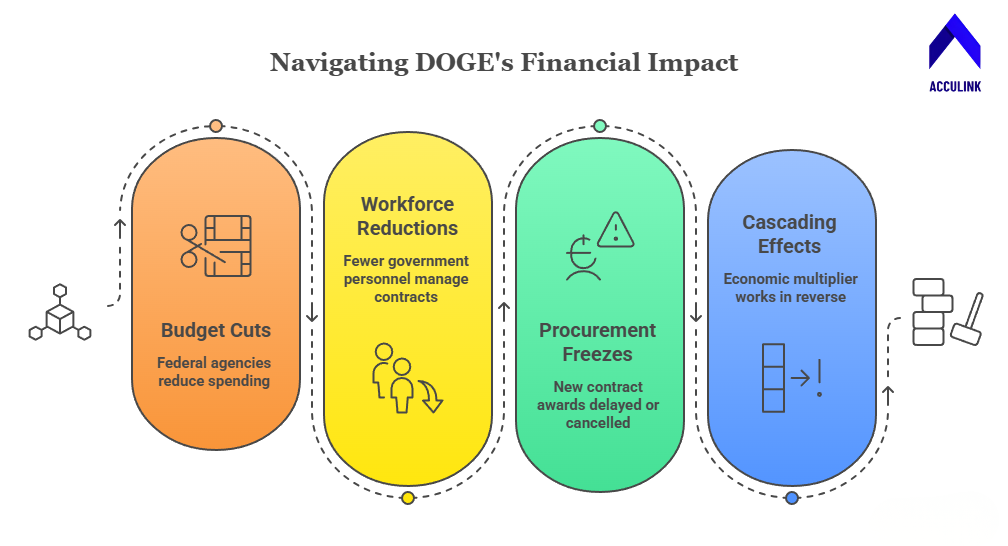
The effects cascade beyond direct government contractors. A defence contractor that loses a contract lays off workers who stop spending at local businesses. A healthcare services company that loses a federal program contract reduces its supplier orders. A construction firm that was building a federal facility sees the project paused. The economic multiplier works in reverse when federal spending contracts.
For CPA firms, the key question isn’t whether DOGE is good or bad policy — it’s how to help affected clients navigate the financial consequences. That requires both advisory capacity (partner time for strategic client conversations) and compliance capacity (preparing the financial statements, tax returns, and regulatory filings that reflect changed circumstances).
Which CPA Firm Clients Are Affected
The DOGE spending cuts affect a broader set of CPA firm clients than most practitioners initially realise. Direct government contractors are the obvious starting point, but the ripple effects extend through multiple layers of the economy.
Direct federal contractors face the most immediate and severe impact. Companies holding contracts with affected agencies face potential contract modifications (reduced scope, lower funding levels), contract terminations (for convenience or due to budget constraints), delayed payments (as agency processing capacity declines). They also face uncertainty about future contract opportunities. The accounting implications are significant: revenue recognition under ASC 606 may need adjustment, contract assets may require reassessment, and financial projections need revision.
Government contract subcontractors and suppliers are the second ring of impact. Companies that supply materials, services, or labour to prime government contractors face reduced orders, extended payment cycles, and potential contract renegotiation. Many of these businesses are small to mid-size — exactly the client profile of most CPA firms.
Defence and national security-adjacent businesses face particular uncertainty. While defence spending has been somewhat insulated from the broadest DOGE cuts, the general atmosphere of budget scrutiny affects procurement timelines and contract renewals. It also clouds long-term planning for defence contractors at every tier.
Healthcare service providers dependent on federal program funding face potential reductions in reimbursement levels, program scope, or administrative support. Non-profit organisations that receive federal grants are evaluating whether their funding will continue at current levels.
Community businesses in areas with significant federal employment feel the indirect effects of workforce reductions. Federal employees who leave government service (voluntarily or otherwise) reduce local spending, affecting small businesses in those communities.
The bottom line for CPA firms: if you serve any clients in these categories — and most firms serve at least some — DOGE’s impact is relevant to your advisory conversations. The firms that engage proactively will capture advisory revenue and strengthen relationships. The firms that wait for clients to bring it up will find their competitors got there first.
Accounting Implications for Affected Clients
DOGE-driven spending changes create specific accounting issues that CPA firms should address proactively. The Financial Accounting Standards Board standards and IRS reporting requirements both apply to the situations clients face.
Revenue recognition under ASC 606 is the most technically complex issue. Government contracts are typically performance obligation contracts with variable consideration, and modifications to contract scope, timing, or funding levels require reassessment of revenue recognition patterns. Contract modifications may need to be treated as separate contracts or as modifications of existing contracts, depending on their nature. The treatment affects both current and future period revenue.
Contract asset and receivable assessment becomes critical when government contract payments are delayed or contract terms are modified. Firms need to evaluate whether receivables remain collectable, whether contract assets should be impaired. They also need to check whether the expected timing of cash flows has changed materially enough to affect financial statement presentation.
Workforce restructuring costs may arise as affected businesses reduce headcount in response to lower revenue. Severance accruals, benefit continuation obligations, and restructuring provisions require proper accounting treatment and payroll compliance.
Tax planning implications include potential net operating loss considerations, estimated tax payment adjustments, and evaluation of whether business deductions change based on modified operations. For S corporations and partnerships, K-1 implications for owners may change based on revised income projections.
Each of these issues requires both technical preparation work (calculations, statement adjustments, return modifications) and advisory judgment (client communication, strategic recommendations, risk assessment). The preparation work is exactly what offshore teams through Acculink CPA handle efficiently at $8–$35/hour. That frees your domestic professionals for the advisory judgment work that clients need and value most.
Advisory Opportunities for CPA Firms
DOGE-related disruptions create several advisory engagement types that CPA firms can package, price, and deliver to affected clients.
Contract compliance review: Help clients evaluate their existing government contracts for termination provisions, modification rights, and compliance obligations that apply during budget changes. This is detailed, document-intensive work where your offshore team can compile contract terms and flag key provisions while your partner provides strategic guidance.
Revenue diversification planning: Help government-dependent clients develop strategies to reduce their reliance on federal revenue. Identify commercial market opportunities, evaluate diversification costs and timelines. Then build financial models showing the path from current government dependence to a more diversified revenue base. This is classic virtual CFO advisory at its most valuable.
Cost restructuring advisory: Help clients right-size their operations for reduced government revenue. Identify which costs are fixed versus variable, model different cost reduction scenarios. Recommend implementation sequencing that preserves the client’s ability to ramp back up if government spending recovers. Compare this to what Michael Corleone would call “protecting the family business” — your job is helping clients survive the downturn with their core capabilities intact.
Financial forecasting under uncertainty: Build scenario-based forecasts that help clients plan for different spending cut trajectories. Best case (cuts are temporary, contracts resume), likely case (partial reduction sustained for 12–18 months), and stress case (permanent reduction requiring fundamental business model adjustment). Clients will pay premium rates for this clarity because the alternative is guessing.
Each engagement generates $3,000–$15,000 in advisory fees depending on client complexity. The firms capturing this revenue are the ones with partner capacity to engage — and that capacity comes from having offshore professionals handle the compliance work that would otherwise consume partner hours.
Frequently Asked Questions
How do DOGE cuts affect my CPA firm directly?
Through increased advisory demand from affected clients (government contractors, subcontractors, community businesses), plus additional compliance complexity from revenue recognition changes, contract modifications, and financial statement adjustments. Both require more capacity from your team.
Which clients should I contact proactively?
Any client with government contract revenue, government grant funding, or significant business from federal employees or government-dependent communities. Compile client data with your offshore team, then have partners deliver personalised advisory outreach.
What advisory services should I offer?
Contract compliance review, revenue diversification planning, cost restructuring advisory, and scenario-based financial forecasting. Package as defined engagements at $3,000–$15,000 per client, depending on complexity.
How do spending cuts affect revenue recognition?
Contract modifications under ASC 606 may require reassessment of performance obligations, variable consideration estimates, and revenue timing. This is technically complex work requiring both preparation (offshore) and judgment (domestic CPA).
Can offshore teams help during the DOGE disruption?
Yes. Acculink CPA’s offshore professionals handle the preparation work — financial modelling, document compilation, tax return adjustments, and audit workpaper support — at $8–$35/hour while your partners focus on client-facing advisory.
References
Government Accountability Office (GAO) — U.S. Government Accountability Office
Congressional Budget Office — Congressional Budget Office
Financial Accounting Standards Board (FASB) — Financial Accounting Standards Board (FASB)
American Institute of CPAs (AICPA) — American Institute of CPAs (AICPA)
Accounting Today — Accounting Today
IRS — Internal Revenue Service (IRS)
Small Business Administration — U.S. Small Business Administration
Journal of Accountancy — Journal of Accountancy
About Acculink CPA
Acculink CPA is a premier offshore staffing and outsourcing company purpose-built for CPA firms, accounting firms, and tax firms in the United States, Canada, and the UAE. With a team of 300+ qualified professionals — including CPAs, Chartered Accountants, Enrolled Agents, and Big 4-trained staff — Acculink provides dedicated offshore accountants, bookkeepers, tax preparers, auditors, virtual CFOs, and virtual assistants at $8–$35/hr, delivering up to 75% cost savings compared to domestic hiring. The company is ISO 27001 certified, SOC 2 Type II aligned, IRS §7216 compliant, and GDPR compliant, with zero security breaches in 5+ years of operations. Acculink offers a 40-hour free trial with no setup fees, no recruitment charges, and no long-term contracts. Over 80 CPA firms across the United States trust Acculink to deliver quality, security, and scalability.
Website: Acculink CPA | Schedule a Call: book a 45-minute call | Email: Info@acculinkcpa.com | Phone: +1 (203) 997-0224
Tags:
About the Author

Related Posts

Payroll Outsourcing Services for CPA & Accounting Firms – Your Guide to Payroll & Compliance
How payroll outsourcing keeps CPA firms' clients compliant — 941/940 and multi-state filings, W-2/1099, on a 2…

Sales Tax Compliance Outsourcing for CPA & Accounting Firms – Why It Works
How outsourcing sales tax compliance handles nexus, multi-state filings, and exemption certificates for CPA fi…