Accounting Busy Season 2027: A Capacity Plan for CPA and Accounting Firms

Summary
Accounting busy season becomes manageable when a CPA firm forecasts preparation, review, and administrative work separately, identifies the slowest stage, and closes each capacity gap before January. This guide provides the formulas, fall timeline, staffing comparison, pilot controls, and weekly metrics needed to build a practical 2027 plan.
Accounting busy season is a predictable period when tax, audit, or reporting deadlines concentrate work. For tax-focused CPA firms, tax busy season generally runs from January through April, followed by an extension peak in September and October. It becomes a capacity problem when stage-level demand exceeds usable hours.
CPA firm capacity planning converts forecast workload into stage-specific hours, compares it with usable staff time, and assigns a solution before a filing deadline.
Fall 2026 is the best time to prepare for the 2027 tax season. Extension work reveals where files stalled, while there is time to fix workflow, add capacity, train, and test before January.
If the forecast already shows a stage-specific shortage, compare outsourced tax preparation services for production work with outsourced tax review services for reviewer capacity. The right answer depends on where work is waiting.
Key Takeaways
- Calculate preparation, review, and administrative capacity separately. Total staff hours can hide a reviewer shortage.
- Forecast from your firm's actual time and workflow data by return group. There is no dependable universal returns-per-preparer formula.
- Find the slowest stage before adding people. More preparation can make the review queue worse if review is already constrained.
- Use fall for process changes, staffing decisions, documentation, secure access, and a representative pilot.
- Keep judgment, client communication, final review, and sign-off with the CPA firm, even when production work is delegated.
Why Fall Is the Right Busy-Season Planning Window
Fall gives a firm two useful forms of evidence: the spring season just completed and the extension queue now moving through the office. Review which work waited on clients, which files sat ready for preparation, which returns remained in review, and which corrections repeated.
The Journal of Accountancy's tax-practice tune-up guidance recommends using lessons from the prior season, managing extensions deliberately, setting clearer client expectations, and continuing process review well before January. Current AICPA and CIMA small-firm guidance also tells firms to review capacity, streamline workflow, automate routine work, and make system changes before peak periods.
Every solution has lead time: recruiting and onboarding, provider due diligence and access design, automation testing, or advance communication of client cutoffs.
How to Calculate Busy Season Accounting Capacity
Tax season capacity planning should start with work, not headcount. Scheduled hours may already be committed to client calls, training, management, leave, or another service line.
1. Group the Work
Separate the forecast into groups that behave differently. Use return type, entity complexity, incoming-record quality, preparer level, or another distinction reflected in your data. Do not use one average for every file.
Phase each group by expected arrival: early-ready, standard-period, late-document, likely extension, and exception work. Do not spread seasonal demand evenly. Then estimate hours for intake and administration, preparation and workpapers, and technical review and finalization.
2. Convert Volume Into Demand Hours
Use recent work to establish a historical median or practical range for each stage and group. Adjust for known changes such as new clients, greater complexity, software migration, or a different team mix.
Demand hours = projected items x historical hours per item + known exception work
If time records are unreliable, sample completed engagements and document the assumptions. Set contingency from historical forecast variance, document delays, turnover, and rework, not a universal percentage.
3. Calculate Usable Capacity by Stage
Usable capacity = scheduled work hours - leave - training - administration - other committed work
Capacity gap = demand hours - usable capacity
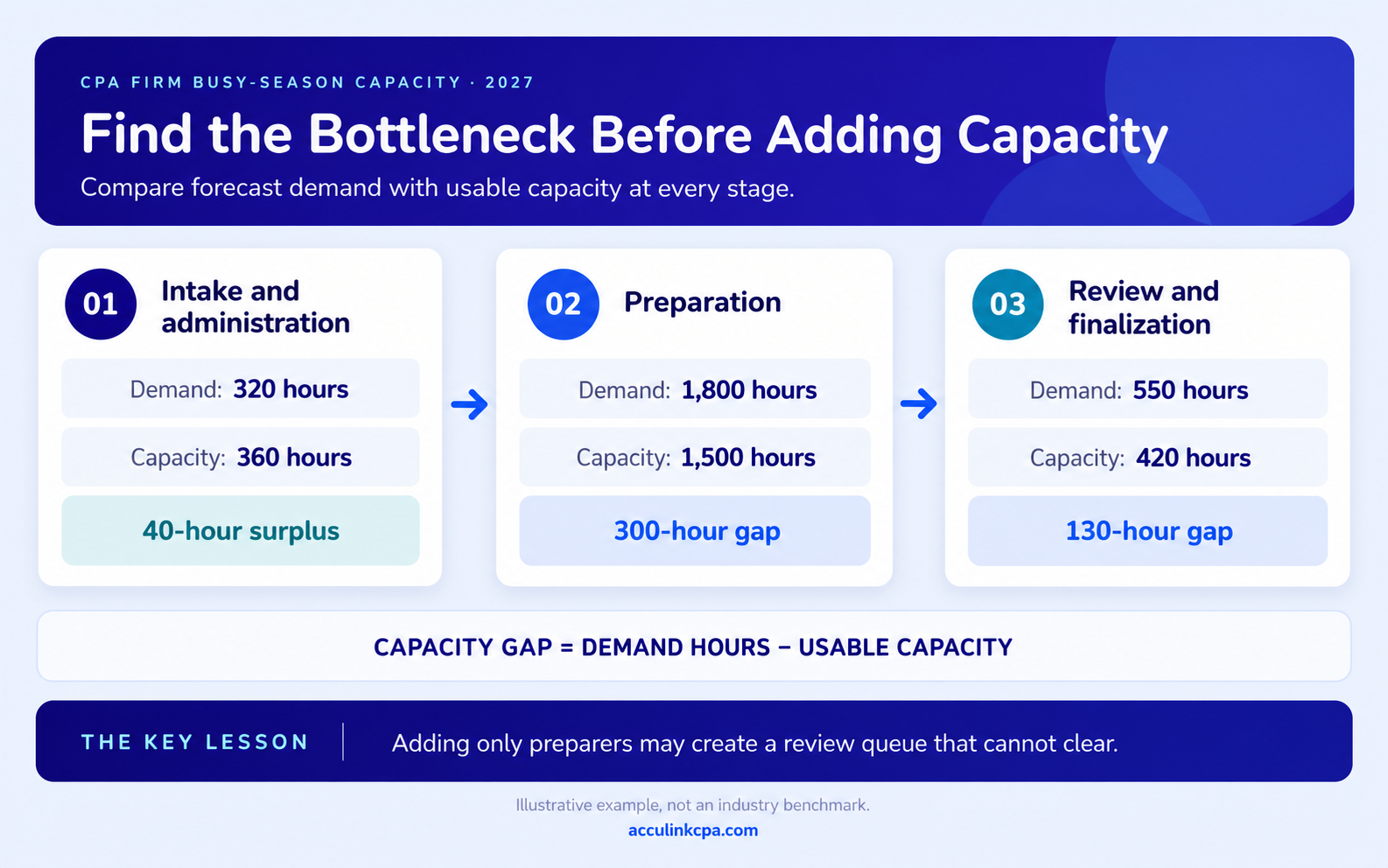
Run the calculation separately for intake, preparation, and review. The following example is illustrative, not an industry benchmark.
| Workflow stage | Forecast demand | Usable capacity | Finding |
|---|---|---|---|
| Intake and administration | 320 hours | 360 hours | 40-hour surplus |
| Preparation | 1,800 hours | 1,500 hours | 300-hour gap |
| Review and finalization | 550 hours | 420 hours | 130-hour gap |
This firm needs both preparation and review relief. Adding only preparers may move work faster into a review queue that cannot clear it. The practical capacity of the whole workflow is limited by its constrained stage.
Seasonal totals can still hide a deadline-week problem. Run the model by week or filing-deadline wave, then carry unfinished work into the next period as opening backlog.
Weekly capacity gap = work required that week + opening backlog - usable capacity that week
Convert a stage-specific gap into a planning estimate with the firm's own ramp-adjusted hours:
Additional capacity units = stage-specific capacity gap / usable hours per added person during the same period
Round up if one role must close the entire gap, or combine staffing with process, client-cutoff, and portfolio actions. Recalculate after the pilot because training and ramp time reduce early usable capacity.
Tax Workflow Management: Find Where Work Actually Waits
Tax workflow management tracks each return from client intake through filing. A visible tax preparation workflow shows whether work is waiting on the client, preparer, reviewer, or finalization owner. At minimum, distinguish:
| Tax return workflow stage | Question the firm should answer |
|---|---|
| Waiting for client information | What is missing, who asked for it, and how long has it been open? |
| Ready for preparation | Is the file complete enough to start? |
| In preparation | Who owns it, and when is the draft expected? |
| Ready for review | How old is the queue, and which deadline is at risk? |
| Returned for questions or correction | Is the issue client-related, technical, or a repeat process error? |
| Ready for delivery or filing | Who performs the final check and sign-off? |
Long hours alone do not identify the constraint. Queue size, stage age, incoming volume, completion rate, and rework together show where throughput is breaking down. If completed drafts wait several days for review, another preparer alone will not improve final throughput. If reviewers keep returning files for missing support, the intake definition or preparation checklist needs attention first.
If the firm needs a system to expose queues and stage age, compare accounting practice management software based on workflow visibility, dashboards, and integrations. Technology can reveal the constrained stage, but it cannot create the missing capacity by itself.
A September-to-January Busy-Season Plan
| Period | Main work | Decision or output |
|---|---|---|
| September and October | Complete extension work, interview staff, classify delays, compare forecast volume with actual capacity | Bottleneck map and quantified gaps |
| October | Decide which gaps need process change, technology, hiring, outside capacity, client action, or a blend | Approved capacity plan and owners |
| November | Document procedures, confirm roles, vet providers, design access, address consent, and schedule training | Ready operating environment |
| December | Run representative files through the complete workflow and return review notes to the people doing the work | Calibrated process and launch decision |
| January | Ramp in controlled batches, review queue health frequently, and adjust assignments before volume peaks | Stable production rhythm |
Before production, confirm client document cutoffs, extension criteria, the owner of deadline overrides, access, acceptance criteria, review ownership, and escalation.
Compare Busy Season Staffing Solutions and Capacity Options
The right mix of tax staffing solutions depends on the stage and duration of the gap. Most firms need a blend of process changes, seasonal staff, permanent staff, or outside capacity.
| Option | Useful when | Main constraint to plan for |
|---|---|---|
| Process change or automation | Repeated manual steps, duplicate entry, unclear routing, or preventable waiting consume capacity | Configuration, adoption, exception handling, and testing |
| Overtime | The gap is brief, limited, and genuinely exceptional | Sustainability, error risk, and dependence on key people |
| Seasonal employee or contractor | Work needs close supervision or a temporary US-based role | Recruiting lead time, availability, training, and continuity |
| Permanent hire | Demand is recurring enough to support year-round capacity | Hiring time, fixed cost, and utilization outside peak periods |
| Domestic or offshore outsourcing | Work is repeatable, can be documented, and needs flexible production or review capacity | Provider fit, secure access, consent, oversight, and internal review |
| Client portfolio and deadline changes | Low-value or persistently late work causes disproportionate pressure | Communication, pricing, disengagement, and revenue effects |
In its 2026 survey of more than 600 tax professionals worldwide, Thomson Reuters found that firms were using combinations of targeted training, task reallocation, outsourcing, and automation to address talent and capacity constraints. A firm should choose according to the stage and duration of its own gap.
If outsourcing is one option, the separate guide to tax preparation outsourcing for CPA firms explains scope, workflow, cost considerations, and operating models without turning this capacity plan into a second outsourcing article.
See how Acculink can support your busy-season workflow.
Get an overview of preparation, review, and dedicated team support for CPA firms.
Which Workflow Stage Needs Added Capacity?
Add capacity where work waits, not wherever a candidate happens to be available.
| Constrained stage | Evidence to confirm | Possible capacity action |
|---|---|---|
| Intake and client follow-up | Files cannot start because documents are incomplete or requests remain unanswered | Tighten ready-to-start criteria, standardize reminders, and assign one owner for missing items |
| Preparation | Complete files remain untouched or draft output trails forecast arrivals | Simplify workpapers, rebalance assignments, add preparation capacity, or reduce low-value work |
| Review | Drafts accumulate, stage age rises, or the same corrections recur | Reserve reviewer blocks, improve first-pass quality, add review capacity, and route work by complexity |
| Finalization and filing | Approved work waits for signatures, authorization, delivery, or e-file control | Clarify ownership, batch administrative steps, and protect finalization time near deadlines |
For a confirmed production gap, the firm may need to hire a tax preparer. If completed drafts are waiting for technical review, the relevant option may be to hire a tax reviewer instead. Client acceptance, material tax judgments, client advice, final technical review, signature, and filing control remain with the CPA firm.
Test the Plan Before Peak Volume
Use a small, representative batch. The easiest files prove little, while unusual files create noise. Include normal complexity, complete source documents, and a common exception.
Before the first file enters the pilot, define:
- entry criteria for a file that is ready to start;
- what a completed draft must contain;
- who performs each review and final sign-off;
- where questions, review notes, and corrections are recorded;
- turnaround expectations for each stage; and
- the evidence required for a decision to expand, correct, or stop.
The accounting outsourcing process provides a six-stage model for scoping, access, preparation, review, sign-off, and feedback. Use it whether the extra capacity is one person or a larger team.
Build Security and Consent Into the Schedule
Do not leave access and consent until the pilot is ready to begin. IRS Publication 4557 tells tax professionals to maintain a written information security plan, limit access, use multifactor authentication, select service providers capable of appropriate safeguards, require safeguards in contracts, and oversee how providers handle customer information.
Whenever tax return information may go to a preparer outside the United States, start with the current IRS Section 7216 information center and Revenue Procedure 2013-14. For Form 1040-series information, the procedure requires taxpayer consent before offshore disclosure. To disclose an unmasked Social Security number with consent, both the US and offshore preparers must maintain adequate data-protection safeguards; otherwise, mask or redact it. Have qualified counsel confirm the firm's facts and workflow before enabling access. The tax preparation outsourcing guide provides more operating context.
For the technical review, use the accounting outsourcing data-security guide, the CPA-firm vendor due diligence checklist, and Acculink's IT and data security framework.
The Weekly Busy-Season Dashboard
Track a small set of measures that lead to action:
| Measure | What it helps decide |
|---|---|
| Ready-to-prepare inventory and forecast arrivals | Whether preparation capacity matches incoming work |
| Oldest item and days in each stage | Where delay is accumulating |
| Drafts completed versus reviews completed | Whether preparation is outrunning review |
| First-pass acceptance and reasons for return | Whether training or procedure needs correction |
| Review hours by work group | Whether complexity or reviewer allocation changed |
| Open client questions and age | Which clients or missing items threaten deadlines |
| Remaining demand versus remaining usable capacity | Whether work must be reassigned before the gap becomes a crisis |
For broader partner-level measures, connect this operating view to the CPA firm KPI guide.
Define each measure once and keep the source consistent. A dashboard that does not trigger an owner, action, and date is only a status report.
Common planning failures are using one average for every return, counting headcount instead of usable hours, ignoring review capacity, changing systems during peak volume, testing on atypical work, and waiting until January to communicate client information cutoffs.
How Acculink Supports Busy-Season Capacity
Acculink supports US CPA, accounting, and tax firms with defined tax preparation and review capacity inside the firm's workflow and under its final review. A firm can address more than one stage by assembling a dedicated offshore team. Review Acculink's engagement models when deciding between a standing team and more flexible capacity.
Start with forecast volume, work groups, software, procedures, usable internal capacity, review ownership, security requirements, and the launch date. Both sides can then scope a controlled pilot and decide whether the model fits.
Discuss your 2027 busy-season capacity plan with Acculink. Share aggregate workload and workflow information first, not confidential client records.
Frequently Asked Questions
What is busy season in accounting?
Busy season in accounting is a predictable period when deadlines concentrate more work than usual. In CPA firms, it often refers to tax filing and extension periods or audit work after client year-ends. Timing depends on the firm's services and client deadlines.
When is CPA busy season?
For many tax-focused US CPA firms, the main peak runs from January through April, followed by an extension peak in September and October. Audit practices may peak according to client year-ends and reporting deadlines. Each firm should map demand by service line.
When should tax season preparation begin for CPA firms?
Begin in fall 2026, while spring and extension work provide current evidence. Settle workflow, staffing, secure access, procedures, training, and pilot corrections before January. Starting late forces provider review, recruiting, setup, training, and incoming client work into the same period.
How do you calculate tax-season capacity?
Group work by type and complexity. Multiply forecast volume by the firm's historical intake, preparation, and review hours, then add known exceptions. Deduct leave, training, administration, and other commitments from scheduled hours. For each stage, demand minus usable capacity reveals the gap.
How many tax preparers does a CPA firm need for busy season?
There is no universal answer. Divide the preparation gap by one added preparer's ramp-adjusted usable hours for the same period. Round up if preparers alone must close the gap, then confirm review can absorb the drafts. Complexity, document quality, software, and procedures make return counts unreliable.
What if review is the busy-season bottleneck?
Protect reviewer time, route files by complexity, improve first-pass quality, and add qualified review capacity if the gap remains. Track ready-for-review inventory, its oldest age, completed reviews, review hours, and repeated correction reasons weekly.
How large should a busy-season pilot be?
A pilot should permit close supervision while revealing normal workflow. Use a representative batch with common complexity and one routine exception. Define entry criteria, output, turnaround by stage, review ownership, correction handling, security controls, and the evidence required before expanding.
Which metric gives the earliest capacity warning?
No metric works alone. Compare forecast arrivals with completions, then watch queue size and oldest age by stage. A queue that grows across periods means incoming work exceeds throughput. Return reasons and first-pass acceptance indicate whether the answer is capacity, intake, or preparation quality.
The Bottom Line
The goal of busy-season accounting planning is not to predict every January surprise. It is to make the foreseeable workload visible, calculate capacity at each stage, and close the preparation, review, process, and client-information gaps while there is still time to test the solution.
Use fall to build the model, assign the actions, and run the workflow. When volume rises, the firm should be executing a tested plan rather than designing one under deadline pressure.
Build capacity before deadline pressure starts.
Discuss your workflow, forecast, preparation gap, and review constraint with Acculink.
Tags:
About the Author

Related Posts
Top Tax Outsourcing Companies for CPA and Accounting Firms (2026 Rankings)
The top tax outsourcing companies for CPA firms in 2026 are Acculink CPA, QX Accounting Services, CapActix, Da…
Top 10 Offshore Staffing Companies for Accounting Firms (2026)
Hiring an offshore team is one of the highest-leverage moves a short-staffed CPA firm can make, but the partne…
Top Outsourced Accounting Firms for CPA Practices (2026)
Choosing an outsourced accounting partner is a high-stakes call because the team touches your clients' data. T…