Middle East Conflict 2026: Impact on Accounting, Outsourcing & CPA Firm Clients


Summary
The ongoing Middle East conflict involving Israel, Iran, and regional proxies has driven oil prices above $100/barrel, creating inflationary pressure, supply chain disruptions, and financial uncertainty across industries that CPA firms advise.
Key Takeaways
• The ongoing Middle East conflict involving Israel, Iran, and regional proxies has driven oil prices above $100/barrel. That creates inflationary pressure, supply chain disruptions, and financial uncertainty across industries that CPA firms advise.
• CPA firm clients in manufacturing, logistics, energy, and retail are affected by rising input costs. These require updated inventory valuations, impairment assessments, and revised financial projections that your team must prepare.
• Advisory opportunities are significant — clients need scenario planning, cost analysis, insurance review, and cash flow management guidance that commands premium fees when delivered proactively.
• India-based offshore operations are geographically distant from the conflict zone and completely unaffected operationally — Acculink CPA’s teams maintain full productivity regardless of Middle East developments.
• The firms winning during this disruption are those with enough offshore capacity to handle the compliance surge while their partners focus on high-value client advisory conversations.
Remember the opening scene of The Big Short where Ryan Gosling looks at the camera and says, “In the end, the big banks took the losses and the taxpayers paid for it”? The Middle East conflict of 2026 isn’t a financial crisis, but the pattern is similar: the geopolitical disruption happens overseas. The accounting implications land on CPA firm desks across America.
Oil prices have surged past $100 per barrel as Strait of Hormuz disruptions threaten global energy supply routes. Manufacturing clients are seeing input costs spike. Logistics companies are rerouting supply chains at a premium cost. Energy sector clients face both opportunity and volatility. And virtually every small business client is feeling the inflation squeeze — from gas station prices to shipping rates to the cost of heating an office in January.
A recent survey by ICAEW found that 56% of accountants reported their practices were exposed to fallout from the Middle East instability. The AICPA has urged practitioners to proactively assess client exposure and provide timely advisory. Accounting Today has covered how firms are adapting their client service models to meet increased demand for financial planning and analysis.
Here’s the uncomfortable truth: most CPA firms are already running at capacity, handling routine compliance work. When a geopolitical disruption creates a surge in advisory demand on top of that baseline workload, something has to give. Either advisory conversations get delayed (and clients go elsewhere), or compliance work falls behind (and deadlines get missed). Or your team burns out trying to do everything (and someone quits in March, making everything worse).
The solution is structural, not heroic: build enough offshore capacity through Acculink CPA that your compliance engine runs independently of disruptions. That frees your partners and managers for the advisory work that this situation demands.
The 2026 Middle East Conflict: What’s Happening
The escalating conflict between Israel, Iran, and regional proxy forces has created the most significant Middle East instability since the 2003 Iraq War. As of early 2026, the situation involves direct military engagement between state actors. It includes threats to critical energy infrastructure and disruption to one of the world’s most important shipping lanes.
The U.S. Energy Information Administration has documented the oil supply impact. Threats to the Strait of Hormuz — through which approximately 20% of the world’s oil supply transits daily — have pushed crude prices above $100/barrel, with volatility making prices unpredictable week to week. Insurance premiums for shipping through the region have skyrocketed, adding another cost layer to global trade.
The Council on Foreign Relations has assessed the broader geopolitical implications, including potential impacts on global trade flows, sanctions regimes, and diplomatic relationships. The World Bank has revised global growth forecasts downward, citing energy price uncertainty as a primary risk factor.
For CPA firm partners, the geopolitical details matter less than the economic consequences that land in your clients’ financial statements. Rising energy costs ripple through every industry. Supply chain disruptions affect inventory valuations. Inflationary pressure squeezes margins. Currency volatility complicates international transactions. And uncertainty makes every financial projection your clients rely on less reliable.
These are exactly the conditions that create advisory demand. Your clients are calling — or they should be, if your firm is communicating proactively. The question is whether your firm has the capacity to respond with substantive guidance. Or is your team too buried in tax preparation and compliance work to pick up the phone.
How CPA Firm Clients Are Affected
The economic ripple effects of the Middle East conflict touch virtually every industry segment that CPA firms serve, creating client-specific impacts that require tailored advisory responses.
Manufacturing clients face the most direct impact through rising raw material and energy costs. Manufacturers who use petroleum-based inputs, energy-intensive processes, or imported components routed through affected shipping lanes are seeing cost increases of 10–30% on specific inputs. This affects inventory costing (FIFO/LIFO election analysis becomes more critical under volatile input pricing), gross margin analysis, pricing decisions, and budget-to-actual variance explanations. Firms providing accounting services to manufacturing clients should be reaching out proactively.
Logistics and transportation clients face dual pressure: higher fuel costs and rerouting expenses as shipping lines avoid conflict zones. Transit times are extending. Insurance premiums are rising. Delivery commitments to end customers are being renegotiated. The accounting implications include potential asset impairments on fixed-route contracts and revenue-recognition timing adjustments for delayed deliveries. It also means updated financial projections reflecting the changed cost environment.
Retail and eCommerce clients feel the inflation pass-through as supply chain costs increase. Pricing strategy becomes critical — how much cost increase to absorb versus pass to customers, how quickly to adjust, and how to communicate price changes without losing market share. Firms serving retail and e-commerce businesses have a natural advisory conversation about margin management and cost containment.
Small businesses across every sector are feeling the general inflationary squeeze. Gas prices affect delivery costs. Heating costs affect overhead. Supplier prices are rising. And customers are becoming more price-sensitive. For firms serving small business clients, the advisory opportunity centres on cash flow management, cost reduction strategies, and pricing analysis.
Energy sector clients face both opportunity and complexity. Higher oil prices benefit producers but create compliance complexity around windfall provisions, production incentives, and regulatory reporting. Firms with energy clients need specialised preparation capacity for complex returns under changed economic conditions.
Accounting Implications and Advisory Opportunities
The Middle East conflict creates specific accounting issues that CPA firms should address proactively with affected clients. The Financial Accounting Standards Board standards and IRS reporting requirements both apply to the situations clients are facing.
Inventory valuation is the most immediate technical issue. Under ASC 330, inventories must be measured at the lower of cost or net realisable value. Rapidly rising input costs may require write-ups of replacement cost estimates that affect current-period margins. For manufacturers and retailers using LIFO, rising prices create LIFO liquidation risks if inventory quantities decline. Your preparers need to flag these issues during financial statement preparation — and your offshore team can be trained to identify the triggers.
Asset impairment assessments may be necessary for clients with long-lived assets whose value is affected by changed economic conditions. Fixed-price contracts, specialised equipment tied to affected supply chains, and assets in energy-dependent industries all require evaluation under ASC 360. This is judgment-intensive work requiring partner attention.
Revenue recognition timing adjustments may be needed for clients with performance obligations affected by supply chain delays. Under ASC 606, if the timing of revenue recognition changes because delivery schedules shift, the accounting must reflect the new reality.
The advisory opportunity is where the real value — and billing — lives. Scenario planning: “If oil stays at $100 for 6 months, here’s what it means for your cash flow.” Pricing strategy: “Here’s the analysis showing you need to raise prices 8% to maintain margins, and here’s how to phase it in.” Cost reduction: “Here are the three expense categories where you can offset 40% of the input cost increase.” Insurance review: “Your business interruption coverage may not cover supply chain disruptions — let’s review.”
Each of these advisory conversations generates $2,000–$10,000 in fees, depending on client size and complexity. Across a portfolio of 50–200 affected clients, that’s substantial revenue — but only if your partners have time for the conversations. Which brings us back to the core operating model. When offshore teams handle the compliance preparation at $8–$35/hour, your partners are free for advisory work billed at $300–$500/hour.
Why India Remains Stable and Unaffected
CPA firm owners sometimes ask: “If there’s a conflict in the Middle East, doesn’t that affect India too?” The short answer is no, not in any way that impacts your offshore operations.
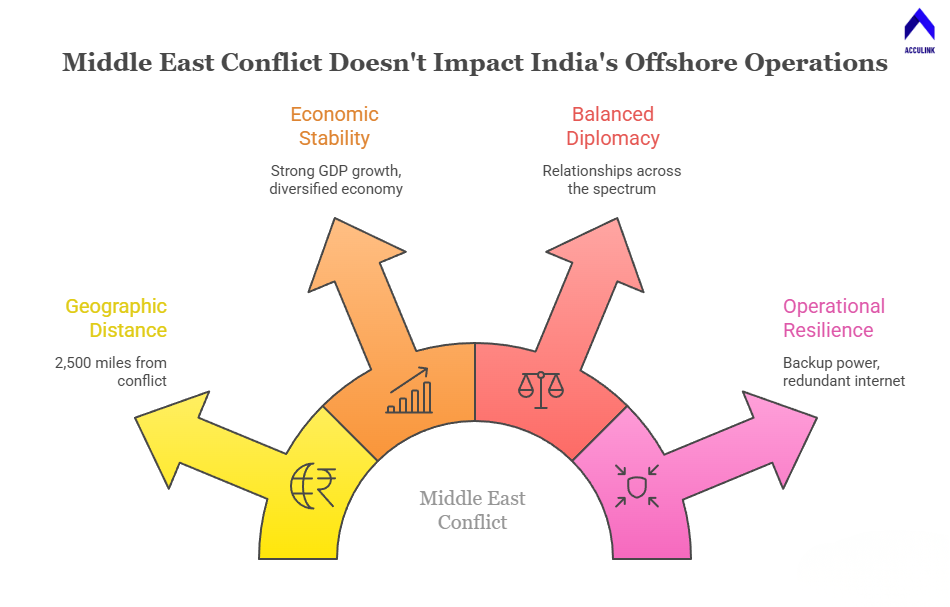
India is approximately 2,500 miles from the nearest Middle East conflict zone. To put that in an American perspective, that’s roughly the distance from New York to Los Angeles. The World Bank rates India’s domestic economic stability as strong. It cites consistent GDP growth above the global average and a diversified economy not dependent on Middle East trade relationships.
India has maintained diplomatic relationships across the Middle East spectrum — including with Israel, Iran, Saudi Arabia, and the UAE — a balanced foreign policy approach that insulates it from the worst effects of regional conflicts. The International Monetary Fund has noted India’s economic resilience to external shocks. It cites the large domestic market, diversified export base, and growing trade relationships with the EU, UK, and ASEAN nations.
Oil price increases do affect India’s economy at the macro level (India is a net oil importer). But this shows up as modest inflationary pressure on the broader Indian economy — not as operational disruption to professional services firms like Acculink CPA. Your offshore team’s productivity, availability, internet connectivity, and data security are completely unaffected by events in the Middle East.
Acculink CPA’s business continuity infrastructure — backup power, redundant internet, encrypted VPN, physical security — provides operational resilience regardless of external events. The company’s ISO 27001 and SOC 2 certifications require documented contingency planning and regular testing. Zero security breaches in 5+ years of operations demonstrates this isn’t theoretical.
For CPA firms worried about geopolitical risk affecting their offshore operations, the evidence is clear. India is the right destination, and Acculink CPA is a provider with the infrastructure and track record to maintain operations through any realistic disruption scenario.
Frequently Asked Questions
How does the Middle East conflict affect my CPA firm?
Primarily through client advisory demand. Clients in manufacturing, logistics, energy, and retail face rising costs, supply chain disruptions, and financial uncertainty, requiring updated projections, valuation analysis, and strategic planning guidance.
Are Acculink’s India operations affected?
No. India is geographically distant from the conflict zone and economically insulated. Acculink CPA’s operations continue normally regardless of Middle East developments — your offshore team maintains full productivity.
What advisory services should I offer clients right now?
Scenario planning, cash flow forecasting, pricing strategy analysis, cost reduction recommendations, insurance coverage review, and supply chain risk assessment. Each creates advisory billing at premium rates.
How can I free up partner time for advisory during this disruption?
Shift compliance and preparation work to your offshore team at $8–$35/hour. This frees partners for $300–$500/hour advisory conversations that clients are actively requesting.
Should I proactively contact affected clients?
Yes. Proactive outreach during disruptions builds trust, creates advisory revenue, and differentiates your firm from competitors who wait for clients to call. Draft communications with AI tools, compile client data with your offshore team, and have partners deliver personalised guidance.
References
U.S. Energy Information Administration — U.S. Energy Information Administration
Council on Foreign Relations — Council on Foreign Relations
World Bank — World Bank
International Monetary Fund (IMF) — International Monetary Fund
Financial Accounting Standards Board (FASB) — Financial Accounting Standards Board (FASB)
ICAEW — Institute of Chartered Accountants in England and Wales (ICAEW)
American Institute of CPAs (AICPA) — American Institute of CPAs (AICPA)
European Commission — Trade — European Commission trade policy
About Acculink CPA
Acculink CPA is a premier offshore staffing and outsourcing company purpose-built for CPA firms, accounting firms, and tax firms in the United States, Canada, and the UAE. With a team of 300+ qualified professionals — including CPAs, Chartered Accountants, Enrolled Agents, and Big 4-trained staff — Acculink provides dedicated offshore accountants, bookkeepers, tax preparers, auditors, virtual CFOs, and virtual assistants at $8–$35/hr, delivering up to 75% cost savings compared to domestic hiring. The company is ISO 27001 certified, SOC 2 Type II aligned, IRS §7216 compliant, and GDPR compliant, with zero security breaches in 5+ years of operations. Acculink offers a 40-hour free trial with no setup fees, no recruitment charges, and no long-term contracts. Over 80 CPA firms across the United States trust Acculink to deliver quality, security, and scalability.
Website: Acculink CPA | Schedule a Call: book a 45-minute call | Email: Info@acculinkcpa.com | Phone: +1 (203) 997-0224
Tags:
About the Author

Related Posts

Hire Offshore Bookkeepers for CPA & Accounting Firms – Blueprint for Outsourced Bookkeeping
How to hire an offshore bookkeeper for your CPA firm — what they do, how vetting and onboarding work, cost (up…

Hire Offshore Accountants for CPA & Accounting Firms – Why Outsourced Accounting Works
How to hire an offshore accountant for your CPA firm — month-end close, GL, GAAP reporting, in your software —…
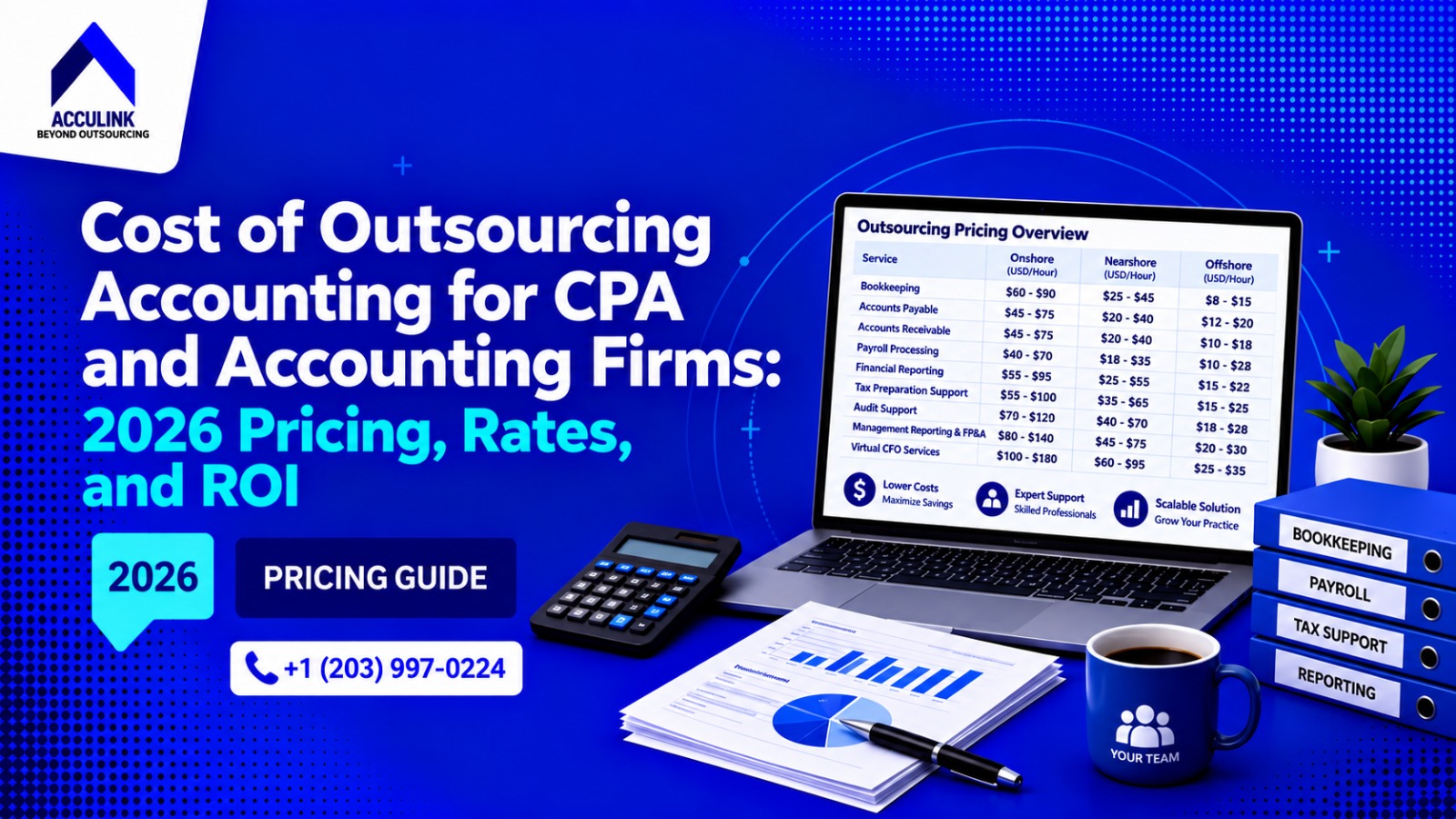
Cost of Outsourcing Accounting for CPA and Accounting Firms: 2026 Pricing, Rates, and ROI
The cost to outsource accounting typically ranges from $8 to $35 per hour, depending on the service, experienc…