Finance & Accounting Outsourcing for Manufacturing Companies – Why Outsource Your Accounting

Manufacturing companies are the backbone of global economies. They transform raw materials into finished goods, create jobs, and drive innovation. However, managing financial operations in a manufacturing environment is complex, time-intensive, and requires specialized expertise. From inventory valuation to compliance and cost controls, the accounting function is a mission-critical component of operational success.
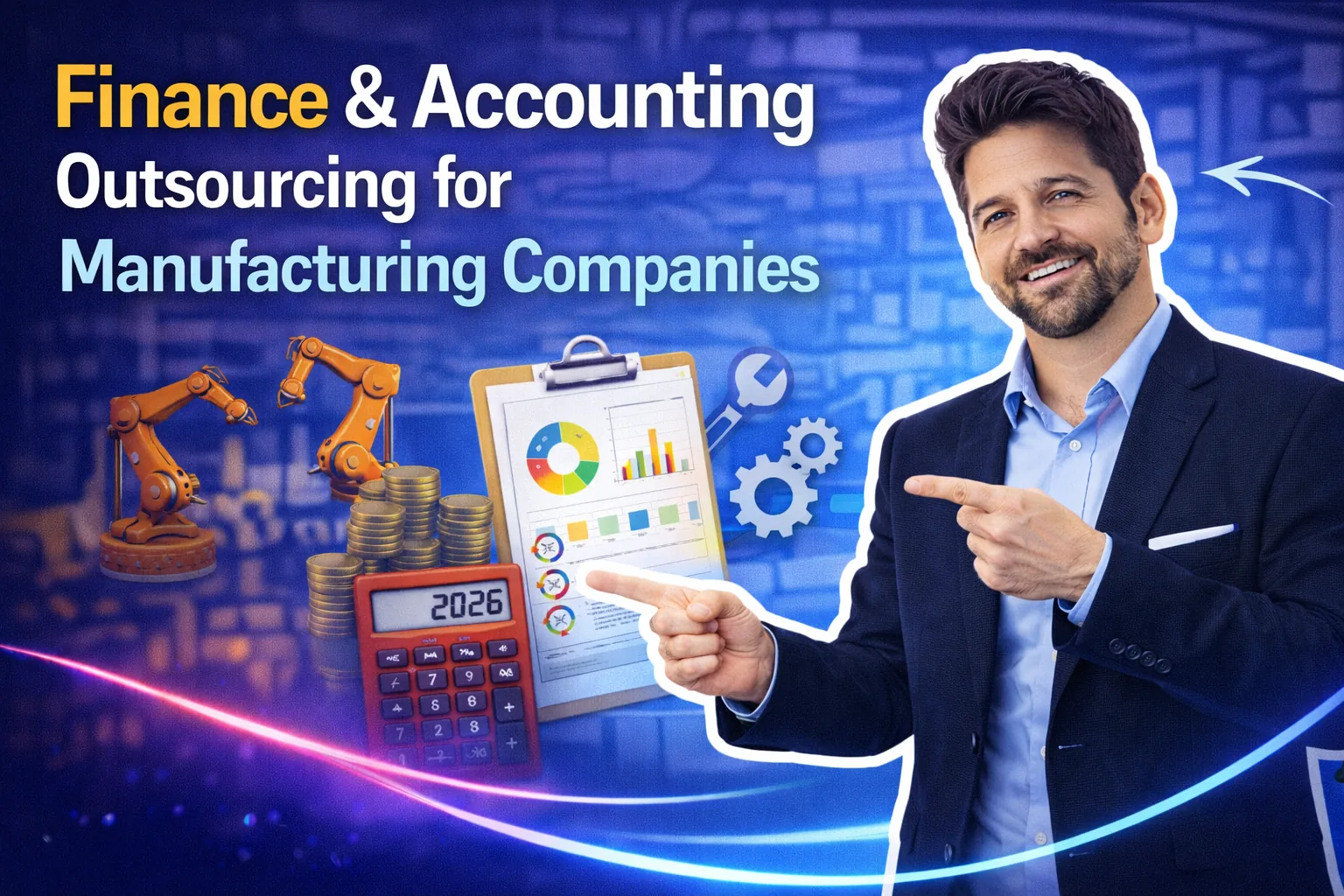
Outsourcing finance and accounting (F&A) functions has rapidly become a strategic priority for many manufacturing businesses. In this blog, we explore what finance and accounting outsourcing is, why manufacturers should consider it, the benefits, common services outsourced, challenges it solves, and how to get started.
What Is Finance & Accounting Outsourcing?
Finance and Accounting Outsourcing (FAO) is a strategic business model in which an organization delegates some or all of its finance and accounting functions to a specialized third-party service provider. Rather than maintaining a fully in-house accounting team, companies leverage external professionals to manage financial operations with greater efficiency, accuracy, and scalability.
FAO can cover a wide spectrum of services, depending on business size, complexity, and objectives. At the foundational level, it may include transactional tasks such as bookkeeping, accounts payable and receivable, payroll processing, and bank reconciliations. At a more advanced level, it can extend to cost accounting, financial reporting, budgeting and forecasting, internal controls, tax compliance, audit support, and CFO-level strategic advisory services.
Outsourcing partners are purpose-built to manage finance functions. They operate with dedicated teams, standardized processes, and industry-specific expertise, allowing businesses to access high-quality financial management without the cost and rigidity of expanding internal headcount.
Key elements that define Finance & Accounting Outsourcing include:
Deep domain expertise
FAO providers employ trained accounting professionals, controllers, and finance leaders who stay current with accounting standards, tax laws, and regulatory requirements. This ensures consistent compliance with frameworks such as GAAP, IFRS, and local tax regulations while reducing the risk of errors or penalties.
Scalable and flexible resources
Outsourcing allows companies to scale finance support up or down based on business needs. Whether responding to seasonal demand, rapid growth, mergers, or system implementations, FAO provides flexibility that is difficult to achieve with fixed in-house teams.
Advanced technology and automation
Most FAO providers leverage modern cloud-based accounting platforms, ERP systems, workflow automation, and reporting tools. This enables faster close cycles, real-time financial visibility, improved data accuracy, and better decision-making without requiring the client to invest heavily in software infrastructure.
Strong focus on compliance, controls, and accuracy
Outsourced finance teams operate with documented processes, segregation of duties, review controls, and audit-ready documentation. This structured approach strengthens internal controls, improves reporting reliability, and supports regulatory and audit requirements.
At its core, Finance & Accounting Outsourcing is not merely a cost-cutting exercise. It is a strategic operating decision that enables organizations to modernize their finance function, improve financial discipline, and shift internal focus from routine processing to higher-value activities such as analysis, planning, and business strategy.
For businesses seeking foundational guidance on accounting principles and financial management frameworks, the U.S. Small Business Administration (SBA) offers authoritative resources that align closely with outsourced accounting models and best practices:
Misconception 1: Outsourcing Reduces Control
When structured correctly, outsourcing actually strengthens financial control.
A well-governed outsourcing model introduces standardized workflows, documented procedures, defined approval hierarchies, and regular reporting cycles. Rather than relying on informal internal processes, businesses gain clearer visibility into financial activities through dashboards, reconciliations, and performance metrics.
Outsourcing providers operate under service-level agreements (SLAs) and compliance frameworks that enforce accountability and consistency. Management retains full ownership of decisions while benefiting from disciplined execution and transparent reporting, resulting in greater not less control over financial operations.
Misconception 2: Outsourcing Is Only for Large Companies
Small and mid-sized businesses often gain the greatest advantage from outsourcing.
Larger enterprises can afford specialized internal finance teams, but smaller and mid-sized organizations typically cannot justify full-time experts for every financial function. Outsourcing bridges this gap by providing access to experienced professionals, advanced tools, and best practices without the cost of permanent hires.
For growing manufacturers in particular, outsourcing enables professional-grade accounting, compliance, and financial insight that would otherwise be difficult to maintain internally. This levels the playing field and supports smarter growth decisions.
Misconception 3: Outsourcing Hurts Internal Jobs
Reality: Strategic outsourcing elevates internal roles rather than eliminating them.
Outsourcing routine, transactional tasks such as data entry, reconciliations, and standard reporting frees internal teams from repetitive work. This allows in-house staff to focus on higher-value responsibilities including financial analysis, business partnering, operational planning, and management decision support.
In many cases, outsourcing reduces burnout, improves job satisfaction, and strengthens the overall finance function by aligning internal talent with strategic priorities rather than administrative workload.
Implementation Best Practices for Finance & Accounting Outsourcing
A successful finance and accounting outsourcing transition depends on clarity, structure, and ongoing oversight. Below are the key implementation headpoints, each explained with focused, practical paragraphs.
1. Define Scope & Objectives
Clearly identify which finance and accounting functions will be outsourced and what the organization aims to achieve. This may include transactional processing, compliance support, reporting, or strategic finance. Defining objectives such as cost efficiency, improved accuracy, faster close cycles, or access to specialized expertise
ensures the outsourcing initiative is aligned with business goals and avoids scope creep.
2. Map Current Processes
Document existing workflows in detail before transitioning responsibilities. This includes process steps, system dependencies, approval hierarchies, and data inputs and outputs. Process mapping helps uncover inefficiencies and control gaps while ensuring the outsourcing partner receives complete operational knowledge, reducing disruption during the transition.
3. Establish KPIs and Governance Metrics
Set clear performance indicators to measure outsourcing effectiveness. Common KPIs include close timelines, error rates, compliance adherence, turnaround times, and cost savings. Governance metrics and review schedules create accountability, support transparent performance tracking, and provide early visibility into potential issues.
4. Ensure Data & System Integration
Align internal systems with the outsourcing partner’s technology environment to enable smooth data flow. This includes ERP integration, secure access controls, data validation protocols, and testing prior to go-live. Strong system integration improves accuracy, reduces manual intervention, and enables real-time financial visibility.
5. Execute Structured Change Management
Prepare internal teams for the transition through clear communication and role definition. Employees should understand how responsibilities will shift, how collaboration will work, and how oversight will be maintained. Effective change management minimizes resistance, preserves institutional knowledge, and ensures continuity of operations.
6. Monitor Performance and Optimize Continuously
Outsourcing should be actively managed through regular performance reviews and feedback cycles. Evaluate SLA compliance, process improvements, evolving business needs, and technology enhancements. Continuous optimization ensures the outsourcing model remains efficient, compliant, and aligned with long-term business strategy.
Choosing the Right Finance & Accounting Outsourcing Partner
Selecting the right outsourcing partner is a strategic decision that directly impacts financial accuracy, compliance, operational efficiency, and long-term scalability. While cost considerations matter, successful outsourcing is ultimately driven by alignment, trust, capability, and governance. A well-chosen partner operates as an extension of your finance function rather than a transactional vendor.
Below are the key criteria to evaluate when selecting a finance and accounting outsourcing provider.
1. Industry Expertise and Domain Knowledge
Industry experience is critical, particularly for manufacturing companies with complex accounting requirements such as cost accounting, inventory valuation, work-in-progress tracking, overhead allocation, and margin analysis.
A qualified partner should demonstrate hands-on experience with manufacturing finance models, regulatory requirements, and operational realities. Industry expertise reduces onboarding time, improves accuracy, and ensures financial reporting aligns with management and compliance needs.
2. Technology Stack and System Compatibility
Your outsourcing partner must be able to integrate seamlessly with your existing technology environment. This includes ERP systems, accounting platforms, payroll software, reporting tools, and data analytics solutions.
A strong technology stack enables automation, real-time visibility, faster close cycles, and scalable operations. Equally important is the provider’s ability to adapt as your systems evolve, whether through upgrades, migrations, or business expansion.
3. Security, Data Protection, and Compliance Controls
Finance data is highly sensitive, making security non-negotiable. The outsourcing provider should follow recognized global standards such as SOC 1 and SOC 2, maintain strict access controls, and implement robust cybersecurity measures.
Key considerations include data encryption, segregation of duties, audit trails, incident response protocols, and regulatory compliance. Strong security practices protect not only financial data but also client trust and organizational reputation.
4. Clear Service Level Agreements (SLAs)
Well-defined SLAs establish accountability and set measurable expectations for performance. These agreements should clearly outline scope of services, turnaround times, accuracy benchmarks, reporting timelines, escalation procedures, and review mechanisms.
Effective SLAs reduce ambiguity, support performance monitoring, and provide a structured framework for managing the outsourcing relationship over time.
5. Communication Model and Cultural Alignment
Consistent communication and cultural compatibility are essential for long-term success. The outsourcing partner should offer clear points of contact, regular reporting, and proactive issue resolution.
Cultural alignment such as shared work ethics, responsiveness, and problem-solving approaches enhances collaboration and reduces friction. When communication flows smoothly, the outsourcing relationship becomes more strategic and results-driven.
6. Scalability and Long-Term Partnership Potential
Beyond current needs, assess the provider’s ability to scale services as your business grows. This includes handling increased transaction volumes, supporting new locations, accommodating regulatory changes, and providing higher-level finance support when required.
A strong outsourcing partner evolves alongside your business, delivering continuous value rather than short-term support.
Conclusion
Finance and accounting outsourcing empowers manufacturing companies to strengthen financial control, improve compliance, and scale efficiently in an increasingly competitive environment. By partnering with a specialized outsourcing provider, manufacturers can move beyond transactional accounting and gain timely insights that support smarter operational and strategic decisions.
Acculink CPA supports this transformation by providing dedicated, industry-trained accounting professionals who integrate seamlessly with manufacturing finance teams. With a strong focus on accuracy, data security, compliance, and scalability, Acculink CPA enables manufacturers to streamline accounting operations, reduce overhead, and maintain audit-ready financials while management stays focused on production efficiency, growth, and long-term value creation.
As manufacturing businesses prepare for future expansion and evolving regulatory demands, working with a trusted partner like Acculink CPA can be a decisive step toward building a resilient, cost-effective, and future-ready finance function.