How to Build an Offshore Team for Your Accounting Firm: A Step-by-Step Playbook


Summary
Learn how to build an offshore team for your accounting firm with this step-by-step guide. Discover strategies to reduce costs, improve efficiency, and scale accounting operations with skilled offshore professionals.
Key Takeaways
-
Building an offshore accounting team isn't a leap of faith — it's a structured, repeatable process that 80+ CPA firms have already followed successfully with providers like Acculink CPA.
-
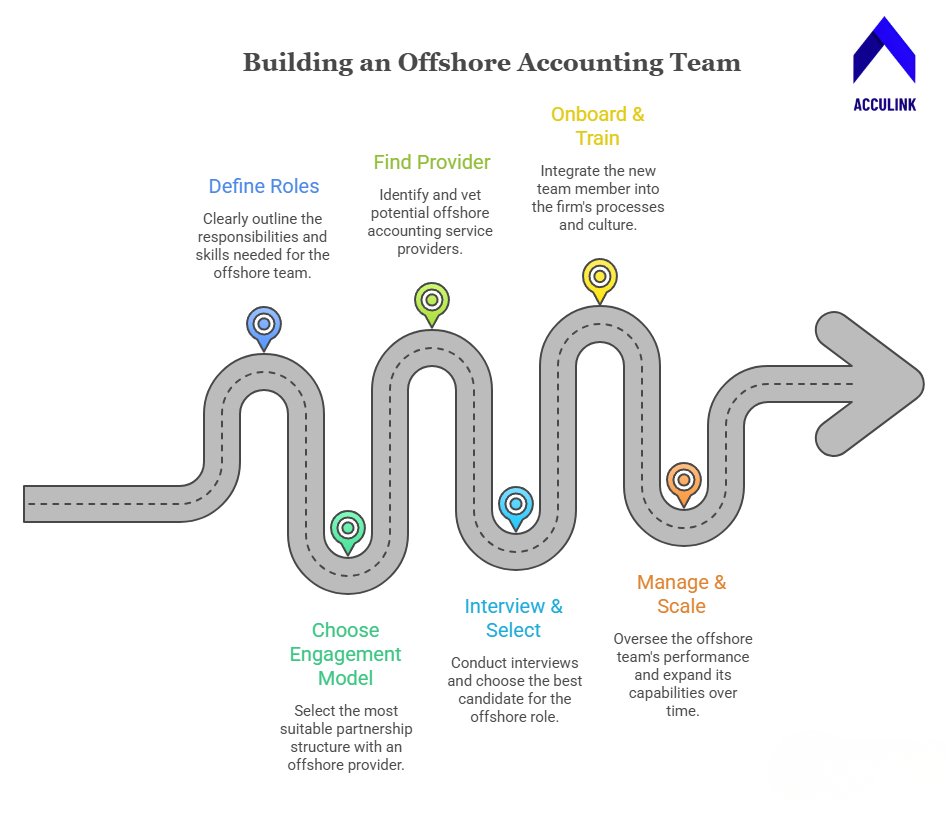
The process follows six clear steps: define roles, choose your engagement model, find the right provider, interview and select, onboard and train, then manage and scale.
-
Start small — most firms begin with 1–2 hires for a specific function (bookkeeping, tax prep) and scale to 10–20+ within a year as confidence grows.
-
The entire timeline from first conversation to a fully operational offshore team member is 2–3 weeks — faster than a domestic hiring cycle that typically runs 3–6 months.
-
Offshore teams deliver 60–75% cost savings, 24-hour work cycles, and reduced partner burnout — but only if you plan the build correctly from the start.
Every CPA firm reaches a breaking point. The point where partners are logging 70-hour weeks during tax season, where client calls go unreturned because everyone's head-down in workpapers, and where the firm's growth ambitions are capped — not by opportunity, but by the number of people who can do the work.
As Reid Hoffman, co-founder of LinkedIn, once observed, "If you are not embarrassed by the first version of your product, you've launched too late." The same logic applies to building offshore teams. Waiting for the perfect moment to start is a guaranteed way to never start at all. The firms that are winning today — the ones clearing 40% more returns per season, the ones whose partners have weekends again — they started building their offshore teams while their competitors were still debating it.
This playbook is your step-by-step blueprint for building an offshore accounting team that works as a seamless extension of your firm. Not a theory document — a practical, week-by-week guide based on the real processes that Acculink CPA and its 80+ CPA firm clients have refined over 5+ years of offshore staffing.
Whether you're hiring your first offshore bookkeeper or scaling from 3 to 15 team members, this guide covers every decision, every milestone, and every potential pitfall along the way.
Step 1: Define the Roles You Need to Fill
Before you contact a single provider, get crystal clear on what you need. The most common mistake firms make is approaching offshore hiring with a vague request — "We need some help with accounting." That's like walking into a staffing agency and saying, "I need someone who does stuff." The more specific you are, the better the match.
Start with Your Pain Points
-
What tasks are consuming the most partner/manager time that shouldn't be?
-
Which functions create the biggest bottleneck during the busy season?
-
Where are errors most frequent — suggesting the need for dedicated capacity?
-
What roles have been hardest to fill domestically?
Common Starting Roles for Offshore Teams
|
Role |
Typical Tasks |
Best For |
|
Bookkeeper |
Reconciliations, journal entries, AP/AR, month-end close |
Firms with steady monthly bookkeeping volume |
|
Tax Preparer |
1040, 1065, 1120, 1120-S return preparation |
Firms needing seasonal or year-round tax capacity |
|
Tax Reviewer |
Review returns for accuracy, flag issues, and quality control |
Firms where partners are doing too much review |
|
Audit Associate |
Workpaper preparation, testing, and documentation |
Firms with audit practices needing fieldwork support |
|
Staff Accountant |
GL maintenance, financial statement prep, reporting |
Firms needing general accounting capacity |
|
Virtual Assistant |
Admin support, scheduling, document management |
Firms needing non-accounting operational support |
|
Virtual CFO |
Cash flow analysis, budgeting, KPI dashboards, advisory |
Firms building advisory service lines |
Acculink offers dedicated hire options across all of these roles, from entry-level (3+ years domestic experience) to senior-level (6+ years of U.S. experience with Big 4 backgrounds). Browse specific role pages: hire an accountant, hire a bookkeeper, hire a tax preparer, hire an auditor.
Step 2: Choose Your Engagement Model — Staffing vs. Outsourcing
This is the most important strategic decision you'll make, and it's one that many firms get wrong because they don't fully understand the difference.
Dedicated Staffing (FTE Model)
-
You hire a specific person who works exclusively for your firm.
-
You manage them directly — assigning tasks, providing feedback, setting priorities.
-
They use your software, follow your SOPs, and attend your meetings.
-
The provider handles HR, payroll, IT, and office infrastructure.
-
Best for: recurring work, long-term capacity building, tax season staffing, and team expansion.
Outsourcing (Project-Based Model)
-
You hand off a defined scope of work to a provider.
-
A project manager from the provider manages the team and delivery.
-
You review deliverables — you don't manage the people.
-
Fixed-price or per-project billing with clear deliverables.
-
Best for: one-time projects, seasonal overflow, catch-up work, or if you have limited time to manage.
Most CPA firms prefer the dedicated staffing model because it gives them full control — the offshore team member becomes truly part of their operation. But the outsourcing model is ideal for specific situations. For a detailed comparison, see our blog on accounting outsourcing services for CPA firms and explore Acculink's engagement models page for detailed pricing and structure.
Step 3: Find the Right Offshore Provider
Not all offshore providers are created equal — and choosing the wrong one is the single biggest reason firms have bad outsourcing experiences. Here's what to evaluate:
CPA-Firm-Specific Experience
A generic staffing agency will send you candidates who can do basic accounting. A CPA-firm-specific provider will send you candidates who know the difference between a 1040 Schedule C and a Schedule E, who understand materiality in audit testing, and who can navigate CCH Axcess without a tutorial. This distinction matters enormously.
Security & Compliance Certifications
Non-negotiable requirements: ISO 27001 (information security management), SOC 2 Type II (service organisation controls), IRS §7216 compliance (for tax work), and GDPR compliance (for data protection). Ask for actual certificates — not just claims on a website.
Acculink CPA maintains all of these certifications with zero security breaches in 5+ years of operations. Their security setup includes 24/7 CCTV monitoring, keycard-controlled access, encrypted VPNs, disabled USB ports, and mandatory NDAs with penalty clauses for every employee.
Talent Quality & Vetting Process
Ask how candidates are sourced, screened, and vetted. What's the interview-to-hire ratio? Do they test for technical skills, communication, and cultural fit? What certifications do their professionals hold? Providers with in-house L&D programs produce consistently better hires.
Trial Period & No-Lock-In Contracts
Any confident provider will let you try before you commit. If a provider insists on long-term contracts without a trial, walk away. Acculink offers a 40-hour free trial — interview, train, and evaluate before spending a dollar.
|
Evaluation Criteria |
Red Flag |
Green Flag |
|
Industry Focus |
Serves 20 different industries generically |
Purpose-built for CPA/accounting firms only |
|
Security |
Claims compliance, but no certificates shown |
ISO 27001, SOC 2, IRS §7216 certified — with proof |
|
Trial Period |
No trial or paid trial only |
Free trial (40 hours) with no obligation |
|
Contract Terms |
Requires a 12-month minimum contract |
No long-term contracts; month-to-month flexibility |
|
Pricing Transparency |
Hidden fees, vague "custom quotes" |
All-inclusive hourly rates, no setup/recruitment fees |
|
Talent Background |
"We have experienced staff" |
CPAs, CAs, EAs with Big 4/top-25 firm experience |
|
Replacement Policy |
No clear process |
Free replacement with knowledge transfer support |
Provider Comparison: What to Ask
Step 4: Interview, Select, and Hire Your Offshore Team
This is where it gets real. The interview process for offshore hires should be just as rigorous as what you'd do for a local hire — maybe more so, because you're evaluating communication quality on top of technical skills.
What to Test in Interviews
-
Technical Knowledge: Ask about specific return types, common adjustments, materiality thresholds, or reconciliation procedures relevant to the role.
-
Software Proficiency: Ask them to walk through how they'd perform a specific task in your software (QuickBooks, CCH Axcess, etc.).
-
Communication: Can they explain a complex issue clearly? Do they ask clarifying questions? Is their English comfortable for your team to work with daily?
-
Problem-Solving: Give them a scenario — "The bank reconciliation is off by $4,200. Walk me through how you'd investigate." Listen for their process, not just their answer.
-
Cultural Fit: Are they proactive or passive? Do they flag issues or wait to be asked? Do they take ownership of their work?
Don't rush this step. Interview 2–3 candidates for each role. It's free with Acculink — no obligation to hire if no one meets your standard.
Step 5: Onboard and Train Like They're Sitting Next to You
The onboarding phase makes or breaks the entire engagement. Firms that invest in proper onboarding get productivity within 2–3 weeks. Firms that skip it spend 3 months frustrated.
Week 1: Foundation
-
Set up all system access: VPN, software logins, email, and communication tools.
-
Conduct a 60–90 minute orientation call. Walk through your firm's culture, values, and expectations.
-
Share your SOP documents, workpaper templates, and review note examples.
-
Assign 2–3 simple tasks as training exercises — not live client work.
Week 2: Guided Production
-
Assign real but lower-risk tasks. Review everything with detailed feedback.
-
Schedule daily 15-minute check-ins during the overlap window.
-
Introduce them to team members they'll interact with regularly.
-
Start tracking turnaround time and accuracy metrics.
Week 3+: Full Production
-
Transition to full workload with standard expectations.
-
Move from daily check-ins to 2–3 per week, then weekly as confidence builds.
-
Provide the same ongoing feedback you'd give any team member — praise good work, correct errors promptly, invest in their development.
As management thinker Jim Collins wrote, "Great vision without great people is irrelevant." The offshore team members you hire are your people now. Treat them accordingly, and they'll deliver accordingly.
Step 6: Manage, Measure, and Scale
Once your offshore team is operational, the focus shifts to optimisation and growth.
Establish KPIs
|
KPI |
What It Measures |
Target Benchmark |
|
Turnaround Time |
Hours from assignment to completion |
Within SLA (e.g., 1040 in 6 hrs, 1065 in 12 hrs) |
|
Error Rate |
Review notes per return |
Declining trend; <3 notes per return after 60 days |
|
Utilization Rate |
Billable hours / available hours |
85–90% for full-time staff |
|
Review Cycle Time |
Time from first submission to final sign-off |
Decreasing over time as quality improves |
|
Client Satisfaction |
Feedback from partners reviewing offshore work |
Consistent positive feedback; specific praise noted |
Communication Cadence
-
Daily: Quick standup (10–15 min) during overlap hours — priorities, blockers, updates.
-
Weekly: 30-minute review of KPIs, workload, and any process improvements.
-
Monthly: Broader performance review with account manager — scaling plans, training needs, satisfaction check.
-
Half-Yearly: Business review (HBR) with the provider — strategic alignment, demand forecasting, team adjustments.
When to Scale
You know it's time to add more offshore team members when:
-
Your existing offshore staff are consistently at 90%+ utilisation.
-
Turnaround times are stretching because of volume, not quality issues.
-
You're turning away work or delaying projects due to capacity constraints.
-
Partners are still spending significant time on work that could be delegated.
Most firms start with 1–2 hires and grow to 5–10 within the first year. Acculink's scalable model means you can go from a single offshore bookkeeper to a full dedicated team spanning accounting, tax, and audit without changing providers.
Common Mistakes When Building an Offshore Team — And How to Avoid Them
-
Mistake #1: Hiring without SOPs. If your processes aren't documented, your offshore team will guess — and guessing means rework. Write your SOPs before your first hire starts.
-
Mistake #2: Skipping the trial period. A 40-hour trial is your insurance policy. Use it to evaluate technical skills, communication, and work quality before committing.
-
Mistake #3: Over-hiring at once. Start with 1–2 roles. Prove the model. Then scale. Firms that hire 10 people on day one often struggle with management overhead.
-
Mistake #4: Treating offshore staff as "vendors." The moment you think of them as outsiders, quality drops. Include them in team meetings, celebrate their wins, and invest in their training.
-
Mistake #5: Ignoring security. Verify certifications. Visit the facility (virtually or in person). Don't assume compliance — confirm it.
For a more comprehensive look at outsourcing pitfalls, read our blog on virtual accounting services for CPA firms.
The ROI of Building an Offshore Accounting Team
Let's put real numbers on what this looks like for a typical 15-person CPA firm that hires 3 offshore team members in Year 1:
|
Metric |
Before Offshore |
After Offshore (Year 1) |
|
Annual Staffing Cost (for 3 roles) |
$240,000–$360,000 (domestic) |
$45,000–$105,000 (offshore, fully loaded) |
|
Net Savings |
— |
$135,000–$255,000 per year |
|
Returns Processed (Tax Season) |
1,200 |
1,600–1,800 (30–50% increase) |
|
Partner Hours on Production |
35% of total hours |
10–15% of total hours |
|
Average Turnaround Time |
5–7 business days |
2–4 business days |
|
Staff Turnover Impact |
Frequent — 3–6 month replacement cycle |
Minimal — provider handles retention & replacement |
These aren't hypothetical projections. Acculink's clients routinely report 60–70% cost reduction, 25% less partner time on operations, and 20–35% profitability growth within the first year.
Frequently Asked Questions
How long does it take to build an offshore accounting team?
From initial conversation to a fully operational team member, the timeline is typically 2–3 weeks. You receive pre-vetted candidate profiles within 5–7 days, conduct interviews in week 2, and complete onboarding by week 3. Subsequent hires are faster because your SOPs and systems are already in place.
Can I start with just one person?
Absolutely. Most firms begin with a single hire — often a bookkeeper or tax preparer — to prove the model. Once you're confident in the workflow and the quality, you scale by adding more roles. There's no minimum headcount requirement.
What if the offshore team member doesn't work out?
Reputable providers offer replacement support at no additional cost. If a hire isn't meeting expectations after proper onboarding and feedback, the provider will source a replacement with full handover support. This is actually easier than replacing a domestic hire.
Do I need to change my software or processes?
No. The offshore team works on your existing software and follows your existing processes. There are no platform restrictions — whether you use QuickBooks, Xero, CCH Axcess, UltraTax CS, or any other tool, the team will adapt to your environment.
How do I manage communication with an offshore team?
Use the 3–4 hour daily overlap window for live communication — standups, questions, and reviews. Use asynchronous tools (Slack, Teams, email) for task assignments and updates. Most firms find that after the first month, the communication rhythm becomes natural and requires minimal extra effort.
Is it safe to give offshore staff access to client data?
Yes — when you work with a certified provider. ISO 27001, SOC 2, and IRS §7216 compliance mean enterprise-grade security is in place. Staff work in secure offices with CCTV, disabled USB ports, encrypted VPNs, and signed NDAs. Many Acculink clients who have visited the India office compare its security to Big 4 firm setups.
References
Bureau of Labour Statistics — Accountants and Auditors — https://www.bls.gov/ooh/business-and-financial/accountants-and-auditors.htm
American Institute of CPAs (AICPA) — https://www.aicpa.org/
Journal of Accountancy — https://www.journalofaccountancy.com/
Institute of Chartered Accountants of India (ICAI) — https://www.icai.org/
Harvard Business Review — Managing Remote Teams — https://hbr.org/
Wikipedia — Offshoring — https://en.wikipedia.org/wiki/Offshoring
About Acculink CPA
Acculink CPA is a premier offshore staffing and outsourcing company purpose-built for CPA firms, accounting firms, and tax firms in the United States, Canada, and the UAE. With a team of 300+ qualified professionals — including CPAs, Chartered Accountants, Enrolled Agents, and Big 4-trained staff — Acculink provides dedicated offshore accountants, bookkeepers, tax preparers, auditors, virtual CFOs, and virtual assistants at $8–$35/hr, delivering up to 75% cost savings compared to domestic hiring. The company is ISO 27001 certified, SOC 2 Type II aligned, IRS §7216 compliant, and GDPR compliant, with zero security breaches in 5+ years of operations. Acculink offers a 40-hour free trial with no setup fees, no recruitment charges, and no long-term contracts. Over 80 CPA firms across the United States trust Acculink to deliver quality, security, and scalability.
Website: Acculink CPA | Schedule a Call: book a 45-minute call | Email: Info@acculinkcpa.com | Phone: +1 (203) 997-0224
Tags:
About the Author

Related Posts

Hire Offshore Accountants for CPA & Accounting Firms – Why Outsourced Accounting Works
How to hire an offshore accountant for your CPA firm — month-end close, GL, GAAP reporting, in your software —…
Accounting Outsourcing Services for CPA & Accounting Firms – Why Outsourcing Works
Accounting outsourcing lets CPA firms add capacity without adding headcount. Why outsourced accounting service…
15 Profitable Add-On Services CPA and Accounting Firms Can Offer Without Hiring In-House
CPA and accounting firms do not need to build every new service with another in-house hire. This guide compare…