CPA Offshore Staffing Pain Points: Why It Is Not Working (And Exactly How to Fix It)

Summary
Many CPA firms struggle with offshore staffing due to communication gaps, quality inconsistencies, time zone challenges, and lack of proper processes. This blog breaks down the key reasons offshore models fail—and provides practical, proven solutions to make offshore staffing efficient, scalable, and truly cost-effective.
Key Takeaways
• Most CPA firms that struggle with offshore staffing are not failing because of offshoring itself — they are failing because of the wrong provider, wrong model, or missing integration structure.
• The nine most common pain points — quality inconsistency, communication lag, high turnover, timezone friction, data security gaps, poor onboarding, workflow misalignment, hidden costs, and lack of senior talent — all have documented, structural solutions.
• Firms that switch from a multi-client offshore vendor to a dedicated staffing model consistently report quality improvement within 60 days and cost stabilisation within 90 days.
• Acculink CPA's dedicated model eliminates the root causes of most offshore pain points: staff work exclusively for your firm, in your software, on your schedule, with a U.S.-facing account manager handling coordination.
• 80+ CPA firms currently operating a structured Acculink offshore model report zero security incidents, sub-24-hour turnaround on standard returns, and staff retention rates above 90% annually.
You leapt. You hired offshore accounting staff, paid the setup fees, sent over the first batch of client files, and waited. What came back was — fine. Sometimes. But then it was late. Then the quality dipped. Then the person you trained for three months was replaced without notice by someone who had never seen your firm's workflows. And now you are wondering whether offshoring actually works, or whether you just paid to learn an expensive lesson.
Here is the truth most offshore staffing companies will not tell you: the offshore model works extremely well. The failures are almost always failures of implementation — the wrong provider structure, the wrong staffing model, or the wrong expectation-setting. This guide names every major pain point CPA firms experience with offshore staffing, explains why each one happens, and gives you the specific fix. If you are evaluating whether your current arrangement is salvageable or whether you need a fresh start, you will find your answer here. You can also read our detailed guide on building a structured offshore accounting team and our breakdown of in-house vs. remote vs. offshore staffing models for full context.
|
YOUR OFFSHORE MODEL SHOULD BE WORKING — LET US FIX IT Acculink CPA delivers dedicated offshore accountants, tax preparers, and bookkeepers at $8–$35/hr. Exclusively yours. ISO 27001. SOC 2. IRS §7216 compliant. Start with a 40-hour free trial — no setup fees, no long-term contracts. → Schedule a Free Consultation — calendly.com/acculinkcpa/45min Trusted by 80+ firms · ISO 27001 · SOC 2 · IRS §7216 · acculinkcpa.com |
Why So Many CPA Firms Are Struggling With Offshore Staffing Right Now
The accounting industry's offshore staffing market has grown rapidly over the past decade. The AICPA estimates that over 40% of CPA firms with 10 or more employees now use some form of offshore or outsourced accounting support. That number is climbing. But growth in adoption has not been matched by growth in provider quality. The market is crowded with vendors who overpromise on talent, underdeliver on management infrastructure, and structure their business models around volume rather than client outcomes.
The result: a significant percentage of CPA firms using offshore staffing right now are using it badly, through no fault of their own. They are in shared-resource pools where their work competes with 50 other clients. They are managing staff who report to a vendor, not to them. They are paying for hours that include non-billable coordination overhead. They are absorbing the cost of turnover they had no say in. These are not inevitable features of offshore staffing — they are features of bad offshore staffing. The distinction matters because the solution is a model change, not an industry exit.
|
Offshore Staffing Model |
How It Works |
Core Problem |
|
Shared resource pool (most vendors) |
Staff serve 10–30 client firms simultaneously |
No loyalty, split attention, high turnover |
|
Project outsourcing |
Work is assigned per task to available staff |
No continuity, no institutional knowledge |
|
Freelance marketplace |
Self-employed contractors, no employer oversight |
No accountability, no security compliance |
|
Dedicated staffing (Acculink model) |
Staff work exclusively for one client firm |
Solves virtually all pain points listed below |
Pain Point 1: Inconsistent Work Quality That Varies Week to Week
Why It Happens
Quality inconsistency in offshore accounting work almost always traces back to one root cause: the staff handling your work are not dedicated to your firm. In a shared-resource pool, your returns and bookkeeping files compete for attention with dozens of other client firms. Staff rotate between engagements based on vendor scheduling, not your deadlines or preferences. Different people touch your work each week, none of whom has deep familiarity with your clients or your quality standards.
Add to this the review structure most offshore vendors use: a single senior reviewer responsible for checking the output of 15 to 20 junior preparers across multiple client firms. That reviewer cannot apply firm-specific quality standards they do not know, to client files they have never seen before, across a portfolio that changes constantly.
The Fix
Dedicated staffing eliminates variable quality at the source. When the same staff member handles your client files every week, they build institutional knowledge. They learn your clients' income patterns, your review preferences, and the edge cases in your niche. Quality improves as a compounding function of familiarity — not as a result of vendor promises.
Acculink CPA's model pairs each client firm with exclusively dedicated staff who are integrated into the firm's own review workflow. Your senior reviewer checks your dedicated staff's output against your standards — not a generic offshore quality rubric. That loop, run consistently, produces the same quality trajectory you would expect from an in-house hire.
Pain Point 2: Communication Delays That Derail Deadlines
Why It Happens
The India Standard Time zone is 10.5 hours ahead of U.S. Eastern, 11.5 hours ahead of Central, and 13.5 hours ahead of Pacific. When a U.S. CPA firm sends a question at 3 PM Eastern, a response at the start of the next Indian business day arrives at approximately 11:30 PM Eastern the previous night — meaning the CPA sees it the following morning. A single clarification round-trip costs 24 hours.
Most offshore vendors handle this by assigning a local U.S. account manager who relays messages to the offshore team. This adds a communication layer rather than removing one. Questions get paraphrased, context gets lost, and the CPA still waits 24 hours for a technical answer because the account manager is not the person doing the accounting work.
The Fix
The solution is a structured overlap window — a defined block each day where your offshore staff are available for real-time communication during your business hours. Acculink CPA builds a 4-hour overlap window into every dedicated staffing engagement: Indian staff shift their schedules to be available from 8 AM to 12 PM Eastern (or equivalent for other time zones). During this window, questions get answered in minutes, not the following morning.
Outside the overlap window, a shared project management channel (Slack, Teams, or your preferred tool) handles asynchronous handoffs with documented status updates so nothing falls through overnight. This structure, combined with clear turnaround SLAs, eliminates the "waiting game" that most CPA firms associate with offshore delays.
|
Communication Structure |
Avg. Response Time |
Deadline Risk |
|
Vendor relay model (most providers) |
18–36 hours per exchange |
High — each clarification costs a day |
|
Email-only async (no overlap) |
12–24 hours |
Moderate — workable only for simple tasks |
|
Overlap window + async channel |
Under 2 hours during overlap, same-day async |
Low — suitable for complex engagements |
|
Dedicated staff + overlap + direct access |
Minutes during overlap |
Minimal — mirrors in-house team dynamics |
Pain Point 3: High Staff Turnover That Erases Months of Training
Why It Happens
In a shared-resource vendor model, the offshore staff member assigned to your account is an employee of the vendor, not a long-term partner in your firm's success. Their career advancement depends on the vendor's internal promotion structure, not on your client satisfaction. When a better internal opportunity arises, or when a competitor vendor offers a higher salary, they leave — and the vendor replaces them without necessarily informing you until after the transition has already happened.
Annual turnover rates in offshore accounting pools commonly run 25–40%. For a CPA firm that spent three months training a staff member on their software stack, review preferences, and client nuances, this is a severe recurring cost. The training clock resets. The quality dips during the learning curve. The CPA owner absorbs all of it.
The Fix
Two structural changes drive retention. First, dedicated staffing creates a genuine professional relationship between the staff member and the client firm. Staff who feel integrated into a firm's team, who are on firm communication channels, who attend firm meetings, and who receive feedback directly from the partners they serve, consistently report higher job satisfaction and lower intent to leave. The relationship itself is a retention mechanism.
Second, provider-side retention practices matter. Acculink CPA invests in staff development, structured career ladders, performance bonuses tied to client outcomes, and a working environment that attracts professionals who want long-term employment — not a short-term gig. The result is an annual staff retention rate above 90% across active client engagements. When transitions do occur, Acculink provides a minimum 30-day overlap so the incoming staff member is fully trained before the outgoing one departs.
|
STOP RETRAINING EVERY SEASON Acculink CPA's dedicated staff stay. 90%+ annual retention across active client engagements. Your dedicated accountant, tax preparer, or bookkeeper learns your firm once — and keeps getting better. 40-hour free trial, no setup fees. → Start Your Free Trial — acculinkcpa.com/contact Trusted by 80+ firms · ISO 27001 · SOC 2 · IRS §7216 · acculinkcpa.com |
Pain Point 4: Staff Who Cannot Work in Your Specific Software
Why It Happens
U.S. CPA firms use a wide variety of software ecosystems: CCH Axcess, Lacerte, ProSeries, Drake, UltraTax, QuickBooks Online, QuickBooks Desktop, Xero, NetSuite, Sage Intacct, Bill.com, and dozens of ancillary tools for document management, client portals, and workflow tracking. Most offshore vendors train their staff on one or two platforms and deploy them broadly, regardless of fit.
The result: a "tax preparer" who has never opened Lacerte gets assigned to a firm running CCH Axcess. They learn on the job — slowly, and at your clients' expense. The CPA firm's partners spend their own time doing basic software training that should have been completed before the first assignment.
The Fix
Pre-deployment technical assessment in your specific software stack is non-negotiable. Before any Acculink staff member is placed with a client firm, they are tested on the exact tools the firm uses. If a firm runs Lacerte for 1040s, ProSeries for 1120-S, and QBO for bookkeeping, the candidate is assessed on all three. Placement only happens when the assessment confirms functional competency.
For firms with highly specific or proprietary workflow tools, Acculink's two-week structured onboarding program — which you can review in our offshore accountant onboarding guide — includes a dedicated tool-training phase before any client work begins. The firm's own senior staff run the tool training; Acculink handles the scheduling and documentation.
Pain Point 5: Data Security You Cannot Audit or Verify
Why It Happens
Most offshore accounting vendors claim to be "secure." They have a privacy policy on their website, a checkbox for GDPR compliance, and a non-disclosure agreement that neither party expects to enforce. What they rarely have is an independently audited security certification, a documented incident response plan, or a WISP that satisfies the Gramm-Leach-Bliley Act's requirements for tax preparers handling client financial data.
CPA firms rarely discover this gap until they need it — during a breach, a regulatory inquiry, or an insurance claim. At that point, the vendor's security claims evaporate, the NDA proves unenforceable across jurisdictions, and the firm absorbs the reputational and financial consequences alone.
The Fix
Security posture should be verified, not trusted. When evaluating any offshore staffing provider, request documentation for: ISO 27001 certification (third-party audited), SOC 2 Type II alignment report, IRS §7216 data processing agreements, WISP documentation, breach history disclosure, and network security architecture overview. A legitimate provider provides all of these without hesitation. A provider who deflects is telling you what their security actually looks like.
Acculink CPA's IT and data security standards include ISO 27001 certification, SOC 2 alignment, IRS §7216-compliant data processing agreements, firewalled delivery environments, USB-disabled workstations, monitored screen activity, VPN-secured file transfer, and zero security breaches across 5+ years of operation. All documentation is available to client firms for review during due diligence. See our due diligence guide for outsourcing providers for the complete checklist.
|
Security Standard |
Typical Offshore Vendor |
Acculink CPA |
|
ISO 27001 Certification |
Claimed but rarely audited |
Third-party certified |
|
SOC 2 Alignment |
Not documented |
Documented and available |
|
IRS §7216 Data Agreements |
Generic NDA only |
Specific, signed agreements per client |
|
WISP Documentation |
Absent |
Maintained and auditable |
|
Network Security Architecture |
Home office / shared office, no monitoring |
Firewalled facility, screen monitoring, VPN |
|
Breach History |
Not disclosed |
Zero incidents — 5+ years, documented |
|
Insurance Claim Supportability |
Unlikely — no audit trail |
Full documentation for insurer review |
Pain Point 6: Onboarding That Takes Months and Still Fails
Why It Happens
Onboarding an offshore staff member without a structured plan is the most common reason the first 90 days of an offshore relationship fail. The typical pattern: a CPA firm owner emails a few process documents, schedules one video call, sends a test return, and then assumes the staff member is ready. The staff member, eager to please, does not ask the questions they should. Work comes back wrong. The firm partner corrects it and sends it back without documenting the correction. The same error reappears the following week.
This is not a talent problem. It is an onboarding infrastructure problem. The staff member never had a clear process map, a defined scope of initial work, a feedback loop structure, or a way to escalate questions without feeling like they were disrupting their supervisor.
The Fix
Structured onboarding has four components that every successful offshore integration includes: a documented process library (standard operating procedures for every recurring task), a scoped first-week assignment (simple, bounded work that lets the staff member demonstrate competency before complexity is added), a daily check-in cadence for the first two weeks (15 minutes, not optional), and a feedback capture system (a shared log where corrections are documented so errors do not repeat).
Acculink CPA's two-week onboarding framework covers all four components and is included at no additional cost for every new placement. The firm's account manager facilitates the process, ensuring the CPA firm's partners spend their time reviewing work — not designing training programs. Further details are in our offshore accountant onboarding guide.
Pain Point 7: Workflow Misalignment — Offshore Staff Work in Isolation
Why It Happens
In a vendor-managed offshore model, the staff member sits inside the vendor's organisational structure. They attend the vendor's team meetings. They report to the vendor's managers. They follow the vendor's quality protocols — which may or may not align with yours. The CPA firm gets output but has no visibility into the process that produced it, no ability to course-correct in real time, and no mechanism for building the offshore staff into a genuine team extension.
The offshore team becomes a black box: files go in, returns come out, and the CPA firm has no idea what happened in between or whether it will happen the same way next week.
The Fix
Integration, not isolation. Dedicated offshore staff should be on your firm's communication channels — Slack, Microsoft Teams, or whatever your team uses. They should attend your team's weekly calls. They should use your firm's project management tools. They should be able to raise a question to your in-house reviewer as naturally as your local staff member would.
This integration model is what distinguishes a true team extension from a transaction vendor. Acculink CPA facilitates full integration into the client firm's workflow stack as part of every engagement. Staff are provided with firm-specific email addresses where relevant, added to firm communication channels, and treated as team members — not external contractors. The hybrid team building guide walks through exactly how this integration is structured.
Pain Point 8: Hidden Costs That Make Offshoring More Expensive Than Expected
Why It Happens
The headline rate looks compelling. But CPA firms frequently discover that the actual all-in cost of their offshore arrangement bears little resemblance to the quoted hourly rate. Common hidden cost categories include: setup and onboarding fees charged upfront, mandatory minimum hour commitments even in slow months, quality-check revision hours not included in the quoted rate, account management fees billed separately, software license fees passed through to the client, currency conversion spreads and international wire fees, and escalation charges for senior review work.
When these costs are aggregated, the effective rate for offshore accounting work often exceeds $40–$50 per hour — comparable to junior U.S. staff in lower-cost markets, without the communication and quality advantages of local employment.
The Fix
Total cost transparency before engagement. Ask every provider for an all-in rate card that includes every fee category. If the provider cannot provide a written, itemised cost structure, the hidden costs exist and are simply not disclosed yet.
Acculink CPA's pricing structure is fully transparent: $8–$35 per hour, depending on role and experience level, no setup fees, no minimum hour commitments, no account management surcharges, and no termination penalties. The 40-hour free trial lets you verify quality and workflow fit before committing any budget. The engagement models page documents every aspect of how the commercial relationship works.
|
Cost Category |
Typical Offshore Vendor |
Acculink CPA |
|
Setup / Onboarding Fee |
$500–$2,000 |
None |
|
Minimum Hour Commitment |
Often 160 hrs/month |
None |
|
Account Management Fee |
$200–$500/month |
Included |
|
Revision / QC Hours |
Billed separately |
Included in staff hours |
|
Termination Penalty |
Often, a 30–to 90–day notice is required |
None |
|
Free Trial |
Rare |
40 hours — fully free |
|
Effective All-In Rate |
$35–$65/hr after hidden fees |
$8–$35/hr — transparent and fixed |
|
NO SETUP FEES. NO HIDDEN COSTS. NO LONG-TERM CONTRACTS. Acculink CPA's pricing is fully transparent: $8–$35/hr for dedicated offshore accountants, tax preparers, bookkeepers, and auditors. 40-hour free trial included. 80+ firms already trust this model. → Hire Your Dedicated Staff — acculinkcpa.com/hire/hire-dedicated-team Trusted by 80+ firms · ISO 27001 · SOC 2 · IRS §7216 · acculinkcpa.com |
Pain Point 9: Offshore Staff Cannot Handle Complex Work Independently
Why It Happens
The offshore accounting industry has a talent distribution problem that most vendors do not acknowledge: the majority of available staff are trained for high-volume, rule-based tax preparation — simple 1040s, W-2 returns, basic bookkeeping. Firms that need senior-level judgment — complex partnership returns, multi-state allocations, audit support, financial statement preparation, or advisory-level analysis — quickly find that offshore staff require so much hand-holding that the time savings evaporate.
This is often framed as an offshore staffing problem. It is actually a talent sourcing problem. Senior-level offshore accounting talent exists in abundance — particularly professionals from Big 4 firms' India offices, ICAI-chartered accountants with U.S. tax experience, and Enrolled Agents who trained in offshore delivery centres. These professionals rarely appear in vendor shared pools because they command higher compensation and prefer stable, dedicated relationships.
The Fix
Match the talent level to the work complexity. If your firm handles complex engagements, you need a provider with access to senior-level offshore talent and the willingness to place them in dedicated roles. Acculink CPA's professional network includes EY GDS alumni, Big 4-trained CAs, experienced Enrolled Agents, and accountants with 7–15 years of U.S. tax and audit experience. These professionals handle complex multi-state returns, K-1 packages, audit workpapers, and CFO-level reporting independently — with your review, not your constant supervision.
For firms that need both volume capacity and complex-engagement coverage, the dedicated team model allows you to build a tiered offshore team: one senior reviewer and two to three preparers, all dedicated to your firm, all integrated into your workflow. That structure replaces what you might otherwise hire as a full in-house team at $180,000–$300,000 in combined salary for a fraction of that cost. Learn more about how to hire dedicated offshore accounting teams.
The Solution Framework: What a Fixed Offshore Model Looks Like
Step 1: Audit Your Current Arrangement
Before switching providers or restructuring, document what is actually broken. Which pain points from this list are you experiencing? Are quality issues tied to specific staff, specific work types, or specific time periods? Is the communication problem structural (timezone, tools) or relational (wrong people)? Is turnover high because of the vendor's culture or because of your onboarding? The diagnosis determines the fix.
Step 2: Decide Whether to Fix or Replace
Some offshore relationships are fixable: the provider is cooperative, the staff member is capable, and the problems are structural gaps that a conversation and new process can address. Others are not: the vendor is unresponsive, the staff pool is too shallow, security compliance is absent, and the commercial model works against your interests. Be honest about which situation you are in. Switching providers is disruptive but finite. Staying in a broken arrangement is a recurring cost with no end date.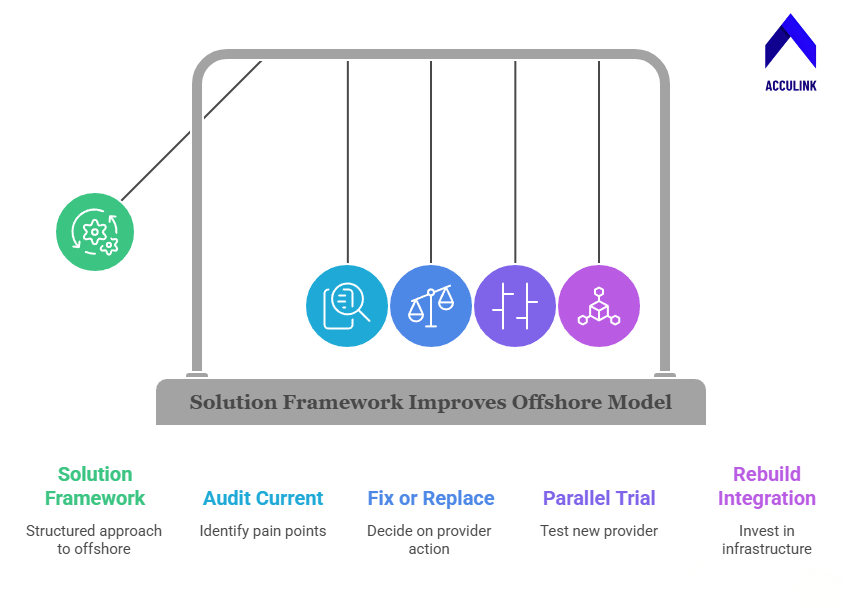
Step 3: Run a Parallel Trial Before Full Migration
If you are considering a new provider, the most risk-managed approach is a parallel trial: keep your existing arrangement running while testing the new provider on a defined scope of work. Acculink CPA's 40-hour free trial is designed for exactly this. Run both arrangements on similar work for four to six weeks. Compare output quality, turnaround time, communication quality, and staff consistency. The comparison makes the decision obvious.
Step 4: Rebuild the Integration Infrastructure
Whichever provider you move forward with, invest two weeks in building the integration structure correctly. Document your processes. Define the overlap window. Set up the communication channels. Establish the feedback loop. Run the onboarding framework. This upfront investment — which costs roughly 40 hours of combined time from your team and the new staff member — pays back within the first month and compounds every month after.
Our 90-day offshore transition guide gives you a week-by-week implementation plan for making this transition structured, low-risk, and fast.
Frequently Asked Questions
How do I know if my current offshore provider is the problem, or if I am managing the relationship wrong?
The clearest diagnostic is consistency. If quality and turnaround are inconsistent despite your firm following a clear process, the problem is usually provider-side: shared staffing pools, high internal turnover, or inadequate talent matching. If quality is consistent but slow, the problem is usually structural: timezone management, communication tools, or review workflow. If you are spending more than two hours per week managing the offshore relationship administratively, the provider is not delivering the management infrastructure they should be. A dedicated staffing model with an account manager handles all of that overhead, so soo you do not have to.
Can I switch offshore providers mid-season without disrupting my clients?
Yes — with planning. The key is a phased transition: identify which engagements are safest to move first (simpler, lower-deadline work), run a parallel trial on those, and migrate complex or time-sensitive engagements only after the new provider has demonstrated capability. Acculink CPA has managed mid-season provider transitions for several client firms and has a structured transition protocol that keeps client deliverables on schedule throughout the switch. The 40-hour free trial period is used to run the parallel test before any commitment is made.
What is the realistic timeline for an offshore staffing arrangement to become fully productive?
With structured onboarding, a dedicated staff member typically reaches 70–80% of target productivity within the first two weeks and full productivity within 45–60 days. Without structured onboarding, this timeline extends to three to four months — and many arrangements never reach full productivity because the feedback loop was never properly established. The onboarding investment at week one pays dividends every week after.
How does Acculink CPA handle situations where a placed staff member is not a good fit?
Acculink CPA's 40-hour free trial is specifically designed to surface fit issues before financial commitment. If a fit problem emerges after the trial, the firm works with the client to identify whether the issue is skill-based (replaceable with a different candidate), communication-based (resolvable with structure changes), or scope-based (addressable with a role redefinition). When a replacement is needed, Acculink provides a minimum 30-day overlap to ensure the incoming staff member is trained before the outgoing one departs — so your firm never loses institutional knowledge overnight.
Is dedicated offshore staffing realistic for a small CPA firm with only three or four in-house staff?
It is often the most valuable for smaller firms. A three-person in-house team with one dedicated offshore tax preparer effectively operates as a five-person firm during tax season, with 60–70% lower labour cost on that added capacity. Acculink's model has no volume minimums: you can start with one staff member and scale as your needs grow. Smaller firms also tend to see faster productivity gains because the dedicated staff member has fewer competing priorities and integrates more fully into the firm's workflow.
References
• AICPA — 2024 PCPS CPA Firm Top Issues Survey
• AICPA — Data Security and Client Confidentiality Resources
• IRS — Section 7216 Guidance for Tax Return Preparers
• IRS — Written Information Security Plan (WISP) for Tax Professionals
• FTC — Gramm-Leach-Bliley Act Safeguards Rule
• Journal of Accountancy — Managing Remote and Offshore Accounting Teams
• Accounting Today — The State of Offshore Staffing in Accounting 2024
• SHRM — Employee Retention and Turnover Cost Analysis
• Deloitte — Global Shared Services Survey 2024
• Acculink CPA — IT & Data Security Standards
• Acculink CPA — Offshore Accounting Outsourcing Services
• Acculink CPA — How to Build an Offshore Team for Your Accounting Firm
About Acculink CPA
Acculink CPA is a premier offshore staffing and outsourcing company purpose-built for CPA firms, accounting firms, and tax firms in the United States, Canada, and the UAE. With a team of 300+ qualified professionals — including CPAs, Chartered Accountants, Enrolled Agents, and Big 4-trained staff — Acculink provides dedicated offshore accountants, bookkeepers, tax preparers, auditors, virtual CFOs, and virtual assistants at $8–$35/hr, delivering up to 75% cost savings compared to domestic hiring. The company is ISO 27001 certified, SOC 2 Type II aligned, IRS §7216 compliant, and GDPR compliant, with zero security breaches in 5+ years of operations. Acculink offers a 40-hour free trial with no setup fees, no recruitment charges, and no long-term contracts. Over 80 CPA firms across the United States trust Acculink to deliver quality, security, and scalability.
Website: Acculink CPA | Schedule a Call: book a 45-minute call | Email: Info@acculinkcpa.com | Phone: +1 (203) 997-0224
Tags:
About the Author

Related Posts

Hire Offshore Payroll Experts for CPA & Accounting Firms – Your Guide to Payroll Outsourcing
Hire an offshore payroll expert for your CPA firm — multi-state filings (941/940), W-2/1099, year-end — at up …

Property Accounting Outsourcing for CPA & Real Estate Firms – Why Outsource Property Accounting
How outsourcing property accounting helps CPA & real estate firms — rent rolls, CAM reconciliations, MACRS dep…

Outsourcing vs. Offshore Staffing for CPA Firms: What\\\\\\\'s the Difference and Which Is Right for You?
Outsourcing and offshore staffing are not the same thing — confusing the two leads to mismatched expectations,…