10 Reasons CPA Firms Should Avoid Freelancers in Outsourcing (And What to Do Instead)


Summary
Freelancers may seem like a quick and cost-effective solution for CPA firms, but they often come with hidden risks—from inconsistent quality and data security concerns to lack of accountability and scalability. In this blog, we break down 10 critical reasons why relying on freelance accountants can hurt your firm’s growth—and explore why dedicated offshore staffing is a smarter, more reliable alternative used by 80+ CPA firms today.
Key Takeaways
• Freelancers may appear cost-effective upfront, but the hidden costs of accountability failures, data breaches, and ghosting during peak tax season can far exceed any savings.
• Accounting firms handle sensitive financial data protected under IRS §7216, Gramm-Leach-Bliley, and state privacy laws — standards most freelancers cannot meet or verify.
• Senior-level accounting talent rarely freelances; firms relying on platforms like Upwork or Fiverr consistently receive junior or misrepresented credentials.
• Dedicated offshore staffing providers like Acculink CPA deliver ISO 27001, SOC 2, and IRS §7216-compliant teams at $8–$35/hr with zero setup fees and a 40-hour free trial.
• 80+ CPA firms have already shifted from freelancer dependency to structured offshore teams — gaining predictable capacity, quality control, and zero security incidents.
It seems like the obvious move. Tax season is piling up, a partner just left, and you need someone who can jump in fast on 1040s or bookkeeping cleanup. So you post on Upwork, get 30 bids overnight, pick someone with a solid profile, and wire the first invoice. Four weeks later, you are chasing deliverables, your client data is sitting on an unprotected laptop somewhere overseas, and the person stopped responding on April 9th — two weeks before the deadline.
This is not a rare story. It is the most common outsourcing mistake CPA firms make. The appeal of freelance accounting outsourcing is understandable: low cost, no commitment, fast access. But the accounting industry has characteristics that make freelancing a fundamentally poor fit. This guide breaks down the 10 most critical risks, backed by data, so you can make a smarter decision. If you are also comparing your broader options, see our full analysis of in-house vs. remote vs. offshore accountants and our step-by-step guide to building a structured offshore team.
|
STOP GAMBLING ON FREELANCERS Acculink CPA delivers dedicated offshore accountants, tax preparers, and bookkeepers at $8–$35/hr. ISO 27001 certified. SOC 2 aligned. IRS §7216 compliant. Start with a 40-hour free trial — no setup fees, no long-term contracts. → Schedule Your Free Consultation — calendly.com/acculinkcpa/45min Trusted by 80+ firms · ISO 27001 · SOC 2 · IRS §7216 · acculinkcpa.com |
Why Accounting Outsourcing Is Not Like IT Outsourcing
The IT industry normalised freelancing for good reason: a developer fixing a JavaScript bug does not have access to your clients' Social Security numbers, tax returns, or bank statements. The work is technical, verifiable in isolation, and the worst-case outcome of a bad hire is a buggy feature.
Accounting outsourcing is categorically different. When you hand off a client's tax return or bookkeeping file to an external party, you are transferring some of the most sensitive data that exists — personal income figures, corporate financials, EINs, and bank account details. The regulatory environment around this data is strict, and the consequences of a breach fall on your firm, not the freelancer.
Three frameworks govern how CPA firms must protect client data: IRS §7216 (consent requirements for third-party disclosure), the Gramm-Leach-Bliley Act (Written Information Security Plan, or WISP), and state-level CPA practice acts. Most freelancers have never heard of a WISP. The majority operate outside the jurisdiction of U.S. law entirely. The gap between what compliance requires and what freelancers provide is not a minor technicality — it is a structural incompatibility.
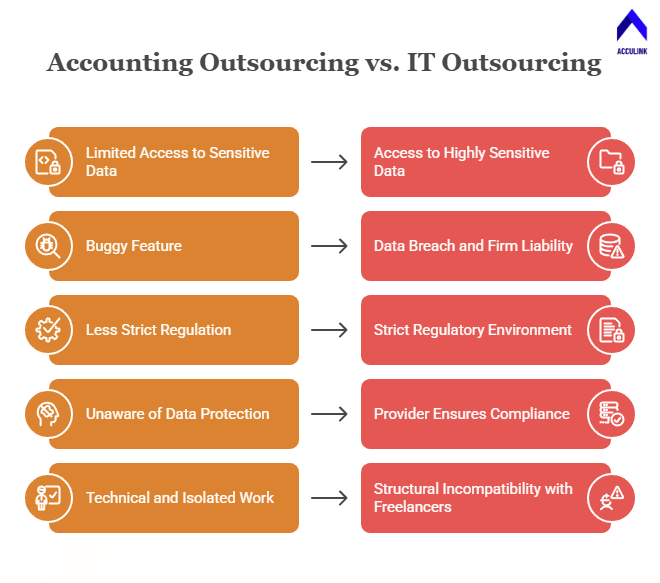
By contrast, a structured offshore staffing relationship through a vetted provider comes with audited security frameworks, signed business associate agreements, and documented IRS §7216 compliance — because the provider's business depends on maintaining them.
|
Factor |
Freelancer |
Dedicated Offshore Staff (Acculink) |
|
IRS §7216 Compliance |
Rarely documented |
Fully compliant with signed agreements |
|
WISP / GLBA Adherence Rarely |
r |
Required and audited |
|
ISO 27001 Certification |
No |
Yes |
|
SOC 2 Alignment |
No |
Yes |
|
Background Checks |
Difficult to verify |
Stringent pre-hire screening |
|
Legal Recourse on Breach |
Minimal or none |
Enforceable SLA and NDA |
|
Data Stored Securely |
Personal devices/home networks |
Firewalled, monitored environments |
Risk 1: No Enforceable Legal Agreement
A professional services relationship without a binding contract is not outsourcing — it is a verbal arrangement with a stranger. Freelance platforms provide terms of service that govern the platform's liability, not yours. When you need to enforce confidentiality, claim damages for a data breach, or seek recourse for missed deadlines, you will find yourself with no meaningful legal foundation.
Laws governing freelance work vary dramatically by country. A contractor based in Pakistan, Bangladesh, or the Philippines operates under legal frameworks that offer little to no protection for U.S. firms pursuing claims. Even within the United States, small claims against a 1099 contractor in another state involve costs that exceed most project values.
A reputable offshore staffing provider provides a formal client services agreement, a rock-solid NDA covering all staff, documented data processing terms under IRS §7216, and clear SLAs with remedies. That is the foundation a CPA firm needs before handing over a single client file.
Risk 2: Data Breach Exposure With No Meaningful Remedy
The AICPA's 2024 data governance survey found that data security concerns are the number one barrier CPA firms cite when evaluating outsourcing. That concern is justified — but it is most justified with unvetted freelancers, not with structured offshore staffing.
The global freelance accounting market is concentrated in economies where cyberattack rates, power infrastructure vulnerabilities, and regulatory oversight are substantially lower than in the U.S. According to Payoneer's Global Gig Economy Index, the largest freelancer markets include India, the Philippines, Ukraine, Pakistan, Bangladesh, Brazil, and Spain — all markets with documented histories of financial fraud and identity theft. That does not mean every professional from these countries is a risk. It means that unvetted, uncontracted individuals operating out of home offices in these markets represent a data risk that no CPA firm should accept.
Acculink CPA's offshore professionals work from ISO 27001-certified, SOC 2-aligned facilities with firewalled networks, monitored workstations, no personal device access to client data, and zero security breaches in 5+ years of operation. That is not a marketing claim — it is an audited, documented track record.
Risk 3: Zero Accountability During Tax Season's Hardest Weeks
The Multi-Client Juggle Problem
Most freelance accountants work with 10 to 20 clients simultaneously. They are managing their own pipeline, chasing their own invoices, and making their own scheduling decisions. When your busy season collides with their busiest week, you are not their priority — the client willing to pay a rush premium is.
This dynamic creates a structural accountability gap. A freelancer who misses your March 15 partnership return deadline loses one client. A dedicated offshore staff member who misses your deadline jeopardises their career with a structured employer who conducts performance reviews, career development, and long-term engagement.
The Ghosting Risk Is Real
"Ghosting" — abruptly stopping all communication with a client — is a documented pattern in freelance accounting relationships. It spikes during peak seasons when freelancers become overcommitted. Firms that have experienced this describe a peculiar panic: a half-finished return, client data in an unknown location, and no way to compel the contractor to complete or return the work.
With a dedicated offshore team, you have a manager. You have an escalation path. You have a second staff member who can cover. That infrastructure does not exist in a freelance relationship.
|
Accountability Factor |
Freelancer Model |
Dedicated Offshore Model |
|
Works exclusively for your firm |
No — multiple concurrent clients |
Yes — dedicated to your firm only |
|
Performance managed by the employer |
No — self-managed |
Yes — structured reviews and KPIs |
|
Escalation path if work stalls |
None |
Account manager + backup staff |
|
Risk of mid-season abandonment |
Highly documented pattern |
Negligible — employment relationship |
|
Contractual deadline enforcement |
Weak or none |
Enforceable SLA |
Risk 4: Cybersecurity Vulnerabilities in Home Office Setups
Many accounting firms assume their risk exposure ends at their own firewall. It does not. The moment client data is transmitted to an external party — even a U.S.-based remote contractor — your security perimeter expands to include that person's entire digital environment.
Freelance accountants typically operate from home offices using consumer-grade broadband, personal laptops, and shared Wi-Fi networks that may serve a household of five. These networks are rarely firewall-protected, rarely monitored for intrusion, and frequently targeted by credential-harvesting attacks. Power infrastructure in developing economies adds another layer: extended outages force mobile hotspot use, which introduces additional exposure.
The FFIEC (Federal Financial Institutions Examination Council) requires institutions providing financial services to maintain comprehensive, documented security plans. The WISP requirement under the Gramm-Leach-Bliley Act applies to tax preparers specifically. A freelancer operating out of a home office almost certainly does not maintain a WISP — and without one, your firm's insurance carrier may deny claims arising from a breach that touched that contractor's environment.
Acculink CPA's delivery environments use enterprise-grade firewalls, VPN-secured file transfer, screen monitoring, USB-disabled workstations, and encrypted data at rest and in transit. Every professional signs a device use policy before accessing a single client file.
|
YOUR CLIENT DATA DESERVES BETTER THAN A HOME NETWORK Acculink CPA operates ISO 27001-certified, SOC 2-aligned delivery centers with zero security breaches in 5+ years. Try a dedicated accountant or tax preparer for 40 hours — free, no commitment. → Start Your Free Trial — acculinkcpa.com/contact Trusted by 80+ firms · ISO 27001 · SOC 2 · IRS §7216 · acculinkcpa.com |
Risk 5: Background Checks Are Difficult, Slow, and Often Skipped
Freelance platforms rely on self-reported credentials, uploaded certificates, and buyer reviews. None of these constitutes a background check. Verifying that a contractor actually holds the credentials they claim — an ICAI CA designation, a CPA license, an enrolled agent registration — is a time-consuming manual process that most firm owners skip when they are under deadline pressure.
There have been documented cases of fraudulent credential claims on freelance platforms across every major accounting credential category. When it surfaces, it surfaces mid-engagement — after client data has been shared, after work has been submitted, and after the client has potentially relied on it.
Acculink CPA's hiring process includes verification of educational credentials, professional certifications, employment history, and references before a candidate is placed with any client firm. The firm also conducts technical assessments in U.S. tax software — CCH Axcess, Lacerte, ProSeries, Drake — before deployment. The hiring happens once; you inherit the result of a rigorous process. See our due diligence guide for accounting outsourcing providers for the questions you should be asking any provider you evaluate.
Risk 6: You Will Not Find Senior Talent on Freelance Platforms
Freelancing attracts early-career professionals building their portfolio, career changers testing a new field, and individuals who value flexibility over professional development. That is a legitimate career path. It is simply not where you find the senior-level tax manager, experienced audit associate, or Big 4-trained CPA who can run complex engagements with minimal supervision.
Experienced accounting professionals overwhelmingly prefer stable employment with career advancement, benefits, leadership opportunities, and mentorship. The talent distribution on freelance platforms skews heavily toward 0–5 years of experience. For routine, highly supervised tasks, this may be adequate. For anything requiring professional judgment — research memos, complex multi-state returns, financial statement review — it is a consistent source of quality risk.
Acculink CPA's professional pool includes EY-trained tax seniors, ICAI Chartered Accountants, Enrolled Agents, and staff with 7–15 years of U.S. accounting experience. These professionals chose structured employment precisely because of the career development, team environment, and long-term stability it provides. You access that talent pool through the firm's dedicated staffing model — talent that would never appear on Upwork.
|
Experience Level |
Freelance Platform Availability |
Acculink Dedicated Staffing |
|
0–3 years (Staff / Associate) |
Very common |
Available |
|
3–7 years (Senior) |
Limited |
Core of the professional pool |
|
7–12 years (Manager / Supervisor) |
Rare |
Available — Big 4 / Top 10 backgrounds |
|
12+ years (Director / Virtual CFO)Rarely |
r |
Available through the Virtual CFO program |
|
Big 4 / Top 10 firm alumni |
Uncommon |
Specifically recruited |
Risk 7: Freelancers Are Unsustainable as a Long-Term Staffing Model
A CPA firm that grows by adding freelancers is not building capacity — it is renting it on a transaction-by-transaction basis. Every season restart means rehiring, onboarding, and quality-checking new people. Institutional knowledge evaporates when a freelancer moves on. Clients who interact (even indirectly) with contractor staff develop no loyalty to your firm's team.
There are also workflow integration problems. Freelancers operate independently. They have their own systems, their own preferences, their own shortcuts. Building a consistent client experience across a team where half the members are contractors working outside your firm's management structure is structurally difficult.
A dedicated offshore model functions like a genuine team extension. Staff use your firm's software stack, follow your review process, attend your team calls, and develop familiarity with your client base over multiple seasons. The compounding return on that familiarity — faster turnaround, fewer errors, proactive client insight — is something a freelance model can never deliver. Read our guide on onboarding an offshore accountant in two weeks to see how quickly a structured integration can be completed.
Risk 8: The Client Poaching Threat
This risk is rarely discussed but frequently experienced. A freelance contractor with direct or indirect exposure to your client list — names, contact information, service scope — has both the motivation and the opportunity to approach those clients directly.
Without a formal non-solicitation agreement that is enforceable across jurisdictions, you have no remedy if this occurs. The freelancer may not even view it as wrong — they are running their own business, after all. The absence of an employment relationship eliminates most of the practical deterrents that prevent employees from soliciting clients.
Acculink CPA's service agreement includes explicit non-solicitation provisions covering both client firm staff and the clients they serve. Staff are bound by employment contracts with their own non-solicitation and confidentiality clauses. The legal architecture exists because it needs to — and because the firm's business model depends on client trust being protected absolutely.
Risk 9 and Risk 10: Individualistic Mindset and WISP Non-Compliance
The Individualistic Mindset Problem
Freelancing is, by nature, an expression of independence. Freelancers set their own hours, choose their own clients, and prioritise their own financial and lifestyle goals. That independence is valuable to them — and it is precisely what makes them a poor fit for integrated team workflows that require consistency, responsiveness, and alignment with your firm's culture.
When your offshore accountant is a dedicated employee of a structured staffing firm, they are embedded in a professional culture that values client service, team collaboration, and quality standards. When they are freelancers, they are running a solo business. Those two orientations produce fundamentally different behaviours under pressure.
WISP Non-Compliance and Insurance Claim Denial
The Written Information Security Plan (WISP) is a mandatory document for all tax preparers under the Gramm-Leach-Bliley Act. It must document how client data is collected, stored, transmitted, and protected. The IRS has made WISP compliance a focus of its data security awareness campaigns, and state CPA boards increasingly incorporate it into practice standards.
Most freelancers do not maintain a WISP. Many have never heard of one. This creates a compounding risk: not only is your client data sitting in an unprotected environment, but when a breach occurs, your firm's cyber liability insurer may deny the claim because your firm used a third-party processor that lacked the required security plan. You absorbed the risk; the insurance does not pay.
Acculink CPA maintains documented WISP-equivalent policies across all client-facing operations, alongside its ISO 27001 certification and SOC 2 alignment. These documents are available to client firms for review as part of the due diligence process. Zero security incidents in 5+ years is the outcome.
Freelancer vs. Dedicated Offshore Staffing: Full Comparison
|
Risk Factor |
Freelancer |
Acculink Dedicated Staff |
|
Legal agreement / NDA |
Weak or none |
Full SLA + enforceable NDA |
|
Data security certification |
None |
ISO 27001, SOC 2, IRS §7216 |
|
WISP compliance |
Rarely maintained |
Documented and auditable |
|
Background verification |
Self-reported only |
Verified credentials + tech test |
|
Senior talent availability |
Rare |
7–15-year experienced professionals |
|
Exclusivity to your firm |
No — multi-client |
Yes — dedicated to you |
|
Accountability structure |
Self-managed |
Manager + KPI reviews |
|
Ghosting/abandonment risk |
High |
Negligible |
|
Non-solicitation protection |
None |
Contractually enforced |
|
Long-term scalability |
Poor |
Scales with your growth plan |
|
Cost range (per hour) |
$15–$60 (billed, variable) |
$8–$35 (fixed, transparent) |
What CPA Firms Should Do Instead
Step 1: Define What You Actually Need
Before engaging any external resource, document the roles, software stack, volume, and oversight capacity you have. Are you looking for a tax preparer who can handle 200 individual returns per season? A bookkeeper for 15 monthly clients? A senior accountant for review-level work? Specificity here prevents the most common outsourcing mistake: hiring a generalist when you need a specialist.
Step 2: Choose a Structured Provider, Not a Platform
The difference between a freelance platform and a structured offshore staffing firm is the difference between a staffing agency and a temp app. A structured provider has already done the hiring, background checking, credentialing, and training. They maintain the security infrastructure. They manage HR, payroll, and compliance for the staff. You direct the work; they handle everything else.
Acculink CPA's dedicated team model delivers a shortlisted candidate profile within days, a structured two-week onboarding, and a dedicated account manager throughout the relationship. The 40-hour free trial removes the commitment risk entirely.
Step 3: Run Due Diligence on Any Provider You Consider
Ask every provider you evaluate: Do you hold ISO 27001 certification? Can you provide SOC 2 documentation? Do your staff sign IRS §7216-compliant data processing agreements? Do you maintain a WISP? What is your breach history, and how do you disclose incidents? A provider that deflects these questions is telling you something important. See our due diligence guide for outsourcing providers for the complete checklist.
Step 4: Start Small, Then Scale
The right model is not a big-bang replacement of your current team. Start with one dedicated staff member in a well-defined role — a bookkeeper for your monthly clients, a tax preparer for overflow 1040 work. Build the integration, refine the workflow, and then scale. Acculink's engagement model is designed for exactly this: no long-term contracts, no setup fees, and a free trial that lets you verify quality before committing.
|
BUILD A TEAM THAT SHOWS UP — EVERY SEASON 80+ CPA firms trust Acculink CPA for dedicated offshore accountants, tax preparers, bookkeepers, and auditors at $8–$35/hr. 40-hour free trial. ISO 27001. SOC 2. IRS §7216 compliant. No setup fees. No long-term contracts. → Hire Your Dedicated Staff Now — acculinkcpa.com/hire/hire-dedicated-team Trusted by 80+ firms · ISO 27001 · SOC 2 · IRS §7216 · acculinkcpa.com |
Frequently Asked Questions
Is it ever appropriate for a CPA firm to use freelancers?
For very low-stakes, non-client-facing administrative tasks — data entry into internal spreadsheets, formatting presentations, research compilation — freelancers can be appropriate. The line is crossed the moment client financial data, tax returns, or identifiable personal information is involved. At that point, the regulatory framework under IRS §7216, GLBA, and state CPA acts requires a higher standard of third-party control than a freelance arrangement can provide. For anything touching outsourced tax preparation or live client accounting, a structured staffing relationship is the only defensible choice.
How much does dedicated offshore staffing actually cost versus freelancers?
The surface-level comparison often favours freelancers because hourly bids on platforms can be very low. But effective cost calculations must include time spent vetting, onboarding, quality-checking, redoing rejected work, and managing the relationship — all of which fall on your firm with a freelancer. Acculink CPA's dedicated staff range from $8 to $35 per hour depending on role and experience level, with no placement fees, no setup costs, and no minimum commitment. The 40-hour free trial lets you verify value before spending anything.
What happens if I try a dedicated offshore staff member and it does not work out?
Acculink CPA's model includes no long-term contracts and no termination penalties. If the initial match is not right, the firm will work to identify a better-fit candidate. The 40-hour free trial period is specifically designed to surface any fit issues before a financial commitment is made. The firm's track record of 80+ active CPA firm clients reflects a placement process that takes role fit seriously from the first conversation.
How does Acculink CPA screen for U.S. tax and accounting knowledge?
Every candidate undergoes a technical assessment in the specific software and subject areas relevant to the role being filled. For tax preparers, this includes practical tests in Lacerte, CCH Axcess, Drake, or ProSeries, depending on the firm's stack. For bookkeepers, QuickBooks Online, Xero, and NetSuite competency is tested. Educational and professional credentials are independently verified. Candidates are also assessed on U.S. tax code familiarity, Schedule C through K-1 knowledge, and communication quality in written English. You receive a detailed candidate profile before any introduction call.
What if I am a solo CPA or a very small firm — is dedicated offshore staffing realistic for me?
Yes — and it may matter more for small firms than large ones. A solo practitioner who loses a freelancer mid-season has no backup and no leverage. A solo CPA with a single dedicated offshore tax preparer through Acculink has a managed, accountable team member who understands their workflow, knows their clients (within §7216 limits), and shows up every day. Acculink's model starts with a single staff member with no volume minimums. See our guide to scaling as a solo CPA without full-time hires for how this works in practice.
References
• AICPA — Data Security and Client Confidentiality Resources
• IRS — Section 7216 Guidance for Tax Return Preparers
• IRS — Written Information Security Plan (WISP) for Tax Professionals
• FTC — Gramm-Leach-Bliley Act Safeguards Rule for Financial Institutions
• FFIEC — IT Examination Handbook: Information Security
• Payoneer — Global Gig Economy Index 2024
• Accounting Today — The Talent Crisis in Public Accounting 2024
• Journal of Accountancy — Outsourcing Best Practices for CPA Firms
• SHRM — Contingent Workforce: Risks, Costs, and Compliance Considerations
• Acculink CPA — IT & Data Security Standards
• Acculink CPA — Offshore Accounting Outsourcing Services
• Acculink CPA — How to Build an Offshore Team for Your Accounting Firm
About Acculink CPA
Acculink CPA is a premier offshore staffing and outsourcing company purpose-built for CPA firms, accounting firms, and tax firms in the United States, Canada, and the UAE. With a team of 300+ qualified professionals — including CPAs, Chartered Accountants, Enrolled Agents, and Big 4-trained staff — Acculink provides dedicated offshore accountants, bookkeepers, tax preparers, auditors, virtual CFOs, and virtual assistants at $8–$35/hr, delivering up to 75% cost savings compared to domestic hiring. The company is ISO 27001 certified, SOC 2 Type II aligned, IRS §7216 compliant, and GDPR compliant, with zero security breaches in 5+ years of operations. Acculink offers a 40-hour free trial with no setup fees, no recruitment charges, and no long-term contracts. Over 80 CPA firms across the United States trust Acculink to deliver quality, security, and scalability.
Website: Acculink CPA | Schedule a Call: book a 45-minute call | Email: Info@acculinkcpa.com | Phone: +1 (203) 997-0224
Tags:
About the Author

Related Posts
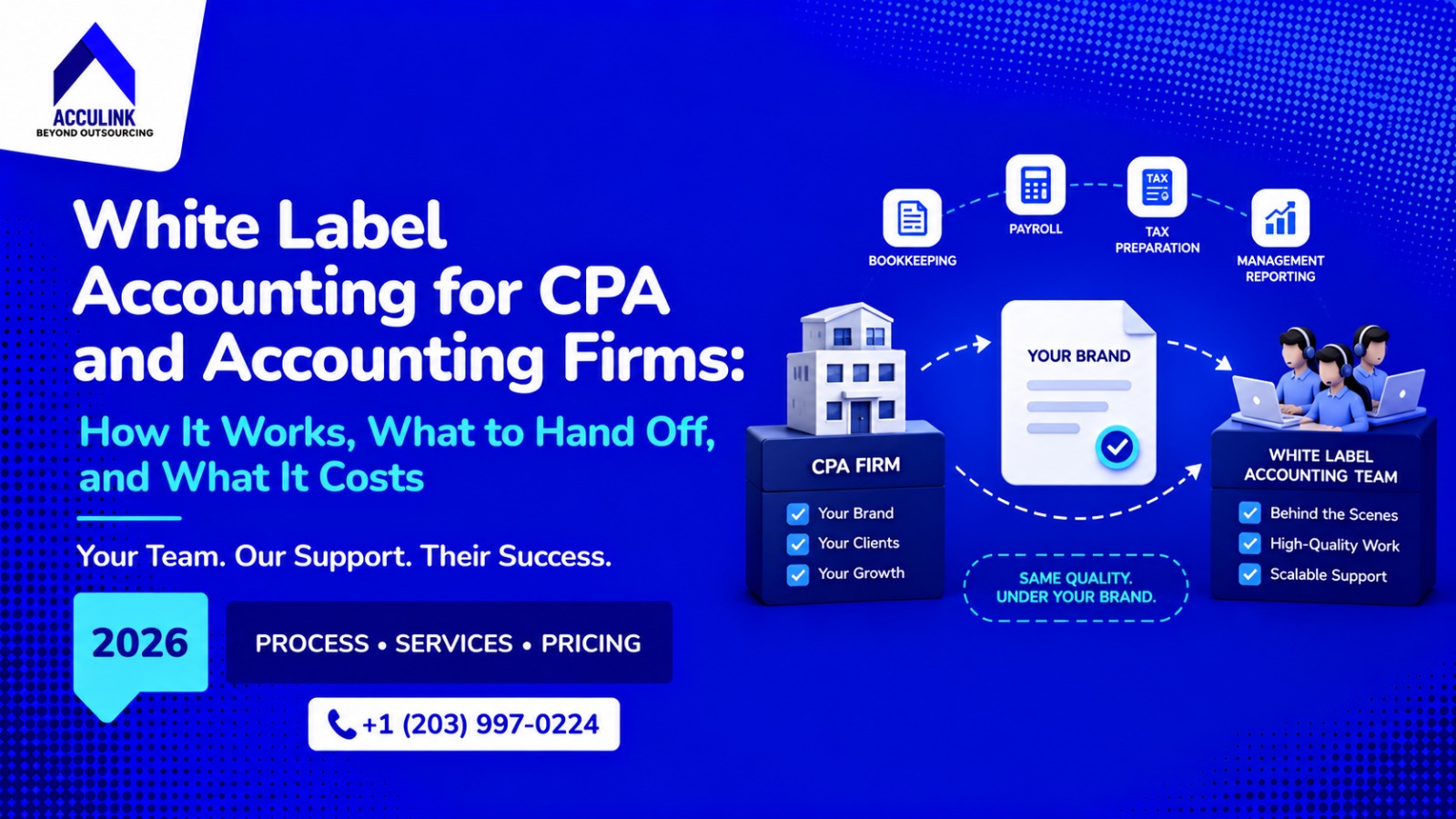
White Label Accounting for CPA and Accounting Firms: How It Works, What to Hand Off, and What It Costs
White label accounting helps CPA firms expand capacity while keeping control of their brand, client relationsh…
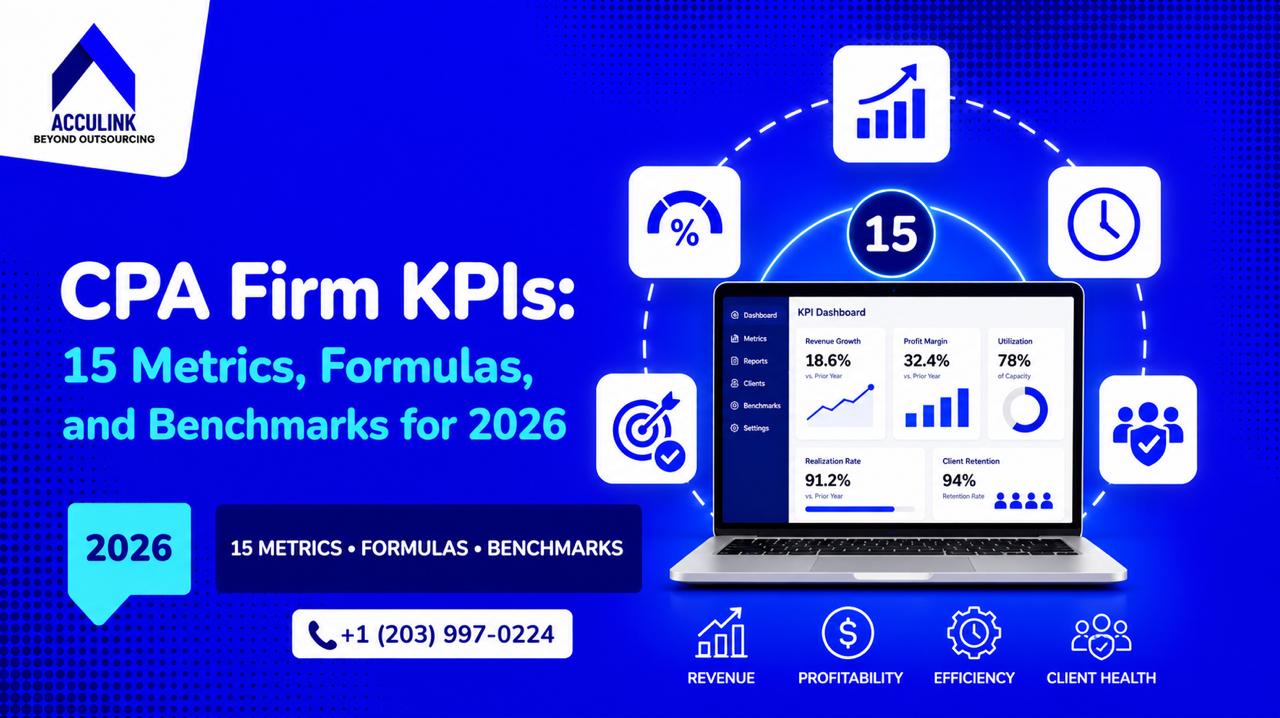
CPA Firm KPIs: 15 Metrics, Formulas, and Benchmarks for 2026
Learn how to measure 15 essential CPA firm KPIs covering profitability, productivity, staffing capacity, clien…
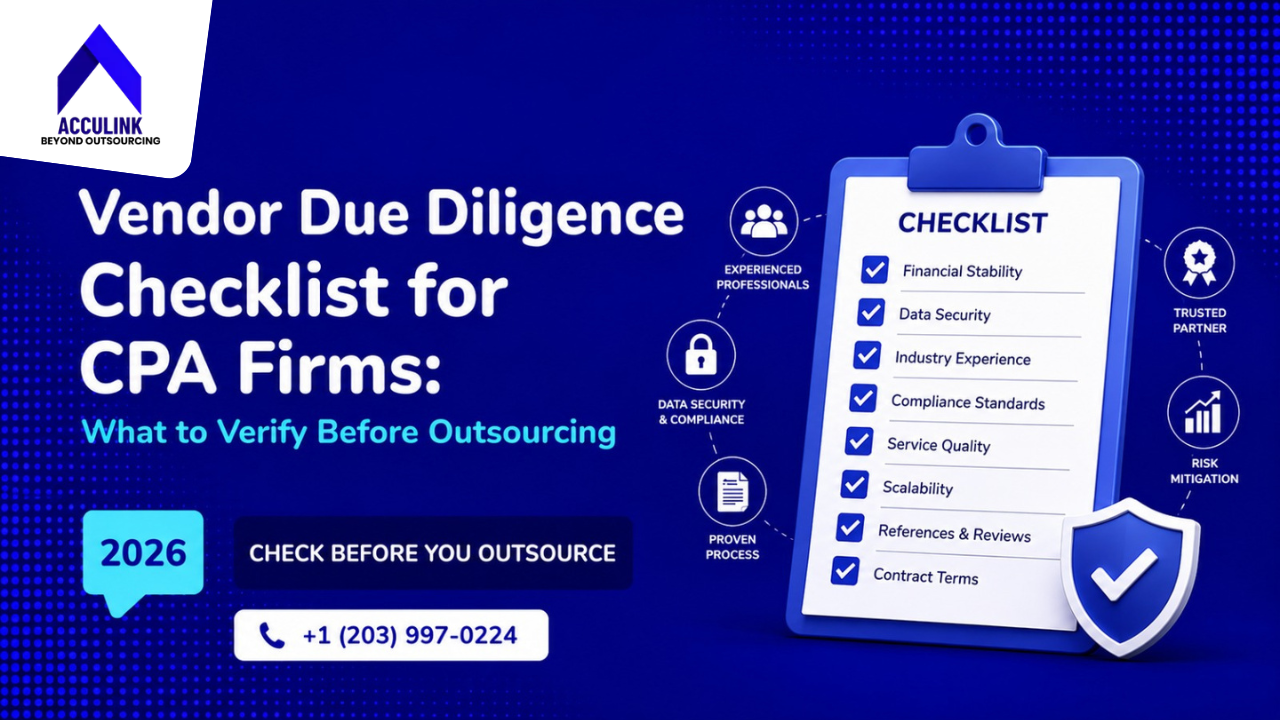
The CPA Firm’s Checklist: How to Evaluate and Choose an Offshore Staffing Partner
A vendor due diligence checklist helps a CPA firm verify that an accounting outsourcing provider is legally es…