Understanding the One Big Beautiful Bill Act: Tax Implications for CPA Firms and Their Clients


Summary
Understanding the One Big Beautiful Bill Act: Tax Implications for CPA Firms and Their Clients
The One Big Beautiful Bill Act represents both a challenge and an opportunity for CPA firms. The compliance workload will increase, the complexity will grow, and clients will demand guidance faster than ever. But the firms that prepare early, communicate proactively, and build capacity through offshore staffing will emerge stronger. They will capture advisory revenue from clients seeking guidance. They will strengthen relationships through proactive communication. And they will handle the compliance surge without burning out their teams because Acculink CPA offshore tax preparers provide the capacity buffer that makes it all manageable. The firms that wait, that scramble to understand the provisions during filing season, that try to handle the workload with the same understaffed team, will fall behind and lose ground that is difficult to recover.
How the OBBBA Compares to TCJA
Understanding the OBBBA in context requires comparing it to the Tax Cuts and Jobs Act of 2017, the last comprehensive tax reform. TCJA fundamentally reshaped the tax code by reducing the corporate rate from 35 per cent to 21 per cent, nearly doubling the standard deduction, capping the SALT deduction at 10,000 dollars, creating the Section 199A qualified business income deduction, and modifying international tax provisions. Many TCJA individual provisions were set to expire after 2025, creating the legislative pressure that the OBBBA addresses.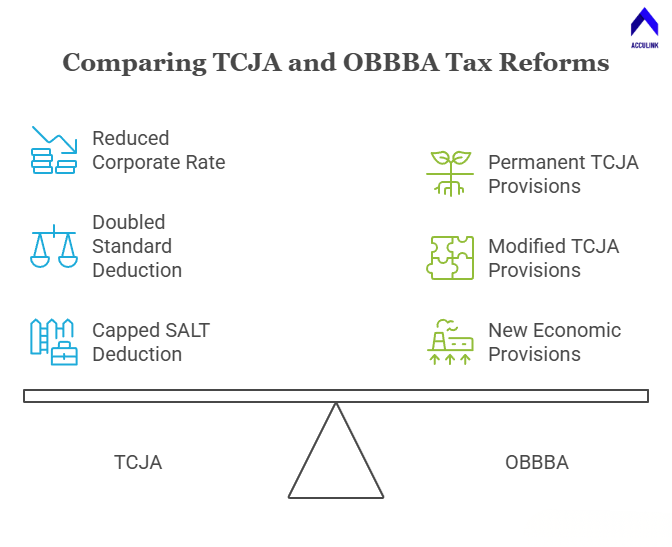
The OBBBA builds on the TCJA framework while making significant modifications. Some TCJA provisions are made permanent, others are modified, and new provisions are added that reflect current economic priorities, es including domestic manufacturing incentives, clean energy credits, and workforce development. For CPA firms that went through TCJA implementation, the OBBBA transition will feel familiar,iar but the scope of changes requires the same level of deliberate preparation, software updates, client communication, and capacity planning.
Client Communication Strategy
How you communicate the OBBBA changes to clients is as important as understanding the changes themselves. Clients are overwhelmed by tax news, much of it inaccurately sensationalised. Your role is to cut through the noise and deliver clear, personalised guidance. Send an initial firm-wide communication summarising the key changes at a high level within 30 days of enactment. Follow up with personalised communications to high-impact clients showing how specific provisions affect their tax situation. Schedule advisory meetings with your top 20 to 30 clients to discuss planning opportunities and updated projections.
Your offshore team from Acculink CPA can support this communication strategy by preparing client-specific tax projection models showing the OBBBA impact compared to the prior law. Assign your offshore analysts to run updated projections for your highest-value clients using your tax planning software. Partners review the projections and deliver them to clients in advisory meetings. This division of labour allows you to reach more clients faster with personalised, data-driven guidance rather than generic newsletters.
Building an OBBBA Action Plan for Your Firm
Create a structured action plan with clear deadlines and ownership assignments. Within 30 days of enactment, complete initial training for all tax staff, including offshore preparers. Within 60 days, update tax planning templates and software settings. Within 90 days, complete client-specific impact assessments for your top 50 clients. Before the next filing season, establish updated workflows for new forms and calculations, train offshore preparers on OBBBA-specific return preparation, and confirm that all tax software updates are installed and tested. This structured approach ensures your firm is prepared rather than scrambling when returns start arriving.
Key Takeaways
-
The One Big Beautiful Bill Act (OBBBA) is the most significant tax legislation since the Tax Cuts and Jobs Act of 2017, introducing sweeping changes to individual taxation, business taxation, SALT deductions, and tax credits.
-
CPA firms face a dual challenge: rapidly understanding the new provisions and communicating their impact to clients who are already asking questions.
-
Key provisions include changes to the SALT deduction cap, modifications to the child tax credit, business tax rate adjustments, new clean energy and manufacturing credits, and changes to estate and gift tax thresholds.
-
The compliance workload from OBBBA will be significant — new forms, updated calculations, and revised planning strategies across every client segment.
-
Offshore tax teams from Acculink CPA provide the capacity to handle the OBBBA compliance surge without burning out domestic staff or turning away clients.
The One Big Beautiful Bill Act — the omnibus tax and spending legislation signed into law in 2026 — is reshaping the tax landscape for every CPA firm and every client in America. Whether you call it OBBBA, the One Big Beautiful Bill, or simply the new tax law, the impact is undeniable: new provisions affecting individual tax rates, business taxation, SALT deductions, child tax credits, estate planning, and energy credits are creating a compliance and advisory workload that will define the next several tax seasons.
For CPA firms, the OBBBA presents both a challenge and an opportunity. The challenge is immediate: you need to understand the provisions, update your software and processes, communicate changes to clients, and prepare for a filing season that will be more complex than any since TCJA implementation in 2018. The opportunity is equally clear: clients need guidance, and the firms that deliver it quickly and competently will strengthen relationships, win new clients, and differentiate from competitors who are still catching up.
This guide covers the key provisions of the OBBBA, their impact on CPA firm clients, practical advisory strategies, and how offshore staffing from Acculink CPA provides the capacity to handle the compliance surge.
What Is the One Big Beautiful Bill Act?
The OBBBA is a comprehensive tax and spending package that emerged from Congress in 2026. Building on and modifying the framework established by the Tax Cuts and Jobs Act of 2017, the OBBBA makes permanent some TCJA provisions that were set to expire, modifies others, and introduces new provisions addressing current economic and policy priorities. The legislation touches virtually every area of the tax code that CPA firms deal with daily.
Key Tax Provisions
Individual Tax Changes
The OBBBA makes several significant changes to individual taxation. Individual tax rates and brackets have been adjusted, with modifications to the rate structure that affect taxpayers across income levels. The standard deduction has been updated, continuing the trend of higher standard deductions that reduce the number of taxpayers who itemise. The child tax credit has been modified with changes to the credit amount, income phase-out thresholds, and refundability provisions. CPA firms need to update their tax planning models to reflect these changes for every individual client.
SALT Deduction Changes
The state and local tax (SALT) deduction has been one of the most politically contentious provisions since the TCJA capped it at $10,000 in 2018. The OBBBA modifies the SALT cap, and CPA firms in high-tax states like New York, New Jersey, California, Connecticut, and Illinois need to analyse the impact for every affected client. Many clients who have been using SALT workaround strategies (pass-through entity taxes) will need their strategies reevaluated under the new rules.
Business Tax Changes
The OBBBA includes provisions affecting business taxation across multiple dimensions. Corporate tax rates and the Section 199A qualified business income deduction have been addressed. Bonus depreciation and Section 179 expensing rules have been modified. Research and development (R&D) amortisation rules under Section 174 have been updated. And new provisions affecting international taxation, including GILTI and FDII calculations, create additional complexity for firms with international clients.
New Credits and Incentives
The OBBBA introduces or modifies several tax credits, including clean energy and manufacturing credits designed to incentivise domestic investment, expanded provisions for opportunity zones and community development, modified education-related credits and deductions, and new provisions affecting retirement savings and planning. Each new credit creates advisory opportunities for CPA firms that understand the eligibility requirements and can identify qualifying clients proactively.
Estate and Gift Tax Changes
The OBBBA addresses estate and gift tax thresholds that were set to revert to lower levels. Changes to the lifetime exemption amount, gift tax annual exclusion, and generation-skipping transfer tax provisions affect estate planning for high-net-worth clients. CPA firms with estate planning practices need to update their planning models and reach out to affected clients.
Impact on CPA Firm Clients
Individual Clients
Every individual tax client is potentially affected by the OBBBA. Tax bracket changes, SALT modifications, child tax credit updates, and standard deduction adjustments mean that year-over-year tax liability comparisons will show significant changes for many clients. CPA firms should prepare tax projection models showing the OBBBA impact for their highest-value individual clients and proactively schedule advisory conversations.
Business Clients
Business clients face a complex web of changes affecting their tax planning strategies. The interplay between corporate rate changes, Section 199A modifications, depreciation rules, and new credits requires integrated analysis. CPA firms serving business clients should prepare scenario models showing the net impact of all relevant provisions and advise on timing strategies (accelerating or deferring income and deductions) to optimise under the new rules.
High-Net-Worth Clients
Estate and gift tax changes create immediate planning urgency for high-net-worth clients. Depending on the direction of threshold changes, clients may need to accelerate or modify gifting strategies, review trust structures, and update estate plans. CPA firms should coordinate with estate planning attorneys to deliver integrated guidance.
How CPA Firms Should Prepare
Step 1: Understand the Provisions
Invest in training immediately. Attend AICPA and state CPA society OBBBA briefings, review IRS guidance as it’s released, and subscribe to tax research platforms for ongoing updates. Assign a point person at your firm to track OBBBA developments and distribute updates to the team.
Step 2: Update Software and Processes
Ensure your tax software vendor has released OBBBA updates. Test the new calculations on sample returns before the filing season. Update your tax planning templates and client-facing materials to reflect the new provisions.
Step 3: Proactively Communicate with Clients
Don’t wait for clients to call asking about the new law. Send a firm-wide client communication summarising the key changes and offering to schedule a planning conversation. The firms that communicate first build trust and capture advisory revenue.
Step 4: Build Capacity for the Compliance Surge
The OBBBA will increase the complexity and time required for many returns. This compliance surge comes on top of an already stretched workforce. Acculink CPA provides pre-vetted offshore tax preparers and tax reviewers who can ramp in 2–3 weeks, handling the increased volume while your domestic team focuses on advisory conversations and complex planning.
Tax Planning Strategies for 2026 Under the OBBBA
Several planning strategies emerge from the OBBBA provisions that CPA firms should evaluate for their clients.
-
Income timing: Analyse whether accelerating or deferring income into different tax years produces a better result under the new rate structure.
-
SALT optimisation: Reevaluate pass-through entity tax elections and other SALT strategies under the modified cap.
-
Depreciation planning: Review capital expenditure timing to maximise bonus depreciation or Section 179 benefits under the updated rules.
-
Credit capture: Identify clients who qualify for new or expanded credits, particularly in clean energy, manufacturing, and R&D.
-
Estate planning: Review gifting strategies and trust structures in light of threshold changes.
-
Entity structure review: Evaluate whether clients’ current entity structures (C Corp, S Corp, partnership, sole proprietorship) remain optimal under the new provisions.
Frequently Asked Questions
What is the One Big Beautiful Bill Act?
The OBBBA is comprehensive tax and spending legislation signed into law in 2026. It modifies individual tax rates, SALT deductions, business taxation, child tax credits, estate thresholds, and introduces new credits and incentives.
How does the OBBBA affect CPA firms?
The OBBBA increases compliance complexity, creates advisory opportunities, and generates a workload surge. Firms need to understand the provisions, update software, communicate with clients, and build capacity to handle the increased volume.
What should CPA firms do to prepare for the OBBBA?
Invest in training, update tax software, proactively communicate with clients, and build capacity through offshore staffing. The firms that prepare early will capture advisory revenue and strengthen client relationships.
How can offshore teams help with the OBBBA compliance surge?
Offshore tax preparers and reviewers from Acculink CPA handle the increased return preparation volume, updated calculations, and expanded filing requirements. This frees domestic staff for client advisory and complex planning.
References
IRS Tax Reform Information — https://www.irs.gov/
AICPA Tax Resources — https://www.aicpa.org/
Congress.gov — https://www.congress.gov/
About Acculink CPA
Acculink CPA is a premier offshore staffing and outsourcing company purpose-built for CPA firms, accounting firms, and tax firms in the United States, Canada, and the UAE. With a team of 300+ qualified professionals — including CPAs, Chartered Accountants, Enrolled Agents, and Big 4-trained staff — Acculink provides dedicated offshore accountants, bookkeepers, tax preparers, auditors, virtual CFOs, and virtual assistants at $8–$35/hr, delivering up to 75% cost savings compared to domestic hiring. The company is ISO 27001 certified, SOC 2 Type II aligned, IRS §7216 compliant, and GDPR compliant, with zero security breaches in 5+ years of operations. Acculink offers a 40-hour free trial with no setup fees, no recruitment charges, and no long-term contracts. Over 80 CPA firms across the United States trust Acculink to deliver quality, security, and scalability.
Website: Acculink CPA | Schedule a Call: book a 45-minute call | Email: Info@acculinkcpa.com | Phone: +1 (203) 997-0224
Tags:
About the Author

Related Posts

Hire Offshore Tax Preparers for CPA & Accounting Firms – Why Outsourced Tax Preparation Works Best.
How to hire an offshore tax preparer for your CPA firm — 1040/1065/1120/1120-S, CCH/UltraTax/Drake, IRS §7216-…

Sales Tax Compliance Outsourcing for CPA & Accounting Firms – Why It Works
How outsourcing sales tax compliance handles nexus, multi-state filings, and exemption certificates for CPA fi…

S Corporation Tax Return Outsourcing for CPA & Accounting Firms – Why It Works
How outsourcing Form 1120-S prep gives CPA firms expert S-corp returns — K-1s, basis, AAA, reasonable comp, QB…