Top 7 Finance and Accounting Outsourcing Trends Reshaping CPA Firms in 2026


Summary
From AI integration to nearshoring, explore the top 7 F&A outsourcing trends transforming CPA firms in 2026 and what you need to do to stay ahead.
Key Takeaways
-
The global FAO market is projected to exceed $59 billion in 2026, growing to $85.9 billion by 2031 at a 7.78% CAGR. Growth is driven by AI adoption, talent shortages, and cost pressure (Mordor Intelligence, 2026).
-
AI-assisted bookkeeping and automated reconciliation are transforming outsourced accounting from a labor-intensive service into a technology-augmented intelligence layer. They reduce manual data entry by up to 80%.
-
Nearshore and offshore hybrid staffing models are replacing pure onshore outsourcing. They deliver cost savings of 50-75% with no meaningful quality trade-off when managed by a certified provider.
-
Compliance complexity -- multi-state tax nexus, beneficial ownership reporting, ESG disclosure -- is driving demand for specialized outsourced expertise at every business size.
-
Acculink CPA serves 80+ firms across the U.S., Canada, and UAE with ISO 27001 certified offshore accounting teams from $8-$35/hr. They cover all 7 trends with zero security breaches in 5+ years.
Finance and accounting outsourcing has undergone more transformation in the last three years than in the preceding decade. The convergence of AI tools, post-pandemic remote work normalization, and a persistent accounting talent shortage has created a new market. The quality, speed, and capabilities of outsourced accounting teams have fundamentally changed. For business owners, CFOs, and CPA firm leaders, understanding these finance and accounting outsourcing trends in 2026 is essential. It informs smart decisions about how to build and scale their finance functions.
This guide covers the top 7 FAO trends reshaping outsourced accounting in 2026. It explains what each one means for your firm's cost structure, competitive positioning, and operational resilience. Whether you are exploring outsourced accounting services for the first time or looking to upgrade an existing arrangement, these trends will define the landscape for the next 24 months.
Trend 1 -- AI-Augmented Accounting and Automated Reconciliation
Artificial intelligence is transforming the most time-consuming tasks in accounting: transaction categorization, bank reconciliation, duplicate detection, and exception flagging. AI-powered tools such as Vic.ai, AppZen, and native AI features embedded in QuickBooks, Xero, and NetSuite now handle routine matching tasks automatically. Human review is focused on exceptions rather than routine transactions.
For outsourced accounting, AI augmentation means the same team can handle significantly higher transaction volumes without proportional headcount increases. This drives down per-transaction costs while improving accuracy -- the human accountant's attention is directed to judgment-intensive tasks while AI handles the mechanical ones. In 2026, no quality FAO provider operates without AI tools in their core technology stack. Research from McKinsey indicates that AI automation is reducing manual data-entry workloads by up to 80% in the most advanced outsourced accounting environments.
Acculink CPA integrates AI-assisted categorization, automated bank-feed reconciliation, and intelligent duplicate detection into every client engagement. This technology layer is included in the standard service -- clients benefit from AI-driven efficiency without having to procure or manage the tools themselves. Our team is proficient in CCH Axcess, UltraTax CS, Lacerte, Drake, QuickBooks, Xero, and Sage. That ensures seamless integration with your existing software stack.
What this means for your firm: If your current outsourced provider cannot demonstrate a live AI integration in their workflow, they are already operating at a competitive disadvantage. Ask specifically which AI tools they use, how they handle exceptions, and what your per-transaction cost trend has looked like over the past 12 months.
Trend 2 -- Offshore Hybrid Teams Replacing Pure Onshore Models
The 'only onshore' bias in accounting outsourcing is rapidly eroding. Post-pandemic normalization of remote work has made the operational difference between an onshore outsourced team and a well-managed offshore team minimal. Both work remotely, both communicate via video and collaboration tools, and both access client systems through secure cloud environments.
What offshore hybrid teams provide that onshore cannot: 50-75% cost savings, access to a larger talent pool of qualified accountants, and time-zone coverage. That enables early-morning close support. Acculink's offshore teams in India include CPAs, Chartered Accountants, Enrolled Agents, and Big 4-trained professionals from firms including Deloitte, PwC, EY, KPMG, RSM, BDO, and Grant Thornton. Those qualifications match or exceed many onshore outsourcing alternatives.
In 2026, the market is shifting toward hybrid models: an onshore relationship manager and client-facing team combined with offshore execution. Acculink has operated this model from day one, with U.S.-based client management and offshore accounting staffing backed by ISO 27001 security and SOC 2 aligned infrastructure. This is why offshore staffing for CPA firms is growing at double the rate of traditional onshore outsourcing arrangements.
What this means for your firm: If you have not explored offshore hybrid staffing in the last 18 months, market conditions have shifted materially. The talent pool has deepened, security standards have improved, and the cost gap versus onshore has widened. The question is no longer whether offshore quality can match onshore. It is whether your organization has the internal processes to manage an offshore team effectively. See How CPA Firms Build Offshore Teams: A Step-by-Step Playbook for a practical framework.
Trend 3 -- Specialization by Industry Vertical
Generic bookkeeping services are being displaced by specialized accounting providers with deep vertical expertise. Healthcare revenue cycle management, government contractor DCAA compliance, legal trust accounting, real estate fund administration, and franchise multi-unit accounting all differ. Each requires knowledge that general-purpose accounting services cannot deliver reliably.
Acculink CPA has developed specializations across key verticals, including:
-
Healthcare AR management and medical billing reconciliation
-
Real estate and property accounting for funds and operating portfolios
-
Manufacturing accounting with cost accounting and inventory management support
-
Restaurant and hotel accounting including POS reconciliation and tip management
-
Non-profit accounting including fund accounting and grant compliance
-
E-commerce accounting including multi-channel revenue reconciliation and sales tax compliance
This specialization matters because vertical-specific errors -- misapplied revenue recognition, incorrect indirect rate calculations, or missed IFTA filing deadlines. These can be far more costly than the fee difference between a generalist and a specialist. Businesses should require vertical-specific case studies and references from any FAO provider they consider.
Trend 4 -- Virtual CFO Services Going Mainstream
The virtual CFO model -- strategic CFO-level guidance on a part-time engagement basis -- has moved from a niche service to a mainstream offering for SMBs and growth-stage companies. Driving this shift: the total cost of a full-time CFO in 2026 ranges from $280,000 to over $430,000 per year (including salary, benefits, payroll taxes, and recruitment costs, per Glassdoor and Robert Half data). That places genuine CFO-level talent out of reach for most companies under $20 million in revenue.
Virtual CFOs provide cash flow forecasting, financial modeling, investor reporting, board package preparation, banking relationship management, and M&A support. Retainers typically range from $5,000 to $10,000. For companies that have already outsourced bookkeeping and accounting, adding a virtual CFO service completes the finance function. The total cost is still 60-70% below building in-house. Acculink's offshore virtual CFOs bring Big 4 advisory experience at a fraction of market-rate retainer costs.
What this means for your firm: If your company has crossed $2-5 million in revenue and is making major capital allocation decisions, pricing strategy changes, or preparing for a financing round without CFO-level input, you are making those decisions blind. A virtual CFO engagement at $5,000-$10,000 per month is a fraction of the cost of a decision made without adequate financial leadership.
Trend 5 -- Real-Time Financial Reporting and Cloud-First Infrastructure
The quarterly financial statement is being replaced by rolling, real-time financial visibility. Cloud-based accounting software -- QuickBooks Online, Xero, NetSuite -- combined with automated bank feeds, integrated invoicing, and real-time dashboards changes the game. CFOs and business owners can access current financial data 24/7.
Outsourced accounting teams in 2026 operate in cloud-first environments, updating books daily or weekly rather than batch-processing at month-end. This shift enables proactive financial management: catching cash flow problems before they materialize. It means identifying revenue recognition issues in-period rather than at close, and providing leadership with the data needed to make real-time decisions. Acculink's virtual accounting services are built entirely on cloud-first infrastructure, with client-specific dashboards and real-time management reporting included in standard engagements.
Organizations that still rely on monthly close cycles and static PDF financial reports are operating with a structural information disadvantage relative to competitors using real-time FAO arrangements. The upgrade cost is modest. The competitive cost of not upgrading compounds monthly.
Trend 6 -- Compliance Complexity Driving Demand for Specialized Expertise
The accounting compliance landscape has never been more complex. Multi-state sales tax nexus rules post-Wayfair, beneficial ownership reporting under the Corporate Transparency Act, ESG disclosure requirements under the EU's Corporate Sustainability Reporting Directive, and increasingly complex revenue recognition standards under ASC 606 all add up. They create compliance burdens that general-purpose accounting teams struggle to manage.
Key compliance areas driving outsourcing demand in 2026:
-
Multi-state sales tax nexus: Economic nexus thresholds triggered in 40+ states since South Dakota v. Wayfair require ongoing monitoring and sales tax compliance outsourcing.
-
Corporate Transparency Act (CTA): Most small businesses must report beneficial ownership information to FinCEN, with civil and criminal penalties for non-compliance.
-
ASC 606 revenue recognition: Complex multi-element contracts require careful performance-obligation identification and timing analysis.
-
ESG disclosure: Large entities and their supply chain partners face growing demand for carbon-footprint tracking, materiality assessment, and stakeholder reporting.
-
IRS audit readiness: Ongoing IRS enforcement priority on pass-through entities, high-income filers, and international structures is increasing documentation requirements.
Outsourced accounting providers that invest in compliance expertise -- and keep that expertise current through continuous professional development -- are capturing disproportionate market share. Acculink's team includes CPAs, Enrolled Agents (EAs), and Chartered Accountants (CAs) who maintain compliance currency across all of these areas, including through ongoing training in outsourced tax preparation services and tax planning and advisory.
Trend 7 -- Security and Compliance Certification Becoming a Baseline Requirement
The data security bar for outsourced accounting has risen significantly. Clients -- especially those in financial services, healthcare, and government contracting -- now require minimum security standards from their accounting providers. The list includes ISO 27001 certification, SOC 2 Type II reports, HIPAA BAA capability, IRS §7216 compliance, and documented incident response procedures.
Providers without these certifications are being excluded from RFPs and procurement processes. In 2026, security certification is not a differentiator -- it is the minimum standard. Acculink CPA maintains ISO 27001:2013 certification and SOC 2 Type II alignment. The record: zero security breaches across 5+ years of operations serving 80+ CPA firms. All staff work from a secure, monitored, centralized office in India -- not from unmonitored home environments. Clients receive updated certification documentation annually.
The FTC Safeguards Rule, which requires non-banking financial institutions to maintain comprehensive information security programs, now extends to accounting firms and their third-party vendors. Any FAO provider that cannot demonstrate compliance with the Safeguards Rule creates regulatory exposure for the accounting firms they serve. Acculink's IT and data security practices are designed specifically to keep accounting firms compliant. See our certificates and alliances page for current certification documentation.
FAO Market Data: 2026 Benchmarks and Projections
The following data points reflect current market research and publicly available benchmarks for the FAO sector. Sources include Mordor Intelligence (2026), McKinsey, BLS, and AICPA.
|
Metric |
2023 Baseline |
2026 Estimate |
Driver |
|
Global FAO market size |
$45-53B (various sources) |
$59.05B (Mordor Intelligence) |
AI adoption + talent shortage |
|
Projected FAO market by 2031 |
-- |
$85.92B at 7.78% CAGR |
Cloud, automation, ESG compliance |
|
% SMBs using outsourced accounting |
~31% |
~47% (projected) |
Cost pressure + cloud enablement |
|
Avg cost saving vs. in-house |
50-60% |
60-75% |
Offshore labor arbitrage + AI |
|
Full-time CFO total annual cost |
$233K-$500K+ |
$280K-$430K+ (salary + benefits) |
Glassdoor / Robert Half 2026 |
|
AI tool usage in outsourced teams |
~18% |
~74% (projected) |
Rapid AI tool deployment |
|
Security breach incidents (top providers) |
Declining |
Near zero (ISO/SOC certified) |
ISO 27001 / SOC 2 investment |
How to Choose an FAO Provider Aligned With 2026 Trends
When evaluating FAO providers for 2026 readiness, use this framework across six dimensions:
-
AI tools and automation: Ask specifically which AI tools are embedded in their workflow, how they handle exception escalation, and what measurable accuracy or efficiency gains they can document.
-
Security certification: Require ISO 27001 certification documentation and a SOC 2 Type II report -- not a verbal assurance. Ask for the most recent certification date and scope.
-
Industry specialization: Ask for client references or published case studies in your specific vertical. A provider with no vertical experience in your industry is a generalist -- price their service accordingly.
-
Virtual CFO capability: Assess whether the provider can grow with you from bookkeeping through controller-level analysis to CFO-level strategic advisory as your business scales.
-
Cloud-first infrastructure: Confirm they work natively in your accounting software via live API integration, not file transfer workflows. File-based data sharing creates both delays and security vulnerabilities.
-
Offshore delivery quality: Ask for the credentials of the offshore team members assigned to your account: CPA or CA certification, Big 4 experience, average tenure, and training investment per year.
Acculink CPA offers a complimentary technology integration assessment during onboarding, ensuring all software connections are established before the engagement goes live -- eliminating the common problem of data silos between client systems and the outsourced team.
The Competitive Advantage of Early FAO Adoption
Businesses that adopted Finance and Accounting Outsourcing early in 2024 and 2025 are now reporting structural cost advantages that competitors without FAO are struggling to match. When a business can operate its complete finance function at $3,000-$8,000 per month through Acculink versus the $15,000-$25,000 per month equivalent in-house cost, the gap is huge. The monthly savings compound into a strategic reserve for growth investment. These savings fund sales hiring, marketing campaigns, product development, or debt service. That creates a widening competitive gap that becomes harder to close the longer competitors wait.
The data quality advantage is equally significant. Organizations with structured FAO arrangements typically produce financial reports that close two weeks faster than average. Error rates sit well below those common in over-extended in-house operations. When your management team makes decisions with accurate, current financial data and competitors are deciding based on stale, error-prone reports, the decision quality gap compounds into materially better business outcomes over 12-24 months.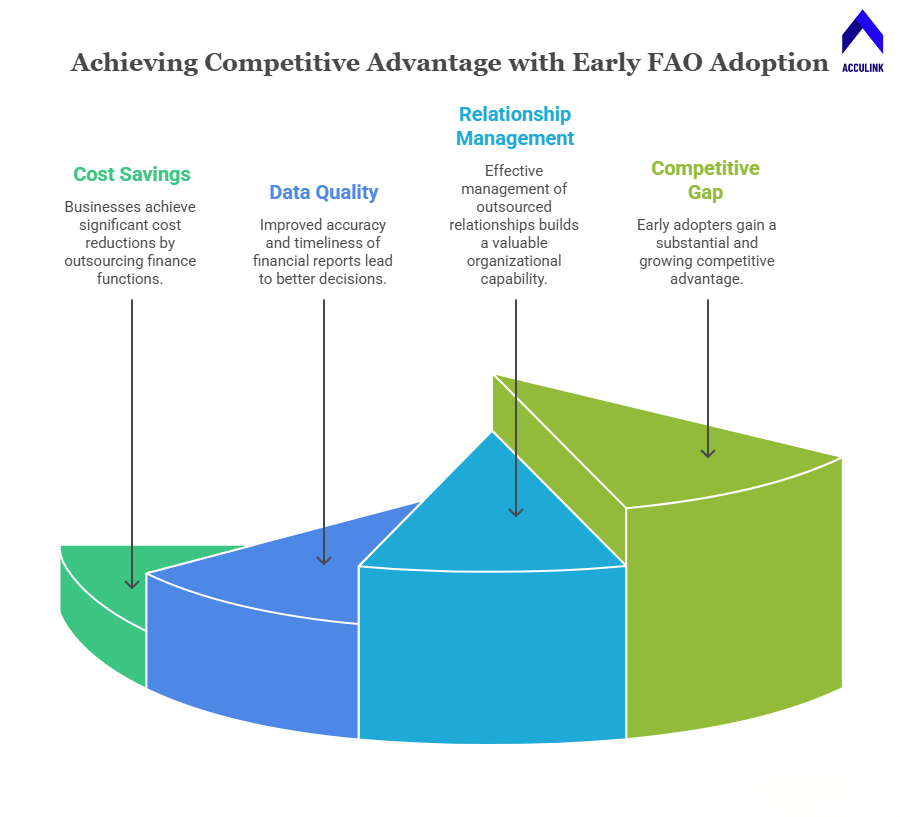
The early FAO adopters have also learned how to manage outsourced accounting relationships effectively -- an organizational capability with its own learning curve. They know how to write clear process documentation, structure approval workflows, review outsourced deliverables efficiently, and expand scope when the business grows. This competence is a genuine competitive asset that takes time to develop and that late adopters will need to build from scratch. For a practical guide to the transition, see The 90-Day FAO Transition Guide for CPA Firms.
Implementation Priorities for Your 2026 FAO Strategy
Translating awareness of FAO trends into a concrete 2026 strategy requires prioritization. Not every trend demands equal urgency -- your priorities should reflect your industry, growth trajectory, and current operational maturity. For most mid-market companies and CPA firms, the highest-leverage moves are:
-
Consolidate transactional accounting with a full-service FAO partner capable of handling bookkeeping, AP/AR management, payroll, and tax preparation under one relationship.
-
Implement real-time financial reporting dashboards -- eliminating the monthly close bottleneck and giving leadership current financial data continuously.
-
Ensure your FAO partner has a documented AI integration roadmap -- confirming they are investing in technology that will reduce your per-transaction costs over time, not just maintaining current service levels.
-
Add virtual CFO oversight if your business is above $2-5M in revenue and facing capital, financing, or strategic planning decisions without C-level financial input.
Budget appropriately for the 2026 FAO transition. Outsourcing transactional accounting functions is not a zero-cost change. There are onboarding investments, software integration costs, and a ramp period during which productivity dips before it rises. However, the ROI timeline for a well-executed FAO transition is typically 6-9 months, after which the ongoing savings compound annually. For current pricing, see Acculink's engagement models and pricing.
Frequently Asked Questions About FAO Trends in 2026
Q: How is AI changing outsourced accounting quality in 2026?
AI tools are reducing manual data-entry workloads by 60-80% in the most automated outsourced accounting environments, according to McKinsey research on finance function transformation. This means fewer transcription errors, faster reconciliations, and human accountant attention directed to judgment calls rather than mechanical tasks. The net result is higher quality at lower cost -- a primary driver of the FAO market growth projected through 2031.
Q: Is offshore accounting as reliable as onshore accounting?
For accounting execution work -- bookkeeping, AP/AR, reconciliation, financial close -- offshore teams from certified providers like Acculink CPA deliver quality that matches or exceeds onshore. The cost is 50-75% lower. The key factors are: team qualifications (CPAs and CAs, not clerical staff), ISO 27001 security certification, robust supervision infrastructure, and documented client-specific processes. Acculink has delivered zero-breach service to 80+ firms across 5+ years.
Q: What is a virtual CFO and does my business need one?
A virtual CFO provides part-time strategic financial guidance -- the work a full-time CFO would do (cash flow forecasting, investor relations, M&A support, banking). You skip the $280,000-$430,000 annual salary and benefits commitment. Most growing businesses benefit from a virtual CFO when revenue exceeds $2-5 million. See Acculink's Virtual CFO services for engagement details and pricing.
Q: How does the Corporate Transparency Act affect my accounting?
The Corporate Transparency Act requires most small businesses to report beneficial ownership information to FinCEN. Civil penalties run up to $500/day and criminal penalties for willful non-compliance. For further background, the FinCEN BOI reporting overview provides the regulatory framework. Outsourced accounting providers who stay current on regulatory developments help clients navigate new requirements proactively. Acculink monitors CTA and other regulatory changes and advises clients before deadlines, not after.
Q: What security certifications should I require from an FAO provider?
At minimum, require: ISO 27001 certification (information security management), SOC 2 Type II report (operational security controls), IRS §7216 compliance (disclosure consent for offshore tax preparation), and documented GDPR-compliant data handling. Providers should be able to produce current certification documentation, not just verbal assurances. The ISO.org ISO 27001 standard page provides the full framework for evaluating provider certifications.
Q: How much does it cost to outsource accounting to an offshore FAO provider?
Offshore FAO pricing ranges widely depending on scope and provider. Acculink CPA's all-inclusive pricing starts at $8/hr for entry-level bookkeeping roles and reaches $35/hr for senior CPA or virtual CFO engagement -- with no setup fees, no recruitment charges, and no long-term contract lock-in. Full-time (160 hrs/month), part-time (80 hrs/month), and project-based arrangements are available. For a detailed pricing comparison, see How Much Does It Cost to Outsource Accounting in 2026.
Conclusion: Positioning Your Firm for the 2026 FAO Landscape
The seven finance and accounting outsourcing trends reshaping 2026 are not abstract forces. They are creating concrete competitive advantages for organizations that adapt quickly and real liabilities for those that do not. AI augmentation, offshore hybrid teams, vertical specialization, virtual CFO adoption, cloud-first infrastructure, compliance expertise, and security certification have moved from differentiators to baseline expectations in the FAO market.
For CPA firm owners and business leaders evaluating their finance and accounting outsourcing strategy in 2026, the central question is no longer whether to use outsourced accounting firms . It is which provider is best positioned to deliver all seven trends under one relationship, at a cost structure that makes the ROI obvious. Acculink CPA, serving 80+ firms with 300+ qualified professionals and 4,000+ in our extended network, is built to be that partner.
With all-inclusive offshore accounting staffing from $8-$35/hr, a 40-hour free trial with no financial obligation, and candidates delivered within 5-7 business days, the barrier to getting started has never been lower. Firms that begin their Acculink engagement in 2026 receive automatic access to ongoing AI capability upgrades, compliance monitoring, and technology integrations. All are included in the standard engagement, with no additional platform fees.
References
-
Mordor Intelligence -- Finance and Accounting Outsourcing Market Size 2026-2031 (January 2026)
-
McKinsey -- The Future of Finance: AI in Accounting and Finance Functions (2025)
-
AICPA -- 2025 PCPS CPA Firm Staffing and Talent Survey (2025)
-
FinCEN -- Beneficial Ownership Information (BOI) Reporting Requirements (Updated 2025)
-
IRS -- Corporate Transparency Act and BOI Reporting for Tax Practitioners (2025)
-
ISO -- ISO/IEC 27001 Information Security Management Standard (Current edition)
-
Glassdoor -- Chief Financial Officer Salary Data United States (May 2026) (2026)
-
Robert Half -- 2026 Salary Guide: Finance and Accounting (2026)
-
QuickBooks -- AI Features and 2026 Product Roadmap (2025-2026)
-
BLS -- Occupational Outlook Handbook: Accountants and Auditors (2025-2026) (2025)
About Acculink CPA
Acculink CPA is a premier offshore staffing and outsourcing company purpose-built for CPA firms, accounting firms, and tax firms in the United States, Canada, and the UAE. With 300+ qualified professionals -- including CPAs, Chartered Accountants, Enrolled Agents, and Big 4-trained staff from Deloitte, PwC, EY, KPMG, RSM, BDO, Grant Thornton, Forvis Mazars, Crowe, and CLA -- Acculink provides dedicated offshore accountants, bookkeepers, tax preparers, auditors, virtual CFOs, and virtual assistants at $8-$35/hr, delivering up to 75% cost savings.
Certifications and trust signals: ISO 27001:2013 certified · SOC 2 Type II aligned · IRS §7216 compliant · GDPR compliant · FTC Safeguards Rule compliant · Zero security breaches in 5+ years · 40-hour free trial · No setup fees · No long-term contracts · Xero Certified Advisor · QuickBooks Advanced Certified ProAdvisor
Website: Acculink CPA Schedule: calendly.com/acculinkcpa/45min Email: Info@acculinkcpa.com Phone: +1 (203) 997-0224 LinkedIn: linkedin.com/company/acculinkcpa
The shift from compliance to advisory is one of the biggest trends in the profession — read how CPA firms are using offshore teams to move from compliance to advisory services.
© 2026 Acculink CPA. All rights reserved. acculinkcpa.com
Tags:
About the Author

Related Posts
Cost of Outsourcing Accounting for CPA and Accounting Firms: 2026 Pricing, Rates, and ROI
The cost to outsource accounting typically ranges from $8 to $35 per hour, depending on the service, experienc…
15 Profitable Add-On Services CPA and Accounting Firms Can Offer Without Hiring In-House
CPA and accounting firms do not need to build every new service with another in-house hire. This guide compare…
Top 10 Payroll Outsourcing Companies for CPA and Accounting Firms (2026)
This guide compares ten payroll outsourcing companies for U.S. CPA and accounting firms. It separates processi…