Top 5 Outsourced Accounts Receivable Mistakes CPA Firms Make and How to Fix Them

Summary
Avoid these 5 costly accounts receivable outsourcing mistakes that CPA firms make — and learn how to fix each one before it damages your client relationships.
Key Takeaways
• The single most expensive accounts receivable outsourcing mistake is hiring a provider with no documented collections playbook — follow-up becomes inconsistent and Days Sales Outstanding (DSO) drifts upward instead of down.
• Skipping data hygiene at onboarding (customer master, ageing review, dispute log) costs 30–45 days of productivity before the outsourced AR team can operate at full capacity.
• AR outsourcing without a three-tier escalation protocol damages customer relationships when disputes and complex balances get mishandled by staff who lack decision authority.
• Failing to baseline AR KPIs (DSO, net collection rate, AR>90 days, bad debt rate) before outsourcing makes it impossible to measure provider performance or hold the team accountable.
• Acculink CPA structurally avoids all 5 mistakes by design — dedicated AR specialists from $8–$35/hr, documented SLAs, ISO 27001:2013 certified operations, and a 40-hour free trial.
Outsourcing accounts receivable can transform working capital and reduce DSO — or it can create cash-flow problems worse than the ones it was meant to solve. The difference between the two outcomes almost always comes down to mistakes made before the engagement starts. The five accounts receivable outsourcing mistakes detailed in this guide are the ones we see most often when CPA firms and finance leaders bring in an offshore AR partner without a structured onboarding plan, KPI baseline, or escalation framework. Each is preventable. Each carries a real, quantifiable financial cost. And each one shows up well before the contract is signed.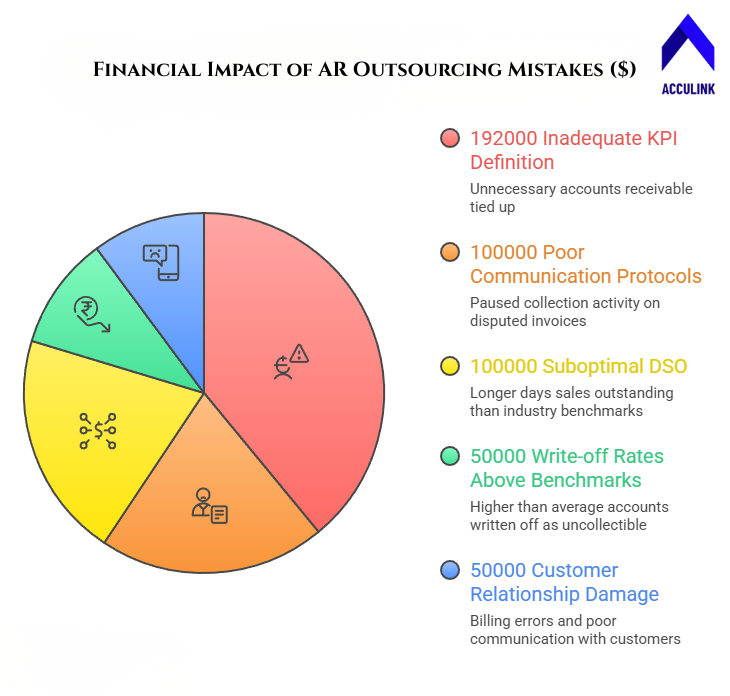
AR outsourcing should reduce DSO, increase net collection rate, and free your internal staff from low-value follow-up work — not introduce new categories of risk. According to IOFM (Institute of Finance & Management), the best-performing AR functions share four traits: clean customer master data, a documented collections cadence, defined escalation rules, and tracked KPIs. The five mistakes below are simply the absence of those traits. This guide walks through each one — and shows how Acculink CPA builds engagements that avoid them.
New to AR outsourcing? Start with our companion guide on accounts payable and receivable outsourcing for CPA accounting firms, which covers the strategic case for outsourcing the order-to-cash cycle. This guide focuses on execution mistakes — the practical traps that derail otherwise sensible engagements.
Mistake 1 — Choosing a Provider Without a Documented Collections Process
The most common (and most expensive) of the accounts receivable outsourcing mistakes is selecting a provider who cannot describe their collections process in writing. Without a documented playbook, follow-up becomes ad hoc — some invoices receive aggressive follow-up, others languish. There is no consistency in tone, no defined channel mix, no escalation logic, and no way to know what good performance even looks like.
Before signing any AR outsourcing agreement, require the provider to produce their written collections playbook. According to IOFM benchmarking research, the highest-performing AR operations operate from a process document that specifies: first-contact timing after the due date (typically Day 1–3), follow-up cadence through Day 30, escalation triggers between Day 30 and Day 60, pre-legal demand letter procedures (Day 60–90), and the customer segmentation rules that dictate which customers get which treatment.
What a Good AR Collections Playbook Looks Like
A defensible collections playbook covers at least nine elements. If the provider cannot show you the playbook before contract signing, do not assume they have one.
· Day-by-day communications calendar from Day 1 post-due through Day 90+, mapped by customer tier.
· Channel specifications — email, phone, customer portal, statement, and what triggers each.
· Tone guidelines by customer tier (top accounts get relationship-aware messaging; standard accounts follow the default sequence).
· Dispute triage workflow — how disputed invoices are categorised, owned, and resolved.
· Promise-to-pay tracking — the system used to record commitments and trigger reminders.
· Payment plan negotiation authority — what the outsourced team can approve unilaterally vs. what needs to be escalated.
· Credit hold decision criteria — the dollar thresholds and ageing triggers that prompt holds.
· Pre-legal demand letter format — template, sign-off, and the timing rules around it.
· KPI reporting cadence — weekly metrics, monthly review calls, quarterly trend analysis.
Acculink CPA provides every AR outsourcing client with a written, version-controlled collections playbook tailored to their customer base, industry, and brand voice. The playbook is built during the structured 2–3 week onboarding and reviewed quarterly. See our accounts payable / accounts receivable outsourcing services for the full engagement model.
The Cost of Undocumented AR Collections
The financial cost of an undocumented collections process is measurable. A 10–15 day increase in DSO from inconsistent follow-up — common in the first 90 days when the outsourced team is improvising — ties up significant working capital. The table below shows the working capital impact of different DSO ranges on a business with $5M annual revenue.
|
DSO Range |
Working Capital Tied Up (on $5M ARR) |
Bad Debt Risk |
|
30–35 days (excellent) |
$411,000 – $479,000 |
<1% — excellent |
|
40–50 days (industry average) |
$548,000 – $685,000 |
1–2% — manageable |
|
55–70 days (concerning) |
$753,000 – $959,000 |
2–5% — concerning |
|
75–90+ days (critical) |
$1.0M – $1.2M+ |
5%+ — high write-off risk |
Industry benchmarks from TechTarget and AR-focused analytics platforms place a DSO under 45 days as favourable for most B2B industries, with sub-30-day DSO typical in retail and manufacturing, varying 45–75 days due to longer credit terms. A poorly onboarded outsourced AR engagement frequently lifts DSO by 5–15 days in the first 60 days before performance normalises. That gap is the cost of skipping the playbook check during provider selection.
Mistake 2 — Inadequate Onboarding: Handing Over Dirty Data
The second most common of the accounts receivable outsourcing mistakes is transitioning AR to an outsourced team without preparing the customer master and ageing data first. Outsourced AR teams need accurate customer contact information, current credit terms, a documented dispute log, and a clean ageing report before they can operate effectively. Handing over a customer master full of stale contacts, undocumented credit terms, and unresolved disputes guarantees the first 30–45 days are spent on data cleanup instead of collections.
Symptoms of inadequate onboarding include: collection emails bouncing because contact records are outdated; customers receiving follow-up on invoices they already disputed verbally with your previous in-house AR clerk; payment terms appearing inconsistently across systems; and the outsourced team being unable to differentiate top-tier accounts from standard accounts because no tiering data exists.
Pre-Outsourcing Data Preparation Checklist
Before transitioning AR to any outsourced team, invest 1–2 weeks in data preparation. Acculink's onboarding includes a structured data intake that walks clients through each of the steps,e — but the work has to happen regardless of which provider you select.
1. Verify primary AP contact information for every customer with an outstanding balance above $500. Validate email, phone, and AP portal login where applicable.
2. Document credit terms for each active customer — Net 30, Net 60, special arrangements, retention clauses, or other deviations from the default.
3. Tag disputed invoices with the dispute reason, relevant supporting documentation, and the internal owner who last touched the dispute.
4. Produce a clean, current report (0–30, 31–60, 61–90, 91+ buckets) and reconcile it to the general ledger AR balance.
5. Document customer-specific billing nuances — invoice email vs. portal, PO number requirements, statement preferences, billing cycles.
6. Identify your top 20% of customers by revenue and tag them for relationship-aware handling.
7. Produce a list of 'no-contact' customers — those in litigation, bankruptcy, or strategic dispute — so the outsourced team does not inadvertently engage them.
According to the IOFM Accredited Receivables Specialist program, clean customer master data is the single biggest determinant of AR team productivity. Organisations that skip this step typically need 30–45 additional days before their outsourced AR team operates at expected capacity — roughly 6 weeks of suboptimal collections output that flows straight to working capital impact.
Mistake 3 — No Defined Escalation Protocol
AR outsourcing without a clear escalation protocol creates the most damaging outcome possible: customer disputes and complex balance situations handled inconsistently by staff who lack the authority or context to make good decisions. A multi-million-dollar customer relationship can be permanently damaged when an offshore AR specialist follows the same dunning sequence on a strategic account that they would apply to a $400 invoice in the 60-day bucket.
This is not a problem of offshore vs. onshore. It is a problem of unclear ownership. The same mistake happens with in-house staff who lack authoritative guidance. The difference with outsourcing is the speed at which the mistake propagates — without a defined escalation framework, the outsourced team defaults to the same rule for every situation.
The 3-Tier Escalation Framework
Before going live with outsourced AR, define three escalation tiers with named contacts and response SLAs. This framework is the single most effective protection against AR outsourcing disasters.
· Tier 1 — Routine follow-up. The outsourced AR team handles independently: standard reminder emails, second-touch calls, payment plan offers within pre-approved parameters, statement re-sends, and acknowledgement of disputes for later triage. Most accounts and most actions live here.
· Tier 2 — Judgment situations. Active disputes requiring research, payment plan requests outside pre-approved limits, credit hold decisions, write-off recommendations under your threshold, and changes to standard credit terms. Tier 2 items route to a named internal owner with a defined SLA — typically 24–48 hours.
· Tier 3 — Executive decisions. Anything affecting a top-20% customer relationship, legal referral candidates, write-offs above the Tier 2 threshold, and contract or pricing implications. Tier 3 escalates to a senior internal contact — typically the controller, CFO, or partner — with a same-day SLA.
Acculink AR engagements include this 3-tier framework as a standard onboarding deliverable. Each tier has documented decision criteria, response SLAs, and a named escalation path on the client side. Hire a dedicated AR/AP executive through Acculink, and the escalation matrix is part of the engagement, not an afterthought.
Mistake 4 — Not Defining AR KPIs Before Outsourcing
How do you know your AR outsourcing engagement is working if you never defined what success looks like? Many businesses outsource AR and receive monthly reports without ever establishing baseline metrics or improvement targets. Six months in, they cannot answer whether the engagement has delivered any quantifiable value — because there was no baseline to measure against.
This is one of the most preventable accounts receivable outsourcing mistakes. AR is a metrics-rich function. Baselines are easy to establish from your existing accounting system. Targets are easy to negotiate at the start of an engagement, when both parties are motivated to define success. Doing this work pre-engagement transforms the outsourcing relationship from a vague delegation into a measurable, accountable partnership.
Five AR KPIs to Baseline Before Outsourcing
Document current performance across five KPIs. Set 90-day and 180-day improvement targets. Build them into the engagement contract. Review monthly.
|
KPI |
Baseline to Measure |
Typical 90-Day Target |
Typical 180-Day Target |
|
Days Sales Outstanding (DSO) |
Last 3-month rolling average |
Reduce by 10–15 days |
Reduce by 15–25 days |
|
Net Collection Rate |
Last 12-month rate |
+2–3 percentage points |
+4–5 percentage points |
|
AR > 90 days (% of total AR) |
Current month-end snapshot |
Reduce by 30% |
Reduce by 50% |
|
First Contact Resolution Rate |
Estimate from the current process |
Reach 75–80% |
Reach 85–90% |
|
Bad Debt Write-Off Rate |
Last 12-month rate |
Reduce by 20% |
Reduce by 40% |
These targets are achievable for most B2B businesses with a structured outsourced AR engagement. Healthcare organisations should additionally track HFMA MAP Keys — the HFMA-defined revenue cycle benchmarks set the industry standard for clean claim rate (target ≥95%), days in net AR, and denial rates. For working capital impact context, Salesforce notes that "a DSO of 30 to 45 days is typically seen as a good benchmark" across most industries, with lower numbers indicating efficient collection cycles and tighter cash conversion.
Mistake 5 — Underestimating the Importance of Customer Communication Tone
AR collections is not just a financial function — it is a customer relationship function. The tone, professionalism, and consistency of collection communications directly affect how customers perceive your brand. An aggressive, transactional collection email to a strategic customer can do more reputational damage than the unpaid invoice itself.
This mistake is particularly common with offshore AR outsourcing when the engagement does not include explicit communication tone training. The outsourced team defaults to template language that reads as formal but cold. Customers — especially top-tier customers accustomed to relationship-based handling — notice the change immediately. Some respond by paying faster. More often, they push back, escalate to your sales team, or quietly start considering alternative suppliers.
Building a Brand-Voice Communication Framework
Before outsourcing AR, develop a communication framework that reflects your brand voice and customer relationship philosophy.
· Tone by tier. Top-tier customers receive softer, more deferential language ("we just wanted to flag this for your awareness"); standard accounts follow the default sequence; non-strategic small balances can use the most direct templates.
· Approved phrases. A short list of phrases that align with your brand voice — "Quick check-in on invoice #..." vs. "Past due notice."
· Prohibited language. Terms to avoid completely — overly legalistic phrases, threats of credit reporting (typically restricted in B2B contexts), and any language that escalates emotionally rather than operationally.
· Channel matching. Some customers prefer email-only, some prefer phone calls, and some require AP portal submissions. Channel preference belongs in the customer master.
· Sign-off authority. Define who is named on outgoing communications — the outsourced specialist, a named internal contact, or a generic "Accounts Receivable" alias. Each has a different perceived authority.
Acculink AR teams undergo communication training specific to each client's brand voice and customer relationship strategy. We treat AR management as a customer experience function, not just a cash collection function — a distinction that Deloitte's working capital research consistently identifies as a hallmark of best-in-class order-to-cash operations.
One important compliance note: in the United States, the Fair Debt Collection Practices Act (FDCPA) regulates third-party consumer debt collection — it does not apply to B2B commercial collections, but it is a useful ethical baseline. Reputable outsourced AR providers (including Acculink CPA) voluntarily adopt FDCPA-aligned communication standards even in B2B engagements, because professional, consistent communication is the right operating standard regardless of legal requirement.
AR Outsourcing Implementation Checklist (Avoid All 5 Mistakes)
Use this pre-outsourcing checklist to systematically avoid all five mistakes. Each item should be complete before the outsourced team takes over live AR work.
· Request and review the provider's written collections playbook (Mistake 1).
· Verify customer master data and complete the 7-step data preparation checklist (Mistake 2).
· Define the 3-tier escalation protocol with named contacts and response SLAs (Mistake 3).
· Establish baselines for DSO, net collection rate, AR>90 days, first-contact resolution, and bad debt rate (Mistake 4).
· Set 90-day and 180-day improvement targets in the engagement contract (Mistake 4).
· Develop communication tone guidelines, approved phrases, and prohibited language (Mistake 5).
· Run a 30-day parallel period before full handoff.
· Schedule monthly KPI review calls with the provider.
· Document the off-boarding contingency — how AR work would return in-house if needed.
Building a Systematic AR Follow-Up Protocol
The most impactful change an outsourced AR team makes in the first 60 days is replacing ad-hoc, reactive collections follow-up with a structured, proactive cadence. The difference between these two approaches typically accounts for 8–12 days of DSO improvement on its own, before any other optimisations are layered in.
A structured cadence operates on a defined schedule: an automated reminder email two days before the due date; a soft follow-up call on Day 1 past due for accounts over a defined dollar threshold; an escalating email sequence on Days 7, 14, and 21; a Day 30 phone call accompanied by an updated statement; a Day 45 formal payment demand; and a Day 60 escalation review with the internal contact. The exact cadence should be calibrated to your industry, your customer base, and your tolerance for relationship risk — but the discipline of having a defined cadence is what separates high-performing AR operations from ones that drift.
Customer segmentation should drive cadence variation. Your largest-revenue customers may warrant a more relationship-sensitive follow-up approach than standard accounts — a phone call from a named internal contact rather than an automated email sequence, for example. Mid-market accounts may follow the standard cadence with minor adjustments. Small-dollar, high-volume accounts may justify a more automated, lower-touch approach. The point is that the segmentation rules need to be explicit and built into the outsourced team's daily workflow, not held informally in the head of an internal manager.
Technology Enablers for Outsourced AR Excellence
The effectiveness of an outsourced AR operation depends significantly on the technology infrastructure it operates within. Cloud-based AR management platforms integrated with your accounting software — QuickBooks Online, Xero, NetSuite, Sage Intacct, or comparable systems — allow the outsourced team to work in real time on the same data your internal team sees, without document exchanges or version control issues. According to Gartner research on order-to-cash outsourcing, the gap between best-in-class and average AR functions has widened over the past three years primarily because of technology adoption — automation, AI-assisted dispute categorisation, and real-time analytics.
Electronic payment infrastructure deserves particular attention. The single most effective way to reduce DSO is to make it easy for customers to pay. If your current process requires customers to receive a paper invoice, write a check, and mail it back, you are losing 7–14 days of DSO compared to peers offering ACH, credit card, or AR portal payment. QuickBooks AR research consistently shows that electronic payment adoption is the single highest-impact lever for DSO reduction — often more impactful than collections follow-up changes.
Analytics capability rounds out the technology stack. An outsourced AR team that produces weekly metrics — new invoices issued, cash collected, ageing bucket movement, DSO trend, dispute rates by customer, and net collection rate — gives you the visibility to manage the function actively rather than passively. Without this analytics layer, you are dependent on the outsourced team to surface issues. With it, you can spot trends before they become problems.
Dispute Management as an AR Excellence Component
Invoice disputes are the hidden enemy of AR performance. A disputed invoice is typically excluded from standard follow-up protocols — collections teams are rightly reluctant to aggressively pursue payment on a balance the customer claims is incorrect. But disputed invoices that linger for 90+ days without resolution become uncollectible by attrition, even when the original dispute was minor.
Acculink's dispute management process begins with categorisation: is the dispute about invoice accuracy, service delivery quality, billing timing, or administrative issues such as a wrong purchase order number or contact? Each category routes to a different internal owner with a defined response SLA. Disputes are tracked in a central log with status, ownership, and resolution timeline. The outsourced AR team owns chase-down and escalation; the internal team owns the decision; the dispute log enforces accountability on both sides.
The business intelligence from dispute tracking is valuable beyond individual case resolution. If 20% of your disputes are caused by invoices being sent to the wrong contact at the customer's organisation, the fix is a billing process change — not a more aggressive collections sequence. If 30% of your disputes are about pricing discrepancies, the fix is upstream in sales order entry. Outsourced AR teams that produce monthly dispute root-cause analysis reduce future dispute volume — not just resolve existing ones. This is one of the highest-value but most overlooked deliverables in an AR outsourcing engagement.
How Acculink CPA Structures AR Outsourcing to Avoid These Mistakes
Every Acculink CPA AR outsourcing engagement includes, by design, the safeguards against all five mistakes detailed above:
· Documented collections playbook — version-controlled, tailored to your industry and customer base, built during onboarding and reviewed quarterly.
· 2–3 week structured onboarding — including customer master review, credit term documentation, ageing reconciliation, and dispute log preparation.
· 3-tier escalation framework — with named internal contacts and SLA-defined response times.
· Monthly KPI reporting — against agreed baselines on DSO, net collection rate, AR>90 days, first-contact resolution, and bad debt rate.
· Brand-voice communication training — so collection communications reflect your company's tone, not generic dunning templates.
· ISO 27001:2013 certified, SOC 2 Type II aligned, GDPR compliant — with zero security breaches across 5+ years of operations and 80+ accounting firm clients.
Engagement starts with a 40-hour free trial — no setup fees, no recruitment charges, and no long-term contract obligation. Dedicated AR specialists are available from $8–$35/hr (all-inclusive). Candidate profiles are delivered within 5–7 business days; full onboarding completes in 2–3 weeks. Review our engagement models and pricing for the full structure, or explore why Acculink CPA is the offshore staffing partner of choice for 80+ U.S., Canadian, and UAE accounting firms.
For broader context on outsourcing pitfalls beyond AR specifically, see our companion piece: Top 10 Mistakes CPA Firms Make When Outsourcing Accounting (and How to Avoid Them). For the security and data-protection framework underpinning every Acculink engagement, see our IT & data security overview. Additional articles on AR, AP, working capital, and CPA firm operations are available in the Acculink CPA blog library.
Frequently Asked Questions: AR Outsourcing
How long does it take to see DSO improvement after outsourcing AR?
Most businesses see measurable DSO improvement within 45–60 days of transitioning to outsourced AR — once the team has completed onboarding, worked through the aged-bucket backlog, and established a structured follow-up cadence. Significant gains (10–15 days of DSO reduction) typically arrive by Day 90; sustainable best-in-class performance arrives by Month 6. Avoiding the five mistakes in this guide is what separates engagements that hit those targets from ones that drift.
Can outsourced AR teams handle high-value customer accounts differently from standard accounts?
Yes — and they should. Acculink segments customer accounts by tier as a standard onboarding deliverable. Major accounts receive relationship-aware, escalation-first communication; standard accounts follow the documented collections sequence; small-balance accounts use higher-touch automation. Tier definitions, communication scripts, and escalation rules per tier are built into the playbook before go-live.
What happens if a customer refuses to pay, and legal action is needed?
Acculink handles collections through the pre-legal escalation stage — systematic follow-up, dispute resolution, payment plan negotiation, and final demand letters. When a gal referral is required, Acculink coordinates the handoff to the client's chosen collections attorney or commercial collections agency. Acculink does not provide legal services or litigation support directly; this is a deliberate scope boundary that keeps the engagement focused on the operational AR work where offshore staffing provides the most value.
How do I measure whether my AR outsourcing provider is performing?
Track five KPIs monthly: DSO (target below 45 days for most industries), net collection rate (target above 96%), percentage of AR over 90 days (target below 10%), bad debt write-off rate (target below 1% for most B2B businesses), and first-contact resolution rate (target above 80%). Compare actuals to the baselines you established before outsourcing, and review variance against the targets in your engagement contract. Acculink provides this reporting as a standard monthly deliverable, with quarterly trend analysis.
Is it possible to outsource AR while keeping AP in-house?
Yes. Many businesses outsource AR and AP independently, or one at a time. Outsourcing AR while retaining AP in-house is a common configuration — particularly when AR volume and complexity are the primary working capital constraint, and AP is handled adequately by existing staff or accounting software automation. Acculink supports AR-only, AP-only, and combined AR/AP engagements; the engagement structure is built around your actual operational needs, not a packaged bundle.
What credentials should I look for in an offshore AR outsourcing provider?
At minimum, an offshore AR provider should hold ISO 27001:2013 certification (information security management), be SOC 2 Type II aligned (security and availability controls), and demonstrate GDPR compliance (data protection). For U.S. CPA firms specifically, IRS §7216 compliance is required if the engagement touches client tax data. Acculink CPA holds all four — ISO 27001:2013 certified, SOC 2 Type II aligned, GDPR compliant, and IRS §7216 compliant — with zero security breaches across 5+ years of operations and 300+ qualified professionals serving 80+ accounting firms across the U.S., Canada, and UAE.
Conclusion: Avoiding AR Outsourcing Mistakes Is a Pre-Engagement Discipline
The five accounts receivable outsourcing mistakes detailed in this guide share a common root: treating AR outsourcing as a cost-reduction transaction rather than a performance partnership. The businesses that get the best results take the time to baseline current performance, document the operating model, define escalation rules, and align communication tone before the engagement starts. Every hour invested in this pre-engagement work returns 10–20 hours of avoided rework in the first 90 days.
High-performance AR outsourcing relationships are defined by three operational characteristics: transparency, speed, and continuous improvement. Transparency means your outsourced partner provides real-time visibility into the work being performed, the outcomes being achieved, and the issues being escalated. Speed means decisions and communications happen on contract-defined SLAs rather than ad hoc. Continuous improvement means quarterly performance reviews that drive measurable change — not just retrospective reporting.
Acculink CPA's AR outsourcing model is built around these three characteristics. Our clients receive access to real-time AR dashboards, benefit from a dedicated AR specialist who knows their customer base by name, and participate in quarterly performance reviews that have produced — for clients who avoid the five mistakes — DSO reductions of 15–25 days within six months. To explore how an Acculink AR engagement could work for your business, schedule a 45-minute consultation or visit our AR/AP management services page for engagement structure and pricing details.
References & Authoritative Sources
1. IOFM — Best Practices to Improve Your Accounts Receivable Performance
2. HFMA — MAP Keys: Industry-Standard Revenue Cycle KPIs
3. HFMA — 7 KPIs Healthcare Providers Should Be Tracking
4. Salesforce — Days Sales Outstanding (DSO): Calculation & Improvement
5. TechTarget — What is Days Sales Outstanding (DSO)?
6. FTC — Fair Debt Collection Practices Act (FDCPA)
7. QuickBooks — Accounts Receivable Best Practices
8. Gartner — Finance Operations Research & Insights
9. Deloitte — Working Capital Management Solutions
10. IOFM — Accredited Receivables Specialist (ARS) Certification
About Acculink CPA
Acculink CPA is a premier offshore staffing and outsourcing company purpose-built for CPA firms, accounting firms, and tax firms in the United States, Canada, and the UAE. With a team of 300+ qualified professionals across accounting, tax, audit, and advisory — plus an extended network of 4,000+ professionals — Acculink CPA serves 80+ accounting firms with all-inclusive pricing from $8 to $35 per hour, a 40-hour free trial, no setup fees, no recruitment charges, and no long-term contracts. Our team includes Big 4 and top-25 firm alumni (Deloitte, PwC, EY, KPMG, RSM, BDO, Grant Thornton, and others), CPAs, Enrolled Agents (EAs), and Chartered Accountants (CAs). Acculink is ISO 27001:2013 certified, SOC 2 Type II aligned, GDPR compliant, and IRS §7216 compliant — with zero security breaches across 5+ years of operations.
Website: Acculink CPA | Schedule: calendly.com/acculinkcpa/45min | Email: Info@acculinkcpa.com | Phone: +1 (203) 997-0224 | LinkedIn: linkedin.com/company/acculinkcpa
Tags:
About the Author

Related Posts
Cost of Outsourcing Accounting for CPA and Accounting Firms: 2026 Pricing, Rates, and ROI
The cost to outsource accounting typically ranges from $8 to $35 per hour, depending on the service, experienc…
15 Profitable Add-On Services CPA and Accounting Firms Can Offer Without Hiring In-House
CPA and accounting firms do not need to build every new service with another in-house hire. This guide compare…
Top 10 Payroll Outsourcing Companies for CPA and Accounting Firms (2026)
This guide compares ten payroll outsourcing companies for U.S. CPA and accounting firms. It separates processi…