Top 10 Mistakes CPA Firms Make When Outsourcing Accounting (And How to Avoid Them)

Summary
Most failed outsourcing experiences aren’t caused by offshore talent being inadequate — they’re caused by mistakes in how firms select providers, onboard staff, and manage the relationship.
Key Takeaways
-
Most failed outsourcing experiences aren’t caused by offshore talent being inadequate — they’re caused by mistakes in how firms select providers, onboard staff, and manage the relationship.
-
The #1 mistake is choosing a provider based on price alone. The cheapest rate almost always delivers the most rework, the highest turnover, and the greatest risk.
-
Failing to document SOPs before outsourcing is the second-most-common mistake. Undocumented processes produce inconsistent results regardless of who does the work.
-
Security negligence, poor communication planning, and not using a trial period round out the top five — all are preventable with proper due diligence.
-
Acculink CPA’s model is designed to prevent each of these 10 mistakes: transparent pricing, 40-hour free trial, IRS §7216 and ISO 27001 compliance, dedicated account managers, and in-house L&D programs.
In the 1994 film Forrest Gump, Tom Hanks delivers the line, "Life is like a box of chocolates. You never know what you’re gonna get." For CPA firms that have outsourced accounting work without doing proper due diligence, the analogy is painfully accurate — except the chocolates are sometimes bitter, sometimes stale, and occasionally missing entirely.
Here’s the reality: outsourcing accounting to offshore professionals works. Eighty-plus CPA firms work with Acculink CPA alone, and thousands more outsource successfully across the industry. But when outsourcing fails, it’s almost always because of avoidable mistakes — mistakes the firm made, not inherent problems with offshore talent.
This blog examines the 10 most common mistakes CPA firms make when outsourcing accounting — and, more importantly, exactly how to avoid each one. Whether you’re outsourcing for the first time or recovering from a bad experience with a previous provider, this guide will help you get it right.
Mistake #1: Choosing a Provider Based on Price Alone
This is the most damaging mistake, and it’s the most common. When a firm sees rates of $5–$7/hr advertised by offshore providers, the temptation is hard to resist. But as Oscar Wilde observed, "A cynic is a man who knows the price of everything and the value of nothing."
Providers at the bottom of the price range cut costs somewhere: less experienced staff, no security certifications, no in-house training, high turnover, and minimal quality controls. The result? Returns that need twice the review time, bookkeeping that requires monthly corrections, and audit workpapers that don’t meet your firm’s standards.
How to avoid it: Evaluate providers on total cost of ownership — rate + rework time + management overhead + risk. A $15/hr preparer who gets it right the first time costs less than a $7/hr preparer who generates 30 minutes of review notes per return. Compare providers on quality metrics, not just hourly rates. See Acculink’s engagement models for transparent, all-inclusive pricing.
Mistake #2: Not Having Documented SOPs Before Outsourcing
If your in-house team operates on tribal knowledge — "everyone just knows how we do it" — you’re setting your offshore team up to fail. Offshore professionals execute brilliantly against clear, documented processes. They struggle without structure, just like any new hire would.
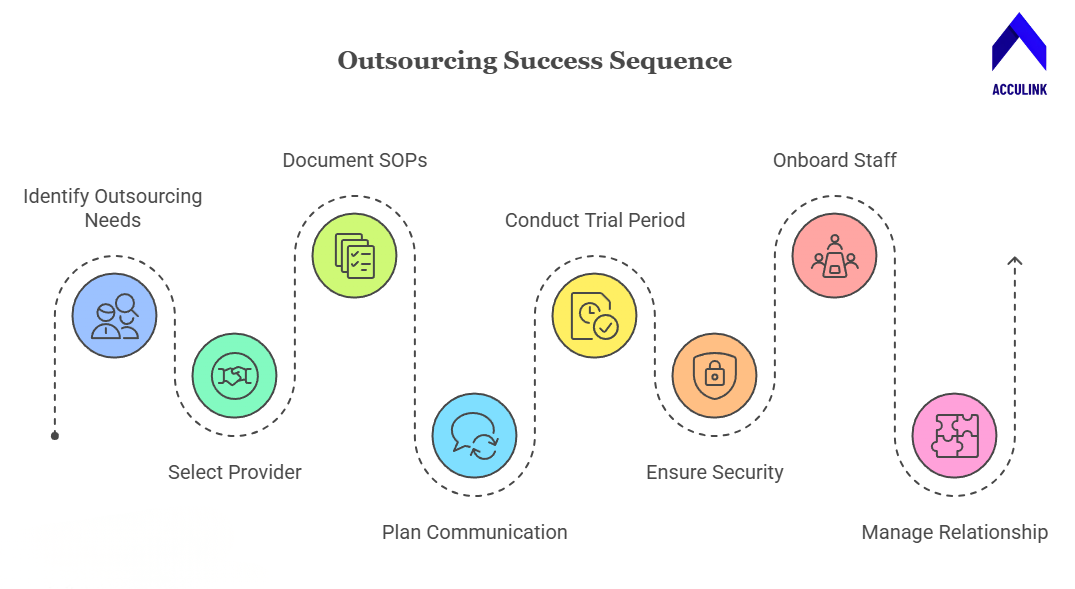
How to avoid it: Before your first offshore team member starts, document your core workflows: how you process a 1040, how you do a bank reconciliation, how you prepare audit workpapers. Include screenshots, step-by-step instructions, and examples of completed work. This investment pays off immediately and permanently. For firms that need help structuring their accounting outsourcing services, Acculink’s account managers can assist with SOP development during onboarding.
Mistake #3: Ignoring Security and Compliance
Some firms are so focused on cost savings that they overlook the single most important factor: data security. CPA firms handle Social Security numbers, bank account details, and tax return information — data protected by IRS §7216, FTC regulations, and AICPA professional standards. Outsourcing to a provider without ISO 27001, SOC 2, and §7216 compliance is a ticking time bomb.
How to avoid it: Demand certificates, not claims. Ask for the actual ISO 27001 certificate, the SOC 2 Type II report, and the §7216 compliance documentation. If a provider can’t produce these within 24 hours, they don’t have them. Review Acculink’s IT & data security framework as a benchmark for what a compliant provider looks like.
Mistake #4: Poor Communication Planning
Many firms assume that hiring an offshore team is a "set it and forget it" situation — assign the work and check the output. This approach guarantees frustration. Offshore teams need the same communication cadence you’d give a local hire, especially in the first 30–60 days.
How to avoid it: Establish a communication rhythm from day one: daily 10–15 minute standups during the overlap window, asynchronous task management (Karbon, Canopy, shared trackers), and weekly 30-minute performance reviews. Provide feedback in writing — specific, not vague. "Check the March 12 deposit — it cleared but wasn’t matched" beats "fix the reconciliation." For firms outsourcing bookkeeping or tax preparation, the communication structure is the single biggest predictor of success.
Mistake #5: Not Using the Trial Period
Some firms skip the trial period because they’re in a rush to get capacity online. This is like buying a car without test-driving it. The trial period is your opportunity to evaluate technical skills, communication quality, turnaround time, and cultural fit — before you commit.
How to avoid it: Always use the trial period — even if you’re confident in the provider. Acculink offers a 40-hour free trial with no obligation. Assign real (but lower-risk) tasks, provide detailed feedback, and evaluate the results before going to full production.
Mistake #6: Not Interviewing Offshore Staff Personally
Some providers assign staff to your account without giving you a choice. You end up with whoever was available — not the person best suited for your firm’s specific needs, clients, and culture.
How to avoid it: Insist on conducting interviews yourself, just as you would for a local hire. Test technical skills, software proficiency, and communication. Acculink provides pre-vetted candidate profiles and lets you interview directly — across every role from bookkeepers to tax preparers to auditors to virtual CFOs. No obligation to hire if no one meets your bar.
Mistake #7: One-Size-Fits-All Expectations
Expecting the same person to handle 1040s, complex partnership returns, and month-end bookkeeping is unrealistic — domestically or offshore. Different tasks require different skill sets and experience levels.
How to avoid it: Match roles to skill levels. Entry-level offshore professionals ($8–$14/hr) handle data entry and basic bookkeeping. Mid-level ($15–$25/hr) handle tax preparation and month-end close. Senior-level ($22–$35/hr) handle complex returns, tax review, and advisory work. Use Acculink’s hire a dedicated team page to see the full range of roles and experience levels available.
Mistake #8: Not Tracking KPIs
If you’re not measuring performance, you’re guessing. Firms that don’t track turnaround times, error rates, and utilisation can’t distinguish between a staffing problem and a process problem — and they can’t course-correct.
How to avoid it: Establish KPIs from week one. Track: turnaround time per task, review notes per return (error rate), utilisation rate (billable vs. available hours), and client satisfaction feedback. Review weekly for the first 60 days, then monthly. As the management maxim goes, "What gets measured gets managed."
Mistake #9: Thinking of Outsourcing as Seasonal Only
Many firms hire offshore staff for the January–April tax season and let them go in May. The next September, they start the hiring and training process all over again. This is the Groundhog Day approach — and it’s expensive in training cost, lost institutional knowledge, and ramp-up time.
How to avoid it: Retain your offshore team year-round. During the off-season, they handle extension returns, bookkeeping, year-end tasks, audit prep, and process documentation. At $10–$20/hr fully loaded, year-round retention costs a fraction of annual rehiring and retraining. Your team is ready from day one every January. See our blog on year-end accounting services for off-season utilisation strategies.
Mistake #10: Not Scaling When the Model Is Working
This is the opposite mistake — the firm that hires one offshore bookkeeper, gets great results, and then... does nothing. They don’t add a tax preparer. They don’t expand to audit. They don’t scale the team. Meanwhile, their partners are still overworked, and their growth is still capped.
In the words of hockey legend Wayne Gretzky, "You miss 100% of the shots you don’t take." If your offshore model is working, take the next shot.
How to avoid it: Set scaling triggers. When your current offshore staff are at 85–90%+utilisation for two consecutive months, it’s time to add capacity. When partners are still spending 20%+ of their time on production work, there’s more to delegate. When you’re turning away clients because of capacity, the ROI of adding another hire is obvious. Acculink’s scalable model lets you go from 1 hire to 20+ without changing providers — explore options for accountants, payroll experts, QuickBooks specialists, and Xero experts.
Quick Reference: All 10 Mistakes at a Glance
|
# |
Mistake |
How to Avoid It |
|
1 |
Choosing based on price alone |
Evaluate the total cost of ownership; prioritise quality over rate |
|
2 |
No SOPs before outsourcing |
Document workflows before the first hire starts |
|
3 |
Ignoring security/compliance |
Demand ISO 27001, SOC 2, IRS §7216 certificates |
|
4 |
Poor communication planning |
Daily standups, async tools, and written feedback |
|
5 |
Not using the trial period |
Always use the 40-hour free trial; assign real tasks |
|
6 |
Not interviewing staff personally |
Interview every hire; test technical + communication skills |
|
7 |
One-size-fits-all expectations |
Match roles to skill levels and experience |
|
8 |
Not tracking KPIs |
Measure turnaround, error rate, utilization from week one |
|
9 |
Seasonal-only thinking |
Retain year-round; use off-season for non-tax work |
|
10 |
Not scaling when it works |
Set utilisation triggers; expand when the model is proven |
Frequently Asked Questions
What’s the most common outsourcing mistake for first-time firms?
Choosing based on price alone and not having SOPs documented. These two mistakes together account for the majority of negative outsourcing experiences. Fix both before you start, and the odds of success increase dramatically.
Can I recover from a bad outsourcing experience with a previous provider?
Absolutely. Most bad experiences are provider-specific, not model-specific. Switching to a CPA-firm-focused provider with proper security, training, and account management typically resolves the issues. Acculink’s 40-hour free trial lets you evaluate before committing again.
How do I know if my current provider is underperforming?
Track these signals: rising error rates, high turnover of assigned staff, inability to produce compliance certificates when asked, poor communication and responsiveness, and your partners still spending excessive time on production. Any two of these together indicate a provider problem.
Should I outsource everything or keep some work in-house?
Keep client relationships, professional judgment, and final review in-house. Outsource the execution: preparation, data entry, workpaper building, reconciliations, and initial quality checks. This hybrid model gives you the best of both worlds.
How long should I evaluate an outsourcing engagement before scaling?
Give it 60–90 days. By day 60, you should see stabilised error rates, predictable turnaround times, and a comfortable communication rhythm. If all three are in place, you have the green light to scale.
References
IRS Section 7216 Information Centre — https://www.irs.gov/tax-professionals/section-7216-information-center
American Institute of CPAs (AICPA) — https://www.aicpa.org/
About Acculink CPA
Acculink CPA is a premier offshore staffing and outsourcing company purpose-built for CPA firms, accounting firms, and tax firms in the United States, Canada, and the UAE. With a team of 300+ qualified professionals — including CPAs, Chartered Accountants, Enrolled Agents, and Big 4-trained staff — Acculink provides dedicated offshore accountants, bookkeepers, tax preparers, auditors, virtual CFOs, and virtual assistants at $8–$35/hr, delivering up to 75% cost savings compared to domestic hiring. The company is ISO 27001 certified, SOC 2 Type II aligned, IRS §7216 compliant, and GDPR compliant, with zero security breaches in 5+ years of operations. Acculink offers a 40-hour free trial with no setup fees, no recruitment charges, and no long-term contracts. Over 80 CPA firms across the United States trust Acculink to deliver quality, security, and scalability.
Website: Acculink CPA | Schedule a Call: book a 45-minute call | Email: Info@acculinkcpa.com | Phone: +1 (203) 997-0224
Tags:
About the Author

Related Posts

Hire Offshore Accountants for CPA & Accounting Firms – Why Outsourced Accounting Works
How to hire an offshore accountant for your CPA firm — month-end close, GL, GAAP reporting, in your software —…

Accounting Outsourcing Services for CPA & Accounting Firms – Why Outsourcing Works
Accounting outsourcing lets CPA firms add capacity without adding headcount. Why outsourced accounting service…

How to Build an Offshore Team for Your Accounting Firm: A Step-by-Step Playbook
Learn how to build an offshore team for your accounting firm with this step-by-step guide. Discover strategies…