The CPA Firm Staffing Crisis: Understanding the Accountant Shortage and What to Do

Summary
The CPA Firm Staffing Crisis: Understanding the Accountant Shortage and What to Do About It
Key Takeaways
-
The accounting profession is facing a structural talent crisis: 75% of CPAs reached retirement eligibility by 2020, new CPA candidates are declining year over year, and accounting program enrollments have dropped significantly since 2016.
-
U.S. CPA firms are competing for a shrinking talent pool with rising salary demands, aggressive poaching, and burnout-driven attrition — creating a staffing gap that conventional recruiting cannot close.
-
The staffing shortage directly impacts firm operations: longer turnaround times, partner burnout, declined engagements, and the inability to grow the practice despite strong client demand.
-
Five strategies can help CPA firms solve the staffing problem: offshore staffing, flexible work models, technology investment, firm culture improvement, and non-traditional talent pipelines.
-
Offshore staffing through providers like Acculink CPA is the fastest, most scalable solution — delivering pre-vetted, U.S.-trained professionals in 5–7 days at $8–$35/hr, with a 40-hour free trial.
There’s a phrase you hear in every CPA firm managing partner meeting, every state CPA society gathering, and every industry conference panel in 2026: “We can’t find people.” It’s not a complaint about quality or commitment. It’s a structural reality. The accounting profession in the United States is losing more people than it’s gaining, and the gap is widening every year.
The numbers tell a stark story. The AICPA has reported that 75% of CPA members reached retirement eligibility by 2020. Accounting program enrollments at U.S. universities have declined substantially from their peak. CPA exam candidates have dropped year over year. And the firms competing for the remaining talent pool are fighting with salary increases, signing bonuses, and flexible work arrangements that would have been unthinkable a decade ago.
For CPA firm partners, this isn’t an abstract workforce trend. It’s the reason you’re reviewing returns at midnight during tax season. It’s the reason you turned down three new clients last quarter because you didn’t have staff to serve them. It’s the reason your best senior accountant is fielding calls from recruiters every week with offers 20% above what you’re paying.
This guide examines the accountant shortage from every angle: the data behind the crisis, the root causes driving it, the impact on firm operations, and — most importantly — five actionable strategies to solve it. Because the firms that figure this out will grow while their competitors stagnate.
As the management thinker Peter Drucker observed, “The best way to predict the future is to create it.” The firms that create their own staffing solutions — rather than waiting for the market to correct itself — will define the next era of public accounting.
The Numbers: How Bad Is the Shortage?
The accounting talent crisis is not a perception problem. The data across multiple dimensions confirms a structural supply-demand imbalance that is worsening annually.
Declining Pipeline of New CPAs
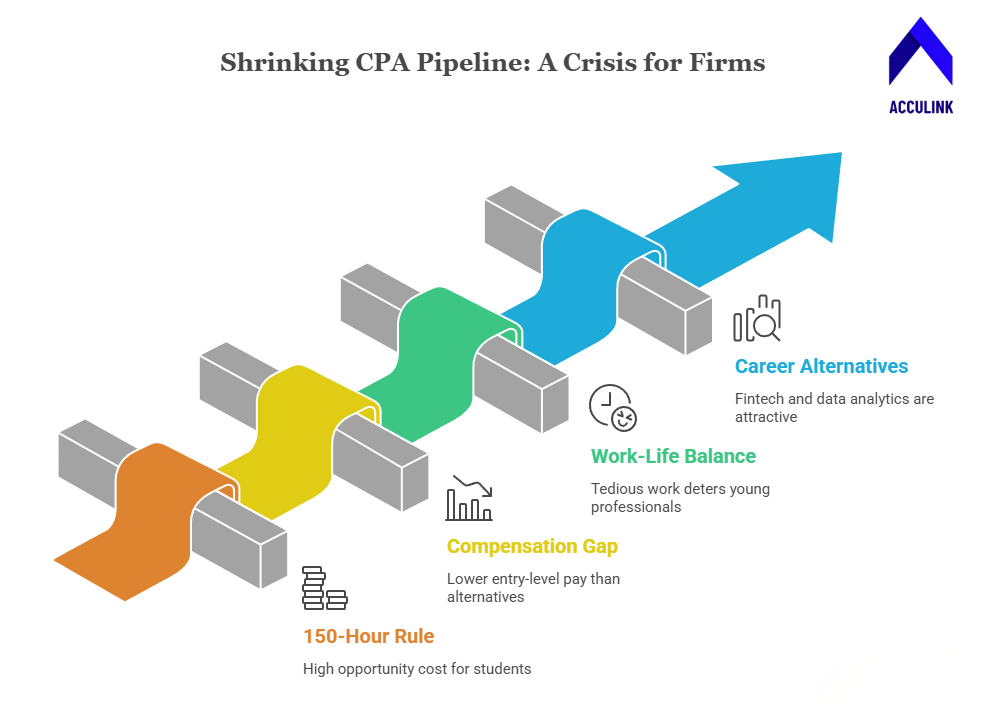
The CPA pipeline is shrinking at both ends. University accounting program enrollments have declined substantially from their peak, with fewer students choosing accounting as a major. The 150-hour education requirement for CPA licensure — effectively mandating a fifth year of college — is a significant deterrent when competing professions like technology and finance offer high-paying careers with only a four-year degree.
CPA exam candidate numbers have dropped correspondingly. Fewer graduates mean fewer exam sitters, which means fewer newly licensed CPAs entering the profession each year. The restructured CPA exam, while designed to modernise the credential, has added uncertainty and complexity that may further discourage candidates during the transition period. For a deeper look at CPA exam changes, see our blog on how the 2026 CPA exam changes affect firm hiring.
The Retirement Wave
The AICPA has documented that 75% of its membership reached retirement eligibility by 2020. While not all eligible CPAs retired immediately, the wave is well underway. Partners and senior professionals who built careers over 30–40 years are stepping back, taking their institutional knowledge, client relationships, and technical expertise with them.
This retirement wave creates a double impact: the firm loses capacity and must simultaneously train replacements (who may not exist) while maintaining client service quality. For many firms, the result is an impossible equation — more work, fewer experienced people, and no clear path to equilibrium. The retirement trend also compounds the knowledge transfer problem: when a 30-year partner retires, decades of client-specific knowledge and professional judgment leave with them.
Salary Inflation and Poaching
The economic law of supply and demand is working exactly as expected: scarce talent commands premium prices. Accounting salaries have risen sharply in recent years, with entry-level positions that paid $50,000–$55,000 five years ago now commanding $60,000–$75,000 in major markets. Senior accountants, tax managers, and audit supervisors command even larger premiums, with experienced tax managers in metropolitan areas earning $120,000–$160,000 or more.
Aggressive poaching has become endemic. Recruiters target your best people with offers 15–25% above their current compensation, often with signing bonuses and remote work flexibility. Retaining talent has become as expensive and time-consuming as recruiting it. For current salary data, see our blog on the 2026 accountant salary report.
Why Fewer People Are Becoming CPAs
Understanding why the pipeline is shrinking is essential to developing effective solutions. Several interconnected factors are driving the decline.
The 150-Hour Rule
The requirement for 150 credit hours of education to sit for the CPA exam effectively adds a fifth year of college for most candidates. This extra year carries significant opportunity cost — a year of tuition ($30,000–$60,000) plus a year of foregone salary ($50,000–$70,000). Students comparing accounting to technology, finance, or consulting careers see a profession that requires more education for similar or lower starting compensation. Several states are actively debating alternatives to the 150-hour rule, but legislative change is slow.
Compensation Gap at Entry Level
Despite recent salary increases, entry-level accounting positions still lag behind competing fields. A computer science graduate can earn $80,000–$120,000 in their first role at a technology company. A finance graduate can start at $75,000–$100,000 in investment banking or corporate finance. An accounting graduate with a CPA track starts at $55,000–$70,000 and faces years of demanding work before reaching comparable compensation levels. For quantitatively minded students, the math doesn’t favour accounting.
Work-Life Balance Perception
The accounting profession has a reputation problem. Tax season hours (60–80 hours per week for 3–4 months), busy season pressure, and the perception of tedious compliance work deter younger professionals who prioritise work-life balance, meaningful work, and career flexibility. This perception — whether fully accurate or not — is keeping talent from entering the profession. Firms that have solved the work-life balance problem through offshore staffing report dramatically improved recruiting results.
Career Alternatives Multiplying
The explosion of fintech, data analytics, corporate finance, and consulting roles has created attractive alternatives for quantitatively minded graduates who might have previously chosen accounting. These roles often offer higher starting pay, more dynamic work, faster advancement, and better perceived work-life balance — without the licensing requirements. The competition for analytical talent is global and intensifying.
 Impact on CPA Firm Operations
The staffing shortage isn’t just a human resources problem. It’s an operational crisis affecting every dimension of firm performance.
-
Partner burnout: When firms can’t hire enough staff, the workload rolls uphill. Partners who should be managing client relationships and developing business are instead preparing returns and reviewing workpapers at midnight. This is unsustainable and leads to partner turnover — the most expensive kind of attrition.
-
Declined engagements: Firms are turning away work because they don’t have the staff to serve new clients. This is revenue left on the table — not because demand is weak, but because supply is insufficient. Every declined engagement is also a referral to a competitor.
-
Longer turnaround times: Understaffed firms take longer to complete returns, audits, and advisory deliverables. This erodes client satisfaction, creates competitive vulnerability, and increases the risk of missed deadlines during tax season.
-
Quality risks: Overworked staff make more mistakes. Rushed reviews miss errors. Quality control suffers when everyone is stretched too thin. The risk of regulatory issues, malpractice claims, and client dissatisfaction rises proportionally.
-
Inability to grow advisory: The industry’s shift from compliance to advisory requires capacity — capacity that doesn’t exist when every available hour is consumed by compliance deliverables. Firms stuck in compliance-only mode fall further behind as the profession evolves.
-
Succession risk: Firms without enough mid-level talent have no succession pipeline. When partners retire, there’s no one ready to step up — forcing fire-sale mergers or practice wind-downs that destroy years of built equity.
5 Strategies to Solve the CPA Firm Staffing Crisis
No single solution will close the staffing gap. The firms that thrive will combine multiple strategies into an integrated workforce model. Here are the five most effective approaches.
Strategy #1: Offshore Staffing
Offshore staffing is the fastest, most scalable, and most cost-effective solution to the accountant shortage. It doesn’t replace domestic hiring — it supplements it, giving your firm the capacity to serve clients, clear backlogs, and free partners for high-value work.
Here’s how it works: you partner with a provider like Acculink CPA to hire dedicated offshore professionals in India who work exclusively for your firm. They use your software, follow your processes, attend your meetings during overlap hours, and report directly to you. Acculink handles HR, payroll, IT infrastructure, and compliance — you manage the work.
The numbers are compelling. Offshore professionals at $8–$35/hr represent 60–75% savings compared to domestic hiring when you factor in salary, benefits, overhead, recruiting costs, and turnover replacement. Pre-vetted profiles are available within 5–7 days, fully onboarded in 2–3 weeks, and you start with a 40-hour free trial to evaluate risk-free.
Roles available through Acculink include accountants, bookkeepers, tax preparers, tax reviewers, auditors, virtual CFOs, payroll experts, and virtual assistants. Start with one hire and scale to 20+ as confidence grows.
The time zone advantage is a bonus: offshore teams work during Indian business hours, overlapping with U.S. evenings and nights. This means returns assigned before you leave the office are in your review queue by morning. Partners who used to work until midnight now leave by 6 PM because the overnight team handles preparation.
Strategy #2: Flexible Work Models
The post-pandemic workforce expects flexibility. Firms that offer remote work, hybrid arrangements, compressed workweeks, and seasonal scheduling options attract and retain talent that rigid competitors lose. Research consistently shows that flexibility is now the second most important factor in job selection for accounting professionals, behind only compensation.
This doesn’t mean abandoning all structure. The best flexible models define clear expectations for availability, communication, and deliverables while giving staff autonomy over where and when they work. Many firms find that combining flexible domestic arrangements with offshore staffing creates the optimal model: domestic staff work flexible hours on high-judgment, client-facing tasks while offshore staff handle preparation and compliance work on a structured schedule.
Practical flexible work options include fully remote positions for experienced professionals, hybrid models with 2–3 days in-office, compressed workweeks (four 10-hour days) during non-busy season, summer Fridays to reward busy season effort, and sabbatical programs for long-tenured staff. Each of these signals to current and prospective employees that your firm values their well-being, not just their billable hours.
Strategy #3: Investing in Technology
Technology doesn’t replace people, but it amplifies their productivity. AI-powered data extraction, automated bank reconciliation, intelligent diagnostics, and workflow automation can reduce the total hours needed per engagement by 20–40%. This means your existing team handles more work without adding hours.
The key technologies for CPA firms in 2026 include practice management platforms (Karbon, Canopy, Jetpack Workflow), AI-powered document processing (GruntWorx, Dext), cloud accounting platforms (QuickBooks, Xero), and AI research tools (ChatGPT, Checkpoint Edge). The firms getting the most value combine technology with offshore teams — AI handles data extraction, offshore staff review and prepare, and partners focus on judgment and advisory.
Strategy #4: Firm Culture and Retention
Recruiting is expensive. Retaining your existing team is far more cost-effective. Firms with strong cultures, clear career paths, competitive compensation, and genuine work-life balance lose fewer people to competitors and burnout.
Practical culture investments include transparent compensation benchmarking so staff know they’re paid fairly, defined career progression from associate to partner with clear milestones, meaningful professional development budgets ($2,000–$5,000 per person annually), mental health and wellness support, and genuine flexibility. Firms that reduce partner burnout through offshore staffing also improve culture indirectly — when leaders aren’t stressed and overworked, the entire firm’s atmosphere improves.
Strategy #5: Non-Traditional Talent Pipelines
The traditional CPA pipeline (accounting degree → CPA exam → public accounting) is broken. Innovative firms are looking beyond it to fill critical roles.
-
Career changers: Professionals from finance, banking, and corporate accounting who want to move into public practice. They bring analytical skills and business acumen even without a traditional CPA background.
-
International credentials: Chartered Accountants (CAs), ACCAs, and other internationally qualified professionals can contribute meaningfully to U.S. CPA firm work. Offshore staffing through Acculink CPA gives you access to this global talent pool — including professionals with Big 4 backgrounds from Deloitte, PwC, EY, and KPMG.
-
Paraprofessional roles: Not every role needs a CPA. Bookkeepers, data analysts, project coordinators, and administrative staff can handle significant portions of the firm's workload without CPA licensure. Defining clear paraprofessional career paths attracts talent that CPA-only firms miss.
-
University partnerships: Building relationships with local universities for internships, campus recruiting, and scholarship programs creates a proprietary pipeline that competitors can’t easily replicate.
The Real Cost of Not Solving the Staffing Problem
Too many firm owners treat the staffing crisis as an inconvenience to manage rather than an existential threat to address. Let’s quantify the cost of inaction.
Consider a mid-size CPA firm with $3 million in revenue and 15 staff. If the firm is understaffed by just two positions, the impact cascades: partners spend 15–20 additional hours per week on preparation work instead of business development and client advisory. At a conservative billing rate of $300/hour, that’s $234,000–$312,000 in lost or undervalued partner time annually. The firm declines 10–15 potential new clients because it lacks capacity, representing $200,000–$400,000 in foregone revenue. Existing staff work longer hours, increasing burnout and turnover risk — and replacing each departed employee costs $15,000–$40,000 in recruiting, training, and lost productivity.
The total annual cost of being understaffed by two positions easily exceeds $500,000 for a firm of this size. Compare that to the cost of hiring two offshore professionals through Acculink CPA: roughly $30,000–$70,000 annually, fully loaded. The ROI is not marginal — it’s transformational.
How Leading Firms Are Combining Strategies
The firms that are thriving despite the staffing crisis are not relying on a single strategy. They’re combining multiple approaches into an integrated workforce model that creates compounding advantages.
A typical high-performing firm uses offshore staff for tax preparation, bookkeeping, audit support, and financial statement preparation — handling 50–60% of the firm’s total production hours. Domestic staff focus on client communication, review and sign-off, advisory conversations, and business development. Technology automates data extraction, reconciliation, and routine categorisation, reducing total hours needed by 20–30%. Flexible work policies retain domestic talent by offering hybrid schedules and genuine time-off policies.
This model produces remarkable results: firms report 60–70% lower staffing costs, 25% less partner time on operations, 30–50% more returns cleared during tax season, and significantly improved work-life balance for domestic staff. The combined effect is a firm that grows faster, profits more, and retains talent better than firms relying solely on domestic hiring.
Frequently Asked Questions
How bad is the accountant shortage in 2026?
The shortage is structural and worsening. 75% of CPAs reached retirement eligibility by 2020, university accounting enrollments have declined substantially, and CPA exam candidate numbers continue to drop. Firms across the U.S. report difficulty hiring at every level.
Why are people leaving the accounting profession?
Key factors include the 150-hour education requirement, entry-level compensation gaps compared to competing fields, work-life balance concerns around busy season hours, and attractive alternatives in technology, finance, and consulting.
How can offshore staffing help solve the accountant shortage?
Offshore staffing provides immediate access to qualified professionals at 60–75% lower cost. Providers like Acculink CPA offer pre-vetted accountants, tax preparers, bookkeepers, and auditors who work as dedicated extensions of your team, using your software and following your processes.
Is offshore staffing a replacement for domestic hiring?
No. Offshore staffing supplements domestic hiring. Domestic staff focus on client-facing, judgment-intensive work. Offshore staff handle preparation, compliance, and analytical tasks. Together, they create a model that’s more productive and cost-effective than either alone.
How quickly can I add offshore staff to my team?
With Acculink CPA, pre-vetted profiles are available within 5–7 days. Fully onboarded in 2–3 weeks. Start with a 40-hour free trial to evaluate fit. No setup fees, no recruitment charges, no long-term contracts.
What roles can offshore staff fill at my CPA firm?
Accountants, bookkeepers, tax preparers, tax reviewers, audit support staff, virtual CFOs, payroll experts, QuickBooks and Xero specialists, billing assistants, and virtual assistants. Experience levels range from entry-level to senior professionals with 6+ years of U.S. experience.
References
American Institute of CPAs (AICPA) — https://www.aicpa.org/
Bureau of Labour Statistics — Accountants and Auditors — https://www.bls.gov/ooh/business-and-financial/accountants-and-auditors.htm
About Acculink CPA
Acculink CPA is a premier offshore staffing and outsourcing company purpose-built for CPA firms, accounting firms, and tax firms in the United States, Canada, and the UAE. With a team of 300+ qualified professionals — including CPAs, Chartered Accountants, Enrolled Agents, and Big 4-trained staff — Acculink provides dedicated offshore accountants, bookkeepers, tax preparers, auditors, virtual CFOs, and virtual assistants at $8–$35/hr, delivering up to 75% cost savings compared to domestic hiring. The company is ISO 27001 certified, SOC 2 Type II aligned, IRS §7216 compliant, and GDPR compliant, with zero security breaches in 5+ years of operations. Acculink offers a 40-hour free trial with no setup fees, no recruitment charges, and no long-term contracts. Over 80 CPA firms across the United States trust Acculink to deliver quality, security, and scalability.
Website: Acculink CPA | Schedule a Call: book a 45-minute call | Email: Info@acculinkcpa.com | Phone: +1 (203) 997-0224
Tags:
About the Author

Related Posts

Hire Offshore Bookkeepers for CPA & Accounting Firms – Blueprint for Outsourced Bookkeeping
How to hire an offshore bookkeeper for your CPA firm — what they do, how vetting and onboarding work, cost (up…

Hire Offshore Accountants for CPA & Accounting Firms – Why Outsourced Accounting Works
How to hire an offshore accountant for your CPA firm — month-end close, GL, GAAP reporting, in your software —…
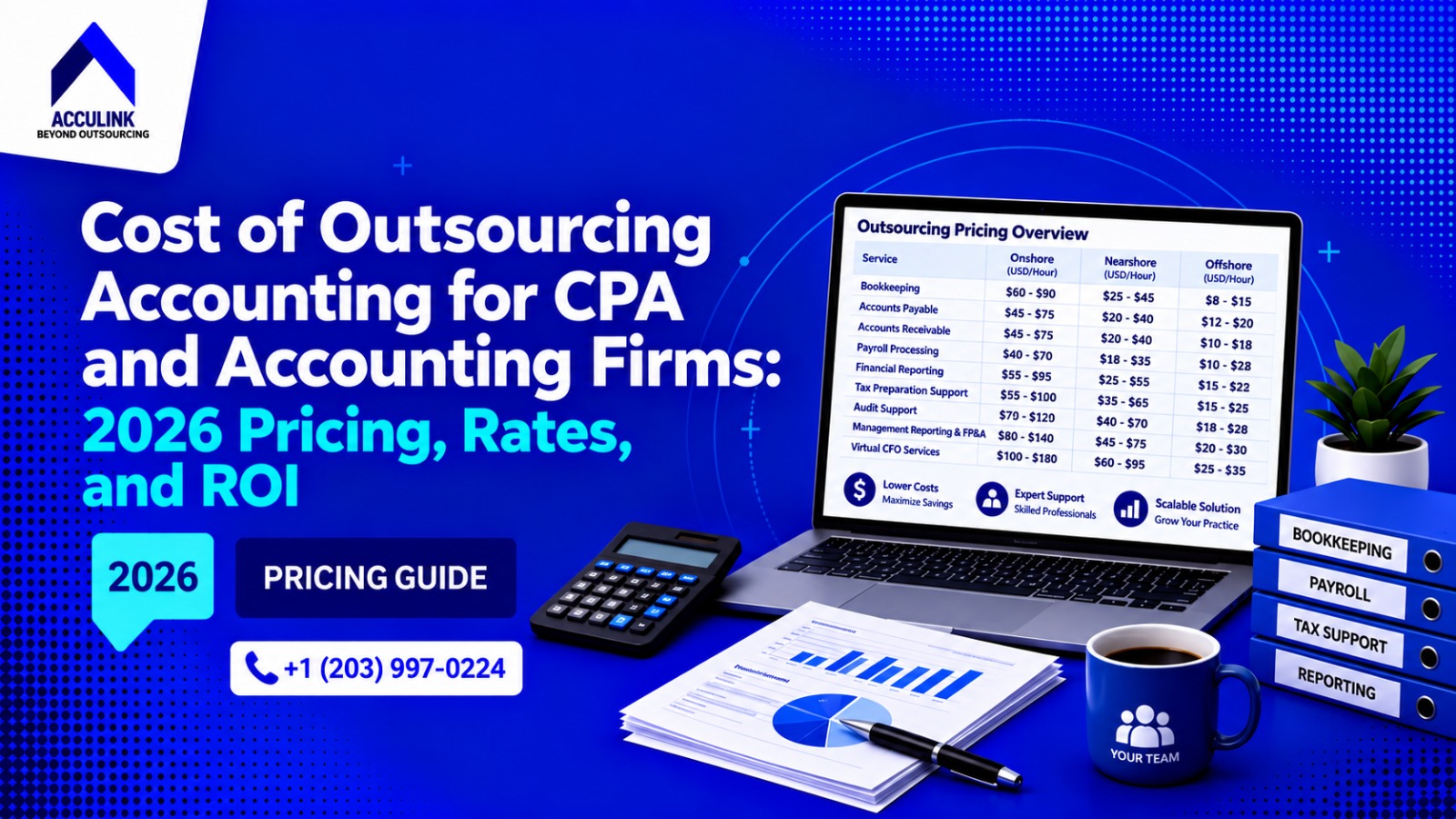
Cost of Outsourcing Accounting for CPA and Accounting Firms: 2026 Pricing, Rates, and ROI
The cost to outsource accounting typically ranges from $8 to $35 per hour, depending on the service, experienc…