The Complete Guide to Client Onboarding for CPA Firms: Templates, Checklists & Best Practices

Summary
The Complete Guide to Client Onboarding for CPA Firms: Templates, Checklists & Best Practices
The investment in building a structured onboarding system pays dividends far beyond efficiency. Firms with standardised onboarding report measurably higher client retention in the first two years, because clients who start with a professional, organised experience develop confidence in their CPA firm from the beginning. They also report fewer billing disputes because the scope was clearly defined upfront, fewer missed deadlines because document collection was systematic rather than ad hoc, and higher client satisfaction scores. After all, expectations were set and met consistently. Every minute spent building your onboarding framework saves hours of problem-solving later. Combined with the operational support of your offshore team from Acculink CPA handling the tactical steps, onboarding becomes a competitive advantage that differentiates your firm from the many practices that still wing it with every new client.
Whether your firm onboards 5 new clients per year or 50, the framework is the same. The only difference is automation and delegation. Small firms can follow the 7-step checklist manually with one offshore assistant handling the operational items. Larger firms should build the framework into their practice management platform with automated triggers, task assignments, and status tracking. The principle remains constant: standardise the process, delegate the operations, and invest partner time only where it creates the most value, which is in the relationship-building moments that turn a new client into a loyal long-term partner.
Onboarding at Scale: Managing 20+ New Clients Per Quarter
For growing firms that onboard 20 or more new clients per quarter, the individual partner-led approach breaks down. You need a scalable onboarding system where your offshore team handles the operational steps consistently while partners provide the personal touch on relationship-critical moments. The framework above supports this because 7 of the 12 checklist items are delegated to offshore staff, creating a repeatable assembly line that produces consistent results regardless of volume.
Build an onboarding dashboard in your practice management platform that tracks every new client through the 7-step framework. Assign your offshore team to monitor the dashboard daily, advancing clients through each stage, sending follow-up reminders for outstanding documents, and flagging any issues that require partner attention. Partners should only need to be involved for engagement letter signing, team introductions, the first deliverable review, and the 2-week check-in call. Everything else runs on the system.
Firms that implement this scalable onboarding model report 50 per cent faster time to first deliverable, significantly fewer dropped steps and missed documents, higher client satisfaction scores in the first 90 days, and less partner time consumed per new client onboarding. The system pays for itself within the first quarter of implementation and becomes more efficient over time as your offshore team internalises the workflow.
Measuring Onboarding Success
How do you know if your onboarding process is working? Track these metrics: time from signed engagement letter to first deliverable completion, percentage of document requests fulfilled within 7 days, number of onboarding steps completed without partner intervention, client satisfaction score at 90 days measured through a brief survey, and first-deliverable error rate compared to established client error rates. Review these metrics quarterly and use them to identify bottlenecks and improvement opportunities in your onboarding workflow.
The most common bottleneck is document collection. Clients delay sending documents despite multiple reminders, which cascades through the entire onboarding timeline. Your offshore team can address this by sending more frequent, more specific follow-up messages through your client portal. Instead of a generic reminder, send targeted messages: we are still waiting for your December bank statement for the ABC checking account number ending in 1234. Specific requests get faster responses than generic ones.
Another common bottleneck is system setup, particularly for clients migrating from a previous CPA firm. Historical data migration, chart of accounts cleanup, and bank feed configuration can be time-consuming. Your Acculink offshore team can handle this entire process, including communicating with the prior firm to obtain records, reconciling opening balances, and verifying that the new setup matches the client's expectations. This frees your domestic staff from hours of tedious configuration work.
Key Takeaways
-
A structured client onboarding process reduces errors, accelerates time-to-productivity, sets clear expectations, and creates a professional first impression that strengthens client retention from day one.
-
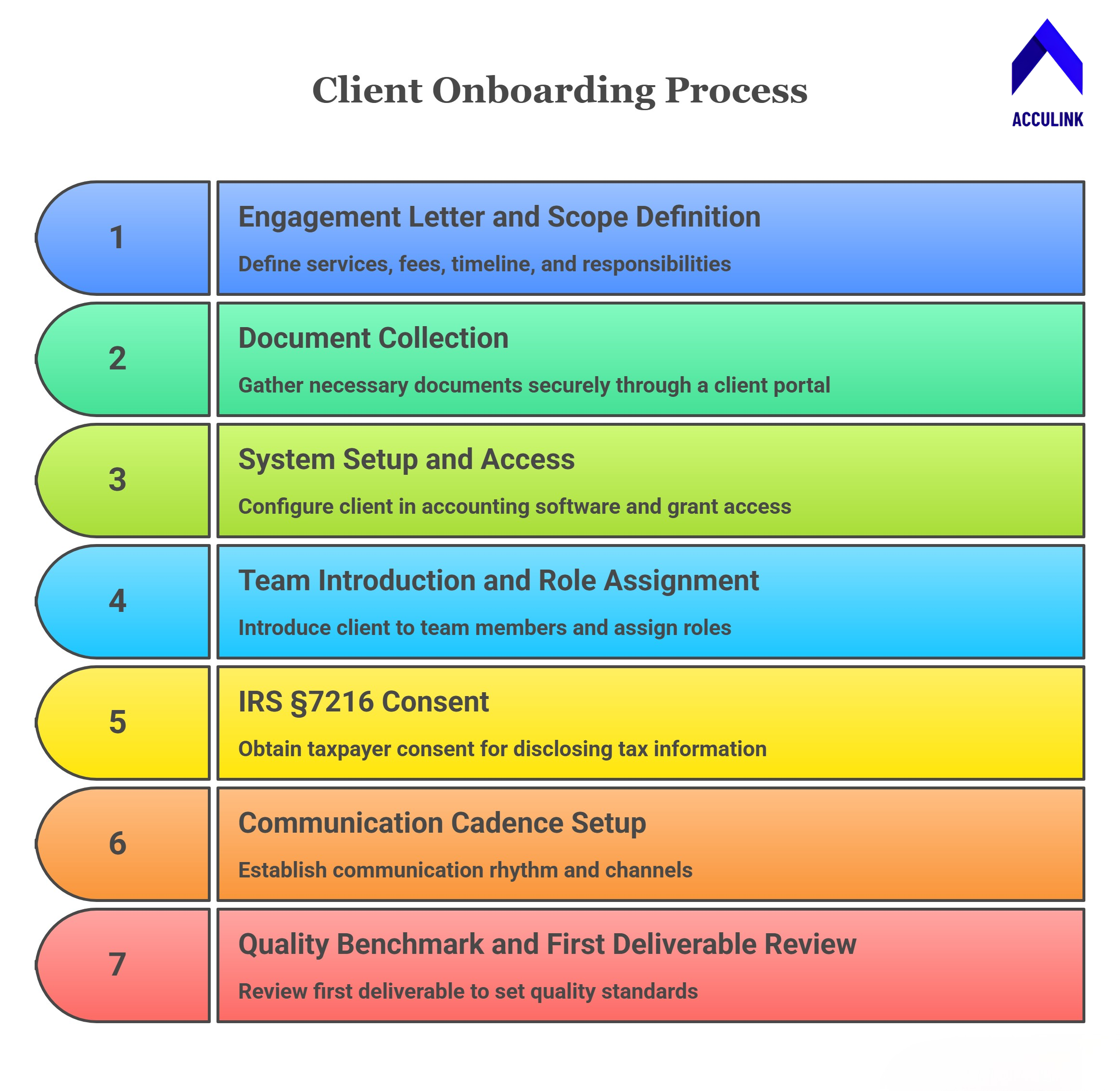
This guide presents a 7-step onboarding framework covering engagement letters, document collection, system setup, team introductions, IRS §7216 consent, communication cadence, and quality benchmarks.
-
For firms using offshore teams, onboarding is where you integrate the offshore professional into the client workflow — seamlessly and invisibly to the end client.
-
Standardised onboarding templates and checklists allow your team (including offshore staff from Acculink CPA) to replicate a consistent, high-quality experience across every new client.
The first 30 days of a client relationship set the tone for everything that follows. A smooth, professional onboarding process signals competence, builds trust, and reduces the friction that causes early-stage client churn. A disorganised onboarding — missing documents, unclear expectations, delayed access, and dropped communications — signals the opposite and starts the relationship on shaky ground.
Yet many CPA firms treat onboarding as an afterthought. The partner shakes hands, someone sends an engagement letter, documents trickle in over weeks, and the team scrambles to get up to speed before the first deliverable is due. This ad hoc approach creates unnecessary stress, wastes time, and produces inconsistent client experiences.
This guide provides a complete, repeatable onboarding framework that your firm can implement immediately. Every step is designed to be delegated — your offshore team from Acculink CPA can handle the operational steps while partners focus on the relationship-building activities that only they can do.
Why Client Onboarding Matters More Than You Think
Client onboarding is not just an administrative process. It’s the foundation of client retention, engagement, profitability, and team productivity. Firms with structured onboarding processes report higher client retention rates in the first two years, faster time to first deliverable, fewer errors during initial engagement periods, and clearer scope boundaries that prevent scope creep. The investment in building a repeatable onboarding system pays dividends across every engagement for years.
The 7-Step Client Onboarding Framework
Step 1: Engagement Letter and Scope Definition
Every client relationship begins with a clear engagement letter that defines the services to be provided, the fees, the timeline, the responsibilities of both parties, and the terms of the engagement. For firms using offshore teams, the engagement letter should include the IRS §7216 disclosure consent (for tax engagements) and a general statement about the firm’s use of qualified support professionals.
The engagement letter is also where you set scope boundaries. Define explicitly what is included and what is not. A bookkeeping engagement includes monthly reconciliation and financial statement preparation,n but does not include tax preparation, payroll processing, or advisory services unless specifically listed. Clear boundaries prevent scope creep and protect profitability.
Step 2: Document Collection
Create a standardised document request list for each service type. For tax clients: prior-year returns, W-2s, 1099s, K-1s, estimated tax payment records, and any correspondence from the IRS or state agencies. For bookkeeping clients: chart of accounts, bank and credit card login credentials or feeds, accounts receivable and payable ageing, loan agreements, and prior-year financial statements.
Use a client portal (SmartVault, Citrix ShareFile, Canopy, or your practice management platform’s built-in portal) to collect documents securely. Your offshore team can monitor the portal, track outstanding items, and send follow-up reminders to clients — eliminating the administrative burden from your domestic staff.
Step 3: System Setup and Access
Configure the client in your accounting software (QuickBooks, Xero, Sage), practice management platform (Karbon, Canopy, Jetpack Workflow), and document management system. Set up bank feeds, connect payment processors, and configure user access permissions. For firms with offshore teams, ensure the offshore preparer has the appropriate access to client systems through Acculink’s secure VPN infrastructure.
This step is often the most time-consuming part of onboarding — and the most easily delegated. Your offshore team from Acculink CPA can handle system configuration, chart of accounts setup, historical data migration, and bank feed testing. The domestic team reviews and approves the setup.
Step 4: Team Introduction and Role Assignment
Introduce the client to every team member who will touch their account. This includes the engagement partner (the client’s primary relationship contact), the senior reviewer (responsible for quality control), and any domestic staff who will communicate with the client directly. The offshore team members work behind the scenes and are not introduced to the client unless the firm specifically chooses to do so.
Assign clear roles: who does the client contact with questions? Who handles routine requests? Who approves deliverables? Clarity at this stage prevents confusion and ensures the client always knows who to reach.
Step 5: IRS §7216 Consent (For Tax Engagements)
If the engagement involves tax return preparation and your firm uses offshore professionals, IRS §7216 requires written taxpayer consent before any tax return information is disclosed to a person located outside the United States. This consent must clearly identify the country (India), explain that tax return information will be shared with offshore support professionals, and be knowingly and voluntarily given by the taxpayer.
Best practice is to include the §7216 consent as a clearly labelled paragraph in your engagement letter, not as a separate document that might get lost. The consent should be straightforward and transparent — most clients are completely comfortable with it when presented professionally. Refusal rates are typically less than 1–2%. For detailed §7216 guidance, see the IRS Section 7216 Information Centre.
Step 6: Communication Cadence Setup
Establish the communication rhythm for the engagement: how often will you communicate, through what channels, and what does the client need to provide on an ongoing basis? For a monthly bookkeeping client, this might include weekly bank feed review by the offshore team, monthly reconciliation and financial statement delivery by the 15th, and a monthly 15-minute call with the engagement partner.
Document the communication cadence in a one-page summary that you share with the client and the offshore team. This ensures everyone is aligned on expectations and prevents the “I didn’t know I was supposed to send that” conversations that derail early-stage engagements.
Step 7: Quality Benchmark and First Deliverable Review
The first deliverable sets the quality standard for the entire engagement. Assign extra review time to the first tax return, the first set of financial statements, or the first advisory report. Have the engagement partner personally review and approve the first deliverable before it reaches the client. Use this as a coaching opportunity for the offshore preparer — provide detailed review notes that establish your firm’s quality expectations.
After the first deliverable is accepted, schedule a brief check-in call with the client to confirm satisfaction, address any questions, and reinforce the communication cadence. This touchpoint demonstrates attentiveness and catches any issues before they become patterns.
Onboarding Checklist: A Practical Template
Here is a condensed onboarding checklist your firm can adapt immediately. Assign each item to either domestic (D) or offshore (O) staff:
-
(D) Send engagement letter with fee schedule and §7216 consent
-
(D) Confirm signed engagement letter received
-
(O) Create a client profile in the practice management system
-
(O) Send document request via client portal
-
(O) Configure the client in the accounting software with the chart of accounts
-
(O) Set up bank feeds and verify connectivity
-
(O) Import historical data and verify opening balances
-
(D) Introduce the client to team members and establish primary contact
-
(D) Confirm communication cadence with client
-
(O) Prepare the first deliverable with extra review time
-
(D) Partner reviews and approves the first deliverable
-
(D) Schedule a 2-week check-in call with the client
Notice that 7 of the 12 steps can be handled by offshore staff, freeing your domestic team — especially partners — to focus on the relationship-building activities that matter most. This delegation pattern is exactly how Acculink CPA’s dedicated staffing model works in practice.
How Offshore Teams Fit Into Client Onboarding
For firms using offshore professionals, onboarding is the moment where the offshore team integrates into the client workflow. The key principle is seamless integration: the offshore team should be fully productive on the client’s account from the first week, working within your firm’s systems, following your SOPs, and producing work that meets your quality standards.
Acculink CPA’s onboarding process for new clients typically follows this timeline: Day 1–2, the offshore preparer reviews the client profile, prior-year work, and engagement scope. Days 3–5, they configure the client in your software and set up bank feeds and access. Week 2, they prepare the first deliverable under close supervision with detailed review notes. By Week 3–4, the offshore team is operating at full productivity with standard review oversight.
The client never needs to know that an offshore professional is handling preparation work unless your firm chooses to disclose this. From the client’s perspective, every deliverable comes from your firm, with your branding, your quality standards, and your partner’s sign-off.
Common Onboarding Mistakes to Avoid
-
Skipping the engagement letter: Starting work without a signed engagement letter exposes your firm to scope disputes, fee collection problems, and professional liability risk. No exceptions.
-
Not collecting documents upfront: Chasing documents piecemeal over weeks wastes time and delays the first deliverable. Send a comprehensive request on Day 1 with a clear deadline.
-
Unclear communication expectations: Clients who don’t know when to expect deliverables or who to contact with questions become frustrated quickly. Document and share the communication cadence.
-
Rushing the first deliverable: The first deliverable sets the quality bar. Invest extra review time to ensure it’s impeccable, even if it means a slightly longer turnaround.
-
Not involving the offshore team early: If your offshore preparer learns about a new client two weeks after engagement, they’re starting behind. Include them from Day 1.
Frequently Asked Questions
How long should client onboarding take for a CPA firm?
2–4 weeks from the signed engagement letter to the first deliverable is standard. Complex engagements (multi-entity, international) may take longer. Simple engagements (individual tax returns) can be onboarded in 5–7 days.
Do I need IRS §7216 consent for bookkeeping clients?
No. §7216 applies specifically to tax return information. Bookkeeping and advisory engagements that do not involve tax return preparation do not require §7216 consent. However, you should always have appropriate confidentiality provisions in your engagement letter.
Can offshore staff handle client onboarding tasks?
Yes. Offshore staff from Acculink CPA handle system setup, document collection tracking, software configuration, historical data migration, and first-deliverable preparation. Partners handle relationship-building activities like team introductions and communication cadence setup.
What is the most important step in client onboarding?
The engagement letter. It defines scope, fees, responsibilities, and legal protections. Everything else builds on this foundation. Never start work without a signed engagement letter.
References
IRS Section 7216 Information Centre — https://www.irs.gov/tax-professionals/section-7216-information-center
AICPA Engagement Letter Resources — https://www.aicpa.org/
About Acculink CPA
Acculink CPA is a premier offshore staffing and outsourcing company purpose-built for CPA firms, accounting firms, and tax firms in the United States, Canada, and the UAE. With a team of 300+ qualified professionals — including CPAs, Chartered Accountants, Enrolled Agents, and Big 4-trained staff — Acculink provides dedicated offshore accountants, bookkeepers, tax preparers, auditors, virtual CFOs, and virtual assistants at $8–$35/hr, delivering up to 75% cost savings compared to domestic hiring. The company is ISO 27001 certified, SOC 2 Type II aligned, IRS §7216 compliant, and GDPR compliant, with zero security breaches in 5+ years of operations. Acculink offers a 40-hour free trial with no setup fees, no recruitment charges, and no long-term contracts. Over 80 CPA firms across the United States trust Acculink to deliver quality, security, and scalability.
Website: Acculink CPA | Schedule a Call: book a 45-minute call | Email: Info@acculinkcpa.com | Phone: +1 (203) 997-0224
Tags:
About the Author

Related Posts

Hire Offshore Bookkeepers for CPA & Accounting Firms – Blueprint for Outsourced Bookkeeping
How to hire an offshore bookkeeper for your CPA firm — what they do, how vetting and onboarding work, cost (up…

Hire Offshore Accountants for CPA & Accounting Firms – Why Outsourced Accounting Works
How to hire an offshore accountant for your CPA firm — month-end close, GL, GAAP reporting, in your software —…
Cost of Outsourcing Accounting for CPA and Accounting Firms: 2026 Pricing, Rates, and ROI
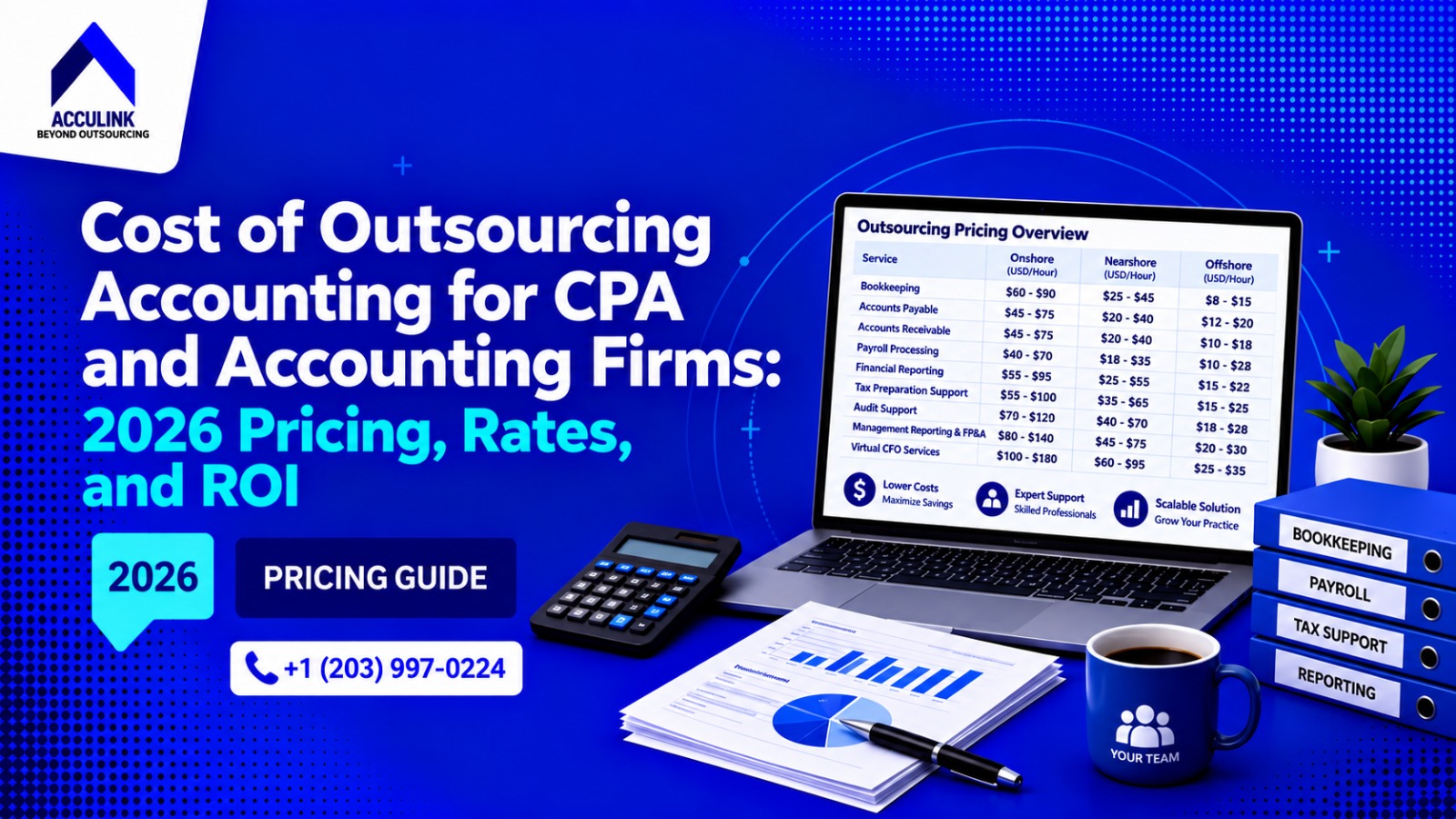
The cost to outsource accounting typically ranges from $8 to $35 per hour, depending on the service, experienc…