Remote Work in Accounting: How CPA Firms Are Managing Distributed Teams in 2026

Summary
The distributed work model is not a temporary accommodation born from the pandemic. It is the permanent operating structure of the modern CPA firm. The firms that have embraced this reality are winning on every dimension that matters: talent acquisition, client service quality, operational efficienc
The distributed work model is not a temporary accommodation born from the pandemic. It is the permanent operating structure of the modern CPA firm. The firms that have embraced this reality are winning on every dimension that matters: talent acquisition, client service quality, operational efficiency, partner work-life balance, and profitability. The firms that are fighting it, demanding full-time office attendance and resisting offshore integration, are losing talent to competitors and leaving growth opportunities unrealised.
Building a distributed team that includes domestic remote staff and offshore professionals from Acculink CPA is not technically difficult. The tools exist, the security frameworks are proven, and the management practices are well established. The challenge is cultural and psychological: firm partners must trust that work gets done without physical presence, must invest in communication systems rather than relying on hallway conversations, and must measure output rather than attendance. The firms that make this mental shift discover that their distributed teams are not just as productive as their previous office-based teams but often significantly more productive. The combination of eliminated commutes, focused work time, overnight offshore production, and flexible schedules creates a working environment that produces better results for everyone involved.
If you are still debating whether to embrace distributed work, the market has already decided for you. Your best job candidates expect flexibility. Your offshore provider offers proven infrastructure. Your cloud platforms work identically from any location. The question is not whether to go distributed but how quickly you can optimise the model. Start with the roadmap in this guide, invest in the tools and practices described here, and build the distributed team that will define your firm's success for the next decade.
Common Remote Work Challenges and How to Solve Them
Challenge: Junior Staff Development
Training junior staff remotely is harder than in-person. They miss the osmosis learning that happens when sitting next to experienced professionals. Solve this by assigning dedicated mentors who schedule weekly one-on-one video calls, creating recorded training libraries using Loom for common procedures, implementing structured review note processes that serve as teaching tools, and pairing junior domestic staff with experienced offshore professionals for collaborative work on routine engagements.
Challenge: Communication Overload
Remote teams sometimes overcompensate for the lack of in-person interaction by scheduling too many meetings and sending too many messages. This creates meeting fatigue and notification overload. Solve this by establishing communication norms: which channels for which types of communication, expected response times, and designated focus time blocks where messages are not expected. A typical framework uses Slack for quick questions with a 2-hour response expectation, email for formal client communication, project management tools for task updates and workflow, and video calls only for complex discussions and scheduled meetings.
Challenge: Maintaining Firm Culture
Culture does not happen automatically in distributed teams. It requires deliberate investment. Successful remote CPA firms build culture through monthly all-hands video meetings where the entire team, including offshore staff,f connects, virtual social events like trivia, coffee chats, and celebrations, transparent communication about firm performance, goals, and strategy, and periodic in-person gatherings once or twice per year for team building. Firms that invest in these practices consistently report that their distributed teams feel more connected than their previous office-based teams, because the culture building is intentional rather than incidental.
The Time Zone Advantage: Working Around the Clock
For firms with offshore team members in India, the time zone difference creates a powerful operational advantage. The offshore team works during Indian business hours, which overlap with U.S. evening and overnight hours. This means work assigned before the U.S. staff leaves the office is completed by the offshore team and sitting in the review queue by the next morning. Effectively, your firm operates on a dual-shift model without anyone working overtime.
During tax season, this advantage becomes transformational. Domestic staff review and finalise returns during the day while offshore preparers prepare the next batch overnight. The result is 30 to 50 per cent more returns cleared per week compared to a single-shift domestic-only model. Partners who used to work until midnight reviewing returns now leave the office by 6 PM because the overnight team has already queued the next day's work. This is not a theoretical benefit. It is the reported experience of the 80-plus CPA firms currently working with Acculink CPA.
The 3 to 4-hour daily overlap window between U.S. and Indian business hours handles all synchronous communication needs: review note discussions, clarifying questions, training sessions, and team meetings. Outside of this window, asynchronous communication through project management tools and recorded video messages keeps the workflow moving without requiring anyone to adjust their schedule.
Key Takeaways
-
Remote and hybrid work is now the dominant operating model for CPA firms in 2026, with over 70% of firms offering some form of flexible work arrangement.
-
The most successful distributed firms combine domestic remote staff for client-facing and judgment-intensive work with offshore professionals for preparation and compliance.
-
Managing distributed teams requires investment in communication tools, security infrastructure, standardised workflows, and intentional culture-building.
-
The security concerns that initially slowed remote adoption have been addressed through cloud platforms, VPN infrastructure, MFA, and compliance frameworks like SOC 2 and ISO 27001.
-
Offshore staffing is the natural extension of the distributed work model — if your domestic team works remotely, adding offshore professionals through Acculink CPA uses the same infrastructure and management practices.
The conversation about remote work in accounting has moved from “should we?” to “how do we do it well?” The pandemic forced every CPA firm to go remote. What surprised most firm partners is that productivity didn’t collapse — in many cases, it improved. Staff worked longer effective hours without commutes, client service continued without interruption, and firms discovered that physical proximity was less important to quality than they had assumed.
Now, in 2026, the firms that have embraced distributed work are winning the talent war, serving more clients, and operating more efficiently than firms that forced everyone back to the office. Remote and hybrid arrangements are no longer a perk — they’re a competitive necessity for firms that want to attract and retain qualified professionals in a market where talent has options.
This guide covers how CPA firms are managing distributed teams in 2026: the operating models that work, the tools and infrastructure required, the security considerations, the communication practices that maintain team cohesion, and how offshore staffing from Acculink CPA fits naturally into the distributed work model.
The State of Remote Work in Accounting: 2026 Reality
The post-pandemic accounting profession has settled into a new equilibrium. The majority of CPA firms now operate in one of three models: fully remote (all staff work from home or co-working spaces), hybrid (staff split time between office and remote, typically 2–3 days in-office), or office-first with flexibility (most staff are in-office but flexibility is available for specific roles or circumstances). The pure office-only model has become a competitive disadvantage in recruiting.
The data from industry surveys consistently shows that firms offering remote or hybrid work attract more candidates, fill positions faster, and retain staff longer than office-only firms. For many professionals, remote work flexibility is a non-negotiable requirement — they will accept lower compensation from a flexible firm before joining a higher-paying office-only firm.
Hybrid vs Fully Remote vs Office: Which Model Works Best?
Fully Remote
Best for firms that serve clients nationally, have already invested in cloud infrastructure, and prioritise talent access over in-person collaboration. Fully remote firms can recruit from anywhere in the country, dramatically expanding their talent pool. The challenge is maintaining culture, training junior staff, and ensuring consistent communication.
Hybrid (2–3 Days In-Office)
The most popular model in 2026. In-office days are used for team meetings, training, collaborative work, and culture-building. Remote days are for focused preparation, client calls, and individual productivity. This model balances the benefits of flexibility with the advantages of periodic in-person interaction. Most firms designate specific days as “team days” to ensure overlap.
Office-First with Flexibility
Staff are expected in the office most days, but can work remotely when needed (sick children, appointments, weather, deep focus work). This model works for firms where in-person mentoring and collaboration are core to the culture, but it limits the talent pool to the local geographic area.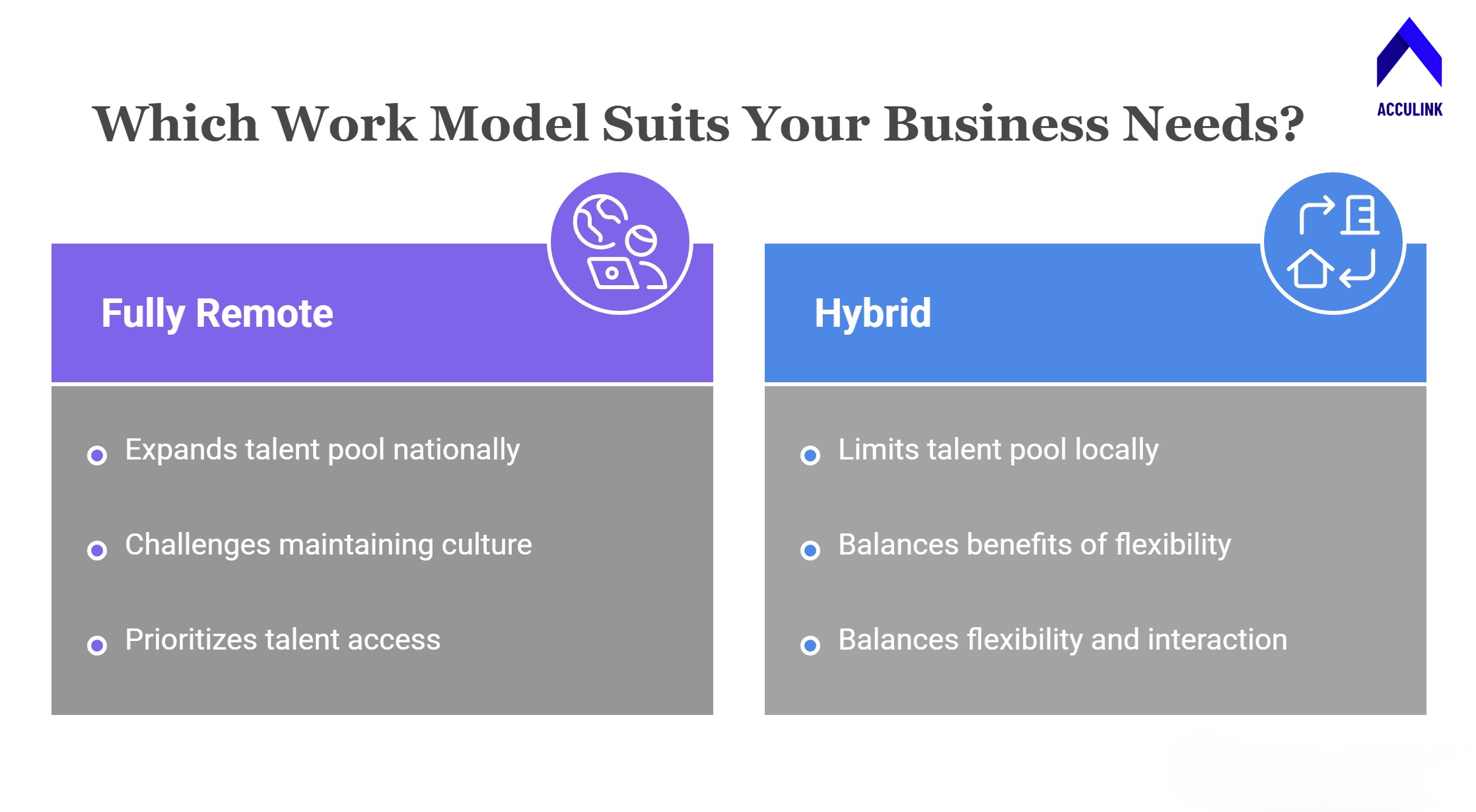
Managing Remote Teams Effectively: Standardise Workflows and SOPs
Remote work only works when everyone follows the same processes. Standardised operating procedures (SOPs) for every engagement type ensure consistency regardless of where the work is performed. SOPs should cover document naming conventions, review note formats, deliverable templates, filing procedures, and quality checklists. Your offshore team from Acculink CPA follows the same SOPs as your domestic staff, ensuring consistent quality.
Use Asynchronous Communication
Distributed teams cannot rely on tap-on-the-shoulder questions. Build a culture of asynchronous communication where questions, updates, and feedback are documented in your project management tool (Karbon, Canopy, Notion, Asana) rather than communicated verbally. This creates a record, reduces interruptions, and works across time zones — particularly important when your team includes offshore professionals in India.
Schedule Intentional Synchronous Time
While asynchronous communication handles 80% of daily work, you need scheduled synchronous time for complex discussions, feedback, and team building. Weekly team meetings, daily 15-minute standups during the busy season, and monthly one-on-ones keep distributed teams connected. For offshore teams, the 3–4 hour overlap window with U.S. business hours is when synchronous communication happens.
Measure Output, Not Hours
Remote work makes time-tracking less meaningful as a management tool. Focus on output metrics: returns completed, reconciliations processed, turnaround times met, error rates maintained. If the work is done well and on time, the hours become secondary. This output-focused approach works identically for domestic remote staff and offshore professionals.
Tools for Remote CPA Firms
-
Practice management: Karbon, Canopy, Jetpack Workflow, Financial Cents — for task assignment, deadline tracking, and workflow management.
-
Communication: Microsoft Teams, Slack, Zoom — for daily communication, video meetings, and quick questions.
-
Cloud accounting: QuickBooks Online, Xero, Sage Intacct — accessible from anywhere with an internet connection.
-
Document management: SmartVault, SharePoint, Citrix ShareFile, Google Drive — for secure document storage and client portals.
-
Tax software: CCH Axcess (cloud-native), UltraTax CS via Virtual Office, GoSystem Tax RS — all accessible remotely.
-
Password management: 1Password, LastPass, Dashlane — for secure credential sharing across distributed teams.
-
Video recording: Loom — for asynchronous training, review note walkthroughs, and client updates.
Security Considerations for Remote and Distributed Work
Security is the most frequently cited concern about remote work in accounting. The concern is legitimate — client data is sensitive, regulatory requirements are strict, and a single breach can be catastrophic. But the security tools and practices available in 2026 make remote work at least as secure as office-based work when implemented properly.
-
Multi-factor authentication (MFA): Required on every system that touches client data. MFA stops the vast majority of unauthorised access attempts.
-
VPN or zero-trust access: Encrypted connections for all remote access to firm systems. Acculink CPA’s offshore staff access client systems exclusively through encrypted VPN connections from secure office facilities.
-
Endpoint management: Firm-issued or firm-managed devices with encryption, remote wipe capability, and regular security updates.
-
Cloud security: Cloud platforms (QuickBooks, Xero, CCH Axcess) handle infrastructure security, encryption, and access controls at enterprise scale.
-
Compliance frameworks: SOC 2 Type II, ISO 27001, and IRS §7216 compliance provide structured security requirements and verification. Acculink CPA maintains all three, with zero security breaches in 5+ years.
How Offshore Staffing Fits the Distributed Work Model
Here’s the insight that forward-thinking firm owners have already internalised: if you can manage a domestic employee working from their home in another state, you can manage an offshore professional working from a secure office in India. The infrastructure is identical — cloud platforms, VPN access, video calls, project management tools, and standardised workflows.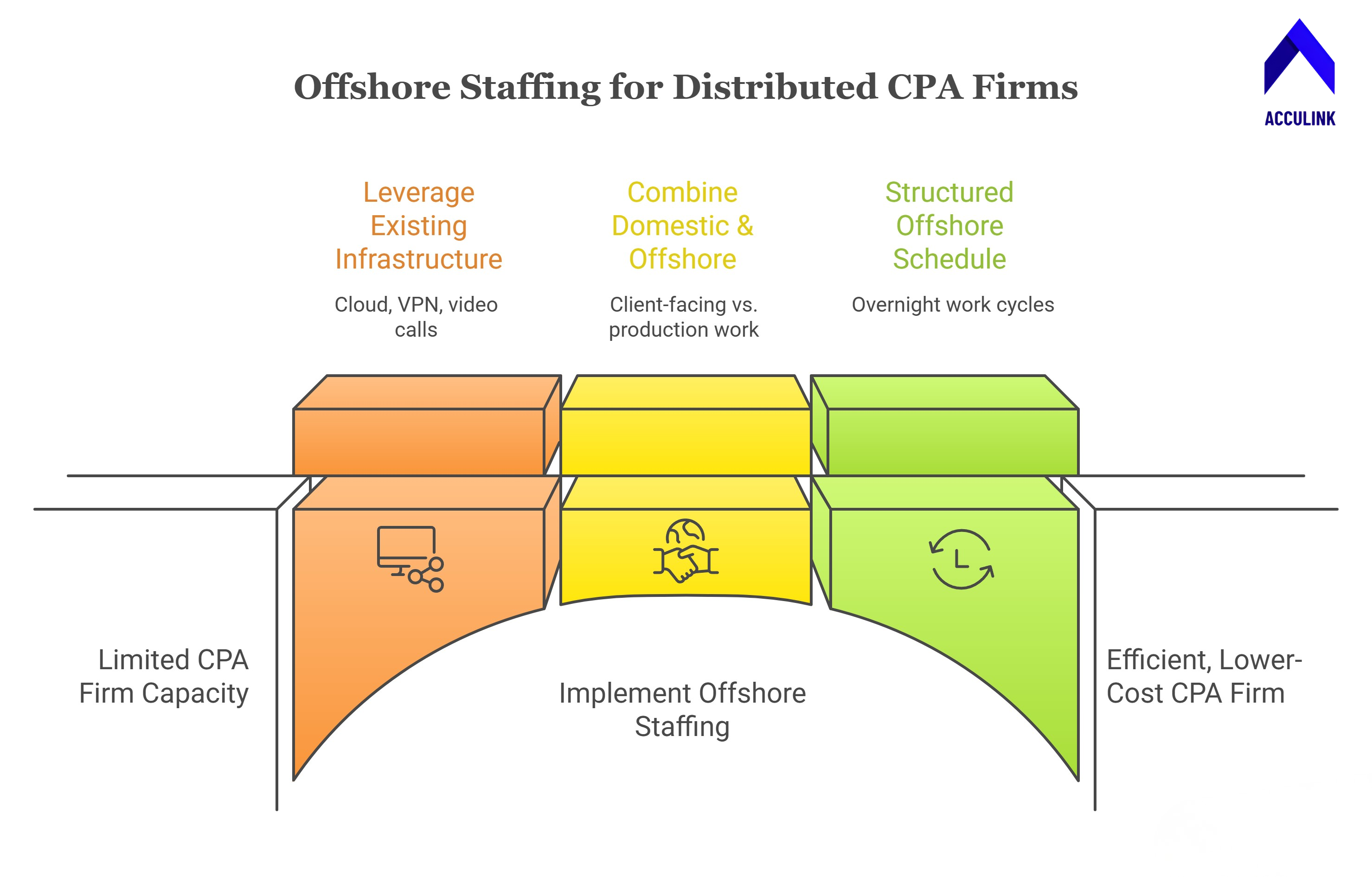
Offshore staffing is simply the logical extension of the distributed work model. The only differences are time zone (which is an advantage, not a disadvantage, because of overnight work cycles) and cost (which is dramatically lower, at $8–$35/hr through Acculink CPA). If you’ve already invested in remote work infrastructure, adding offshore professionals requires zero additional technology investment.
The optimal distributed model for CPA firms in 2026 combines domestic remote or hybrid staff for client-facing, judgment-intensive work with offshore professionals for preparation, compliance, and analytical work. Partners operate from wherever they’re most productive. Senior staff work hybrid schedules. Offshore teams handle production work on a structured schedule. The result is a firm that operates 18–20 hours per day across time zones, with lower costs, faster turnaround, and happier staff.
Building a Distributed Team: Domestic + Offshore
If you’re building a distributed team from scratch or expanding your existing remote operation, here’s a practical roadmap.
-
Step 1: Standardise your workflows. Document SOPs for every engagement type before adding remote or offshore staff.
-
Step 2: Invest in cloud tools. Move to cloud accounting, cloud tax software, and cloud document management if you haven’t already.
-
Step 3: Add domestic remote flexibility. Offer hybrid or remote options to existing staff and use this to test your remote management capabilities.
-
Step 4: Add offshore capacity. Start with 1–2 dedicated offshore professionals from Acculink CPA. They plug into your existing infrastructure and follow your SOPs.
-
Step 5: Iterate and scale. Refine your communication cadence, quality review process, and work allocation as the distributed team matures. Scale offshore capacity based on results.
Frequently Asked Questions
What percentage of CPA firms offer remote work in 2026?
Over 70% of CPA firms offer some form of remote or hybrid work arrangement. Fully remote and hybrid models are the most common, with office-only arrangements increasingly limited to small, local firms.
Is remote work secure enough for CPA firm client data?
Yes, when implemented properly. MFA, VPN, encrypted devices, cloud platforms, and compliance frameworks (SOC 2, ISO 27001) make remote work at least as secure as office-based work. Offshore providers like Acculink CPA add physical security layers, including 24/7 CCTV and keycard access.
How do you manage an offshore team remotely?
The same way you manage domestic remote staff: through standardised workflows, project management tools, asynchronous communication, scheduled synchronous meetings, and output-based performance measurement. The 3–4 hour daily overlap window handles real-time communication needs.
Does remote work hurt team culture?
Not if you invest in intentional culture-building: regular video meetings, periodic in-person gatherings, virtual social events, and clear communication practices. Many distributed firms report a stronger culture than office-based firms because they must be deliberate about connection rather than relying on proximity.
References
AICPA — https://www.aicpa.org/
IRS Security Requirements — https://www.irs.gov/tax-professionals/protect-your-clients-protect-yourself
About Acculink CPA
Acculink CPA is a premier offshore staffing and outsourcing company purpose-built for CPA firms, accounting firms, and tax firms in the United States, Canada, and the UAE. With a team of 300+ qualified professionals — including CPAs, Chartered Accountants, Enrolled Agents, and Big 4-trained staff — Acculink provides dedicated offshore accountants, bookkeepers, tax preparers, auditors, virtual CFOs, and virtual assistants at $8–$35/hr, delivering up to 75% cost savings compared to domestic hiring. The company is ISO 27001 certified, SOC 2 Type II aligned, IRS §7216 compliant, and GDPR compliant, with zero security breaches in 5+ years of operations. Acculink offers a 40-hour free trial with no setup fees, no recruitment charges, and no long-term contracts. Over 80 CPA firms across the United States trust Acculink to deliver quality, security, and scalability.
Website: Acculink CPA | Schedule a Call: book a 45-minute call | Email: Info@acculinkcpa.com | Phone: +1 (203) 997-0224
Tags:
About the Author

Related Posts

Hire Offshore Bookkeepers for CPA & Accounting Firms – Blueprint for Outsourced Bookkeeping
How to hire an offshore bookkeeper for your CPA firm — what they do, how vetting and onboarding work, cost (up…

Hire Offshore Accountants for CPA & Accounting Firms – Why Outsourced Accounting Works
How to hire an offshore accountant for your CPA firm — month-end close, GL, GAAP reporting, in your software —…
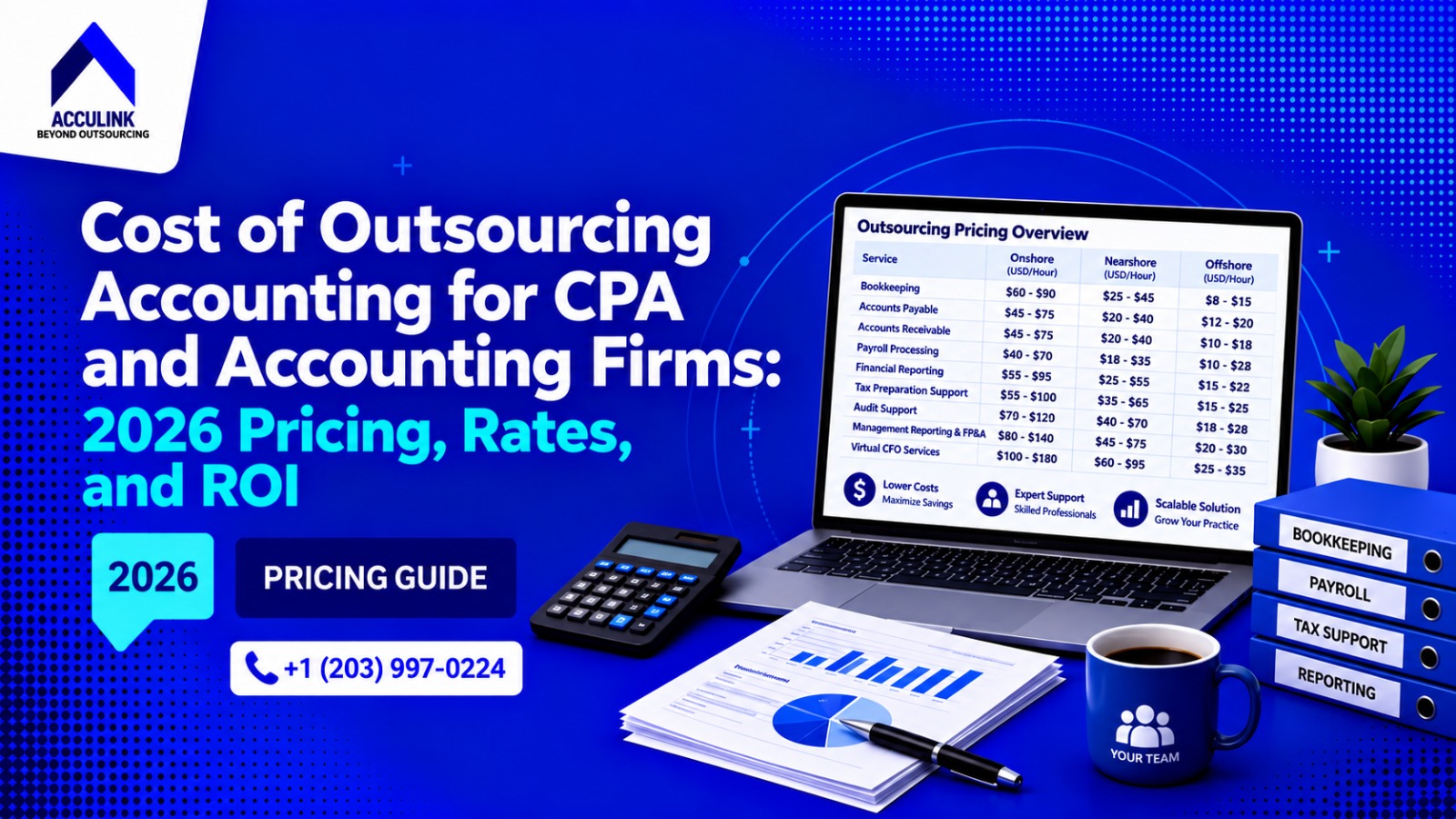
Cost of Outsourcing Accounting for CPA and Accounting Firms: 2026 Pricing, Rates, and ROI
The cost to outsource accounting typically ranges from $8 to $35 per hour, depending on the service, experienc…