Outsourcing vs. Offshore Staffing for CPA Firms: What\\\\\\\'s the Difference and Which Is Right for You?

Summary
Outsourcing and offshore staffing are not the same thing — confusing the two leads to mismatched expectations, wasted money, and frustration.
Key Takeaways
-
Outsourcing and offshore staffing are not the same thing — confusing the two leads to mismatched expectations, wasted money, and frustration.
-
Outsourcing means handing work to a vendor who manages delivery. Offshore staffing means hiring dedicated professionals who work exclusively for your firm, under your management.
-
Most CPA firms prefer the dedicated staffing model because it offers full control over quality, processes, and team culture — but the outsourcing model has specific advantages for seasonal overflow and one-off projects.
-
You don't have to choose one or the other. Many firms use a hybrid approach — dedicated staff for core, year-round work and outsourcing for peak-season overflow.
-
Acculink CPA offers both models, allowing firms to switch or combine based on changing needs — with no setup fees, no lock-in contracts, and a 40-hour free trial.
If you've spent any time researching offshore options for your CPA firm, you've probably encountered the terms "outsourcing" and "offshore staffing" used interchangeably. Blog posts, LinkedIn ads, and sales pitches throw both terms around as if they mean the same thing.
They don't. And the distinction matters — a lot.
As Mark Twain once quipped, "The difference between the almost right word and the right word is the difference between the lightning bug and the lightning." In accounting services, choosing the wrong engagement model isn't just a semantic issue — it's an operational one. The wrong model for your firm means misaligned expectations, frustrated staff, and results that fall short. The right model means your firm runs smoother, your costs drop, and your partners stop doing work that someone else should be handling.
In this guide, we'll break down exactly what each model means, how they compare across every dimension that matters to a CPA firm, and how to decide which is right for your practice. We'll also show you how Acculink CPA's flexible engagement models give you the option to do either — or both — without switching providers.
Defining the Terms: Outsourcing vs. Offshore Staffing
What Is Outsourcing?
Outsourcing — in the context of CPA firms — means sending a defined package of work to an external provider, who takes responsibility for completing it and delivering the finished product. You define the scope, set the deadline, and receive the output. The provider manages the people, the process, and the quality internally.
Think of it like hiring a catering company for an event. You tell them the menu and the headcount. They decide who cooks, how they cook, and when. You get the food on time. You don't manage their kitchen.
-
You hand off work; the provider delivers results.
-
A project manager from the provider is your single point of contact.
-
You don't manage the individual staff — you manage the relationship.
-
Pricing is typically project-based or per-deliverable.
What Is Offshore Staffing?
Offshore staffing — sometimes called dedicated staffing or the FTE model — means you hire a specific professional (or team) who works exclusively for your firm. They use your software, follow your SOPs, attend your meetings, and report to you directly. The offshore provider handles the infrastructure — HR, payroll, IT, office space, and compliance — but you manage the work.
Think of it like hiring a chef to work in your kitchen, making your recipes, your way. You're the boss. The staffing company just handles the logistics.
-
You interview and select the specific person.
-
They work exclusively for your firm — not shared across clients.
-
You manage them daily — assigning tasks, reviewing work, and giving feedback.
-
Pricing is hourly or monthly (FTE).
Head-to-Head Comparison: Outsourcing vs. Offshore Staffing
Here's where the rubber meets the road. Let's compare the two models across every dimension that matters to a CPA firm:
|
Dimension |
Outsourcing (Project Model) |
Offshore Staffing (Dedicated/FTE Model) |
|
Control over work |
Low–Medium. You define the scope; the provider decides the execution. |
High. You manage daily tasks, priorities, and quality directly. |
|
Team management |
The provider manages the team. You interact with a project manager. |
You manage the team directly. Provider handles HR/IT/compliance. |
|
Staff exclusivity |
Staff may work on multiple clients. |
Staff work exclusively for your firm. |
|
Process alignment |
Provider uses their processes unless you specify otherwise. |
Staff follow your SOPs, templates, and review procedures. |
|
Software |
Provider may use their own tools. |
Staff work on your software (QuickBooks, CCH, Xero, etc.). |
|
Communication |
Through a project manager. Limited direct staff interaction. |
Direct daily communication during overlap hours. |
|
Quality control |
Provider handles QC. You review final deliverables. |
You control QC through your own review process. |
|
Pricing model |
Fixed price per project or per deliverable. |
Hourly ($8–$35/hr) or monthly FTE rate. |
|
Flexibility |
High for variable workloads. Easy to scale up/down by project. |
High for steady workloads. Scale by adding/removing FTEs. |
|
Speed to start |
Can be fast for defined projects. |
5–7 days for candidate profiles; 2–3 weeks to fully onboard. |
|
Best for |
Seasonal overflow, one-off projects, catch-up work. |
Year-round work, core operations, tea and m building. |
|
Cultural integration |
Low. Provider is external. |
High. Staff becomes part of your team culture. |
Pros and Cons of Each Model
Outsourcing: The Pros
-
Minimal management overhead. You don't have to supervise daily — just review deliverables.
-
Easy to scale up and down. Need 200 extra 1040s processed next month? Send the batch.
-
Predictable costs. Fixed-price projects mean no surprises.
-
Faster ramp-up for defined scopes. If your project is well-defined, the provider can start quickly.
Outsourcing: The Cons
-
Less control over quality. You're trusting the provider's QC process, not your own.
-
Limited process alignment. Work may not match your firm's specific standards unless you provide extremely detailed SOPs.
-
No team building. The people doing your work may change without notice.
-
Communication lag. Everything goes through a project manager, adding a layer.
Offshore Staffing: The Pros
-
Full control. You manage the person, the process, and the quality — just like a local hire.
-
Deep, firm knowledge. Over time, your offshore staff learns your clients, your preferences, and your standards.
-
Better quality trajectory. Because you're giving direct feedback, quality improves faster and more consistently.
-
Cultural integration. Your offshore team becomes a true extension of your firm, not an external vendor.
-
Cost predictability. Monthly FTE rates make budgeting straightforward.
Offshore Staffing: The Cons
-
Requires management investment. You need to onboard, train, and manage — the same way you would a domestic hire.
-
Upfront onboarding time. The first 2–3 weeks require effort to set up systems, share SOPs, and build rapport.
-
Less suited for one-off spikes. If you have a single project with no ongoing need, dedicated staffing may be more than you need.
When to Choose Outsourcing
The outsourcing model is the right fit when:
-
You have a defined, finite project — e.g., processing 500 backlogged 1040s from an acquired practice.
-
You need seasonal overflow support and don't want year-round staff — e.g., extra tax prep capacity from January to April only.
-
You don't have the bandwidth to manage additional staff — you just need the work done.
-
You want to test offshore work before committing to a dedicated hire.
Real-world example: A mid-size CPA firm in Texas inherited 800 unfiled returns when they merged with a smaller practice. They outsourced the catch-up project to a provider, who completed all 800 returns in 10 weeks with a dedicated project team. The firm's partners didn't manage a single person — they just reviewed the output.
When to Choose Offshore Staffing
The dedicated staffing model is the right fit when:
-
You have steady, recurring work that needs year-round capacity — bookkeeping, monthly close, and an ongoing tax prep.
-
You want deep process alignment — your offshore team follows your SOPs, uses your templates, and works in your systems.
-
You're building for scale — you plan to grow the offshore team over time as part of your firm's long-term operating model.
-
Quality control is paramount — you want to manage the review process directly.
-
You want someone who knows your clients — not a rotating cast of anonymous preparers.
Real-world example: A 20-person CPA firm in New York started with one dedicated offshore bookkeeper for monthly client reconciliations. Within six months, they had added two tax preparers and one audit associate. All four team members attend the firm's Monday morning standups. The partners say the offshore team "feels like they're just down the hall."
Can You Do Both? The Hybrid Approach
Here's what the most strategically mature CPA firms are doing: they use both models simultaneously.
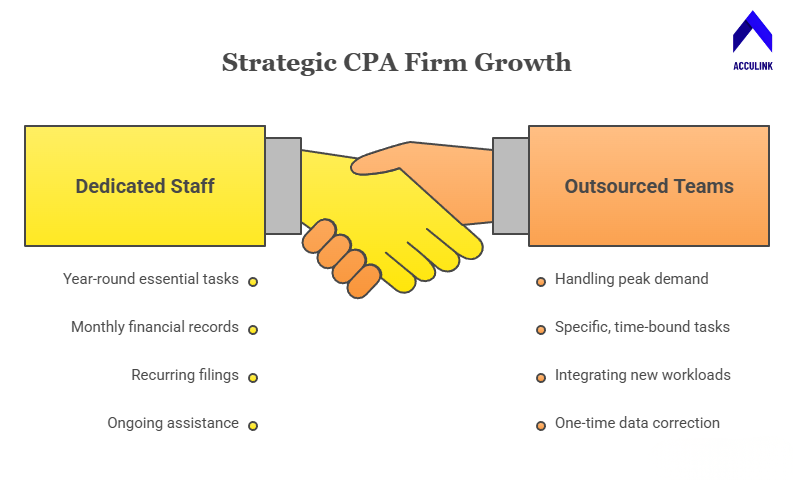
- Dedicated staff handle the core, year-round workload — monthly bookkeeping, recurring tax returns, and ongoing audit support.
- Outsourced project teams handle seasonal overflow — the extra 300 returns that show up between February and April, the backlog from an acquired practice, the one-time cleanup project.
This hybrid model gives you the deep integration and quality control of dedicated staffing, combined with the on-demand scalability of outsourcing. You get the best of both worlds without having to over-hire for peak season or scramble when volume spikes.
Acculink CPA is one of the few providers purpose-built for this hybrid approach. Because they offer both engagement models under one roof, you can start with a dedicated hire, add project-based overflow during tax season, and scale back after April — all without switching providers, renegotiating contracts, or onboarding new teams.
Acculink CPA's Two Engagement Models: A Quick Reference
|
Feature |
Dedicated Staffing (FTE) |
Outsourcing (Fixed Price) |
|
How it works |
You hire a specific person who works only for you |
You send work; Acculink's team delivers results |
|
Management |
You manage daily tasks and priorities |
Acculink's project manager handles execution |
|
Pricing |
$8–$35/hr (all-inclusive) |
Fixed price per project or per return |
|
Time options |
Full-time (160 hrs/mo), Part-time (80 hrs/mo), or Ad Hoc |
Project-based — pay for what you need |
|
Setup fee |
$0 |
$0 |
|
Contract |
No long-term commitment |
No long-term commitment |
|
Free trial |
40 hours — interview, train, evaluate |
Available on request |
|
Best for |
Year-round work, team building, core operations |
Seasonal overflow, catch-up, and defined projects |
For the full breakdown, visit the engagement models page or read more about why 80+ CPA firms choose Acculink.
Decision Framework: Which Model Is Right for Your Firm?
Still not sure? Run through this quick decision checklist:
|
Question |
If Your Answer Is... |
Recommended Model |
|
Is this a recurring, ongoing need? |
Yes — it's year-round work. |
Dedicated Staffing |
|
Is this a one-time or seasonal project? |
Yes — defined scope and deadline |
Outsourcing |
|
Do I want to manage the person daily? |
Yes — I want control |
Dedicated Staffing |
|
Do I want to just review deliverables? |
Yes — I want hands-off |
Outsourcing |
|
Am I building a long-term offshore team? |
Yes — this is strategic |
Dedicated Staffing |
|
Do I need surge capacity for tax season? |
Yes — on top of my existing team |
Outsourcing (or hybrid) |
|
Is process alignment critical? |
Yes — they must follow our SOPs |
Dedicated Staffing |
If you answered "dedicated staffing" for most questions, start there. If you're split, the hybrid approach is likely your best bet.
Frequently Asked Questions
What's the main difference between outsourcing and offshore staffing?
In outsourcing, you hand work to a provider and receive deliverables — you don't manage the people. In offshore staffing, you hire a dedicated professional who works exclusively for your firm under your management. The provider handles infrastructure; you handle the work.
Which model is cheaper?
Both offer significant cost savings compared to domestic hiring (60–75%). Outsourcing can be cheaper for one-off projects because you only pay per deliverable. Dedicated staffing is typically more cost-effective for ongoing, year-round work because you have a predictable monthly rate and deeper efficiency gains over time.
Can I switch between models?
Yes. With a flexible provider like Acculink, you can start with one model and switch or combine as your needs evolve. Many firms begin with outsourcing to test the waters, then transition to dedicated staffing once they see the quality and want more control.
Do I need different software for each model?
No. In the dedicated staffing model, staff work on your software. In the outsourcing model, the provider can work on your software or their own, depending on your preference. There's no additional technology investment required for either model.
How do I manage quality in the outsourcing model?
Set clear deliverable specifications upfront, provide sample workpapers as benchmarks, and conduct thorough reviews on the first few batches. A good provider will have their own QC layer before deliverables reach you. Over time, the feedback loop tightens, and quality stabilises.
Is there a minimum commitment for either model?
No. Acculink offers both models with no long-term contracts. Dedicated staffing is available full-time, part-time, or ad hoc. Outsourcing is project-based. You scale up, scale down, or pause based on your firm's needs.
References
Journal of Accountancy — https://www.journalofaccountancy.com/
Bureau of Labour Statistics — Accountants and Auditors — https://www.bls.gov/ooh/business-and-financial/accountants-and-auditors.htm
Harvard Business Review — Outsourcing Strategy — https://hbr.org/
Wikipedia — Outsourcing — https://en.wikipedia.org/wiki/Outsourcing
Wikipedia — Offshoring — https://en.wikipedia.org/wiki/Offshoring
About Acculink CPA
Acculink CPA is a premier offshore staffing and outsourcing company purpose-built for CPA firms, accounting firms, and tax firms in the United States, Canada, and the UAE. With a team of 300+ qualified professionals — including CPAs, Chartered Accountants, Enrolled Agents, and Big 4-trained staff — Acculink provides dedicated offshore accountants, bookkeepers, tax preparers, auditors, virtual CFOs, and virtual assistants at $8–$35/hr, delivering up to 75% cost savings compared to domestic hiring. The company is ISO 27001 certified, SOC 2 Type II aligned, IRS §7216 compliant, and GDPR compliant, with zero security breaches in 5+ years of operations. Acculink offers a 40-hour free trial with no setup fees, no recruitment charges, and no long-term contracts. Over 80 CPA firms across the United States trust Acculink to deliver quality, security, and scalability.
Website: Acculink CPA | Schedule a Call: book a 45-minute call | Email: Info@acculinkcpa.com | Phone: +1 (203) 997-0224
Tags:
About the Author

Related Posts

Hire Offshore Accountants for CPA & Accounting Firms – Why Outsourced Accounting Works
How to hire an offshore accountant for your CPA firm — month-end close, GL, GAAP reporting, in your software —…
Accounting Outsourcing Services for CPA & Accounting Firms – Why Outsourcing Works
Accounting outsourcing lets CPA firms add capacity without adding headcount. Why outsourced accounting service…

Virtual Accounting Services for CPA & Accounting Firms – Offshore Accounting Support
How virtual accounting gives CPA firms a managed, cloud-based accounting team — bookkeeping to reporting — wit…